

Kirjahaku
Etsi kirjoja tekijän nimen, kirjan nimen tai ISBN:n perusteella.
747 tulosta hakusanalla Cherokee Hatcher


The Cherokee Land Lottery, Containing a Numerical List of the Names of the Fortunate Drawers in Said Lottery, with an Engraved Map of Each District
James F. Smith
Antigonos Verlag
2025
nidottu

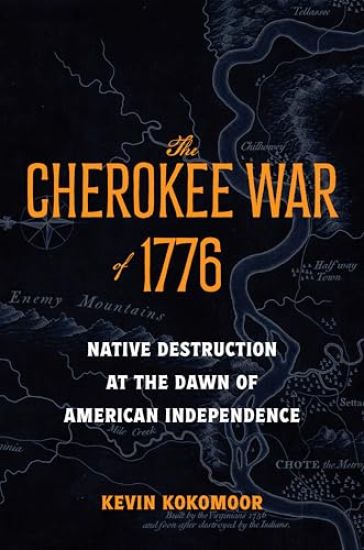
The forgotten history of the US war against the Cherokee offers a crucial reframing of America's origin story. Americans remember 1776 as the year liberty was declared, the moment they cast off tyranny and proclaimed the self-evident truths of equality and freedom. But that same summer, as patriots celebrated their defiant new nation, American armies launched another campaign—this one aimed at destroying the Cherokee nation. The Cherokee War of 1776 recasts America's founding moment by tracing the importance of westward ambition and settler violence to the origins of the Revolutionary War. In this gripping and sobering book, historian Kevin Kokomoor uncovers the rarely acknowledged war waged by the emerging United States against the Cherokee people just days after the Declaration of Independence was signed. Far from a spontaneous frontier skirmish, this war was a coordinated, state-backed campaign with a clear aim: seize Indigenous land and crush Native resistance. Many of the very men who championed liberty on parchment simultaneously advocated for the wholesale destruction of a sovereign Native nation. At the heart of this story is Cherokee resistance, which was strategic, determined, and deeply rooted in community dynamics. Figures like Dragging Canoe emerged to lead a movement that endured long after American armies had burned Cherokee towns to the ground. Kokomoor foregrounds Cherokee voices, motivations, and resilience, challenging the notion that they were merely pawns in a colonial struggle and forcing us to reckon with the real costs of independence and the long fight for Indigenous sovereignty.
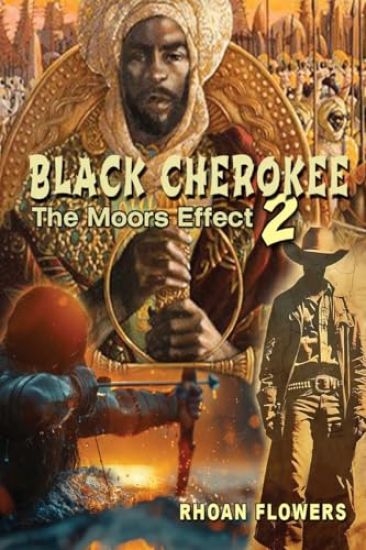
Black Cherokee 2/The Moors' Effect
Rhoan Flowers
2026
pokkari
Leadership Lessons from the Cherokee Nation: Learn from All I Observe
Chad "Corntassel" Smith
McGraw-Hill Professional
2013
sidottu
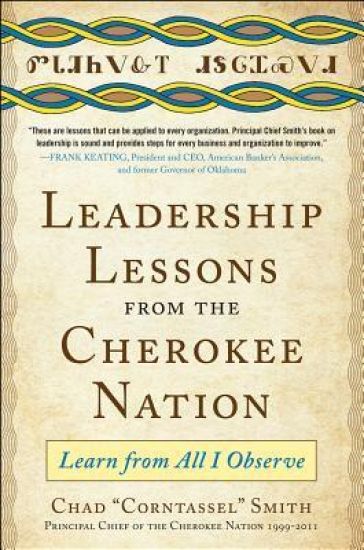
"If you want to be successful, it is this simple.Know what you are doing, love what you are doing. And believe in what you are doing." -- Will RogersWhen Chad Smith became Principal Chief, the Cherokee Nation was a chaotic and dysfunctional entity. By the end of his tenure, 12 years later, the Nation had grown its assets from $150 million to $1.2 billion, increased business profits 2,000 percent, created 6,000 jobs, and dramatically advanced its education, language, and culturalpreservation programs.How could one team influence such vast positive change?The Cherokee Nation's dramatic transformation was the result of Smith's principle-based leadership approach and his unique "Point A to Point B model"--the simple butprofound idea that the more you focus on the final goal, the more you will accomplish . . . and the more you will learn along the way. In other words, "look at the end rather than getting caught up in tanglefoot."In Leadership Lessons from the Cherokee Nation, Smith combines Cherokee wisdom handed down from generation to generation with a smart leadership approach that takestoday's very real issues into consideration. He explains why this leadership approach works and how you can apply it to your own organization, whether business, government,or nonprofit. Learn all the lessons that drive powerful leadership, including how to:Be a lifelong learnerSolve problems with creativity and innovationRecruit and develop strong leadersDelegate wiselyAct with integrity and dignityDon't be distracted from your objectiveLead by exampleMore than a simple how-to leadership guide, Leadership Lessons from the Cherokee Nation offers a holistic approach to the subject--how to become a powerful leader inside and direct your energy outward toaccomplish any goal you set your mind to.Praise for Leadership Lessons from the Cherokee Nation:"These are lessons that can be applied to every organization. Principal Chief Smith's book on leadership is sound and provides steps for every business and organization to improve." -- Frank Keating, President and CEO, American banker's Association, and former Governor of Oklahoma"An indelible chronicling of time-proven elements for tribal and organizational success; just as applicable today as they were a thousand years ago." -- Jay Hannah, Cherokee Citizen, Executive Vice President of Financial Service, BancFirst, and former Chairman of the 1999 Cherokee Constitution Convention"A remarkable account of how the Cherokee Nation reached a pinnacle of success by incorporating common elements of planning, group action, and sharing credit forthat success." -- Ross Swimmer, former Principal Chief of the Cherokee Nation 1975-1985 and former Assistant Secretary for Indian Affairs, US Department of the Interior"Chief Smith shares stories with lessons that work in business; it is not where we are, but where we aspire to go that counts." -- Harold Hamm, Chairman and CEO, Continental Resources, Inc."Chief Smith shares from a Cherokee perspective how to get from where you are to where you want to go." -- Archie Dunham, Independent Non-Executive Chairman,Chesapeake Energy, and former Chairman, ConocoPhillips"Outlines the reasons for the Nation's amazing growth and stability during [Chief Smith's] term. His principles of organization, leadership, and caring make sense; they work in all organizations." -- David Tippeconnic, CEO, Arrow-Magnolia International, Inc.,and former President and CEO, CITGO Petroleum Corp.
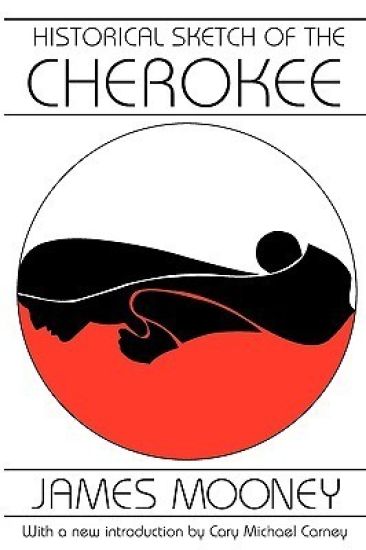
When James Mooney lived with and studied the Cherokee between 1887 and 1900, they were the largest and most important Indian tribe in the United States. His dispassionate account of their history from the time of their first contact with whites until the end of the nineteenth century is more than a sequence of battles won and lost, treaties signed and broken, towns destroyed and people massacred. There is humanity along with inhumanity in the relations between the Cherokee and other groups, Indian and non-Indian; there is fortitude and persistence balanced with disillusionment and frustration. In these respects, the history of the Cherokee epitomizes the experience of most Native Americans. The Cherokee Nation ceased to exist as a political entity seven years after the initial study was done, when Oklahoma became a state.In the introduction to the original publication of this history in 1900, James Mooney commented that "there is change indeed in dress and outward seeming, but the heart of the Indian is still his own." This history was originally included in the 19th Annual Report of the Bureau of American Ethnology.It was republished under the auspices of the National Anthropological Archives of the Smithsonian Museum of Natural History, at the request of the Governing Body of the Cherokee Nation, in 1975, with new introductory material and supplementary illustrations from the archives. The volume has a foreword from W.W. Keeler, chief of the Cherokee Nation, and an introduction by Richard Mack Bettis, president of the Tulsa Tsa-La-Gi-Ya Cherokee Community.
This work explores the dynamic issues of race and religion within the Cherokee Nation and to look at the role of secret societies in shaping these forces during the nineteenth century.
126 myths: sacred stories, animal myths, local legends, many more. Plus background on Cherokee history, notes on the myths, parallels, etc.
Myths Of The Cherokee And Sacred Formulas Of The Cherokees
James Mooney
KESSINGER PUBLISHING CO
2007
sidottu
The Removal Of The Cherokee Indians From Georgia, 1827-1841
Wilson Lumpkin
Kessinger Pub
2007
pokkari

The Removal of the Cherokee Indians from Georgia, 1827-1841
Wilson Lumpkin
Kessinger Pub
2008
sidottu


The First Woman Cherokee Chief: Wilma Pearl Mankiller
Patricia Morris Buckley; Aphelandra Messer
RANDOM HOUSE USA INC
2023
nidottu

The First Woman Cherokee Chief: Wilma Pearl Mankiller
Patricia Morris Buckley
Random House Books for Young Readers
2023
sidottu
Find out all about Wilma Pearl Mankiller, the first woman Cherokee chief whose image appears on the U.S. quarter, in this Step 3 Biography Reader. In 1985, Wilma Pearl Mankiller became the first woman Principal Chief of the Cherokee Nation. She had to convince her people that the chief should be the best person for the job, man or woman. Before the English came to what is now the United States, Cherokee women and men shared the leadership of the tribe. This created balance. But the English colonists told the Native People that men should be in charge. It stayed that way for many years, until Wilma Pearl Mankiller made history. She used the concept of gaduji, of everyone helping each other, to make the Cherokee Nation strong. Step 3 Readers feature engaging characters in easy-to-follow plots and popular topics--for children who are ready to read on their own.

The New Testament Cherokee Translation From Sequoyah by Lisa Christiansen: Holy Bible
Lisa Christine Christiansen; Sequoyah George Guess
Penguin International Publishing
2014
nidottu
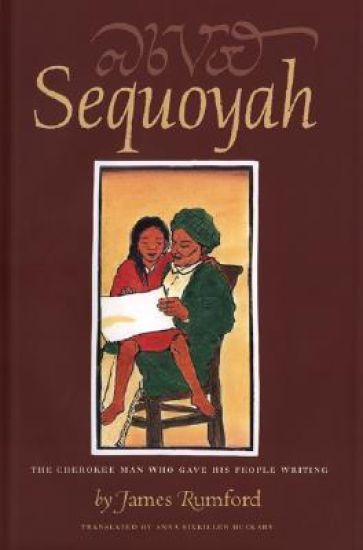
A 2005 Sibert Honor Book The story of Sequoyah is the tale of an ordinary man with an extraordinary idea--to create a writing system for the Cherokee Indians and turn his people into a nation of readers and writers. The task he set for himself was daunting. Sequoyah knew no English and had no idea how to capture speech on paper. But slowly and painstakingly, ignoring the hoots and jibes of his neighbors and friends, he worked out a system that surprised the Cherokee Nation--and the world of the 1820s--with its beauty and simplicity. James Rumford's Sequoyah is a poem to celebrate literacy, a song of a people's struggle to stand tall and proud.