Kirjojen hintavertailu. Mukana 11 244 527 kirjaa ja 12 kauppaa.

Kirjahaku

Etsi kirjoja tekijän nimen, kirjan nimen tai ISBN:n perusteella.

1000 tulosta hakusanalla D Castleton

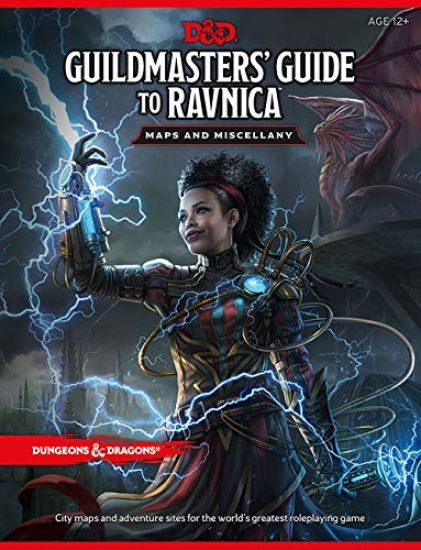
D&d Guildmasters Guide Ravnica RPG Mappk
Explore a worldwide cityscape in the first Dungeons & Dragons campaign setting to take on the world of Magic: The Gathering. This accessory contains resources that Dungeon Masters can use to enhance the experience of running a campaign in the sprawling city of Ravnica, using Guildmasters' Guide to Ravnica, a Dungeons & Dragons campaign sourcebook sold separately that explores one of the most popular settings in Magic: The Gathering. Contained within this durable folder are 20 laminated cardstock sheets designed for use with dry-erase markers. The pack includes the following resources to help you run your Ravnica campaign: - 7 double-sided color maps of Ravnica's Tenth District, with helpful quick-reference information about each district (8.5" x 11") - 11 double-sided, single-color maps of adventure sites associated with Ravnica's guilds, with helpful tables and reference information on each location (8.5" x 11") - 2 perforated sheets of color Faces of Ravnica cards (18 cards total), with character illustrations on one side and descriptions of guild charms on the other.

D&d Dungeon of the Mad Mage Map Pack
Descend into Undermountain with this collection of dungeon maps and adventure cards for the world's greatest roleplaying game. This accessory contains resources that Dungeon Masters can use to enhance the experience of running Waterdeep: Dungeon of the Mad Mage, a Dungeons & Dragons hardcover adventure sold separately. Contained within this durable folder are 16 cardstock sheets designed for use with dry-erase markers. The pack includes the following resources to help you run Dungeon of the Mad Mage: 23 maps of Undermountain, each one representing a different level of the dungeon (8.5" x 11") 3 maps of the subterranean town of Skullport (8.5" x 11") 18 perforated Secrets cards 9 perforated Elder Runes cards
D&d Tactical Maps Reincarnated
Bring your Dungeons & Dragons game to life with this collection of twenty beautifully rendered, full-color, tactical poster maps. Maps are a key element of every Dungeons & Dragons campaign. A map's importance in bringing your world to life can't be overstated. The same can be said for your encounter maps. Sometimes you need a visual representation of the area your adventurers are in, or perhaps tactical combat is simply the way your group rolls. However you play, we've got you covered. Twenty beautifully rendered, tactical poster maps are contained herein, perfect for bringing any D&D game to life. 20 full color poster maps. Each is adorned with a 1-inch grid, perfect for use with D&D miniatures. A wide assortment of terrain, environments, and locations are represented. This "Best of" collection is carefully chosen from some of our most exciting adventures: Tomb of Horrors (4th edition) Vor Rukoth (4th edition) Demon Queen's Enclave (4th edition) Death's Reach (4th edition) The Book of Vile Darkness (4th edition) Kingdom of the Ghouls (4th edition) Dungeon Master's Kit (4th edition) Orcs of Stonefang Pass (4th edition) Fields of Ruin (3rd edition) Gargantuan Blue Dragon (3rd edition) Vaults of the Underdark (4th edition) Legend of Drizzt Scenario Pack (3rd edition) Colossal Red Dragon (3rd edition) Red Hand of Doom (3rd edition)aa
D&d Forgotten Realms Laeral Silverhand's Explorer's Kit (D&d Tabletop Roleplaying Game Accessories)
Dice and miscellany for the world's greatest roleplaying game EXPLORE THE REALMS Let Laeral Silverhand-Open Lord of Waterdeep, centuries-old archmage, and daughter of the goddess of magic-guide you on your path to adventure. INCLUDES: Eleven Dice (two d20s, one d12, two d10s, one d8, four d6s, one d4)Twenty illustrated, double-sided cards detailing Laeral's expert insights on key characters, locations, and lore from across the Forgotten RealmsTM.A durable, felt-lined box that functions as two dice trays.Foldout double-sided map of the Sword Coast and the city of Waterdeep (11" x 16")
D&d Dungeon Masters Screen: Dungeon Kit (Dungeons & Dragons DM Accessories)

D&d Dungeon Masters Screen: Dungeon Kit (Dungeons & Dragons DM Accessories)

Lawrence Watt-Evans; Robert E. Howard; Dragons

Wizards of the Coast
2024
muu
Delve into dungeons with this kit for the world's greatest roleplaying game Delve into the Dungeons' DepthsThis kit equips the Dungeon Master(R) with a screen and other tools that are perfect for running D&D(R) adventures through dungeons, whether ruined or thriving. The Dungeon Master's screen features a painting of a fantastic vista that plunges into the deep reaches of a mountain. Useful rules references cover the screen's interior, with an emphasis on dungeon-delving.
The Life and Times of Rev. Samuel Patton, D. D., and Annals of Holston Conference
The Reverend Samuel Patton was admitted into the Tennessee Conference in 1819. When Holston Conference was formed in 1824, he became a part of that area. He was assigned Sequatchie Valley as his first appointment in 1819 and thus began his ministry years until his death in 1854. Truly one of the first histories of the Holston Conference, listing his appointments from 1824 to 1854. The Irish born Doctor Samuel Patton was born in Lancaster District of South Carolina in 1797. His grandfather John Patton is from Pennsylvania with John's wife being a descendent of a Scots Seceder named Nichols. An appendix (Annals of the Holston Conference, from 1824 to 1853) and an index to full-names, places and subjects add to the value of this work.
D'une phénoménologie de la perception chez Heidegger
Ce travail ambitionne inaugurer la thématisation d'une phénoménologie de la perception chez Heidegger. En prenant le contre-pied de bien des interprétations récentes concernant de questions cruciales de l'ontologie heideggerienne, notamment celles de l'articulation temporelle du présent et de la distinction entre Zuhandenheit et Vorhandenheit, il défend la thèse inattendue que la temporalité de la perception sert de fil conducteur de l'ontologie heideggerienne du temps, dans la mesure où elle impose la scission de la temporalité en modes authentiques et modes inauthentiques. Notre commentaire serré sur les textes de l'époque de Marbourg fera apparaître que l'opposition entre la temporalité authentique de la perception `naturelle', identifiée positivement à la circonspection, et la temporalité inauthentique de la perception `théorique' ne résume pas simplement la critique heideggerienne de Husserl, mais contribue, avant tout, à ouvrir un espace critique dans la problématique phénoménologique de la perception dans son évolution de Husserl jusqu'à Merleau-Ponty. This book claims to inaugurate the thematization of a phenomenology of perception in Heidegger. Running counter to many recent interpretations concerning crucial questions of Heideggerian ontology (particularly the temporal articulation of present and the distinction between Zuhandenheit and Vorhandenheit), it defends the unexpected thesis that the temporality of perception serves as a conductor of the Heideggerian ontology of time, by splitting temporality into authentic and unauthentic modes. Concise commentary on the texts of the Marburg period show that the opposition between the authentic temporality of `natural' perception (positively identified as circumspection) and the unauthentic temporality of `theoretical' perception does not merely summarize the entireHeideggerian critique of Husserl but, above all, helps to open a decisive path in the phenomenological account of perception in its evolution from Husserl to Merleau-Ponty.
University-Industry R&D Collaboration in the United States, the United Kingdom, and Japan
Over the last several decades there has been a growing interest in Research & Development (R&D) policy. This is particularly so in advanced industrialized nations that have adopted science- and technology- based strategies for national economic competitiveness. The United States, the United Kingdom, and Japan -- the three nations that are the subjects of this book -- share this policy strategy. Each of these nations is committed to hamessing the innovations that stern from scientific and technological advance to promote national economic prosperity. Governments can influence their nation's R&D efIort in three general ways. First, they can directly fund the R&D efIort through grants, loans, appropriations, or government contracts. Second, they can provide tax and financing incentives to encourage higher levels of private sector R&D. Third, they can use their power to create inter-organizational collaborations that vastly extend and expand the nation's collective R&D efIort. University-industry collaborations are a principal type of these inter­ organizational R&D efIorts -- and the focus of this book.
D. L. Moody

D. L. Moody

Faith Coxe Bailey

Moody Publishers
2024
nidottu
In an exciting novel form, D. L. Moody: God's Bold Messenger tells the incredible story of one of the greatest evangelists of the nineteenth century. Deeply committed to the gospel and devoted to bringing the love of God to bear on the lives of young and old, Moody preached across America and throughout Europe. Faith Coxe Bailey brings alive the story of the bigger-than-life man who was a servant to poor communities and whose preaching and vision have an ongoing influence in the lives of many. Though his formal education ended after fifth grade, Moody became a champion of education, starting three schools, including Moody Bible Institute. From reaching out to lost children, to training women, to bridging the gap between denominations, Moody is a hero of the faith with whom all should be well acquainted. You will be encouraged by the faithful and adventurous life of Dwight Lyman Moody. D. L. Moody dared to take up a challenge and see what God could do with a life totally committed to Him. Bailey brings to color the story of God's Bold Messenger.
D W Winnicott

D W Winnicott

Michael Jacobs

SAGE Publications Ltd
1995
nidottu
`The importance of Michael Jacobs' book lies in his attempt to convey... Winnicott's profound influence.... Jacobs rightly delights in the creativity and imagination of his subject and illustrates these with numerous quotations and descriptions from Winnicott's writings.... What is conveyed throughout the book is the essence of Winnicott.... [whose] gift was to make psychoanalytic language, methods and concepts more widely available, accepted and appreciated to a nonpsychoanalytic world' - British Psychological Society Counselling Psychology Review One of the best-known British psychoanalysts, D W Winnicott attracts the interest of counsellors and psychotherapists far beyond the strict psychoanalytic tradition in which he was trained. He coined many phrases that have entered the discourse of therapy, such as `good enough mother', `transitional object' and `facilitating environment'. Winnicott has had a profound impact on research into the mother-baby relationship, and his unorthodox manner and sparkling writing style have attracted enthusiastic acclaim. In this book, Michael Jacobs summarizes Winnicott's life and explains his major theoretical concepts. He also rigorously evaluates his practice as a clinician - for example, the holding and management of deeply regressed patients. While highlighting Winnicott's brilliance and creativity, Jacobs is not afraid to scrutinize his contributions more critically. He also discusses criticisms others have made of Winnicott, notably within the psychoanalytic movement. The final chapter assesses the influence of Winnicott's thinking in other countries as well as in Britain.
D. H. Lawrence

D. H. Lawrence

Anaïs Nin

Swallow Press
1964
pokkari
In 1932, two years after D. H. Lawrence's death, a young woman wrote a book about him and presented it to a Paris publisher. She recorded the event in her diary: "It will not be published and out by tomorrow, which is what a writer would like when the book is hot out of the oven, when it is alive within oneself. He gave it to his assistant to revise." The woman was Anaïs Nin. Nin examined Lawrence's poetry, novels, essays, and travel writing. She analyzed and explained the more important philosophical concepts contained in his writings, particularly the themes of love, death, and religion, as well as his attention to primitivism and to women. But what Anaïs Nin brought to the explication of Lawrence's writing was an understanding of the fusion of imaginative, intuitive, and intellectual elements from which he drew his characters, themes, imagery and symbolism.
D Is for Deadbeat: A Kinsey Millhone Mystery

D Is for Deadbeat: A Kinsey Millhone Mystery

Sue Grafton; Grafton

Henry Holt Company
1987
sidottu
Sue Grafton's #1 New York Times bestselling series, reissued for a whole new generation of readers D IS FOR DEADBEAT He called himself Alvin Limardo, and the job he had for Kinsey was cut-and-dried: locate a kid who'd done him a favor and pass on a check for $25,000. It was only later, after he'd stiffed her for her retainer, that Kinsey found out his name was Daggett. John Daggett. Ex-con. Inveterate liar. Chronic drunk. And dead. The cops called it an accident--death by drowning. Kinsey wasn't so sure. Pulled into the detritus of a dead man's life, Kinsey soon realizes that Daggett had an awful lot of enemies. There's the daughter who grew up with a cheating drunk for a father, and the wife who's become a religious nut in response to an intolerable marriage. There's the lady who thought she was Mrs. Daggett--and has the bruises to prove it--only to discover the legal Mrs. D. And there are the drug dealers out $25,000. But most of all, there are the families of the five people John Daggett killed, victims of his wild, drunken driving. The D.A. called it vehicular manslaughter and put him away for two years. The families called it murder and had very good reason to want John Daggett dead. Deft, cunning, and clever, this latest Millhone mystery also confronts some messy truths, for, as Kinsey herself says, "Some debts of the human soul are so enormous only life itself is sufficient forfeit"--but as she'd be the first to admit, murder is not a socially acceptable solution. "A" Is for Alibi"B" Is for Burglar"C" Is for Corpse"D" Is for Deadbeat"E" Is for Evidence"F" Is for Fugitive"G" Is for Gumshoe"H" Is for Homicide"I" Is for Innocent"J" Is for Judgment"K" Is for Killer"L" is for Lawless"M" Is for Malice"N" Is for Noose"O" Is for Outlaw"P" Is for Peril "Q" Is for Quarry"R" Is for Ricochet "S" Is for Silence "T" Is for Trespass"U" Is for Undertow "V" Is for Vengeance "W" Is for Wasted "X"
D. H. Lawrence

D. H. Lawrence

Greiff Louis K.

Southern Illinois University Press
2006
nidottu
Between 1949 and 1999, the life and works of D. H. Lawrence inspired ten feature films: nine based on works of fiction and one based on biography. In ""D. H. Lawrence: Fifty Years on Film"", Louis K. Greiff examines these films as adaptations, as cultural or historical documents, and as independent works of art. Significantly, the films were not spread evenly throughout the decades but appeared in three clusters. The first group, or the ""black and white,"" appeared between 1949 and 1960. With the exception of Marc Allegret's ""L'Amant de Lady Chatterley"" (1955), all celebrate the British common man as a midcentury hero and promote an unmistakable yet never strident postwar ethos that is Marxist in spirit. The second cluster occurred during the late 1960s and early 1970s. These films show Lawrence embraced many values shared by the culture at large of the time - nonconformity, neobohemianism, sexual rebellion, war protest, and the celebration of youth. The third group answers the question, ""Why, in an un-Lawrentian decade like the 1980s, was there a revival of Lawrence's works on film?"" Greiff also deals with the contributions made by directors, Ken Russell and Christopher Miles, both of whom directed Lawrence films of the latter two clusters. He shows how Russell and, to a lesser extent, Miles were responsible for bringing mass audiences in touch with the works of Lawrence. Greiff's final and most important goal is to interpret and evaluate the Lawrence films. He looks first at the film as a visual representation of its text, then as an original act of creation and object of art.
D. H. Lawrence

D. H. Lawrence

Eliseo Vivas

Northwestern University Press
2018
nidottu
In D. H. Lawrence, Eliseo Vivas examines the aesthetic triumphs and failures of Lawrence’s major works through a literary device that he coins “the constitutive symbol.” Understanding how Lawrence uses the constitutive symbol provides new insight into his world views. Vivas covers a wide range of Lawrence's work, including Aaron’s Rod, Kangaroo, The Plumed Serpent, Lady Chatterley’s Lover, Sons and Lovers, The Rainbow, and Women in Love. Vivas was one of the first scholars to use psychological criticism to read Lawrence’s works; Vivas's and his particularly fresh reading of Lawrence’s novels continue to make this a significant literary-critical study.
D-Day Bombers

D-Day Bombers

Stephen Darlow

Stackpole Books
2010
nidottu
Before Allied soldiers set foot on the beaches of Normandy on D-Day, June 6, 1944, American and British bombers helped pave the way by pounding German positions on the shoreline and farther inland, a vital mission that continued as the troops waded ashore and the battle beyond the beachhead began. In this lively look at D-Day in the air, eight different bomber crews--three American and five British--tell their unforgettable stories from inside B-17s, B-24s, Lancasters, and Halifaxes.