Cornelius Alexander Anderson Jr., a.k.a. the Deuce, is the privileged only son of the president of an HBCU (Historically Black Colleges and Universities). He is the darling of his prominent family with his life completely planned and directed by the family. He is not even allowed to choose the woman he must marry in order to produce the expected heir to carry on the prominent line. Through his own grit and determination, he becomes a well-known professional basketball player. The renown and wealth that comes from his skill and talent in his chosen profession is never accepted by his family as worthy. It is not surprising that his family views his eventual choice of a companion for himself the same way. Elaine Drummond is a young woman who has never really known who she is, although she has always been aware of what society dictates for her. She has grown up knowing that she must keep to her place. Something inside of her makes her rebel against her dictatorial mother who claims to want to keep her safe by keeping her away from the harsh experiences that the world always gives to girls like her. Elaine cannot let herself trust. She knows better than to hope or believe. It is no surprise that devastating fireworks are the result of their meeting. There is no way to avoid the hand of fate. Someone will surely learn thats how heartaches are made.
Cornelius Alexander Anderson, Jr. a.k.a. "The Deuce" is not only a skilled and talented professional basketball player but he also shows potential as a leader and a coach. Serving as a coach and motivator at the Olympic Games in Montreal he finds himself in an important position to influence the decisions of the IOC. He has made some decisions and investments that have made him quite wealthy. With his loyal circle of friends, he has helped to make their special group savvy investors who carry on a note-worthy enterprise. The Deuce is the namesake and only son of his father, Cornelius Alexander Anderson, Sr., president of an HBCU (Historically Black Colleges and Universities). The whole dynamic family still seeks to guide The Deuce's life and influence his decisions. When he meets Elaine Drummond, a beautiful, shy college girl, she proves to be much more of a dynamic go getter than he could have ever imagined. Her life takes an unexpected turn that will cause conflicts for both of them.
In a world of spectacle, one boy's truth could bring the house down. London, 1789. After a fire consumes the Theatre Royal, master showman Joseph Eliot is desperate to rebuild. His answer comes in the form of a strange, silent boy - his skin marked with tiger-like stripes - and a plan to turn curiosity into spectacle. As the boy is thrust into the limelight alongside a live tiger, audiences are captivated. But behind the applause, dark questions stir. Where did the boy come from? Why does he never speak? And what secret binds him to a powerful man with influence - and a motive to see him disappear? As the city whispers and danger mounts, someone is arrested for a crime they may not have committed. Rebecca must uncover the truth before the curtain falls - for the boy, for Joseph, and for herself... A vivid historical tale of wonder, love, and the fine line between performance and exploitation, The Tyger Striped Boy blends the theatrical heart of The Greatest Showman with the soulful mystery of Life of Pi.
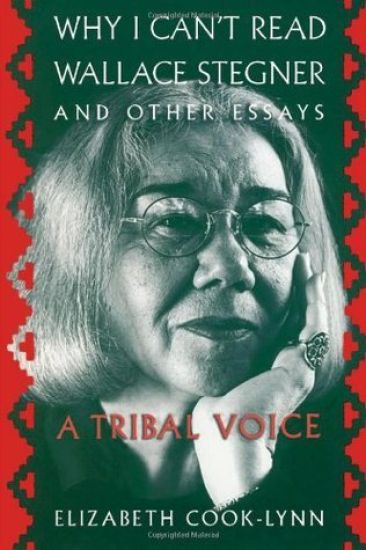
This collection of essays reveals the thoughts of a Native American feminist intellectual. A poet and literary scholar, Elizabeth Cook-Lyyn grapples with issues she encountered as a Native American in academia. She asks questions of critical importance to tribal people.
Informed by Jurgen Habermas's public sphere theory, this book studies the popular eighteenth-century genre of the epistolary narrative through readings of four works: Montesquieu's Lettres persanes (1721), Richardson's Clarissa (1749-50), Riccoboni's Lettres de Mistriss Fanni Butlerd (1757), and Crevecoeur's Letters from an American Farmer (1782).The author situates epistolary narratives in the contexts of eighteenth-century print culture: the rise of new models of readership and the newly influential role of the author; the model of contract derived from liberal political theory; and the techniques and aesthetics of mechanical reproduction. Epistolary authors used the genre to formulate a range of responses to a cultural anxiety about private energies and appetites, particularly those of women, as well as to legitimate their own authorial practices. Just as the social contract increasingly came to be seen as the organising instrument of public, civic relations in this period, the author argues that the epistolary novel serves to socialise and regulate the private subject as a citizen of the Republic of Letters.
"Litlost" penned by S. Elizabeth Cook is a composition of emotional harmony, projected through verse and creativity. "Litlost" penned by S. Elizabeth Cook is a composition of emotional harmony, projected through verse and creativity. "Litlost" penned by S. Elizabeth Cook is a composition of emotional harmony, projected through verse and creativity.
From one of the writers of the twentieth-century Native American Literary Renaissance comes a remarkable tale about how to acknowledge the past and take a chance on the future. Rooted in tribal-world consciousness, That Guy Wolf Dancing is the story of a young tribal wolf-man becoming a part of his not-sonatural world of non-tribal people. Twenty-something Philip Big Pipe disappears from an unsettled life he can hardly tolerate and ends up in an off-reservation town.When he leaves, he doesn’t tell anyone where he is going or what his plans, if he has any, might be. Having never taken himself too seriously, he now faces a world that feels very foreign to him. As he struggles to adapt to the modern universe, Philip, ever a "wolf dancer", must improvise, this time to a sound others provide for him. Like the wolf, Philip sometimes feels hunted, outrun, verging on extinction.Only by moving rhythmically in a dissident, dangerous, and iconic world can Philip Big Pipe let go of the past and craft a new future.
Inside the Sioux Nation's pursuit of recognition and justice This book is the powerful story of the ongoing struggle of indigenous Americans in the twentieth century United States and of its shift in focus from traditional battlefield and massacre sites to federal courtrooms and the halls of Congress. The Politics of Hallowed Ground includes excerpts from the diary kept by Mario Gonzalez, the attorney for the Sioux Nation in its struggle for recognition of the Wounded Knee Massacre site as a national monument. Gonzalez's personal record of the struggle is coupled with commentary by Elizabeth Cook-Lynn, a Native American writer who places the work in its historical context. Together, the two voices will draw the reader into far more than the continuing struggle of the Sioux people to achieve justice. The book covers Sioux history from before the Wounded Knee tragedy to modern times, through the Sioux Nation's long and often rancorous dialogue with the U.S. government over control of South Dakota's Black Hills, traditional Sioux lands recognized by treaty in 1877 and never forfeited or sold. After reading a 13-year-old survivor's narrative of what happened at Wounded Knee and the list of the dead and wounded, readers will find it difficult not to share the Sioux perspective.
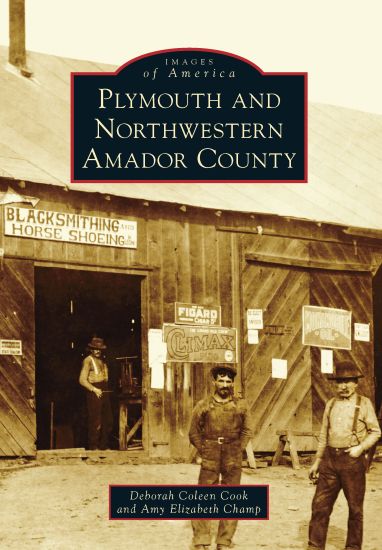
In Plymouth and Northwestern Amador County mother and daughter authors Deborah Coleen Cook and Amy Elizabeth Champ present a look into the chronological past of the region from the native Miwok people to the 21st century with photographs gleaned from local families and historic repositories. Situated near the Sierra Nevada foothills in the northwestern region of Amador County is the small town of Plymouth. This hamlet, and other surrounding towns such as Drytown, Fiddletown, and River Pines, have been home to farmers, ranchers, and merchants since the early days of the California Gold Rush. Plymouth, known to be the gateway to the world-famous Shenandoah Valley wine country, is a thriving community with a hometown feel. History lives here, from the aged buildings along Main Street to the ruins of the Plymouth-Consolidated Mine, one of the largest gold producers in California. Cook, a retired historic archaeologist and former Amador County archivist, spent much of her professional career studying the history of Amador County and is a former longtime resident of Plymouth. Champ has been a resident of Plymouth since obtaining her doctoral degree at the University of California at Davis. She currently teaches in Amador County.
Faculty and staff in higher education are looking for ways to address the deep inequity and systemic racism that pervade our colleges and universities. Pedagogical partnership can be a powerful tool to enhance equity, inclusion, and justice in our classrooms and curricula. These partnerships create opportunities for students from underrepresented and equity-seeking groups to collaborate with faculty and staff to revise and reinvent pedagogies, assessments, and course designs, positioning equity and justice as core educational aims. When students have a seat at the table, previously unheard voices are amplified, and diversity and difference introduce essential perspectives that are too often overlooked.In particular, the book contributes to the literature on pedagogical partnership and equity in education by integrating theory, synthesizing research, and providing concrete examples of the ways partnership can contribute to more equitable educational systems. At the same time, the authors acknowledge that partnership can only realize its full potential to redress harms and promote equity and justice when thoughtfully enacted. This book is a resource that will inspire and challenge a wide variety of higher education faculty and staff and contribute to advancing both practice and research on the potential of student-faculty pedagogical partnerships. Presenting a conceptual framework for understanding the various epistemological, affective, and ontological harms that face students from equity-seeking groups in postsecondary education, Promoting Equity and Justice Through Pedagogical Partnership applies this conceptual framework to current literature in partnerships, highlighting the promise of partnership as the way to redress these harms. The authors ground both the conceptual framework and the literature review by offering two case studies of pedagogical partnership in practice. They then explore the complexities raised by their framework, including the conditions under which partnerships themselves may risk reproducing epistemic, affective, or ontological harms. Applying the framework in this way allows them to propose strategies that make it more likely for these mediations to be successful. Finally, the authors focus on the future of pedagogical partnership and share their perspectives on new directions for inquiry and practice. After summarizing the overarching themes developed throughout the book, the authors leave the reader with a set of questions and recommendations for further inquiry and discussion.A Series on Engaged Learning and Teaching Book. Visit the books’ companion website, hosted by the Center for Engaged Learning, for book resources.
Faculty and staff in higher education are looking for ways to address the deep inequity and systemic racism that pervade our colleges and universities. Pedagogical partnership can be a powerful tool to enhance equity, inclusion, and justice in our classrooms and curricula. These partnerships create opportunities for students from underrepresented and equity-seeking groups to collaborate with faculty and staff to revise and reinvent pedagogies, assessments, and course designs, positioning equity and justice as core educational aims. When students have a seat at the table, previously unheard voices are amplified, and diversity and difference introduce essential perspectives that are too often overlooked.In particular, the book contributes to the literature on pedagogical partnership and equity in education by integrating theory, synthesizing research, and providing concrete examples of the ways partnership can contribute to more equitable educational systems. At the same time, the authors acknowledge that partnership can only realize its full potential to redress harms and promote equity and justice when thoughtfully enacted. This book is a resource that will inspire and challenge a wide variety of higher education faculty and staff and contribute to advancing both practice and research on the potential of student-faculty pedagogical partnerships. Presenting a conceptual framework for understanding the various epistemological, affective, and ontological harms that face students from equity-seeking groups in postsecondary education, Promoting Equity and Justice Through Pedagogical Partnership applies this conceptual framework to current literature in partnerships, highlighting the promise of partnership as the way to redress these harms. The authors ground both the conceptual framework and the literature review by offering two case studies of pedagogical partnership in practice. They then explore the complexities raised by their framework, including the conditions under which partnerships themselves may risk reproducing epistemic, affective, or ontological harms. Applying the framework in this way allows them to propose strategies that make it more likely for these mediations to be successful. Finally, the authors focus on the future of pedagogical partnership and share their perspectives on new directions for inquiry and practice. After summarizing the overarching themes developed throughout the book, the authors leave the reader with a set of questions and recommendations for further inquiry and discussion.A Series on Engaged Learning and Teaching Book. Visit the books’ companion website, hosted by the Center for Engaged Learning, for book resources.
Politicians and opinion leaders on both sides of the Mason-Dixon line struggled to formulate coherent responses to the secession of the deep South states. The Confederate attack on Fort Sumter in mid-April 1861 triggered civil war and the loss of four upper South states from the Union. The essays by three senior historians in "Secession Winter" explore the robust debates that preceded these events. For five months in the winter of 1860-1861, Americans did not know for certain that civil war was upon them. Some hoped for a compromise; others wanted a fight. Many struggled to understand what was happening to their country. Robert J. Cook, William L. Barney, and Elizabeth R. Varon take approaches to this period that combine political, economic, and social-cultural lines of analysis. Rather than focus on whether civil war was inevitable, they look at the political process of secession and find multiple internal divisions-political parties, whites and nonwhites, elites and masses, men and women. Even individual northerners and southerners suffered inner conflicts. The authors include the voices of Unionists and Whig party moderates who had much to lose and upcountry folk who owned no slaves and did not particularly like those who did. Barney contends that white southerners were driven to secede by anxiety and guilt over slavery. Varon takes a new look at Robert E. Lee's decision to join the Confederacy. Cook argues that both northern and southern politicians claimed the rightness of their cause by constructing selective narratives of historical grievances. "Secession Winter" explores the fact of contingency and reminds readers and students that nothing was foreordained.
Politicians and opinion leaders on both sides of the Mason-Dixon line struggled to formulate coherent responses to the secession of the deep South states. The Confederate attack on Fort Sumter in mid-April 1861 triggered civil war and the loss of four upper South states from the Union. The essays by three senior historians in "Secession Winter" explore the robust debates that preceded these events. For five months in the winter of 1860-1861, Americans did not know for certain that civil war was upon them. Some hoped for a compromise; others wanted a fight. Many struggled to understand what was happening to their country. Robert J. Cook, William L. Barney, and Elizabeth R. Varon take approaches to this period that combine political, economic, and social-cultural lines of analysis. Rather than focus on whether civil war was inevitable, they look at the political process of secession and find multiple internal divisions-political parties, whites and nonwhites, elites and masses, men and women. Even individual northerners and southerners suffered inner conflicts. The authors include the voices of Unionists and Whig party moderates who had much to lose and upcountry folk who owned no slaves and did not particularly like those who did. Barney contends that white southerners were driven to secede by anxiety and guilt over slavery. Varon takes a new look at Robert E. Lee's decision to join the Confederacy. Cook argues that both northern and southern politicians claimed the rightness of their cause by constructing selective narratives of historical grievances. "Secession Winter" explores the fact of contingency and reminds readers and students that nothing was foreordained.
As the U.S. Space Force (USSF) pursues rapid acquisition of warfighting capabilities, a key question is whether the streamlining techniques being used to get new space systems to operators quickly create mission assurance vulnerabilities. The authors of this report examine the techniques being used to accelerate USSF acquisition, the risks associated with them, their potential impact on mission assurance, and the possible mitigations.