Kirjojen hintavertailu. Mukana 11 342 296 kirjaa ja 12 kauppaa.

Kirjahaku

Etsi kirjoja tekijän nimen, kirjan nimen tai ISBN:n perusteella.

1000 tulosta hakusanalla Eric J Butler Jr

Decision Making and Business Performance

Decision Making and Business Performance

Eric J. Bolland; Carlos J. Lopes

Edward Elgar Publishing Ltd
2018
sidottu
How and to what extent do decisions affect business performance? Despite years of study by academic researchers and industry practitioners, there still remains a need to draw a clear and established connection between decision making and performance. By closely examining consequential business decisions made by key executives, this book offers a better understanding of business performance and recommendations for improved business practices.Through the use of case studies and interviews with business leaders based on 17 theorized measures of performance, this breakthrough study not only clarifies the impact of decisions on business performance, but also defines and distinguishes decisions that lead to successful and unsuccessful performance. Recommendations are made to optimize decision making for businesses of all sizes and projections about the future of decision making and performance are provided. This book can be used both as a reference source for academic researchers and students seeking further research on the subject, and as a practical guide for leaders and business professionals seeking advancement and better decision making within the industry.
Strategizing

Strategizing

Eric J. Bolland

Emerald Publishing Limited
2020
sidottu
Strategy is an essential part of business, but strategizing often gets ignored or left behind. In this exciting new work, Eric J. Bolland introduces strategizing as a key component of strategy development and execution, showing strategizing as a way to aid organizations with their futures. To strategize successfully, businesses need a set of well-developed tools to help them perform specific actions continuously. Starting by tracing the origin and evolution of strategy and strategic planning, this exciting new guide puts forward advice on how to put strategy research into strategizing practice. In detailed chapters, Bolland addresses how strategizing works, with twenty real-world cases to show how theory can become reality, citing art, history, literature, science, psychology and philosophy to explore the human impulse to strategize. A valuable accompaniment for business students of strategy, as well as a practical handbook for staff and mid- and upper-level managers, this book is an essential read for anyone seeking guidance about planning the futures of their organizations.
Poiema of a servant

Poiema of a servant

Eric J. Goldsmith

Independently Published
2019
nidottu
Some thoughts are better expressed than concealed. Freedom has always had a voice that relieves the hearts of others and I'll be one of many that will speak and write until we are delivered from others and self-bondage.
The Supremacy of Love

The Supremacy of Love

Eric J. Silverman

Rowman Littlefield
2019
sidottu
Thirty-five years ago Alasdair MacIntyre’s After Virtue established virtue ethics as a major challenger to competing visions of morality, but there is still considerable disagreement concerning which version of virtue ethics provides the best approach. The Supremacy of Love describes and advocates an agape-centered vision of Aristotelian virtue ethics that portrays love as the most important moral virtue, and the goals of love as a partial constituent of every genuine virtue. This structural improvement to Aristotelian virtue ethics—found originally in the ethics of Thomas Aquinas—enables this account to address several controversial topics in contemporary virtue ethics, including why the virtues cannot be used badly, in what sense is there a unity between the virtues, how the virtues benefit the virtuous person, and how virtues provide action guidance. Eric J. Silverman demonstrates how and why a distinctly love-centered approach to virtue ethics should make the view widely attractive in comparison to alternative accounts of virtue ethics, duty based deontological theories, as well as results-based consequentialist views.
The Supremacy of Love

The Supremacy of Love

Eric J. Silverman

Lexington Books
2021
nidottu
Thirty-five years ago Alasdair MacIntyre’s After Virtue established virtue ethics as a major challenger to competing visions of morality, but there is still considerable disagreement concerning which version of virtue ethics provides the best approach. The Supremacy of Love describes and advocates an agape-centered vision of Aristotelian virtue ethics that portrays love as the most important moral virtue, and the goals of love as a partial constituent of every genuine virtue. This structural improvement to Aristotelian virtue ethics—found originally in the ethics of Thomas Aquinas—enables this account to address several controversial topics in contemporary virtue ethics, including why the virtues cannot be used badly, in what sense is there a unity between the virtues, how the virtues benefit the virtuous person, and how virtues provide action guidance. Eric J. Silverman demonstrates how and why a distinctly love-centered approach to virtue ethics should make the view widely attractive in comparison to alternative accounts of virtue ethics, duty based deontological theories, as well as results-based consequentialist views.
Decision Making and Business Performance

Decision Making and Business Performance

Eric J. Bolland; Carlos J. Lopes

Edward Elgar Publishing Ltd
2019
nidottu
How and to what extent do decisions affect business performance? Despite years of study by academic researchers and industry practitioners, there still remains a need to draw a clear and established connection between decision making and performance. By closely examining consequential business decisions made by key executives, this book offers a better understanding of business performance and recommendations for improved business practices.Through the use of case studies and interviews with business leaders based on 17 theorized measures of performance, this breakthrough study not only clarifies the impact of decisions on business performance, but also defines and distinguishes decisions that lead to successful and unsuccessful performance. Recommendations are made to optimize decision making for businesses of all sizes and projections about the future of decision making and performance are provided. This book can be used both as a reference source for academic researchers and students seeking further research on the subject, and as a practical guide for leaders and business professionals seeking advancement and better decision making within the industry.
The Shadow Market

The Shadow Market

Eric J. Weiner

Oneworld Publications
2011
pokkari
The most potent force in global commerce today isn’t Wall Street, the multinational banks, or the governments of the G7 countries. In this brilliant and startling investigation, acclaimed business reporter Eric J. Weiner uncovers the real powers guiding our shaky recovery from the worldwide financial crisis and shaping the economy of our future. Taking advantage of the current recession and the liquidity problems in the United States and Europe, cash-flush nations such as China, Abu Dhabi, Singapore, Saudi Arabia, and even Norway are using sovereign wealth funds and other investment vehicles to secure major holdings in multinational corporations as well as massive tracts of farmland and natural resources. This is the Shadow Market, quietly controlling political agendas as well as the flow of capital in the West – and assembling gigantic investment portfolios that will form the power structure of tomorrow’s economy.
A New Beginning in Sight

A New Beginning in Sight

Eric J Arnott

Royal Society of Medicine Press Ltd
2006
sidottu
Consultant eye surgeon, Eric Arnott, was one of the original pioneers of small-incision surgery. He was the first to perform modern Phaco surgery in Europe and designed lens implants that have restored the sight to millions of patients. The word autobiography is simply insufficient to describe this book, which is a remarkable testament to the life, works and marriage of a remarkable man.The book details the original invention of the lens implant by Harold Ridley, who Eric worked with in his early years of medical training. It goes on to follow the development of small-incision Phaco surgery, instigated by Charlie Kelman, and the disinterest and contempt held by the peers of these ophthalmologic pioneers. The author describes every advance in this field of ophthalmology in fascinating detail. The importance to Eric of religion, spirituality, family life and helping others less fortunate than himself is reinforced in this enthralling and at times very amusing read. Arnott draws you into his narrative, rousing thoughts of disbelief as you are compelled to continue reading, each new chapter and event in his life proving as fascinating as the last.Entertaining and illuminating, A New Beginning in Sight provides a detailed history of ophthalmology and is essential reading for ophthalmologists, other specialists and non-specialists alike.
Animal Rights And Pornography

Animal Rights And Pornography

Eric J Miller

Soft Skull Press
2004
nidottu
Miller's book plunges readers into the twisted mentalities of some of the most horrible human beings with the hope of shedding light on the perversion, violence, rage and subversion that everyone struggles with. His unusual and fiercely original stories include the rape of a wordless victim watching a woman dance behind glass at a peep show by another man; of the rage felt against a woman wearing a fur coat, mid- intercourse; and a pet store clerk who returns at night to torture the animals, his behaviour so debased the owners blame and blugeon the chimpanzee.
Claudia Jennings An Authorized Biography

Claudia Jennings An Authorized Biography

Eric J Karell

Midnight Marquee Press, Inc.
2018
pokkari
During the 1970s Claudia Jennings was one ofPlayboy's top models, as well as the undisputedQueen of Cult cinema. This is the complete story ofher life, authorized by her family. The book coversher childhood, early days as a teen cheerleader, herfi lm career, and sadly, her tragic death at the age of29. Claudia Jennings was not just a one dimensional"party girl." Through dozens of interviews withfamily, friends and colleagues in the entertainmentbusiness, a portrait emerges of a kind, sweet, complex and nurturing woman who loved children andhelping others. The book explores her relationshipwith Hugh Hefner, her extraordinary movie careerand the peaks and valleys of her personal life. All herfi lms are reviewed and include behind the camerastories from cast and crew, who were on the set atthe time. With a forward written by the legendaryRoger Corman and featuring many rare photographs, the book is a must-have for fans of Claudia, cultmovies and cinematic history.
We Ride a Whirlwind: Sherman and Johnston at Bennett Place
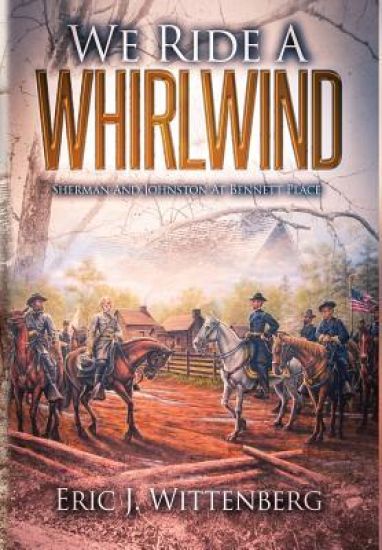
The events at Appomattox Court House in Virginia on April 9, 1865 have long been considered the end of the Civil War. However, there were still Confederate armies in the field. Maj. Gen. William T. Sherman, commander of the Union armies operating in North Carolina, still faced a 31,000 man Confederate army commanded by Gen. Joseph E. Johnston. In addition, another 60,000 Confederate soldiers remained under arms east of the Mississippi River. Johnston's army inflicted heavy losses on Sherman's forces at the Battle of Bentonville in March 1865, but was nearly captured when its escape route was nearly blocked by Sherman's much larger army. Instead of pursuing Johnston, whose troops escaped to Smithfield, North Carolina, Sherman instead marched to Goldsboro, where his army was reinforced and spent two weeks resting and refitting. Unlike Lee's army, which was surrounded at Appomattox and compelled to surrender, Johnston's army was not surrounded and had a substantial head start on Sherman, who would face hard marches and possibly another bloody battle before he could compel Johnston to surrender. When Sherman learned that the Army of the Potomac had captured Richmond and caused Lee's army to flee toward Danville, on the Virginia/North Carolina state line, he set his army in motion. By the time it reached Smithfield on April 12, Johnston had fallen back to Raleigh. Sherman pursued, prompting Johnston to evacuate Raleigh. But then word arrived of Lee's surrender--an event that changed everything. Johnston, realizing that there was no further reason to flee in an attempt to link up with Lee's army, asked Sherman to meet with him to discuss terms of surrender. Then came word of the assassination of Abraham Lincoln, an event that prompted Johnston to say that with the death of the President of the United States, the South had lost its best friend. This set the stage for the dramatic events that occurred at James Bennett's farm in modern-day Durham. In three remarkable meetings, Sherman and Johnston tried to not only set the terms for the surrender of the 91,000 Confederate troops east of the Mississippi River, but to make peace, once and for all. The new administration of President Andrew Johnson, eager for vengeance for the assassination of Lincoln, rejected the terms negotiated by Sherman and Johnston, excoriated Sherman in the press, and forced him to threaten Johnston with the renewal of hostilities if he did not surrender upon the same terms offered to Lee at Appomattox. Johnston wisely accepted those terms, leading to the surrender of his command and those other Confederates east of the Mississippi. This is the story of those events, told in detail, and often in the words of the participants themselves. Author Eric J. Wittenberg has masterfully told this compelling story. Numerous photographs and maps accompany the narrative describing the end of the great American tragedy of the Civil War.
We Ride a Whirlwind: Sherman and Johnston at Bennett Place
The events at Appomattox Court House in Virginia on April 9, 1865 have long been considered the end of the Civil War. However, there were still Confederate armies in the field. Maj. Gen. William T. Sherman, commander of the Union armies operating in North Carolina, still faced a 31,000 man Confederate army commanded by Gen. Joseph E. Johnston. In addition, another 60,000 Confederate soldiers remained under arms east of the Mississippi River. Johnston's army inflicted heavy losses on Sherman's forces at the Battle of Bentonville in March 1865, but was nearly captured when its escape route was nearly blocked by Sherman's much larger army. Instead of pursuing Johnston, whose troops escaped to Smithfield, North Carolina, Sherman instead marched to Goldsboro, where his army was reinforced and spent two weeks resting and refitting. Unlike Lee's army, which was surrounded at Appomattox and compelled to surrender, Johnston's army was not surrounded and had a substantial head start on Sherman, who would face hard marches and possibly another bloody battle before he could compel Johnston to surrender. When Sherman learned that the Army of the Potomac had captured Richmond and caused Lee's army to flee toward Danville, on the Virginia/North Carolina state line, he set his army in motion. By the time it reached Smithfield on April 12, Johnston had fallen back to Raleigh. Sherman pursued, prompting Johnston to evacuate Raleigh. But then word arrived of Lee's surrender--an event that changed everything. Johnston, realizing that there was no further reason to flee in an attempt to link up with Lee's army, asked Sherman to meet with him to discuss terms of surrender. Then came word of the assassination of Abraham Lincoln, an event that prompted Johnston to say that with the death of the President of the United States, the South had lost its best friend. This set the stage for the dramatic events that occurred at James Bennett's farm in modern-day Durham. In three remarkable meetings, Sherman and Johnston tried to not only set the terms for the surrender of the 91,000 Confederate troops east of the Mississippi River, but to make peace, once and for all. The new administration of President Andrew Johnson, eager for vengeance for the assassination of Lincoln, rejected the terms negotiated by Sherman and Johnston, excoriated Sherman in the press, and forced him to threaten Johnston with the renewal of hostilities if he did not surrender upon the same terms offered to Lee at Appomattox. Johnston wisely accepted those terms, leading to the surrender of his command and those other Confederates east of the Mississippi. This is the story of those events, told in detail, and often in the words of the participants themselves. Author Eric J. Wittenberg has masterfully told this compelling story. Numerous photographs and maps accompany the narrative describing the end of the great American tragedy of the Civil War.
Five or Ten Minutes of Blind Confusion: The Battle of Aiken, South Carolina, February 11, 1865
One of the few Confederate battlefield victories in the dark days of 1865 occurred at Aiken, South Carolina, on February 11, 1865. Aiken itself had little strategic significance to either side; Union Maj. Gen. William T. Sherman had intended to by-pass the small resort town. Sherman intended that his cavalry commander, Maj. Gen. Judson Kilpatrick head off in the direction of Augusta, Georgia to confuse the Confederates of his true target, Columbia, the capital of South Carolina. Since the Civil War began in South Carolina, both Sherman and the men of his army were eager to punish its population. Maj. Gen. Joseph Wheeler, the commander of the Confederate cavalry forces, had another idea. Aiken is approximately 13 miles from Augusta, Georgia and the largest gunpowder works in the Confederacy. Wheeler feared that Kilpatrick intended to destroy the powder works, which were critical to the continued military viability of the Confederate armies. On February 11, 1865, Wheeler set an ambush and drew the Union cavalry into his trap at Aiken, then pounced with nearly 3,000 Confederate horse soldiers. The urban street fighting was short and brutal. Kilpatrick himself was nearly captured, and only hard fighting by his troopers saved his command, which was able to extract itself from Wheeler's trap. Wheeler followed, and a full day of combat ended with one of the final Confederate battlefield victories of the Civil War. It was a tactical victory for Wheeler, but a strategic disaster for the Confederacy. Wheeler's stand made the defense of Columbia untenable, and just six days later, Columbia fell. Nearly the entire downtown was burned in a great conflagration, and the Palmetto State suffered. In Five or Ten Minutes of Blind Confusion: The Battle of Aiken, South Carolina, February 11, 1865, award-winning Civil War cavalry historian Eric J. Wittenberg tells the story of the Battle of Aiken in both tactical and strategic detail for the first time. Readers will learn of the near disaster that befell the Union troopers, and how Wheeler's move was actually a strategic debacle. Featuring five fine maps by a master cartographer and approximately 50 illustrations, this book fills an important gap in the body of literature addressing Sherman's 1865 Carolinas Campaign. It marks Wittenberg's third book on aspects of the Civil War in the Carolinas in 1865.
Five or Ten Minutes of Blind Confusion: The Battle of Aiken, South Carolina, February 11, 1865
One of the few Confederate battlefield victories in the dark days of 1865 occurred at Aiken, South Carolina, on February 11, 1865. Aiken itself had little strategic significance to either side; Union Maj. Gen. William T. Sherman had intended to by-pass the small resort town. Sherman intended that his cavalry commander, Maj. Gen. Judson Kilpatrick head off in the direction of Augusta, Georgia to confuse the Confederates of his true target, Columbia, the capital of South Carolina. Since the Civil War began in South Carolina, both Sherman and the men of his army were eager to punish its population. Maj. Gen. Joseph Wheeler, the commander of the Confederate cavalry forces, had another idea. Aiken is approximately 13 miles from Augusta, Georgia and the largest gunpowder works in the Confederacy. Wheeler feared that Kilpatrick intended to destroy the powder works, which were critical to the continued military viability of the Confederate armies. On February 11, 1865, Wheeler set an ambush and drew the Union cavalry into his trap at Aiken, then pounced with nearly 3,000 Confederate horse soldiers. The urban street fighting was short and brutal. Kilpatrick himself was nearly captured, and only hard fighting by his troopers saved his command, which was able to extract itself from Wheeler's trap. Wheeler followed, and a full day of combat ended with one of the final Confederate battlefield victories of the Civil War. It was a tactical victory for Wheeler, but a strategic disaster for the Confederacy. Wheeler's stand made the defense of Columbia untenable, and just six days later, Columbia fell. Nearly the entire downtown was burned in a great conflagration, and the Palmetto State suffered. In Five or Ten Minutes of Blind Confusion: The Battle of Aiken, South Carolina, February 11, 1865, award-winning Civil War cavalry historian Eric J. Wittenberg tells the story of the Battle of Aiken in both tactical and strategic detail for the first time. Readers will learn of the near disaster that befell the Union troopers, and how Wheeler's move was actually a strategic debacle. Featuring five fine maps by a master cartographer and approximately 50 illustrations, this book fills an important gap in the body of literature addressing Sherman's 1865 Carolinas Campaign. It marks Wittenberg's third book on aspects of the Civil War in the Carolinas in 1865.
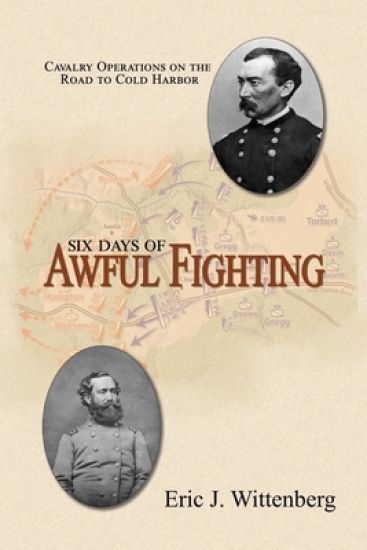
Six Days of Awful Fighting: Cavalry Operations on the Road to Cold Harbor
Most students of the American Civil War know about the terrible fighting that occurred at Cold Harbor in Hanover County, Virginia, from June 1-3, 1864. However, few know about the severe cavalry fighting leading up to the battle of Cold Harbor. From May 27 to June 1, the Cavalry Corps of the Army of the Potomac and the Cavalry Corps of the Army of Northern Virginia slugged it out at places like Hanovertown, Haw's Shop, Matadequin Creek, Hanover Court House, Ashland, and, finally, Cold Harbor itself, setting the stage for the well-known infantry battle that broke out on the afternoon of June 1, 1864.One cannot truly understand how the battle of Cold Harbor played out unless one also understands how the armies got there. This book brings the armies to the battle of Cold Harbor. The May 28, 1864, battle of Haw's Shop was considered the harshest cavalry battle of the war to date; but, it was eclipsed two weeks later by the battle of Trevilian Station. Haw's Shop marked Maj. Gen. Wade Hampton's emergence as the new commander of the Army of Northern Virginia's Cavalry Corps in the wake of the death of the lamented cavalry chief, Maj. Gen. J. E. B. Stuart, 16 days earlier.This is the first monograph dedicated to telling the story of these largely overlooked cavalry battles. Familiar characters such as Philip H. Sheridan, Fitzhugh Lee, George A. Custer, and David M. Gregg play significant roles in these battles. So, too, do lesser-known participants. Approximately 70 photographs and 25 maps grace this book's pages.
Six Days of Awful Fighting: Cavalry Operations on the Road to Cold Harbor
Most students of the American Civil War know about the terrible fighting that occurred at Cold Harbor in Hanover County, Virginia, from June 1-3, 1864. However, few know about the severe cavalry fighting leading up to the battle of Cold Harbor. From May 27 to June 1, the Cavalry Corps of the Army of the Potomac and the Cavalry Corps of the Army of Northern Virginia slugged it out at places like Hanovertown, Haw's Shop, Matadequin Creek, Hanover Court House, Ashland, and, finally, Cold Harbor itself, setting the stage for the well-known infantry battle that broke out on the afternoon of June 1, 1864.One cannot truly understand how the battle of Cold Harbor played out unless one also understands how the armies got there. This book brings the armies to the battle of Cold Harbor. The May 28, 1864, battle of Haw's Shop was considered the harshest cavalry battle of the war to date; but, it was eclipsed two weeks later by the battle of Trevilian Station. Haw's Shop marked Maj. Gen. Wade Hampton's emergence as the new commander of the Army of Northern Virginia's Cavalry Corps in the wake of the death of the lamented cavalry chief, Maj. Gen. J. E. B. Stuart, 16 days earlier.This is the first monograph dedicated to telling the story of these largely overlooked cavalry battles. Familiar characters such as Philip H. Sheridan, Fitzhugh Lee, George A. Custer, and David M. Gregg play significant roles in these battles. So, too, do lesser-known participants. Approximately 70 photographs and 25 maps grace this book's pages.
Doorways to the Deadeye

Doorways to the Deadeye

Eric J Guignard

JournalStone
2019
pokkari
Luke Thacker is a drifting hobo in Depression-era America, riding the rails of the nation and surviving by crumbs and hope. Along the way, he learns the iconography of transients--the Hobo Code--better than anyone else, and deciphers a secret that thrusts him into Athanasia, the middle ground of memories.Here he learns that all around us is the realm of the deadeye, where the deceased persevere by how they are remembered. The memories Luke meets will do anything to never be forgotten, whether by trickery, violence, or daring.Luke learns, too, that what's remembered yesterday is not always the same as what will be remembered tomorrow, and he sets off to keep alive the memories of those he loves in the way a 'bo does best: telling tales of old legends, and making up new ones alike.Now, fifty years later, the tall crossbucks of Luke Thacker are repeated by homeless King Shaw, who's struggling to keep Luke's own legend alive and with it, perhaps, his own.'Cause it don't matter if you rob banks with a dead John Dillinger, are hunted over the years by vengeful Earp brothers, or go against the monstrous railroad guard Smith McCain: when a story is told, all who are part of it become a little stronger.