Kirjojen hintavertailu. Mukana 11 627 220 kirjaa ja 12 kauppaa.

Kirjahaku

Etsi kirjoja tekijän nimen, kirjan nimen tai ISBN:n perusteella.

1000 tulosta hakusanalla John Hardingham

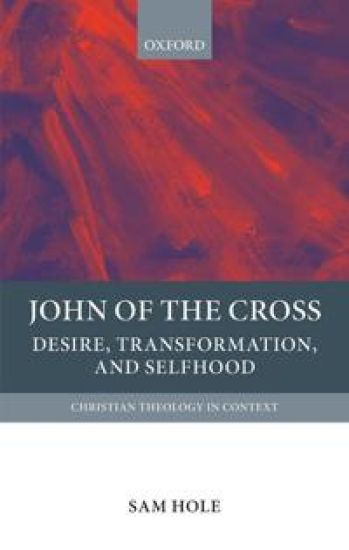
John of the Cross

John of the Cross

Sam Hole

Oxford University Press
2020
sidottu
Through the 'dark night of the soul' to the depiction of the erotically-charged union of the soul and God, the poetry and prose works of the Spanish friar John of the Cross (1542-1591) offer a striking account of the transformation of the individual in the course of the Christian life. John of the Cross: Desire, Transformation, and Selfhood argues that these writings are animated by John's own creative and subtly conceptualized notion of erotic desire. John's understanding of desire has the potential to enrich recent theological discussion of the subject, but it has been curiously neglected in past scholarship. To correct this lacuna, this study undertakes a detailed historical analysis in three parts. Firstly, it attends to the patristic, medieval, and sixteenth-century Spanish influences on John's writings, showing how John reworks a long tradition of biblical, Christian, and Platonic reflection on the concept. Secondly, it traces the importance of desire through John's writings, demonstrating how he develops the theme through his poetry, his anthropology of the soul, and his account of the spiritual ascent. Thirdly, it explores the reception of his writings in the twentieth century, demonstrating how particular modern philosophical and theological commitments have prevented scholars from recognising the rich and distinctive shape of John's theological vision. John's account of the transformation of the self, with its hopeful vision of the graced transformation of the soul's desires, has significance beyond the constrained modern categories of systematic theology, Christian spirituality, pastoral theology, and mysticism--it is a vision that is worthy of recovery today.
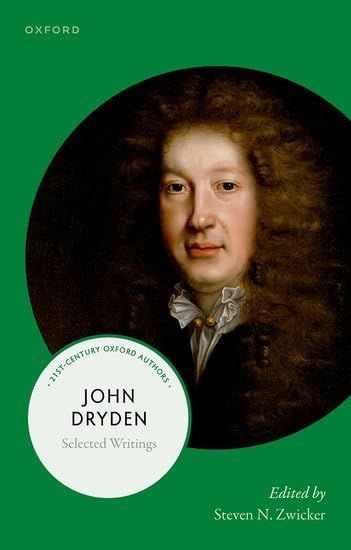
John Dryden

John Dryden

Oxford University Press
2024
nidottu
This volume in the 21st Century Oxford Authors series offers students an authoritative, comprehensive selection of the poetry and prose of John Dryden, the most important poet, dramatist, translator, and literary theorist of the later seventeenth century. He wrote across the tumultuous decades of political and cultural revolution--years stretching from the end of the Cromwellian Protectorate in 1659 through the reign of William III--and he addressed the crucial events of those decades. These were years of unprecedented political revolution, and of a remarkable transformation of English literary culture, with John Dryden at the literary centre. He invented new literary modes including the theatre of spectacle known as heroic drama; he perfected the heroic couplet, a form that became the chief instrument of public poetry; he adapted works of Shakespeare and Milton; he wrote excoriating satire; and he brought the translation of classical poetry to new levels of perfection; and throughout his career he wrote works of literary theory that defined his own practices and the literary ethos of his age. By the time that Dryden died in 1700 he had redefined English literary culture; his work recalled and embodied all the genres and modes of early modern literature and anticipated the brilliance of eighteenth-century satire as performed by Jonathan Swift and Alexander Pope. This edition represents the span of a long career in its remarkable variety. All the genres in which Dryden wrote are represented: panegyrics, lyrics, odes, epigrams, verse epistles, historical poems, commendatory verse, commemorative poems, religious poems, satires, plays, prologues and epilogues, translations, critical prose, dedications, prefaces, biography, and letters. Explanatory notes and commentary enhance the study, understanding, and enjoyment of these works, and the edition includes an Introduction to the life and works of Dryden, and a Chronology.
John Keats and the Perils of Posterity

John Keats and the Perils of Posterity

Nicholas Roe

Oxford University Press
2025
sidottu
This book begins with an account of the disease that killed Keats and contributed to the enduring myth that he was a doomed genius. Newspaper reports of Keats's death and early 'tribute' poems marking his demise form the substance of successive chapters, as do early attempts at researching and writing a biography of him. Keats's would-be biographers included his publisher John Taylor whose biographical endeavours preceded Keats's death, his mentor Leigh Hunt who devoted a chapter to 'Mr. Keats' in his brilliant 1828 book Lord Byron and some of his Contemporaries, and his friend and collaborator Charles Brown whose draft life narrative remains a vital source of information. Poised to emigrate to New Zealand, Brown passed his script and source materials to Richard Monckton Milnes enjoining him to complete the work (Brown conceded that Milnes had an advantage in having not known Keats). This book explores Milnes's efforts and success in publishing his Life, Letters, and Literary Remains of John Keats in 1848 --the first full-scale biography of the poet. Milnes's book has proved a formative and enduring influence for all of Keats's biographers, and the scale and resourcefulness of Milnes's labours are explored in detail. The closing chapters trace the influence of Milnes's book in the later nineteenth century, as new editions and fresh biographies appeared and Keats's reputation grew. The volume devotes many pages to the life experiences of the two women who had been closest to Keats: his sister Fanny and his fiancé Fanny Brawne. It also reflects on the means by which the Keats-Shelley House in Rome, and Keats House in Hampstead, were secured as memorial sites.
John Locke: Locke on Money, Volume I

John Locke: Locke on Money, Volume I

Patrick Hyde Kelly

Oxford University Press
2025
nidottu
Locke on Money presents for the first time the entire body of the philosopher's writings on this important subject (other than Two Treatises of Government). Accurate texts, together with an apparatus listing variant readings and significant manuscript changes, record the evolution of Locke's ideas from the original 1668-74 paper on interest to the three pamphlets on interest and coinage published in the 1690s. The introduction by Patrick Hyde Kelly establishes the wider context of Locke's writings in terms of contemporary debates on these subjects, the economic conditions of the time, and the circumstances of writing and publication. It shows, notably, that Locke's supposed responsibility for the 1696 recoinage is a myth. The account of what Locke derived from Mercantilist writings and of how he reformulated these in accordance with his philosophy illuminates his contribution to the evolution of economics, and will aid reappraisal of Two Treatises. The picture that emerges confirms Locke's status as major economic thinker, contrary to the prevalent view of recent decades. There are two volumes in the present edition. This first volume of Locke on Money contains the frontmatter and the texts of 'The Early Writings on Interest, 1688-74' and 'Some Considerations'.
John Locke: Locke on Money, Volume II

John Locke: Locke on Money, Volume II

Patrick Hyde Kelly

Oxford University Press
2025
nidottu
Locke on Money presents for the first time the entire body of the philosopher's writings on this important subject (other than Two Treatises of Government). Accurate texts, together with an apparatus listing variant readings and significant manuscript changes, record the evolution of Locke's ideas from the original 1668-74 paper on interest to the three pamphlets on interest and coinage published in the 1690s. The introduction by Patrick Hyde Kelly establishes the wider context of Locke's writings in terms of contemporary debates on these subjects, the economic conditions of the time, and the circumstances of writing and publication. It shows, notably, that Locke's supposed responsibility for the 1696 recoinage is a myth. The account of what Locke derived from Mercantilist writings and of how he reformulated these in accordance with his philosophy illuminates his contribution to the evolution of economics, and will aid reappraisal of Two Treatises. The picture that emerges confirms Locke's status as major economic thinker, contrary to the prevalent view of recent decades. There are two volumes in the present edition. This second volume of Locke on Money contains the texts 'Short Observations' and 'Further Considerations', as well as the Appendices and endmatter.
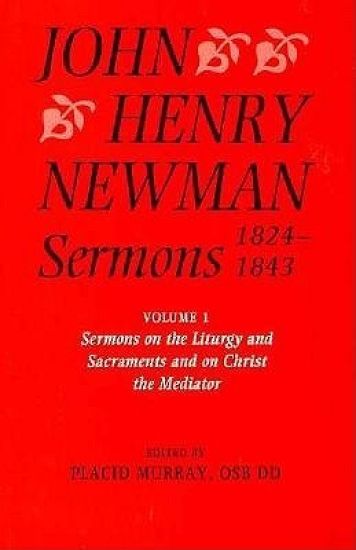
John Henry Newman Sermons 1824-1843: Volume I: Sermons on the Liturgy and Sacraments and on Christ the Mediator
From 1824 to 1843 Newman was an active clergyman of the Church of England; during this time, he entered the pulpit about 1,270 times. Newman published 217 of the sermons which he wrote during these years; a further 246 sermons survive in manuscript in the Archives of the Birmingham Oratory, some only as fragments but the majority as full texts. These sermons will be published in a series of five volumes, the aim being to transcribe them accurately, with sufficient editorial apparatus for the theological development within them to be understood, and their historical situation to be clear. The forty-three sermons contained in Volume I reveal Newman's attitude to his pastoral charge, his theology of liturgy based on the Book of Common Prayer; his gradual acceptance of the doctrine of baptismal regeneration as a substitute for his earlier belief in conversion as understood by the Evangelicals; the eventual supremacy of the Eucharist in his own spiritual life; his growing reserve about preaching on the Atonement; his faith in the divinity of Christ the Mediator; and finally, his understanding of the Church as the remedial and mediatorial kingdom of Christ on earth.
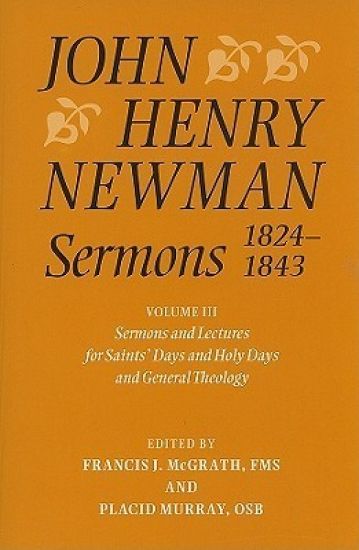
John Henry Newman Sermons 1824-1843
From 1824 to 1843, Newman was an active clergyman of the Church of England. Throughout these twenty years, he entered the pulpit about 1,270 times and wrote about 604 sermons. Of these, he eventually published 217 sermons which he had written and delivered; a further 246 sermons survive in manuscript in the Archives of the Birmingham Oratory, some only as fragments but the majority as full texts. Volume I was published in 1991 and Volume II in 1993. When completed, the series will consist of five volumes. Volume III contains a further fifty hitherto unpublished sermons belonging to this period. There are twenty-five sermons especially composed for Saints' Days and Holy Days and, with one exception, all preached at St Mary the Virgin University Church, Oxford, between 1830 and 1843. Towards the end of 1831, after years of dissatisfaction with his mode of writing and preaching sermons, Newman hit upon a new mode of delivery. There are also twenty-five sermons which Newman categorized as General Theology. They cover such areas as: the Second Coming; the efficacy of prayer; angels; baptismal regeneration; the Trinity, religious mystery; the Creed; and the dogmatic principle. There is also one particular sermon on slavery in which Newman argues that slavery is 'a condition of life ordained by God in the same sense that other conditions of life are'. Since many of these sermons were preached and re-preached several times over this twenty-year period, they are important for an understanding of Newman's theological and spiritual development.
John Henry Newman Sermons 1824-1843
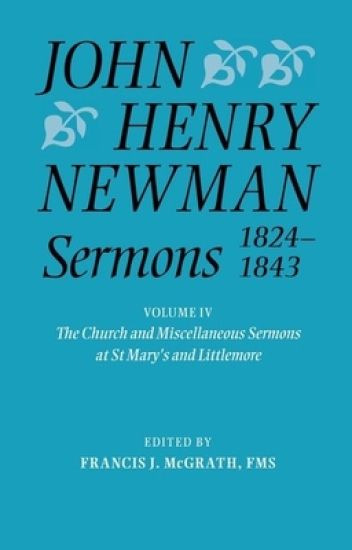
From 1824 to 1843 Newman was an active clergyman of the Church of England; during these years he entered the pulpit about 1,270 times. He published 217 of the sermons which he wrote during these years; a further 246 sermons survive in manuscript in the Archives of the Birmingham Oratory, some only as fragments, some simply as sermon abstracts, but the majority as full texts. When completed, this series of the sermons will consist of five volumes. Volume IV contains thirty-nine sermons covering a period of sixteen years from the time when John Henry was still an Evangelical to the period immediately leading up to his departure from the Church of England. Part I contains twelve sermons on the Church, preached over a thirteen-year period from 1824 to 1837. Five of these belong to the twenty months spent as Curate of the old church of St Clement's and the other seven while Vicar of St Mary's, including the first sermon he ever preached on High Church principles. Part II contains a miscellany of twenty-seven sermons preached between 1828 and 1840. They range from five sermons on the Incarnate Christ; one to commemorate the dedication of the new church at Littlemore; one on Rome and Antichrist, two on behalf of the Church Missionary Society and the Society for the Propagation of the Gospel; two to mark the deaths of George IV and his former classic master, Walter Meyers; one also to commemorate the anniversary of the execution of Charles I.
John Henry Newman Sermons 1824-1843
From 1824 to 1843, Newman was an active clergyman in the Church of England. Throughout these twenty years, he entered the pulpit about 1,270 times and wrote about 600 sermons. Of these, he eventually published 217 sermons which he had written and delivered; a further 246 sermons survive in manuscript form in the Archives of the Birmingham Oratory. Volume V marks the second and final stage of a project which began with the publication of the first volume of his celebrated The Letters and Diaries of John Henry Newman in 1961, concluding 32 volumes later in 2008. Volume I of his unpublished Anglican sermons was published in 1991; Volume II in 1993; Volume III in 2010; Volume IV in 2011. Volume V contains 51 sermons plus 62 sermon abstracts, all but 2 of which belong to the 20 months when he was Curate of St Clement's, Oxford, from June 1824 until April 1826. During his tenure there, he composed 150 sermons; approximately one quarter of his Anglican output. Part I begins with the first sermon he ever preached and concludes with his farewell sermon. They demonstrate to what extent Newman was an Evangelical on first entering Anglican orders. Part II contains 2 charity sermons preached after resigning the curacy; one on the virtue of almsgiving for the purpose of raising funds for unemployed workers affected by the Stock Market crash of 1825; the other on National Schools and their close connection with the Anglican Church.