Kirjojen hintavertailu. Mukana 12 273 265 kirjaa ja 12 kauppaa.

Kirjahaku

Etsi kirjoja tekijän nimen, kirjan nimen tai ISBN:n perusteella.

1000 tulosta hakusanalla John Stuart

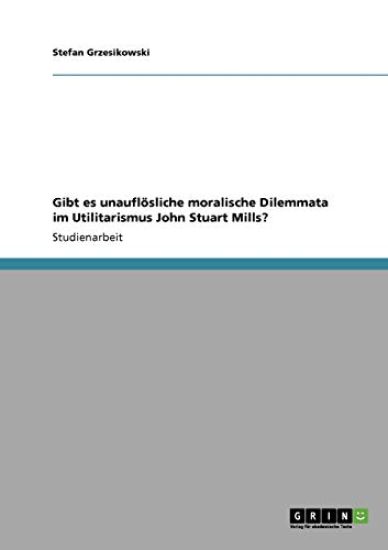
Der Zusammenhang zwischen Freiheit und Verantwortung in John Stuart Mills Essay "Über die Freiheit"
Studienarbeit aus dem Jahr 2008 im Fachbereich Philosophie - Praktische (Ethik, sthetik, Kultur, Natur, Recht, ...), Note: 2,0, Christian-Albrechts-Universit t Kiel (Philosophisches Seminar), Veranstaltung: Freiheit und Verantwortung als Grundprobleme des Liberalismus, Sprache: Deutsch, Abstract: ...] Mit eben diesem Mittelweg besch ftigt sich die vorliegende Arbeit. Im Zentrum der Untersuchungen steht dabei John Stuart Mills 1859 publizierter Essay " ber die Freiheit," in dem die b rgerliche oder soziale Freiheit thematisiert wird. Weil Mill schon in seiner Einleitung zu dem Schluss kommt, dass diese Freiheit nur dann gew hrleistet werden kann, wenn der Mensch ein gewisses Ma an Verantwortung gegen ber seinen Mitmenschen bernimmt, soll insbesondere der Frage nachgegangen werden, in welcher Beziehung Freiheit und Verantwortung zueinander stehen. Dabei wird auch nachvollzogen, von welcher Freiheit bei Mill berhaupt die Rede ist und ob Mills Auffassung von Verantwortung das oben beschriebene Dilemma l sen k nnte. Zuerst soll darin das Interesse auf die Entstehung des Textes gest tzt werden. John Stuart Mill lebte in einer Zeit, die vor allem f r ihre Umbr che im philosophischen Denken bekannt ist. Um aufzeigen zu k nnen, wie seine Gedanken von den Umst nden dieser Zeit, aber auch von seinen Vordenkern gepr gt wurden, sollen die Einfl sse auf seinen Essay " ber die Freiheit" an erster Stelle erl utert werden. Darauf aufbauend wird darauf verwiesen, wie die Begriffe Freiheit und Verantwortung bei Mill eingef hrt werden. Denn diese bilden die Basis f r den weiteren Gang der vorliegenden Untersuchung. Der n chste Abschnitt der Arbeit widmet sich der Freiheit des Individuums in der Gesellschaft. Um berhaupt aufzeigen zu k nnen, wann ein Mensch frei ist oder nicht, muss der Begriff der Freiheit zun chst genauer untersucht werden. Dabei spielen auch die Gesetze eine nicht ganz unerhebliche Rolle, weil sie die Freiheit der Menschen in der Gesellschaft letztendlich einsc
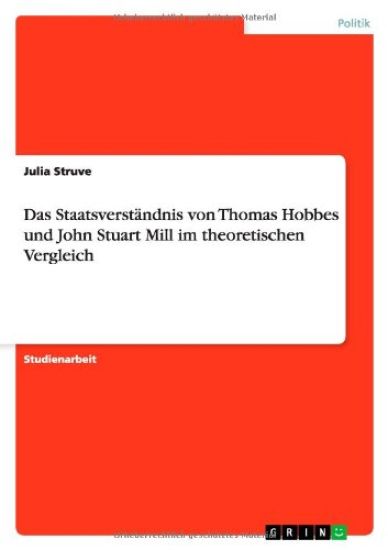
Das Staatsverstandnis von Thomas Hobbes und John Stuart Mill im theoretischen Vergleich
Studienarbeit aus dem Jahr 2012 im Fachbereich Politik - Politische Theorie und Ideengeschichte, Note: 2,0, Technische Universit t Dresden (Institut f r Politikwissenschaft), Veranstaltung: Einf hrung in die politische Theorie und Ideengeschichte, Sprache: Deutsch, Abstract: Bereits mit der Entstehung der unterschiedlichsten Kulturen besch ftigte sich der Mensch mit der Aufstellung sozialer Gemeinschaften und Kontakte, sowie deren gesellschaftlichen Ordnungsprinzipien. Dennoch ergaben sich erst im Laufe der geschichtlichen Entwicklung die bis heute so bedeutungsvollen Begriffe wie Freiheit, Volk, Recht und Gesetz, sowie der Begriff des Staates, mit welchen sich das politische Aussehen der sozialen Gemeinschaften zunehmend ver nderte. Der Staat als gesellschaftlich, ordnende politische Instanz wurde Grundlage, Gegenstand und Instrument politischer Theorie und Ideengeschichte sowohl in der Antike, im Mittelalter, in der Neuzeit als auch in der Moderne. Diese Vorstellung verdeutlicht den Gegenstand dieser wissenschaftlichen Arbeit, welche sich im Folgenden mit einem Vergleich der staatstheoretischen Vorstellungen von Thomas Hobbes und John Stuart Mill befassen wird. Trotz der sehr unterschiedlichen historischen Kontexte beider Theoretiker, wird anhand signifikant gew hlter Analysekategorien ein Vergleich im Hinblick auf ihr jeweiliges Staatsverst ndnis durchf hrbar. Grundlage dieses theoretischen Vergleiches bilden hierbei die Texte "Leviathan" von Thomas Hobbes sowie " ber die Freiheit" und "Das Laisser-faire-Prinzip" von John Stuart Mill. Zu Beginn werden die zugrunde gelegten Menschenbilder und der Freiheitsbegriff der beiden Theoretiker erl utert und verglichen. Im Anschluss daran werden die Entstehung des jeweiligen Staates und die Prinzipien der Staatsf hrung betrachtet. Dabei soll auch auf die Souver nit t und Machtaus bung innerhalb des Staates eingegangen werden. Die wichtigsten Rechte und Pflichten der B rger bzw. der Gesellschaft und selbstverst ndlich des S
Logic and Reality in the Philosophy of John Stuart Mill
'Nobody reads Mill today,' wrote a reviewer in Time magazine a few years ago. ! One could scarcely praise Mr Melvin Maddocks, who penned that remark, for his awareness of the present state of Mill studies, for of all nineteenth century philosophers who wrote in English, it is 1. S. Mill who remains the most read today. Yet it would not be so far from the truth to say that very few people pay much serious attention nowadays to Mill's writings about logic and metaphysics (as distinct from those on ethical and social issues), despite the fact that Mill put enormous effort into their composition and through them exerted a considerable influen­ ce on the course of European philosophy for the rest of his century. But the only sections of A System of Logic (1843) and An Examination of Sir William Hamilton's Philosophy (1865) to which much reference is now made comprise only a small proportion of those very large books, and the prevailing assumption is that Mill's theories about logical and meta­ physical questions are, with few exceptions, of merely antiquarian in­ terest. Bertrand Russell once said that Mill's misfortune was to be born at the wrong time (Russell (1951), p. 2). It can certainly appear that Mill chose an inauspicious time to attempt a major work on logic.
Logic and Reality in the Philosophy of John Stuart Mill
'Nobody reads Mill today,' wrote a reviewer in Time magazine a few years ago. ! One could scarcely praise Mr Melvin Maddocks, who penned that remark, for his awareness of the present state of Mill studies, for of all nineteenth century philosophers who wrote in English, it is 1. S. Mill who remains the most read today. Yet it would not be so far from the truth to say that very few people pay much serious attention nowadays to Mill's writings about logic and metaphysics (as distinct from those on ethical and social issues), despite the fact that Mill put enormous effort into their composition and through them exerted a considerable influen­ ce on the course of European philosophy for the rest of his century. But the only sections of A System of Logic (1843) and An Examination of Sir William Hamilton's Philosophy (1865) to which much reference is now made comprise only a small proportion of those very large books, and the prevailing assumption is that Mill's theories about logical and meta­ physical questions are, with few exceptions, of merely antiquarian in­ terest. Bertrand Russell once said that Mill's misfortune was to be born at the wrong time (Russell (1951), p. 2). It can certainly appear that Mill chose an inauspicious time to attempt a major work on logic.
James Mill, John Stuart Mill, and the History of Economic Thought
Commemorating the 250th anniversary of James Mill’s birth and the 150th of John Stuart Mill’s death, this volume analyses the Mills’ discussions on topics such as environment, cultivation, education, utilitarianism, socialism, international relations, international trade, and living standard.John Stuart Mill is an important figure of the classical political economy, and his father played a critical role in the early stages of his intellectual development. The contributions of the two Mills are examined by leading scholars on the theory and history of economics from Japan, UK, and France. They not only deal with the Mills’ individual contributions but also shed light on their relationships and associations with a number of economists and philosophers in Britain between the late 18th and the early 20th centuries, including Adam Smith, Malthus, Ricardo, Pennington, Torrens, Martineau, Longfield, Morris, Sidgwick, and Marshall.This book is an essential read for scholars interested in the economics of James and John Mill, and reconsideration of their theories and thoughts using the backdrop of the current state of society.
James Mill, John Stuart Mill, and the History of Economic Thought
Commemorating the 250th anniversary of James Mill’s birth and the 150th of John Stuart Mill’s death, this volume analyses the Mills’ discussions on topics such as environment, cultivation, education, utilitarianism, socialism, international relations, international trade, and living standard.John Stuart Mill is an important figure of the classical political economy, and his father played a critical role in the early stages of his intellectual development. The contributions of the two Mills are examined by leading scholars on the theory and history of economics from Japan, UK, and France. They not only deal with the Mills’ individual contributions but also shed light on their relationships and associations with a number of economists and philosophers in Britain between the late 18th and the early 20th centuries, including Adam Smith, Malthus, Ricardo, Pennington, Torrens, Martineau, Longfield, Morris, Sidgwick, and Marshall.This book is an essential read for scholars interested in the economics of James and John Mill, and reconsideration of their theories and thoughts using the backdrop of the current state of society.
From the Axial Age to the Moral Revolution: John Stuart-Glennie, Karl Jaspers, and a New Understanding of the Idea
In 1873, John Stuart Stuart-Glennie elaborated a theory of 'the moral revolution' to characterize the historical shift from roughly 600 BCE in a variety of civilizations, as part of a critical theory of history. This book brings light to the now eclipsed theory and offers new contexts and understandings of the phenomenon.
The Revd. [Reverend] John Stuart, D.D., U.E.L., of Kingston, U.C. and his Family; a Genealogical Study,
This work has been selected by scholars as being culturally important, and is part of the knowledge base of civilization as we know it. This work was reproduced from the original artifact, and remains as true to the original work as possible. Therefore, you will see the original copyright references, library stamps (as most of these works have been housed in our most important libraries around the world), and other notations in the work.This work is in the public domain in the United States of America, and possibly other nations. Within the United States, you may freely copy and distribute this work, as no entity (individual or corporate) has a copyright on the body of the work.As a reproduction of a historical artifact, this work may contain missing or blurred pages, poor pictures, errant marks, etc. Scholars believe, and we concur, that this work is important enough to be preserved, reproduced, and made generally available to the public. We appreciate your support of the preservation process, and thank you for being an important part of keeping this knowledge alive and relevant.