Kirjojen hintavertailu. Mukana 11 699 587 kirjaa ja 12 kauppaa.

Kirjahaku

Etsi kirjoja tekijän nimen, kirjan nimen tai ISBN:n perusteella.

1000 tulosta hakusanalla Michael A. Cook

Innovation for the 21st Century

Innovation for the 21st Century

Michael A. Carrier

Oxford University Press Inc
2009
sidottu
In recent years, innovation has been threatened by the United States legal system. Much of the blame can be attributed to the antitrust and intellectual property laws. Innovation for the 21st Century seeks to reverse this trend, offering ten revolutionary proposals, from pharmaceuticals to peer-to-peer software, to help foster innovation. Michael A. Carrier illustrates the benefits of improving the patent system and incorporating innovation into copyright and antitrust law. He also dips into a rich business literature to import ideas on "disruptive innovation" and "user innovation." And he replaces the 20th-century view that the IP and antitrust laws are in conflict with a new 21st-century framework that treats them as collaborators. Innovation for the 21st Century: Harnessing the Power of Intellectual Property and Antitrust Law provides a comprehensive framework for the patent, copyright, and antitrust laws to promote innovation.
Reviving Rationality

Reviving Rationality

Michael A. Livermore; Richard L. Revesz

Oxford University Press Inc
2021
sidottu
For decades, administrations of both political parties have used cost-benefit analysis to evaluate and improve federal policy in a variety of areas, including health and the environment. Today, this model is under grave threat. In Reviving Rationality, Michael Livermore and Richard Revesz explain how Donald Trump has destabilized the decades-long bipartisan consensus that federal agencies must base their decisions on evidence, expertise, and analysis. Administrative agencies are charged by law with protecting values like stable financial markets and clean air. Their decisions often have profound consequences, affecting everything from the safety of workplaces to access to the dream of home ownership. Under the Trump administration, agencies have been hampered in their ability to advance these missions by the conflicting ideological whims of a changing cast of political appointees and overwhelming pressure from well-connected interest groups. Inconvenient evidence has been ignored, experts have been sidelined, and analysis has been used to obscure facts, rather than inform the public. The results are grim: incoherent policy, social division, defeats in court, a demoralized federal workforce, and a loss of faith in government's ability to respond to pressing problems. This experiment in abandoning the norms of good governance has been a disaster. Reviving Rationality explains how and why our government has abandoned rationality in recent years, and why it is so important for future administrations to restore rigorous cost-benefit analysis if we are to return to a policymaking approach that effectively tackles the most pressing problems of our era.
City of Song

City of Song

Michael A. Figueroa

OXFORD UNIVERSITY PRESS INC
2022
nidottu
Modern Jerusalem, a city central to Jewish, Muslim, and Christian religious imaginaries and the political epicenter of the Israeli-Palestinian crisis, is to put it mildly a highly contested space. More surprising, perhaps, is that its musical landscape not only reflects these rifts but also helped to define them as the ancient city transitioned to modernity during the twentieth century. In City of Song: Music and the Making of Modern Jerusalem, author Michael A. Figueroa argues that musical renderings of Jerusalem have been critical to the formation of Israeli political consciousness. The book demonstrates how Israeli songwriters helped to shape their public's territorial imagination-- creating images of a city at once heavenly and earthly, that dwells in longing, that must not be forgotten, that compels one to bereave the dead, that represents the fulfilment of prophecy, and that is the site of immense cultural diversity. The dynamic history of its representation in lyrics and music helps dispel any notion that the Israeli-Palestinian crisis is timeless, intractable, and based on static, essential identities; while there are continuities across historical divides, radical change constantly transpires. City of Song combines analyses of musical meaning, political discourse, and public performance over the long twentieth century (1880s-2010) to reveal how the Israeli-Palestinian crisis' territorial fixation on Jerusalem has been constructed, historically contingent, and subject to artistic intervention in modernity. Through a musical history of Jerusalem, Figueroa introduces a novel, humanities-centered approach to one of the world's most contested cities, and one of the defining cultural and political questions of our era.
City of Song

City of Song

Michael A. Figueroa

OXFORD UNIVERSITY PRESS INC
2022
sidottu
Modern Jerusalem, a city central to Jewish, Muslim, and Christian religious imaginaries and the political epicenter of the Israeli-Palestinian crisis, is to put it mildly a highly contested space. More surprising, perhaps, is that its musical landscape not only reflects these rifts but also helped to define them as the ancient city transitioned to modernity during the twentieth century. In City of Song: Music and the Making of Modern Jerusalem, author Michael A. Figueroa argues that musical renderings of Jerusalem have been critical to the formation of Israeli political consciousness. The book demonstrates how Israeli songwriters helped to shape their public's territorial imagination— creating images of a city at once heavenly and earthly, that dwells in longing, that must not be forgotten, that compels one to bereave the dead, that represents the fulfilment of prophecy, and that is the site of immense cultural diversity. The dynamic history of its representation in lyrics and music helps dispel any notion that the Israeli-Palestinian crisis is timeless, intractable, and based on static, essential identities; while there are continuities across historical divides, radical change constantly transpires. City of Song combines analyses of musical meaning, political discourse, and public performance over the long twentieth century (1880s-2010) to reveal how the Israeli-Palestinian crisis' territorial fixation on Jerusalem has been constructed, historically contingent, and subject to artistic intervention in modernity. Through a musical history of Jerusalem, Figueroa introduces a novel, humanities-centered approach to one of the world's most contested cities, and one of the defining cultural and political questions of our era.
Unconventional Combat

Unconventional Combat

Michael A. Messner

Oxford University Press Inc
2021
nidottu
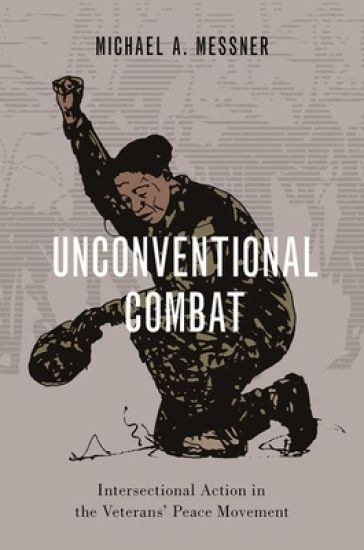
In recent decades, there has been a generational shift of the US veterans' peace movement, from one grounded mostly in the experiences of older white men of the Vietnam War era, to one informed by a young, diverse cohort of post-9/11 veterans. In Unconventional Combat, Michael A. Messner traces this transformation through the life-history interviews of six veterans of color to show how their experiences of sexual and gender harassment, sexual assault, racist and homophobic abuse during their military service has shaped their political views and action. Drawing upon participant observation with the Veterans For Peace and About Face organizations and interviews with older male veterans as his backdrop, Messner shows how veterans' military experiences form their collective "situated knowledge" of intersecting oppressions. This knowledge, Messner argues, further shapes their intersectional praxis, which promises to transform the veterans' peace movement and potentially link their anti-militarist work with other movement groups working for change. As intersectionality has increasingly become central to the conversation on social movements, Unconventional Combat is not only a story about the US veterans' peace movement, but it also offers broad relevance to the larger world of social justice activism.
Dangerous Instrument

Dangerous Instrument

Michael A. Robinson

OXFORD UNIVERSITY PRESS INC
2023
sidottu
As increasingly contentious politics in the United States raise concerns over the "politicization" of traditionally non-partisan institutions, many have turned their attention to how the American military has been--and will be--affected by this trend. Since a low point following the end of the Vietnam War, the U.S. military has experienced a dramatic reversal of public opinion, becoming one of the most trusted institutions in American society. However, this trend is more complicated than it appears: just as individuals have become fonder of their military, they have also become increasingly polarized from one another along partisan lines. The result is a new political environment rife with challenges to traditional civil-military norms. In a data-driven analysis of contemporary American attitudes, Dangerous Instrument examines the current state of U.S. civil-military affairs, probing how the public views their military and the effect that partisan tribalism may have on that relationship in the future. Michael A. Robinson studies the sources and potential limits of American trust in the armed services, focusing on the interplay of the public, political parties, media outlets, and the military itself on the prospect of politicization and its associated challenges. As democratic institutions face persistent pressure worldwide, Dangerous Instrument provides important insights into the contemporary arc of American civil-military affairs and delivers recommendations on ways to preserve a non-partisan military.
Dangerous Instrument

Dangerous Instrument

Michael A. Robinson

OXFORD UNIVERSITY PRESS INC
2023
nidottu
As increasingly contentious politics in the United States raise concerns over the "politicization" of traditionally non-partisan institutions, many have turned their attention to how the American military has been--and will be--affected by this trend. Since a low point following the end of the Vietnam War, the U.S. military has experienced a dramatic reversal of public opinion, becoming one of the most trusted institutions in American society. However, this trend is more complicated than it appears: just as individuals have become fonder of their military, they have also become increasingly polarized from one another along partisan lines. The result is a new political environment rife with challenges to traditional civil-military norms. In a data-driven analysis of contemporary American attitudes, Dangerous Instrument examines the current state of U.S. civil-military affairs, probing how the public views their military and the effect that partisan tribalism may have on that relationship in the future. Michael A. Robinson studies the sources and potential limits of American trust in the armed services, focusing on the interplay of the public, political parties, media outlets, and the military itself on the prospect of politicization and its associated challenges. As democratic institutions face persistent pressure worldwide, Dangerous Instrument provides important insights into the contemporary arc of American civil-military affairs and delivers recommendations on ways to preserve a non-partisan military.
The Ethiopic Text of the Book of Ezekiel

The Ethiopic Text of the Book of Ezekiel

Michael A. Knibb

Oxford University Press
2015
sidottu
Ezekiel is one of the few books of the Ethiopic Old Testament of which no critical edition has hitherto existed, and the aim of this work is to fill that gap. It provides a critical edition of the oldest accessible text of the Geez version and is based on a collation of fifteen manuscripts. The Ethiopic version is a daughter version of the Septuagint, and the work sheds light on the character of the original translation and on its subsequent history. The latter included the revision of the translation in the early mediaeval period, which was in part influenced by a Syriac-based Arabic version, and a further revision of the translation based on the Masoretic text.
Authoritarian Liberalism and the Transformation of Modern Europe

Authoritarian Liberalism and the Transformation of Modern Europe

Michael A. Wilkinson

Oxford University Press
2021
sidottu
This title recounts the transformation of Europe from the post-war era until the Euro-crisis, using the tools of constitutional analysis and critical theory. The central claim is twofold: Europe has been gradually reconstituted in a manner that combines political authoritarianism with economic liberalism and that this order is now in a critical condition. Authoritarian liberalism is constructed supranationally, through a taming of inter-state relations in the project of European integration; at the domestic level, through the depoliticization of state-society relations; and socially, through the emergence of a new constitutional imaginary based on liberal individualism. In the language of constitutional theory, this transformation can be captured by the substitution of supranationalism for internationalism, technocracy for democracy, and economic for political freedom. Sovereignty is restrained, democracy curtailed, and class struggle repressed. This constitutional trajectory takes time to unfold and develop and it presents continuities and discontinuities. On the one hand, authoritarian liberalism is deepened by the neoliberalism of the Maastricht era and the creation of Economic and Monetary Union. On the other hand, counter-movements then also begin to emerge, geopolitically, in the return of the German question, domestically, in the challenges to the EU presented by constitutional courts, and informally, in the rise of anti-systemic political parties and movements. Sovereignty, democracy, and political freedom resurface, but are then more actively suppressed through the harsher authoritarian liberalism of the Euro-crisis phase. This leads now to an impasse. Anti-systemic politics return but remain uneasily within the EU, suggesting authoritarian liberalism has reached its limits if just about managing to maintain constitutional order. As yet, there has been no definitive rupture, with the possible exception of Brexit.
Staying Power

Staying Power

Michael A. Cusumano

Oxford University Press
2010
sidottu
As we move into an era of simultaneous innovation and commoditization, enabled by digital technologies, managers around the world are asking themselves "how can we both adapt to rapid changes in technology and markets, and still make enough money to survive - and thrive?" To provide answers to these important and urgent questions, MIT Sloan School of Management Professor Michael Cusumano draws on nearly 30 years of research into the practices of global corporations that have been acknowledged leaders and benchmark setters - and Microsoft, Apple, Intel, Google, and others in software, internet services, and consumer electronics, and Toyota in manufacturing. If we look deeply enough, he contends, we can see the ideas that underpin the management practices that make for great companies, and drive their strategic evolution and innovation capabilities. From his deep knowledge of these organizations, Cusumano distils six enduring principles that he believes have been - in various combinations - crucial to their strategy, innovation management practices, and ability to deal with change and uncertainty. The first two principles - platforms (not just products), and services, for product firms - are relatively new and broader ways of thinking about strategy and business models, based on Cusumano's latest research. The other four - capabilities (not just strategy), the "pull" concept, economies of scope, and flexibility (not just efficiency) - all contribute to agility, which is a mix of flexibility and speed. Some practices associated with these ideas, such as dynamic capabilities, just-in-time production, iterative or prototype-driven product development, flexible design and manufacturing, modular architectures, and component reuse, are now commonly regarded as standard best practices. They are also essential to a new world dominated by platforms and technology-enabled services.
The Occupiers

The Occupiers

Michael A. Gould-Wartofsky

Oxford University Press Inc
2015
sidottu
Occupy Wall Street burst onto the stage of history in the fall of 2011. First by the tens, then by the tens of thousands, protestors filled the streets and laid claim to the squares of nearly 1,500 towns and cities, until, one by one, the occupations were forcibly evicted. In The Occupiers, Michael Gould-Wartofsky--one of the first social scientists on the ground in Zuccotti Park--offers a front-seat view of the action in the streets of New York City and beyond. Painting a vivid picture of everyday life in the square through the use of material gathered in the course of a year of participant observation, Gould-Wartofksy traces the occupation of Zuccotti Park--and some of its counterparts across the United States and around the world--from inception to eviction. He takes up the challenges the occupiers faced, the paradoxes of direct democracy, and the dynamics of direct action and police action and explores the ways in which occupied squares became focal points for an emerging opposition to the politics of austerity, restricted democracy, and the power of corporate America. Much of the discourse on the Occupy phenomenon has treated it as if it lived and died in Zuccotti Park, but Gould-Wartofsky follows the evicted occupiers into exile and charts the evolving strategies of the movement as it seeks to resist, regroup, and reoccupy. Removed from public spaces and news headlines, Occupy has spread out from the financial centers and across an America still struggling to recover in the aftermath of the crisis. Even if the movement fails to achieve radical reform, Gould-Wartofksy maintains, it may well accelerate the pace of change in the United States in the years to come.
Some Men

Some Men

Michael A. Messner; Max A. Greenberg; Tal Peretz

Oxford University Press Inc
2015
sidottu
What does it mean for men to join with women as allies in preventing sexual assault and domestic violence? Based on life history interviews with men and women anti-violence activists aged 22 to 70, Some Men explores the strains and tensions of men's work as feminist allies. When feminist women began to mobilize against rape and domestic violence, setting up shelters and rape crisis centers, a few men asked what they could do to help. They were directed "upstream," and told to "talk to the men" with the goal of preventing future acts of violence. This is a book about men who took this charge seriously, committing themselves to working with boys and men to stop violence, and to change the definition of what it means to be a man. The book examines the experiences of three generational cohorts: a movement cohort of men who engaged with anti-violence work in the 1970s and early 1980s, during the height of the feminist anti-violence mobilizations; a bridge cohort who engaged with anti-violence work from the mid-1980s into the 1990s, as feminism receded as a mass movement and activists built sustainable organizations; a professional cohort who engaged from the mid-1990s to the present, as anti-violence work has become embedded in community and campus organizations, non-profits, and the state. Across these different time periods, stories from life history interviews illuminate men's varying paths--including men of different ethnic and class backgrounds--into anti-violence work. Some Men explores the promise of men's violence prevention work with boys and men in schools, college sports, fraternities, and the U.S. military. It illuminates the strains and tensions of such work--including the reproduction of male privilege in feminist spheres--and explores how men and women navigate these tensions.
Some Men

Some Men

Michael A. Messner; Max A. Greenberg; Tal Peretz

Oxford University Press Inc
2015
nidottu
What does it mean for men to join with women as allies in preventing sexual assault and domestic violence? Based on life history interviews with men and women anti-violence activists aged 22 to 70, Some Men explores the strains and tensions of men's work as feminist allies. When feminist women began to mobilize against rape and domestic violence, setting up shelters and rape crisis centers, a few men asked what they could do to help. They were directed "upstream," and told to "talk to the men" with the goal of preventing future acts of violence. This is a book about men who took this charge seriously, committing themselves to working with boys and men to stop violence, and to change the definition of what it means to be a man. The book examines the experiences of three generational cohorts: a movement cohort of men who engaged with anti-violence work in the 1970s and early 1980s, during the height of the feminist anti-violence mobilizations; a bridge cohort who engaged with anti-violence work from the mid-1980s into the 1990s, as feminism receded as a mass movement and activists built sustainable organizations; a professional cohort who engaged from the mid-1990s to the present, as anti-violence work has become embedded in community and campus organizations, non-profits, and the state. Across these different time periods, stories from life history interviews illuminate men's varying paths--including men of different ethnic and class backgrounds--into anti-violence work. Some Men explores the promise of men's violence prevention work with boys and men in schools, college sports, fraternities, and the U.S. military. It illuminates the strains and tensions of such work--including the reproduction of male privilege in feminist spheres--and explores how men and women navigate these tensions.
River Ecology

River Ecology

Michael A. Mallin

Oxford University Press
2023
sidottu
Rivers have been vitally important to human populations worldwide for millennia as “highways” for inland travel, and as sources of water for drinking, cooking, cleaning, manufacturing, irrigation, and power generation, as well as repositories for human, animal, and industrial wastes. This accessible textbook takes a broad approach to river ecology, covering the basics but going beyond by including topics that are often overlooked such as blackwater streams and rivers, tidal creek ecosystems, and reservoir limnology. Since most running water (lotic) systems have been altered or impacted by human activities, there is significant emphasis on anthropogenic impacts, including sedimentation, nutrient pollution and related eutrophication issues as well as the effects of dams and river fragmentation, power plant operations, chemical contamination, wastewater treatment discharges, industrial scale livestock production, invasive species, and rural and urban storm water runoff on river ecosystems. Advances in stream and river restoration are also discussed.
River Ecology

River Ecology

Michael A. Mallin

Oxford University Press
2023
nidottu
Rivers have been vitally important to human populations worldwide for millennia as “highways” for inland travel, and as sources of water for drinking, cooking, cleaning, manufacturing, irrigation, and power generation, as well as repositories for human, animal, and industrial wastes. This accessible textbook takes a broad approach to river ecology, covering the basics but going beyond by including topics that are often overlooked such as blackwater streams and rivers, tidal creek ecosystems, and reservoir limnology. Since most running water (lotic) systems have been altered or impacted by human activities, there is significant emphasis on anthropogenic impacts, including sedimentation, nutrient pollution and related eutrophication issues as well as the effects of dams and river fragmentation, power plant operations, chemical contamination, wastewater treatment discharges, industrial scale livestock production, invasive species, and rural and urban storm water runoff on river ecosystems. Advances in stream and river restoration are also discussed.
Staying Power

Staying Power

Michael A. Cusumano

Oxford University Press
2012
nidottu
As we continue in an era of simultaneous innovation and commoditization, enabled by digital technologies, managers around the world are asking themselves "how can we both adapt to rapid changes in technology and markets, and still make enough money to survive - and thrive?" To provide answers to these important and urgent questions, MIT Sloan School of Management Professor Michael Cusumano draws on nearly 30 years of research into the practices of global corporations that have been acknowledged leaders and benchmark setters - including Apple, Intel, Google, Microsoft, Toyota, Sony, Panasonic, and others in a range of high-technology, services, and manufacturing industries. These companies have also encountered major challenges in their businesses or disruptions to their core technologies. If we look deeply enough, he contends, we can see the ideas that underpin the management practices that make for great companies, and drive their strategic evolution and innovation capabilities. From his deep knowledge of these organizations, Cusumano distils six enduring principles that he believes have been - in various combinations - crucial to their strategy, innovation management practices, and ability to deal with change and uncertainty. The first two principles - platforms (not just products), and services (especially for product firms) - are relatively new and broader ways of thinking about strategy and business models, based on Cusumano's latest research. The other four - capabilities (not just strategy or positioning), the "pull" concept (not just push), economies of scope (not just scale), and flexibility (not just efficiency) - all contribute to agility, which is a mix of flexibility and speed. Many practices associated with these ideas, such as dynamic capabilities, just-in-time production, iterative or prototype-driven product development, flexible design and manufacturing, modular architectures, and component reuse, are now commonly regarded as standard best practices. These six enduring principles are essential in a new world dominated by platforms and technology-enabled services.
Innovation for the 21st Century

Innovation for the 21st Century

Michael A. Carrier

Oxford University Press Inc
2011
nidottu
On their broadest level, the IP and antitrust laws aim to increase societal welfare. But they do so in different ways. The foundation of the IP system is the right to exclude. This right allows inventors to recover their investment costs and to obtain profits. Relatedly, it discourages "free riders" who imitate the invention and - because they have no investment costs to recover - undercut the price. The right to exclude, in short, is designed to increase innovation. The very exclusion at the heart of IP nonetheless might seem suspicious to antitrust, which focuses on harms to competition. The antitrust laws presume that competition leads to lower prices, higher output, and more innovation. They anticipate that certain agreements between competitors or conduct by monopolists prevents consumers from enjoying these benefits. In Innovation in the 21st Century: Harnessing the Power of Intellectual Property and Antitrust Law, Michael Carrier contends that intellectual property and antitrust, the two most important laws fostering innovation, are not being used most effectively to achieve this goal and offers various proposals that individually and collectively remedy this deficiency.
How the Brain Got Language

How the Brain Got Language

Michael A. Arbib

Oxford University Press Inc
2012
sidottu
This book explains how the human brain evolved to make language possible and how cultural evolution took over from biological evolution during the transition from basic forms of communication to fully fledged languages. Basing his argument on the latest research in neuroscience, linguistics, and primatology, Michael Arbib presents an up-to-the-minute version of a theory that offers insights into the evolutionary importance of the brain's mirror neurons that enable monkeys, chimps, and humans to recognize the actions of others. Only in humans have these evolved to allow the "complex imitation" which supports the breakthrough to language. This theory, he shows, lights the path from the simple manual gesture we share with apes, to the imitation of manual skills and pantomime, and to the development of sign language and speech. It also explains why we can learn sign languages as easily as we can learn to speak. The author looks at how the brain mechanisms that made the original emergence of fully-fledged languages possible are still active in the ways that children acquire language today and sign languages continue to emerge. He also shows their crucial role in the processes by which languages change on time scales from decades to centuries. This book explains how the brain evolved to make language Michael Arbib provides nonspecialist readers with all the necessary background in primatology, neuroscience, and linguistics. His compelling account of this fascinating subject is fully accessible to a general audience.
Hippocrates Cried

Hippocrates Cried

Michael A Taylor

Oxford University Press Inc
2013
sidottu
Hippocrates Cried offers an eye-witness account of the decline of American psychiatry by an experienced psychiatrist and researcher. Arguing that patients with mental disorders are no longer receiving the care they need, Dr. Taylor suggest that modern psychiatrists in the U.S. rely too heavily on the DSM, a diagnostic tool that fails to properly diagnose many cases of mental disorder and often neglects important conditions or symptoms. American psychiatry has come to reflect simplistic algorithms forged by pharmaceutical companies, rather than true scientific methodology. Few professionals have a working knowledge of psychopathology outside of what is outlined in the DSM, and more mental health patients are being treated by primary care physicians than ever before. Dr. Tayler creates a passionate yet scholarly account of this issue. For psychiatrists and researchers, this book is a plea for help. Combining personal vignettes and informative data, it creates a powerful illustration of a medical field in turmoil. For the general reader, Hippocrates Cried will provide a fresh perspective on an issue that rarely receives the attention it requires. This book strips American psychiatry of its modern misconceptions and seeks to save a form of medicine no longer rooted in science.
The Emergence of Tropical Medicine in France

The Emergence of Tropical Medicine in France

Michael A. Osborne

University of Chicago Press
2014
sidottu
The Emergence of Tropical Medicine in France examines the turbulent history of the ideas, people, and institutions of French colonial and tropical medicine from their early modern origins through World War I. Until the 1890s colonial medicine was in essence naval medicine, taught almost exclusively in a system of provincial medical schools built by the navy in the port cities of Brest, Rochefort-sur-Mer, Toulon, and Bordeaux. Michael A. Osborne draws out this separate species of French medicine by examining the histories of these schools and other institutions in the regional and municipal contexts of port life. Each site was imbued with its own distinct sensibilities regarding diet, hygiene, ethnicity, and race, all of which shaped medical knowledge and practice in complex and heretofore unrecognized ways. Osborne argues that physicians formulated localized concepts of diseases according to specific climatic and meteorological conditions, and assessed, diagnosed, and treated patients according to their ethnic and cultural origins. He also demonstrates that regions, more so than a coherent nation, built the empire and specific medical concepts and practices. Thus, by considering tropical medicine's distinctive history, Osborne brings to light a more comprehensive and nuanced view of French medicine, medical geography, and race theory, all the while acknowledging the navy's crucial role in combating illness and investigating the racial dimensions of health.