Kirjojen hintavertailu. Mukana 12 016 292 kirjaa ja 12 kauppaa.

Kirjahaku

Etsi kirjoja tekijän nimen, kirjan nimen tai ISBN:n perusteella.

1000 tulosta hakusanalla Notes Magiques

Notes on Set Theory

Notes on Set Theory

Yiannis Moschovakis

Springer-Verlag New York Inc.
2005
nidottu
The axiomatic theory of sets is a vibrant part of pure mathematics, with its own basic notions, fundamental results, and deep open problems. It is also viewed as a foundation of mathematics so that "to make a notion precise" simply means "to define it in set theory." This book gives a solid introduction to "pure set theory" through transfinite recursion and the construction of the cumulative hierarchy of sets, and also attempts to explain how mathematical objects can be faithfully modeled within the universe of sets. In this new edition the author has added solutions to the exercises, and rearranged and reworked the text to improve the presentation.
Notes on Lie Algebras

Notes on Lie Algebras

Hans Samelson

Springer-Verlag New York Inc.
1990
nidottu
(Cartan sub Lie algebra, roots, Weyl group, Dynkin diagram, . . . ) and the classification, as found by Killing and Cartan (the list of all semisimple Lie algebras consists of (1) the special- linear ones, i. e. all matrices (of any fixed dimension) with trace 0, (2) the orthogonal ones, i. e. all skewsymmetric ma­ trices (of any fixed dimension), (3) the symplectic ones, i. e. all matrices M (of any fixed even dimension) that satisfy M J = - J MT with a certain non-degenerate skewsymmetric matrix J, and (4) five special Lie algebras G2, F , E , E , E , of dimensions 14,52,78,133,248, the "exceptional Lie 4 6 7 s algebras" , that just somehow appear in the process). There is also a discus­ sion of the compact form and other real forms of a (complex) semisimple Lie algebra, and a section on automorphisms. The third chapter brings the theory of the finite dimensional representations of a semisimple Lie alge­ bra, with the highest or extreme weight as central notion. The proof for the existence of representations is an ad hoc version of the present standard proof, but avoids explicit use of the Poincare-Birkhoff-Witt theorem. Complete reducibility is proved, as usual, with J. H. C. Whitehead's proof (the first proof, by H. Weyl, was analytical-topological and used the exis­ tence of a compact form of the group in question). Then come H.
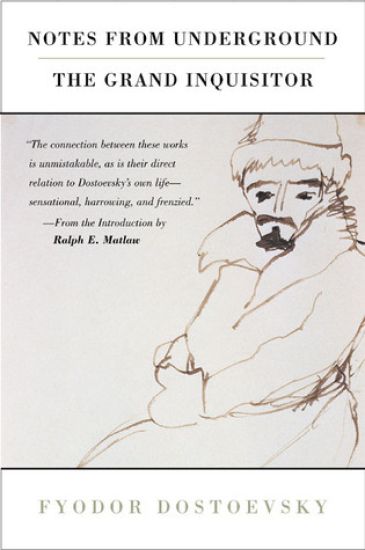
Notes from Underground

Notes from Underground

Fyodor Dostoevsky

WW NORTON CO
2021
nidottu
About Dostoevsky’s Notes from Underground “The novels of Dostoevsky are seething whirlpools, gyrating sandstorms, waterspouts that hiss and boil and suck us in. They are composed purely and wholly of the stuff of the soul. Against our wills we are drawn in, whirled round, blinded, suffocated, and at the same time filled with a giddy rapture. . . . Men are at the same time villains and saints; their acts are at once beautiful and despicable. . . . It is all the same to him whether you are noble or simple, a tramp or a great lady. Whoever you are, you are the vessel of this perplexed liquid, this cloudy, yeasty, precious stuff, the soul.” —Virginia Woolf
Notes from Underground

Notes from Underground

Fyodor Dostoevsky

WW Norton Co
2000
nidottu
"Backgrounds and Sources" includes relevant writings by Dostoevsky, among them "Winter Notes on Summer Impressions," the author’s account of a formative trip to the West. New to the Second Edition are excerpts from V. F. Odoevksy’s "Russian Nights" and I. S. Turgenev’s "Hamlet of Shchigrovsk District." In "Responses", Michael Katz links this seminal novel to the theme of the underground man in six famous works, two of them new to the Second Edition: an excerpt from M. E. Saltykov-Shchedrin’s The Swallows, Woody Allen’s Notes from the Overfed, Robert Walser’s The Child, an excerpt from Ralph Ellison’s The Invisible Man, an excerpt from Yevgeny Zamyatin’s We, and an excerpt from Jean-Paul Sartre’s Erostratus. "Criticism" brings together eleven interpretations by both Russian and Western critics from the nineteenth and twentieth centuries, two of them new to the Second Edition. Included are essays by Nikolai K. Mikhailovsky, Vasily Rozanov, Lev Shestov, M. M. Bakhtin, Ralph E. Matlaw, Victor Erlich, Robert Louis Jackson, Gary Saul Morson, Richard H. Weisberg, Joseph Frank, and Tzvetan Todorov. A Chronology and Selected Bibliography are also included.
Notes From An Odin Actress

Notes From An Odin Actress

Julia Varley

Routledge
2010
sidottu
‘As an actress I sit, speak, run, sweat and, simultaneously, I represent someone who sits, speaks, runs and sweats. As an actress, I am both myself and the character I am playing. I exist in the concreteness of the performance and, at the same time, I need to be alive in the minds and senses of the spectators. How can I speak of this double reality?’ – Julia VarleyThis is a book about the experience of being an actress from a professional and female perspective. Julia Varley has been a member of Odin Teatret for over thirty years, and Notes from an Odin Actress is a personal account of her work with Eugenio Barba and this world-renowned theatre company.This is a unique window onto the in-depth exercises and day-to-day processes of an Odin member. It is a journal to enlighten anyone interested in the performances, the discoveries and the hard physical work that accompany a life in theatre.
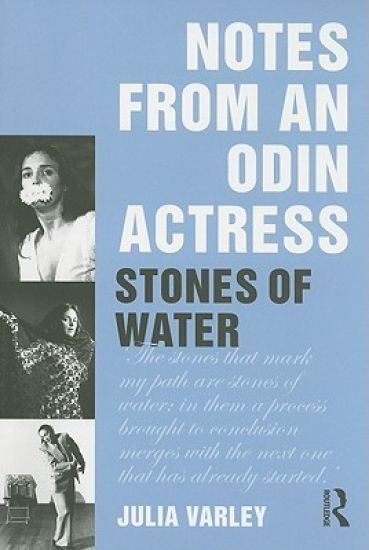
Notes From An Odin Actress

Notes From An Odin Actress

Julia Varley

Routledge
2010
nidottu
‘As an actress I sit, speak, run, sweat and, simultaneously, I represent someone who sits, speaks, runs and sweats. As an actress, I am both myself and the character I am playing. I exist in the concreteness of the performance and, at the same time, I need to be alive in the minds and senses of the spectators. How can I speak of this double reality?’ – Julia VarleyThis is a book about the experience of being an actress from a professional and female perspective. Julia Varley has been a member of Odin Teatret for over thirty years, and Notes from an Odin Actress is a personal account of her work with Eugenio Barba and this world-renowned theatre company.This is a unique window onto the in-depth exercises and day-to-day processes of an Odin member. It is a journal to enlighten anyone interested in the performances, the discoveries and the hard physical work that accompany a life in theatre.
Notes For The Nile

Notes For The Nile

Hardwicke D. Rawnsley

Routledge
2012
nidottu
First published in 2006. This delightful book written in 1892 by a founder of the National Trust is regarded as a classic of high Victorian travel writing. After three journeys to the East, Rawnsley decided that existing guide-books were not sufficiently explicit and set out to write this witty and informative account that reflects a highly likeable character to whom it is impossible not to warm. Beginning with observations such as ‘everything can be got in Cairo except good English tea’ and ‘never expect your guide to know anything about Egyptian history or the monuments up the Nile’, Rawnsley sets off to show us the best of Egypt during a golden age of exploration and touring, he visits the two egyptologists to whom he dedicates this book, joining Flinders Petrie at the Medum pyramid to observe the excavations, and talking to Emile Brugsch about the royal mummies which had been brought from their tombs to the Cairo Museum just a few years previously. In the ruins of Thebes and Luxor he is struck by what he calls ‘the silence of the dead’ which he contrasts with the obvious love of the ancient Egyptians for music, as shown in their art and in the many hymns preserved in papyri. Although the music itself has been lost, it seemed a pity to Rawnsley that the hymns, dirges, poems and wise sayings should remain unknown to the general reader because of their unmusical form. He presents a number of them here, translated and rendered into metre, a unique contribution that greatly enhances the enjoyment of Egypt at first hand or at a distance. The work concludes with what Rawnsley considers to be its most important part – the timeless wisdom embodied in the sayings of Ptah-hotep taken from the Prisse papyrus.
Notes on a Killing: Love, Lies, and Murder in a Small New Hampshire Town
Their friendship would kill her... Weaver and fiber artist Edith "Pen" Meyer knew her friend Sandy Merritt's relationship with a married man was wrong. She had even urged Sandy to take out a restraining order against Kenneth Carpenter. Which was why her call to Sandy on February 23, 2005, seemed to come from out of the blue. During it, she told Sandy to drop the restraining order and get back together with Ken. Pen was never seen again. One man stood to gain from Pen's disappearance: Ken Carpenter. But evidence was bleak: no blood, no DNA, no body. Until detectives found notes hidden beneath a leather chair that turned out to be a playbook for murder... INCLUDES PHOTOS
Notes from the Midnight Driver

Notes from the Midnight Driver

Jordan Sonnenblick

Scholastic Paperbacks
2007
nidottu
Just when you thought you had it all figured out . . ."Alex Peter Gregory, you are a moron " Laurie slammed her palms down on my desk and stomped her foot. I get a lot of that.One car crash.One measly little car crash. And suddenly, I'm some kind of convicted felon.My parents are getting divorced, my dad is shacking up with my third-grade teacher, I might be in love with a girl who could kill me with one finger, and now I'm sentenced to babysit some insane old guy.What else could possibly go wrong?This is the story of Alex Gregory, his guitar, his best gal pal Laurie, and the friendship of a lifetime that he never would have expected.
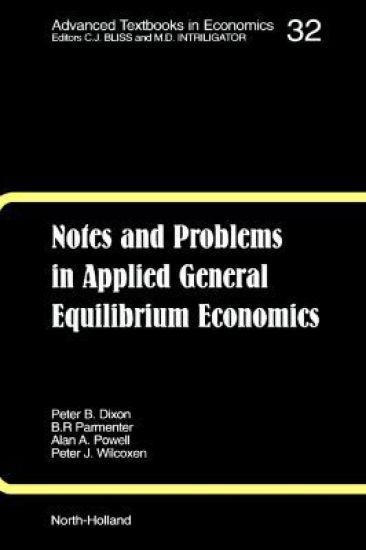
Notes and Problems in Applied General Equilibrium Economics
"General-equilibrium" refers to an analytical approach which looks at the economy as a complete system of inter-dependent components (industries, households, investors, governments, importers and exporters). "Applied" means that the primary interest is in systems that can be used to provide quantitative analysis of economic policy problems in particular countries. Reflecting the authors' belief in the models as vehicles for practical policy analysis, a considerable amount of material on data and solution techniques as well as on theoretical structures has been included. The sequence of chapters follows what is seen as the historical development of the subject.The book is directed at graduate students and professional economists who may have an interest in constructing or applying general equilibrium models. The exercises and readings in the book provide a comprehensive introduction to applied general equilibrium modeling. To enable the reader to acquire hands-on experience with computer implementations of the models which are described in the book, a companion set of diskettes is available.
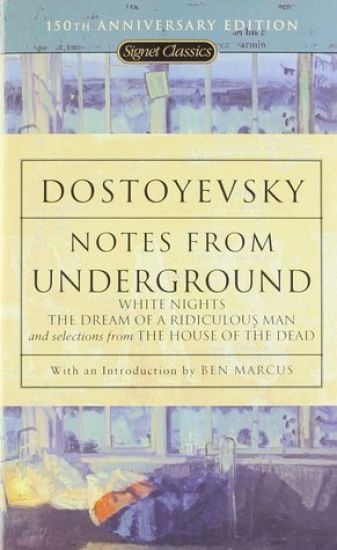
Notes From Underground, White Nights, The Dream Of A Ridiculous Man And House Of The Dead
A collection of powerful stories by one of the masters of Russian literature, illustrating Fyodor Dostoyevsky's thoughts on political philosophy, religion and above all, humanity. From the primitive peasant who kills without understanding that he is destroying a human life, to the anxious antihero of Notes From Underground--a man who both craves and despises affection--this volume and its often-tormented characters showcase Dostoyevsky's evolving outlook on man's fate. The compelling works presented here were written at distinct periods in the author's life, at decisive moments in his groping for a political philosophy and a religious answer. Thomas Mann described Dostoyevsky as "an author whose Christian sympathy is ordinarily devoted to human misery, sin, vice, the depths of lust and crime, rather than to nobility of body and soul"--and Notes From Underground as "an awe-and-terror-inspiring example of this sympathy." Translated and with an Afterword by Andrew R. MacAndrew With an Introduction by Ben Marcus
Notes on Feline Internal Medicine

Notes on Feline Internal Medicine

Kit Sturgess

John Wiley Sons Inc
2013
nidottu
feline internal medicine Helping you get started with a problem-solving approach to a sick cat. feline internal medicine kit sturgess Notes on Feline Internal Medicine, second edition, is part of a popular series specifically designed, through an accessible note-based style, to ensure veterinarians and students have quick and easy access to comprehensive and practical clinical and diagnostic information. Distinct differences exist between cats and dogs not only in their physiology and metabolism but also in the way disease tends to present. This book is a short ‘pocket guide’ to feline internal medicine helping you to formulate a diagnostic plan and therapeutic strategy. The focus is on evidence-based medicine where available, otherwise current best-practice is presented. The book is divided into five sections: Section 1 gives an overview of some key areas of feline medicine including paediatric and geriatric medicine.Section 2 focuses on the approach to common presenting signs.Section 3 covers the differential diagnosis of commonly used haematologic and biochemical parameters.Section 4 presents an organ-system based approach.Section 5 covers feline infectious diseases. CHANGES FOR THIS EDITION Stronger focus is placed on initial testing for a disease, and what changes might be expected.Additional sections have been added on sedation and anaesthesia, health screening, oncology and emergency and critical care.More diagrams have been added to aid understanding.Care has been taken to avoid repetition and focus on common conditions.
Notes on Fermat's Last Theorem

Notes on Fermat's Last Theorem

Alfred J. van der Poorten

John Wiley Sons Inc
1996
sidottu
Around 1637, the French jurist Pierre de Fermat scribbled in the margin of his copy of the book Arithmetica what came to be known as Fermat's Last Theorem, the most famous question in mathematical history. Stating that it is impossible to split a cube into two cubes, or a fourth power into two fourth powers, or any higher power into two like powers, but not leaving behind the marvelous proof he claimed to have had, Fermat prompted three and a half centuries of mathematical inquiry which culminated only recently with the proof of the theorem by Andrew Wiles. This book offers the first serious treatment of Fermat's Last Theorem since Wiles's proof. It is based on a series of lectures given by the author to celebrate Wiles's achievement, with each chapter explaining a separate area of number theory as it pertains to Fermat's Last Theorem. Together, they provide a concise history of the theorem as well as a brief discussion of Wiles's proof and its implications. Requiring little more than one year of university mathematics and some interest in formulas, this overview provides many useful tips and cites numerous references for those who desire more mathematical detail. The book's most distinctive feature is its easy-to-read, humorous style, complete with examples, anecdotes, and some of the lesser-known mathematics underlying the newly discovered proof. In the author's own words, the book deals with "serious mathematics without being too serious about it." Alf van der Poorten demystifies mathematical research, offers an intuitive approach to the subject—loosely suggesting various definitions and unexplained facts—and invites the reader to fill in the missing links in some of the mathematical claims. Entertaining, controversial, even outrageous, this book not only tells us why, in all likelihood, Fermat did not have the proof for his last theorem, it also takes us through historical attempts to crack the theorem, the prizes that were offered along the way, and the consequent motivation for the development of other areas of mathematics. Notes on Fermat's Last Theorem is invaluable for students of mathematics, and of real interest to those in the physical sciences, engineering, and computer sciences—indeed for anyone who craves a glimpse at this fascinating piece of mathematical history. An exciting introduction to modern number theory as reflected by the history of Fermat's Last Theorem This book displays the unique talents of author Alf van der Poorten in mathematical exposition for mathematicians. Here, mathematics' most famous question and the ideas underlying its recent solution are presented in a way that appeals to the imagination and leads the reader through related areas of number theory. The first book to focus on Fermat's Last Theorem since Andrew Wiles presented his celebrated proof, Notes on Fermat's Last Theorem surveys 350 years of mathematical history in an amusing and intriguing collection of tidbits, anecdotes, footnotes, exercises, references, illustrations, and more. Proving that mathematics can make for lively reading as well as intriguing thought, this thoroughly accessible treatment Helps students and professionals develop a background in number theory and provides introductions to the various fields of theory that are touched upon *Offers insight into the exciting world of mathematical research *Covers a number of areas appropriate for classroom use *Assumes only one year of university mathematics background even for the more advanced topics *Explains why Fermat surely did not have the proof to his theorem *Examines the efforts of mathematicians over the centuries to solve the problem *Shows how the pursuit of the theorem contributed to the greater development of mathematics
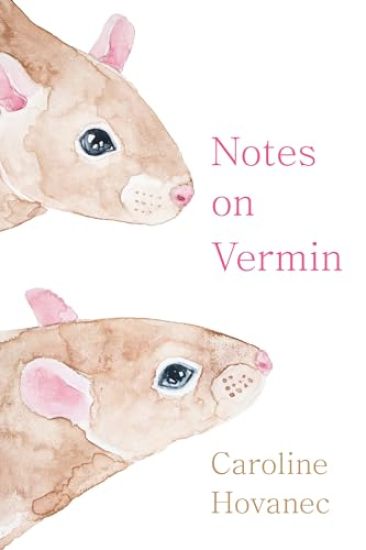
Notes on Vermin

Notes on Vermin

Caroline Hovanec

THE UNIVERSITY OF MICHIGAN PRESS
2025
nidottu
Vermin—rats, cockroaches, pigeons, mosquitoes, and other pests—are, to most people, objects of disgust. And vermin metaphors, likening human beings to these loathed creatures, appear in the ugliest forms of political rhetoric. Indeed, vermin imagery has often been used to denigrate poor, foreign, or racialized people. Yet many writers have reclaimed vermin, giving new meaning to creeping rodents, swarming insects, and wriggling worms. Notes on Vermin is an atlas of the literary vermin that appear in modern and contemporary literature, from Franz Kafka’s gigantic insect to Richard Wright’s city rats to Namwali Serpell’s storytelling mosquitoes. As parasites, trespassers, and collectives, vermin animals prove useful to writers who seek to represent life in the margins of power. Drawing on psychoanalysis, cultural studies, eco-Marxism, and biopolitics, this book explores four uses for literary vermin: as figures for the repressed thought, the uncommitted fugitive, the freeloading parasite, and the surplus life. In a series of short, accessible, interlinked essays, Notes on Vermin explores what animal pests can show us about our cultures, our environments, and ourselves.
Notes from the North Country

Notes from the North Country

THE UNIVERSITY OF MICHIGAN PRESS
1983
nidottu
In Notes from the North Country, O. B. Eustis observes and records the seasonal changes of the north country from his home in northern Michigan. Each observation in his year-long diary reflects a special insight about nature. He writes about those he has come to know so well-the deer and duck, mink and skunk, sparrow and chickadee. He writes about pussy willows, Juneberries, lilacs, and goldenrod; and he writes about winter's hardship, spring's blooming, summer's storms, and fall's first snow¬-truly a love affair with nature.
Notes on Vermin

Notes on Vermin

Caroline Hovanec

THE UNIVERSITY OF MICHIGAN PRESS
2025
sidottu
Vermin—rats, cockroaches, pigeons, mosquitoes, and other pests—are, to most people, objects of disgust. And vermin metaphors, likening human beings to these loathed creatures, appear in the ugliest forms of political rhetoric. Indeed, vermin imagery has often been used to denigrate poor, foreign, or racialized people. Yet many writers have reclaimed vermin, giving new meaning to creeping rodents, swarming insects, and wriggling worms. Notes on Vermin is an atlas of the literary vermin that appear in modern and contemporary literature, from Franz Kafka’s gigantic insect to Richard Wright’s city rats to Namwali Serpell’s storytelling mosquitoes. As parasites, trespassers, and collectives, vermin animals prove useful to writers who seek to represent life in the margins of power. Drawing on psychoanalysis, cultural studies, eco-Marxism, and biopolitics, this book explores four uses for literary vermin: as figures for the repressed thought, the uncommitted fugitive, the freeloading parasite, and the surplus life. In a series of short, accessible, interlinked essays, Notes on Vermin explores what animal pests can show us about our cultures, our environments, and ourselves.
Notes on Nursing

Notes on Nursing

Florence Nightingale

Dover Publications Inc.
2000
nidottu
Outspoken writings by the founder of modern nursing record fundamentals in the needs of the sick that must be provided in all nursing. Covers such timeless topics as ventilation, noise, food, bed and bedding, light, cleanliness, and observation of the sick. "Still the finest book on nursing." — Co-Evolution Quarterly.
Notes from the Underground

Notes from the Underground

Fyodor Dostoyevsky

Dover Publications Inc.
2000
nidottu
Darkly fascinating short novel depicts the struggles of a doubting, supremely alienated protagonist in a world of relative values. Seminal work introduced moral, religious, political and social themes that dominated Dostoyevsky's later masterworks. Constance Garnett's authoritative translation is reprinted here, with a new introduction.
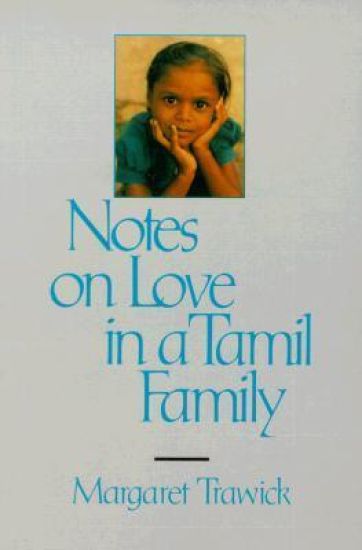
Notes on Love in a Tamil Family

Notes on Love in a Tamil Family

Margaret Trawick

University of California Press
1992
pokkari
Love, as a force in human affairs, is still not given much attention or credency by social scientists. With Notes on Love in a Tamil Family, Margaret Trawick places the notion of love prominently in social scientific discourse. Her unforgettable and profusely illustrated study is a significant contribution to anthropology and to South Asian studies. Trawick lived for a time in the midst of one large South Indian family and sought to understand the multiple and mutually shared expressions of anpu--what in English we call love. Often enveloping the author herself, changing her as she inevitably changed her hosts, this family performed before the young anthropologist's eyes the meaning of anpu: through poetry and conversation, through the not always gentle raising of children, through the weaving of kinship tapestries, through erotic exchanges among women, among men, and across the great sexual boundary. She communicates with grace and insight what she learned from this Tamil family, and we discover that love is no less universal than selfishness and individualism.