Kirjojen hintavertailu. Mukana 11 342 296 kirjaa ja 12 kauppaa.

Kirjahaku

Etsi kirjoja tekijän nimen, kirjan nimen tai ISBN:n perusteella.

1000 tulosta hakusanalla Robert Cornforth

Robert Musil's 'The Man Without Qualities'

Robert Musil's 'The Man Without Qualities'

Payne Philip

Cambridge University Press
1988
sidottu
Robert Musil's The Man without Qualities is perhaps the most important novel in German written in the twentieth century - certainly it is among the most brilliant, puzzling and profound. This, the first comprehensive study of the work to appear in English, guides the reader towards Musil's central concerns. It examines how Musil laboured through draft after draft to produce material that would pass his own strict literary 'quality control' and traces major themes through different layers of narrative with the aid of close textual analysis. It details how Musil subjects leading figures of fin-de-siecle Vienna to intense ironic scrutiny and how, by drawing on his extensive knowledge of philosophy, psychology, politics, sociology and science, he works into his novel essayistic statements which record the state of contemporary European civilisation. Through a disturbing and deeply serious liaison with his sister, Musil's hero Ulrich, is shown to struggle through to the brink of self-discovery and enlightenment.
Robert Lowell

Robert Lowell

Cambridge University Press
1989
pokkari
Robert Lowell is one of the most widely recognised and influential poets of the second half of this century. Yet his career is problematical and raises many questions about direction and quality, particularly in light of his repeated reorientation of thematic concern and poetic technique. Many previous studies of the poet have accounted for these radical differences in Lowell’s work by examining the poet’s private life, but this collection of essays attempts to reassess Lowell’s poetry and to restimulate critical thinking about it by focusing on his texts to raise new questions and discussions about the work. The twelve essays in this volume, by many of the most distinguished scholars in the field, offer a chronological review of Robert Lowell’s career as a poet. The book includes pieces on major works such as Lord Weary’s Castle, Life Studies, For the Union Dead, ‘Skunk Hour’, Notebook, the sonnets of 1969–73 as well as four essays devoted to Lowell’s last complete and often neglected work, Day by Day. Employing a variety of methodologies, the essays arrive at innovative and, often, controversial interpretations of Lowell’s poems.
Robert South (1634–1716)

Robert South (1634–1716)

Gerard Reedy

Cambridge University Press
1992
sidottu
Robert South (1634–1716) was one of the great Anglican writers and preachers of his age. A contemporary of Dryden and Locke, he faced the profound political and philosophical changes taking place at the beginning of the Enlightenment in England. With the interdependence of Church and State forcing a conjunction of religious and political issues, South's life and work as a preacher show him reacting to changes in civil and ecclesiastical polity over the course of his active public life. Gerard Reedy’s book, the first major study of South, makes a strong case for the importance of his sermons, their complexity, beauty and wit, and their place in the history of post-Restoration English literature. Discussing sermons of South which deal with his theory of politics, language, the sacrament and mystery, Reedy reintroduces us to a lively and seminal master of prose, politics and theology in the late Stuart era.
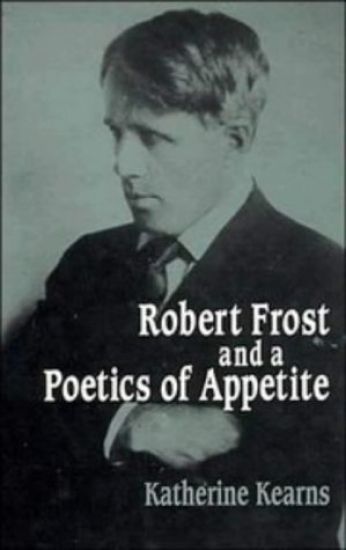
Robert Frost and a Poetics of Appetite

Robert Frost and a Poetics of Appetite

Katherine Kearns

Cambridge University Press
1994
sidottu
Robert Frost and a Poetics of Appetite reads Frost's poetry within a theoretical perspective generated, but not limited by feminist analysis, and it evaluates Frost's persistent feminising of poetic language in ways that he typically dramatises as both erotic and humiliating. Kearns examines how Frost's dual and potentially conflicting obligations - to be manly and to be a poet - inform his entire poetics. Rather than approaching Frost's poetry with the methods and assumptions of deconstruction in mind, this book finds that Frost himself forces a deconstructive reading: his unstable ironies, his complexities and his manipulations of form are designed precisely to produce the conviction that any suggestion of significance is arbitrary and personal. The study unites biography, psychology and feminism in creating an adept and imaginative instrument of interpretation.
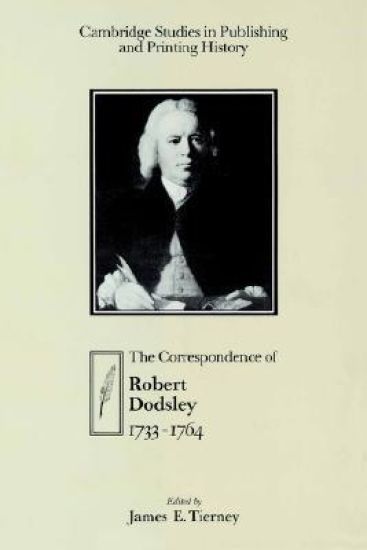
The Correspondence of Robert Dodsley

The Correspondence of Robert Dodsley

Robert Dodsley

Cambridge University Press
2004
pokkari
The Correspondence of Robert Dodsley 1733–1764 brings to light much previously unpublished detail for the study of eighteenth-century British literary and publishing history. It is a fully annotated edition of letters exchanged between Robert Dodsley - London’s leading literary publisher of the mid eighteenth century - and his authors, members of the book trade, and friends. Numbering about four hundred pieces, the correspondence reflects the publisher’s relations with such people as Edmund Burke, the 4th Earl of Chesterfield, David Garrick, Thomas Gray, David Hume, Samuel Johnson, Laurence Sterne, and Horace Walpole. A lengthy introduction provides an account of Dodsley’s publishing career, including his negotiations with authors and other publishers, and offers many insights into the technical and financial operation of the contemporary book trade.
Robert Boyle and the Limits of Reason

Robert Boyle and the Limits of Reason

Jan W. Wojcik

Cambridge University Press
2002
pokkari
In this study of Robert Boyle's epistemology, Jan W. Wojcik reveals the theological context within which Boyle developed his views on reason's limits. After arguing that a correct interpretation of his views on 'things above reason' depends upon reading his works in the context of theological controversies in seventeenth-century England, Professor Wojcik details exactly how Boyle's three specific categories of things which transcend reason - the incomprehensible, the inexplicable, and the unsociable - affected his conception of what a natural philosopher could hope to know. Also covered in detail is Boyle's belief that God had deliberately limited the human intellect in order to reserve a full knowledge of both theology and natural philosophy for the afterlife.
Robert Boyle and the Limits of Reason

Robert Boyle and the Limits of Reason

Jan W. Wojcik

Cambridge University Press
1997
sidottu
In this study of Robert Boyle's epistemology, Jan W. Wojcik reveals the theological context within which Boyle developed his views on reason's limits. After arguing that a correct interpretation of his views on 'things above reason' depends upon reading his works in the context of theological controversies in seventeenth-century England, Professor Wojcik details exactly how Boyle's three specific categories of things which transcend reason - the incomprehensible, the inexplicable, and the unsociable - affected his conception of what a natural philosopher could hope to know. Also covered in detail is Boyle's belief that God had deliberately limited the human intellect in order to reserve a full knowledge of both theology and natural philosophy for the afterlife.
Robert Boyle: A Free Enquiry into the Vulgarly Received Notion of Nature
In this book, published in 1686, the scientist Robert Boyle (1627–91) attacked prevailing notions of the natural world which depicted 'Nature' as a wise, benevolent and purposeful being. Boyle, one of the leading mechanical philosophers of his day, believed that the world was best understood as a vast, impersonal machine, fashioned by an infinite, personal God. In this cogent treatise, he drew on his scientific findings, his knowledge of contemporary medicine and his deep reflection on theological and philosophical issues, arguing that it was inappropriate both theologically and scientifically to speak of Nature as if it had a mind of its own: instead, the only true efficient causes of things were the properties and powers given to matter by God. As such, A Free Enquiry into the Vulgarly Received Notion of Nature represents one of the subtlest statements concerning the philosophical issues raised by the mechanical philosophy to emerge from the period of the scientific revolution.
Robert Boyle: A Free Enquiry into the Vulgarly Received Notion of Nature
In this book, published in 1686, the scientist Robert Boyle (1627–91) attacked prevailing notions of the natural world which depicted ‘Nature’ as a wise, benevolent and purposeful being. Boyle, one of the leading mechanical philosophers of his day, believed that the world was best understood as a vast, impersonal machine, fashioned by an infinite, personal God. In this cogent treatise, he drew on his scientific findings, his knowledge of contemporary medicine and his deep reflection on theological and philosophical issues, arguing that it was inappropriate both theologically and scientifically to speak of Nature as if it had a mind of its own: instead, the only true efficient causes of things were the properties and powers given to matter by God. As such, A Free Enquiry into the Vulgarly Received Notion of Nature represents one of the subtlest statements concerning the philosophical issues raised by the mechanical philosophy to emerge from the period of the scientific revolution.
Robert Maillart: Builder, Designer, and Artist

Robert Maillart: Builder, Designer, and Artist

David P. Billington

Cambridge University Press
1997
sidottu
This comprehensive biography traces the life and works of Robert Maillart, one of the most important engineers and designers of the twentieth century. His career developed around a central issue of modern technological society: the debate between two antithetical views of engineering opposing applied science, which relied on general mathematical theories for understanding structures against design, which Maillart championed. Maillart considered structures not merely works of utility but also as works of art. As utilitarian objects, he created a series of innovations of lasting significance. Aesthetically, Maillart shaped his three innovations in concrete to create surprising and often stunning new forms. Providing an analysis of these innovations, this biography also connects Maillart’s aesthetic ideas with the private and professional context in which he worked.
The Narrative of Robert Adams, A Barbary Captive

The Narrative of Robert Adams, A Barbary Captive

Robert Adams

Cambridge University Press
2005
pokkari
First published in London in 1816, The Narrative of Robert Adams is an account of the adventures of Robert Adams, an African American seaman who survives shipwreck, slavery, and brutal efforts to convert him to Islam, before being ransomed to the British consul. In London, Adams is discovered by the Company of Merchants Trading which publishes his story, into which Adams inserts a fantastical account of a trip to Timbuctoo. Adams's story is accompanied by contemporary essays and notes that place his experience in the context of European exploration of Africa at the time, and weigh his credibility against other contemporary accounts. Professor Adams's introduction examines Adams's credibility in light of modern knowledge of Africa and discusses the significance of his story in relation to the early nineteenth century interest in Timbuctoo, and to the literary genres of the slave narrative and the Barbary Captivity narrative.
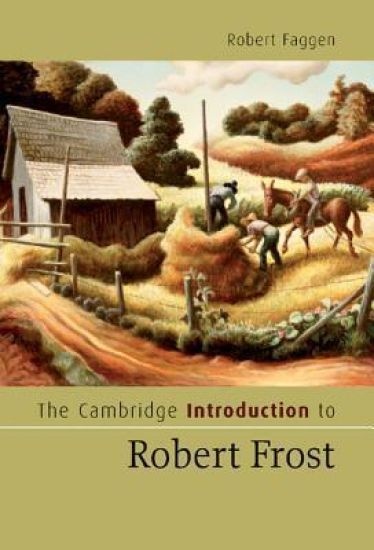
The Cambridge Introduction to Robert Frost

The Cambridge Introduction to Robert Frost

Robert Faggen

Cambridge University Press
2008
pokkari
Robert Frost is one of the most popular American poets and remains widely read. His work is deceptively simple, but reveals its complexities upon close reading. This Introduction provides a comprehensive but intensive look at his remarkable oeuvre. The poetry is discussed in detail in relation to ancient and modern traditions as well as to Frost's particular interests in language and sound, metaphor, science, religion, and politics. Faggen both looks back to the literary traditions that shape Frost's use of form and language, and forward to examine his influence on poets writing today. The recent controversies in Frost criticism and in particular in Frost biography are brought into sharp focus as they have shaped the poet's legacy and legend. The most accessible overview available, this book will be invaluable to students, readers and admirers of Frost.
Robert Nozick

Robert Nozick

Cambridge University Press
2002
sidottu
This is a 2002 introductory volume to Robert Nozick, one of the dominant philosophical thinkers of the current age. It is part of a new series, Contemporary Philosophy in Focus. Each volume in the series will consist of newly commissioned essays that will cover all the major contributions of a preeminent philosopher in a systematic and accessible manner. Robert Nozick is one of the most creative and individual philosophical voices of the last 25 years. His most famous book, Anarchy, State and Utopia (1974), presents the classic defense of the libertarian view that only a minimal state is just. Nozick has also made significant contributions in later publications to such areas as rational choice theory, ethics, epistemology and philosophy of mind. Outside philosophy the book will be of particular interest to professionals and students in political science, law, economics, sociology and psychology.
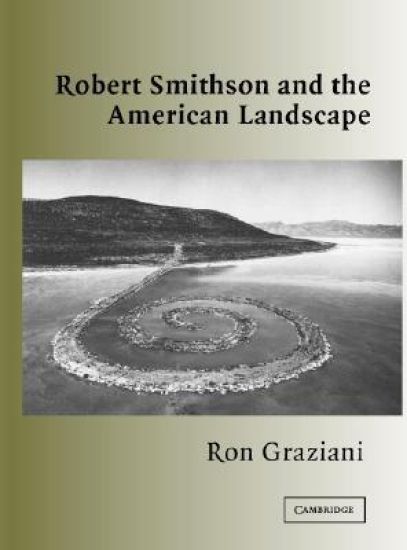
Robert Smithson and the American Landscape

Robert Smithson and the American Landscape

Ron Graziani

Cambridge University Press
2004
sidottu
Robert Smithson and the American Landscape is a social history of the artist’s earthworks and their critical reception. Providing a close analysis of Smithson’s own writings and art works, Ron Graziani demonstrates how his earthworks were part of an aesthetic and civic fault line that ruptured in the 1960s. Smithson’s humanized environments were a powerful indictment of modernist sense of art and nature. Moreover, Graziani shows how Smithson’s earthworks formed part of what was called the ‘new conservationism’ in the late 1960s and how they gave material form to the contradictions of a sociological issue that was inseparable from its economic legacy.
The Narrative of Robert Adams, A Barbary Captive

The Narrative of Robert Adams, A Barbary Captive

Robert Adams

Cambridge University Press
2005
sidottu
First published in London in 1816, The Narrative of Robert Adams is an account of the adventures of Robert Adams, an African American seaman who survives shipwreck, slavery, and brutal efforts to convert him to Islam, before being ransomed to the British consul. In London, Adams is discovered by the Company of Merchants Trading which publishes his story, into which Adams inserts a fantastical account of a trip to Timbuctoo. Adams's story is accompanied by contemporary essays and notes that place his experience in the context of European exploration of Africa at the time, and weigh his credibility against other contemporary accounts. Professor Adams's introduction examines Adams's credibility in light of modern knowledge of Africa and discusses the significance of his story in relation to the early nineteenth century interest in Timbuctoo, and to the literary genres of the slave narrative and the Barbary Captivity narrative.
The Cambridge Introduction to Robert Frost

The Cambridge Introduction to Robert Frost

Robert Faggen

Cambridge University Press
2008
sidottu
Robert Frost is one of the most popular American poets and remains widely read. His work is deceptively simple, but reveals its complexities upon close reading. This Introduction provides a comprehensive but intensive look at his remarkable oeuvre. The poetry is discussed in detail in relation to ancient and modern traditions as well as to Frost's particular interests in language and sound, metaphor, science, religion, and politics. Faggen both looks back to the literary traditions that shape Frost's use of form and language, and forward to examine his influence on poets writing today. The recent controversies in Frost criticism and in particular in Frost biography are brought into sharp focus as they have shaped the poet's legacy and legend. The most accessible overview available, this book will be invaluable to students, readers and admirers of Frost.
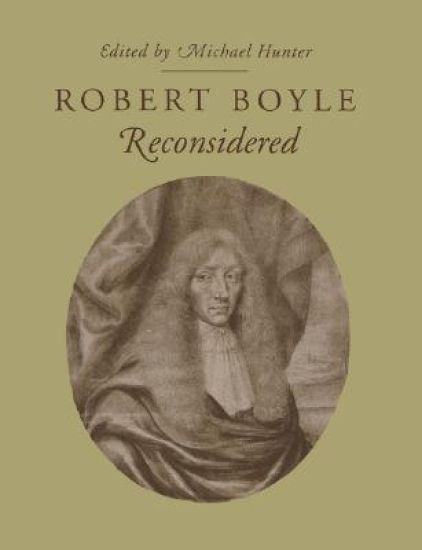
Robert Boyle Reconsidered

Robert Boyle Reconsidered

Cambridge University Press
2003
pokkari
This book presents a new view of Robert Boyle (1627–91), the leading British scientist in the generation before Newton. It comprises a series of essays by scholars from Europe and North America which scrutinise Boyle’s writings on science, philosophy and theology in detail, bringing out the subtlety of his ideas and the complexity of his relationship with his context. Particular attention is given to Boyle’s interest in alchemy and to other facets of his ideas which might initially seen surprising in a leading advocate of the mechanical philosophy. Many of the essays use material from among Boyle’s extensive manuscripts, which have recently been catalogued for the first time. The introduction surveys the state of Boyle studies and deploys the findings of the essays to offer a revaluation of Boyle. The book also includes a bibliography of writings on Boyle since 1940.
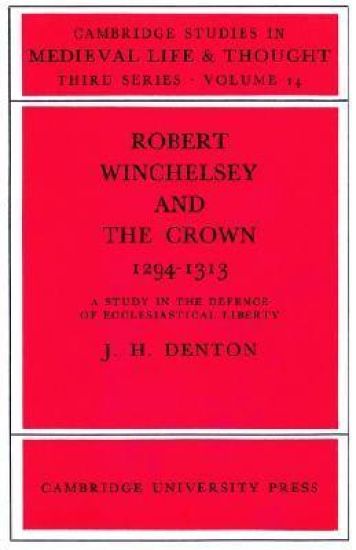
Robert Winchelsey and the Crown 1294–1313

Robert Winchelsey and the Crown 1294–1313

Jeffrey H. Denton

Cambridge University Press
2002
pokkari
This is the first detailed study of the career of one of the most important medieval archbishops of Canterbury. Robert Winchelsey sought to defend ecclesiastical rights and liberties at a time when the English Church was under constant pressure from the king and his government, and he suffered suspension from office as a result of his opposition to Edward I. The theme of the book is the relationship of this learned and saintly archbishop with the Crown during the last troubled years of Edward I’s reign and the first equally troubled years of Edward II’s reign.
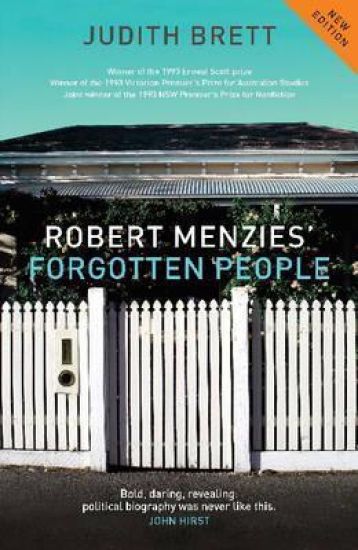
Robert Menzies' Forgotten People

Robert Menzies' Forgotten People

Judith Brett

MELBOURNE UNIVERSITY PRESS
2007
pokkari
In 1941, RG Menzies delivered to war-time Australia what was to be his richest, most creative speech, and one of his most influential. ""The Forgotten People"" was a direct address to the Australian middle class, the 'people' who would return him to power in 1949 and keep him there until his retirement in 1966. Who were these 'forgotten people'? The middle class pitting their values of hard work and independence against the collectivist ethos of labour? Women, shunning the class-based politics of men? The parents of Menzies' childhood in the small country town of Jeparit? And how did this relate to his fervently held belief in his status as a Briton, the boundaries of which nation were 'not on the Kentish Coast but at Cape York and Invercargill'? Judith Brett deftly traces the links between the private and public meanings of Menzies' political career. Taking us deep into both the man and the culture he represented and well beyond the restraints of conventional biography, Brett, reveals the ambivalence that lay at the heart of the Australian self-image. This is absorbing and essential reading for an understanding of the Australia that produced a Menzies - and of a prime minister who, whether loved or hated, shaped the way we imagined ourselves in the postwar world.
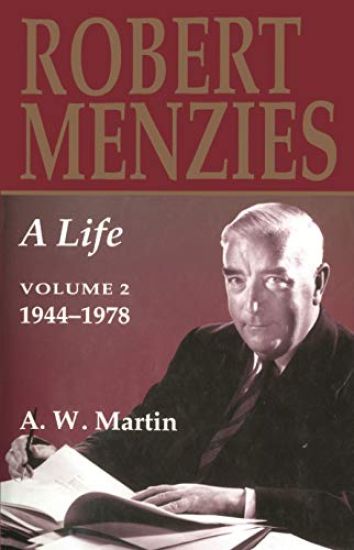
Robert Menzies, a Life

Robert Menzies, a Life

A.W. Martin

Melbourne University Press
1999
nidottu
For each new generation of Australians, the name Robert Gordon Menzies resounds across the political landscape. No other federal politican this century can match his record period as Prime Minister, from 1949 to 1966. Not one of us is untouched by his life and work. This long-awaited second volume of Allan Martin's unrivaled biography describes and analyses the flowering of policies and practices foretold in the first. Beginning with the birth of the Liberal Party at the end of World War II, it is the first detailed study of Menzies' climb to power and of his post-war strategies for the country and the world. It ends with his death in 1978, mourned by many as an irreplaceable leader and father figure. The tumultuous years of the 1950s were echoed in Menzies' own life. His political acumen built on universal Cold War fears, and his anti-communist campaigns brought him into bitter conflict with H. V. Evatt. Menzies' frequent trips to the United States and Great Britain, usually by sea and invariably in time for the Test cricket, fuelled accusations of absenteeism. Menzies' lifelong devotion to all things British, most notably the monarchy, was rewarded towards the end of his life by investiture as a Knight of the Thistle and by his succeeding Winston Churchill as Lord Warden of the Cinque Ports. The personal pleasure derived from his growing international stature cushioned to some degree his fall from power in domestic politics. This volume completes a monumental contribution to Australian political biography. For both scholars and ordinary Australians, Allan Martin has sought to chronicle Menzies' life and to judge what kind of a man he was and what sort of prime ministerial life he led.