Kirjojen hintavertailu. Mukana 11 239 951 kirjaa ja 12 kauppaa.

Kirjahaku

Etsi kirjoja tekijän nimen, kirjan nimen tai ISBN:n perusteella.

1000 tulosta hakusanalla Roderic Grigson

Unto the Right Honourable the Lords of Council and Session, the Petition of Mrs Florence Macleod, Spouse to Roderick Macdonald Tacksman of Sandaig, and the Said Roderick Macdonald, for his Interest,
The 18th century was a wealth of knowledge, exploration and rapidly growing technology and expanding record-keeping made possible by advances in the printing press. In its determination to preserve the century of revolution, Gale initiated a revolution of its own: digitization of epic proportions to preserve these invaluable works in the largest archive of its kind. Now for the first time these high-quality digital copies of original 18th century manuscripts are available in print, making them highly accessible to libraries, undergraduate students, and independent scholars.This collection reveals the history of English common law and Empire law in a vastly changing world of British expansion. Dominating the legal field is the Commentaries of the Law of England by Sir William Blackstone, which first appeared in 1765. Reference works such as almanacs and catalogues continue to educate us by revealing the day-to-day workings of society.++++The below data was compiled from various identification fields in the bibliographic record of this title. This data is provided as an additional tool in helping to insure edition identification: ++++Bodleian Library (Oxford)T211669Dated at head of the drop-head title: July 13. 1768. Edinburgh, 1768]. 23, 1]p.; 4

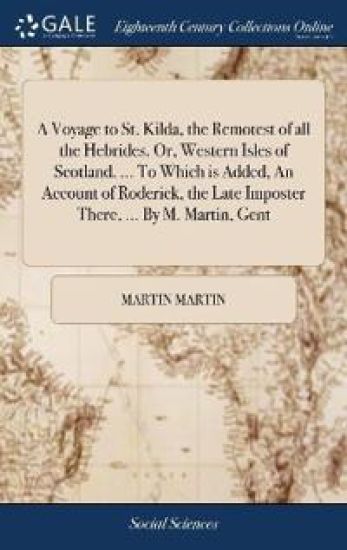
A Voyage to St. Kilda, the Remotest of all the Hebrides. Or, Western Isles of Scotland. ... To Which is Added, An Account of Roderick, the Late Imposter There, ... By M. Martin, Gent
The 18th century was a wealth of knowledge, exploration and rapidly growing technology and expanding record-keeping made possible by advances in the printing press. In its determination to preserve the century of revolution, Gale initiated a revolution of its own: digitization of epic proportions to preserve these invaluable works in the largest archive of its kind. Now for the first time these high-quality digital copies of original 18th century manuscripts are available in print, making them highly accessible to libraries, undergraduate students, and independent scholars.Delve into what it was like to live during the eighteenth century by reading the first-hand accounts of everyday people, including city dwellers and farmers, businessmen and bankers, artisans and merchants, artists and their patrons, politicians and their constituents. Original texts make the American, French, and Industrial revolutions vividly contemporary.++++The below data was compiled from various identification fields in the bibliographic record of this title. This data is provided as an additional tool in helping to insure edition identification: ++++Bodleian Library (Oxford)T152363London: printed for R. Griffith, 1749. 2],82p.; 8
Information for Henry Davidson of Tulloch, Against Alexander M'Kenzie, Late of the Stamp-office, London, one of the Tutors of Sir Hector M'Kenzie of Gairloch, Kenneth M'Kenzie, Uncle by the Father's Side, Roderick M'Kenzie of Red-castle
The 18th century was a wealth of knowledge, exploration and rapidly growing technology and expanding record-keeping made possible by advances in the printing press. In its determination to preserve the century of revolution, Gale initiated a revolution of its own: digitization of epic proportions to preserve these invaluable works in the largest archive of its kind. Now for the first time these high-quality digital copies of original 18th century manuscripts are available in print, making them highly accessible to libraries, undergraduate students, and independent scholars.This collection reveals the history of English common law and Empire law in a vastly changing world of British expansion. Dominating the legal field is the Commentaries of the Law of England by Sir William Blackstone, which first appeared in 1765. Reference works such as almanacs and catalogues continue to educate us by revealing the day-to-day workings of society.++++The below data was compiled from various identification fields in the bibliographic record of this title. This data is provided as an additional tool in helping to insure edition identification: ++++Bodleian Library (Oxford)T213015Dated at head of the drop-head title: October 18. 1771. Edinburgh, 1771]. 28p.; 4
Forgotten Voices of the Secret War

Forgotten Voices of the Secret War

Roderick Bailey

Ebury Press
2009
pokkari
'The Gestapo kept me three days in this interrogation house. They especially wanted to know what I did after my escape, and precise things on the organisation of the SOE. And just for fun I suspect, because I had really not much to tell them, they pulled one of my toenails out...' - Robert Sheppard, SOE agentThe Special Operations Executive (SOE) was a secret British organisation created early in World War 2 to encourage resistance and carry out sabotage behind enemy lines: in Winston Churchill's famous phrase, to 'set Europe ablaze'. Drawing on the vast resources of the Imperial War Museum Sound Archive and featuring a mass of previously unpublished personal testimonies, Forgotten Voices of the Secret War tells the stories of SOE agents, HQ staff, diplomats, aircrew and naval personnel in their own words. As the war unfolds, we learn of parachute drops into enemy territory, torture by the Gestapo and nerve-wracking sabotage missions in far-flung climes.Forgotten Voices of the Secret War is both an incredible account of espionage during World War 2 and a fitting testament to the efforts and sacrifices of a dedicated group of courageous men and women.
Forgotten Voices of D-Day

Forgotten Voices of D-Day

Roderick Bailey

Ebury Press
2010
pokkari
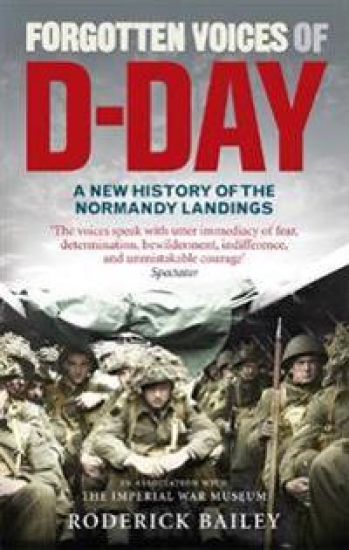
6 June 1944: the day Allied forces crossed the Channel and began fighting their way into Nazi-occupied Northwest Europe. Initiated by airborne units and covered by air and naval bombardment, the Normandy landings were the most ambitious combined airborne and amphibious assault ever attempted. Their success marked the beginning of the end for Nazi Germany.Drawing on thousands of hours of eyewitness testimony recorded by the Imperial War Museum, Forgotten Voices of D-Day tells the compelling story of this turning point in World War 2. Hearing from paratroopers and commandos, glider pilots and landing craft crewmen, airmen and naval personnel, we learn first-hand what it was like as men waited to go in, as they neared the beaches and drop zones, and as they landed and met the enemy. Accounts range from memories of the daring capture of 'Pegasus' bridge by British glider-bourn troops to recollections of brutal fighting as the assault forces stormed the beaches. Featuring a mass of previously unpublished material, Forgotten Voices of D-Day is a powerful and important new record of a defining moment in modern history.
Forgotten Voices of the Victoria Cross

Forgotten Voices of the Victoria Cross

Roderick Bailey

Ebury Press
2011
pokkari
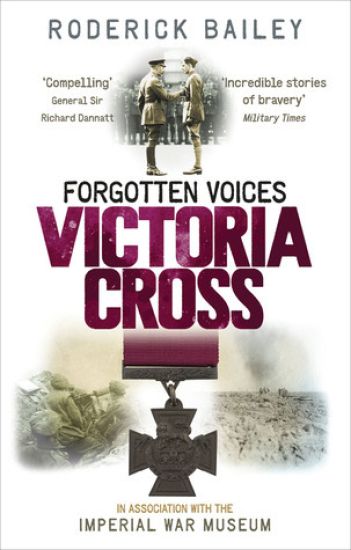
'It wasn't until after he was safely back in the aircraft again that I heard that he'd actually been out on the wing to try to put the fire out ... Remember that we were flying at about 90 miles an hour at a height of 13,000 feet'Squadron Leader RP Widdowson on Sergeant James Ward, who earned his VC in 1941 The Victoria Cross, awarded to the most courageous and determined servicemen, is the highest military decoration that can be bestowed.In Forgotten Voices: Victoria Cross, first-hand accounts of soldiers, sailors and airmen describe the incredible events that earned these extraordinary men the VC in the last century.Captivating and often humbling, these stories depict exceptional acts of bravery in unimaginable situations, of men who would say they were just doing their duty.Introduction by General Sir Richard Dannatt.
An Economic History of the English Garden

An Economic History of the English Garden

Roderick Floud

Penguin Books Ltd
2020
pokkari
'Roderick Floud's ground-breaking study of the history, money, places and personalities involved in British gardens over the past 350 years gives fascinating insight into why gardening is part of this country's soul.' Michael Heseltine, Deputy Prime Minister (1996-1997)'Thousands of books have been written about the history of British gardens but Roderick Floud, one of Britain's most distinguished economic historians, asks new and important questions: how much did gardens cost to build and maintain, and where did the money come from? Superbly researched, it is full of information which will surprise both economists and gardeners. The book is fun as well as edifying: Floud shows us gardens grand and humble, and introduces us gardeners, plantsmen and technologies in wonderful varieties.' Jane Humphries, Centennial Professor, London School of EconomicsAt least since the seventeenth century, most of the English population have been unable to stop making, improving and dreaming of gardens. Yet in all the thousands of books about them, this is the first to address seriously the question of how much gardens and gardening have cost, and to work out the place of gardens in the economic, as well as the horticultural, life of the nation. It is a new kind of gardening history.Beginning with the Restoration of Charles II in 1660, Roderick Floud describes the role of the monarchy and central and local government in creating gardens, as well as that of the (generally aristocratic or plutocratic) builders of the great gardens of Stuart, Georgian and Victorian England. He considers the designers of these gardens as both artists and businessmen - often earning enormous sums by modern standards, matched by the nurserymen and plant collectors who supplied their plants. He uncovers the lives and rewards of working gardeners, the domestic gardens that came with the growth of suburbs and the impact of gardening on technical developments from man-made lakes to central heating.AN ECONOMIC HISTORY OF THE ENGLISH GARDEN shows the extraordinary commitment of money as well as time that the English have made to gardens and gardening over three and a half centuries. It reveals the connections of our gardens to the re-establishment of the English monarchy, the national debt, transport during the Industrial Revolution, the new industries of steam, glass and iron, and the built environment that is now all around us. It is a fresh perspective on the history of England and will open the eyes of gardeners - and garden visitors - to an unexpected dimension of what they do.
Greece

Greece

Roderick Beaton

Penguin Books Ltd
2020
pokkari
SHORTLISTED FOR THE CUNDILL HISTORY PRIZE 2020 AND THE RUNCIMAN AWARD 2021A FINANCIAL TIMES BOOK OF THE YEAR 'The best history of Greece around... Beautifully written and packed with insights about the culture and the people. I will be dipping into this book for the rest of my life' Victoria HislopWe think we know ancient Greece, the civilisation that shares the same name and gave us just about everything that defines 'western' culture today, in the arts, sciences, social sciences and politics. Yet, as Greece has been brought under repeated scrutiny during the financial crises that have convulsed the country since 2010, worldwide coverage has revealed just how poorly we grasp the modern nation. This book sets out to understand the modern Greeks on their own terms.How did Greece come to be so powerfully attached to the legacy of the ancients in the first place, and then define an identity for themselves that is at once Greek and modern? This book reveals the remarkable achievement, during the last 300 years, of building a modern nation on, sometimes literally, the ruins of a vanished civilisation. This is the story of the Greek nation-state but also, and perhaps more fundamentally, of the collective identity that goes with it. It is not only a history of events and high politics, it is also a history of culture, of the arts, of people and of ideas.
Armageddon and Paranoia: The Nuclear Confrontation Since 1945

Armageddon and Paranoia: The Nuclear Confrontation Since 1945

Rodric Braithwaite

Oxford University Press
2018
sidottu
Former British Ambassador to the Soviet Union and author of the definitive account of the Soviet invasion and occupation of Afghanistan, Sir Rodric Braithwaite offers here a tour d'horizon of nuclear policy from the end of World War II and start of the Cold War to the present day. Armageddon and Paranoia unfolds the full history of nuclear weapons that began with the arms race between the United States and the Soviet Union and now extends worldwide. For decades, an apocalypse seemed imminent, staved off only by the certainty that if one side launched these missiles the other would launch an equally catastrophic counterstrike. This method of avoiding all-out nuclear warfare was called "Deterrence," a policy of Mutually Assured Destruction (MAD). Still, though neither side actively wanted to plunge the world into nuclear wasteland, the possibility of war by misjudgment or mistake meant fears could never be entirely assuaged. Both an exploration of Deterrence and the long history of superpower nuclear policy, Armageddon and Paranoia comes at a time when tensions surrounding nuclear armament have begun mounting once more. No book until this one has offered so comprehensive a history of the topic that has guided--at times dominated--the world in which we live.
The Origins of the Cultural Revolution

The Origins of the Cultural Revolution

Roderick MacFarquhar

Oxford University Press
1997
sidottu
This is the final volume in a trilogy which examines the politics, personalities, economics, culture, and international relations of China from the mid-1950s to the mid-1960s. Roderick MacFarquhar is the first to use a multitude of new Chinese sources to answer the question: Why did Chairman Mao Zedong launch the Cultural Revolution which plunged China into chaos and almost destroyed its Communist Party? Volume 3 begins with the great famine of the early 1960s which resulted in tens of millions of deaths, setting in train a series of emergency measures which increasingly divided Mao from his comrades-in-arms. The Chairman's anger that they were prepared to adopt `capitalist' methods to rescue the country was sharpened by his belief that Moscow was denouncing his revolutionary diplomacy because the Soviet leadership had gone capitalist and sold out to the `imperialist' West. From 1961 to 1966, the increasingly urgent question for Mao was how to prevent a similar revolutionary deterioration in China. The Cultural Revolution, in which tens of thousands of loyal party veterans were publicly disgraced to make way for a supposedly more leftist generation of Red Guards, was his answer. Ironically, after it all ended with Mao's death, one survivor, Deng Xiaoping, was so appalled at the destructiveness of the Chairman's final cataclysm that he actually did turn to capitalism to revive the country. This volume is the first scholarly work for twenty years to focus on the whole gamut of events - political, economic, intellectual, military, and international - in the years leading up to the Cultural Revolution and makes use of a multitude of Chinese documentary, biographical, and historical works that have only appeared in the last decade.
Oxford Reading Tree: Read With Biff, Chip & Kipper First Experiences Kipper's First Match

Oxford Reading Tree: Read With Biff, Chip & Kipper First Experiences Kipper's First Match

Roderick Hunt; Annemarie Young; Kate Ruttle

Oxford University Press
2014
nidottu
Do you like football? Sam and his dad love to play football! In this story Kipper goes to watch a football match with Sam and his family. Read this story to learn about what it might be like to watch a football match. This entertaining and sensitively written story is perfect for reading together, packed with facts and humour to familiarise your child with what to expect from a first experience such as going to watch a football match. First Experiences with Biff, Chip & Kipper have been carefully created to help parents explore the wider world with their child, talk about shared feelings and emotions, and build vocabulary through the fun activities included in every book. Each book also includes practical tips and ideas for you to use when reading together. This series is linked to Read with Biff, Chip & Kipper -the UK's best-selling home reading series, and is supported by free eBooks and advice for parents at www.oxfordowl.co.uk. Biff, Chip & Kipper are characters from the Oxford Reading Tree series, which is used in 80% of primary schools.
Oxford Reading Tree: Read With Biff, Chip & Kipper First Experiences Going to the Vet

Oxford Reading Tree: Read With Biff, Chip & Kipper First Experiences Going to the Vet

Roderick Hunt; Annemarie Young; Ruttle Kate

Oxford University Press
2014
nidottu
Do you have a pet? Biff, Chip and Kipper have a dog called Floppy. In this story they worry when Floppy has to go to the vet. Read this story to learn about how the vet might help to make animals better. This entertaining and sensitively written story is perfect for reading together, packed with facts and humour to familiarise your child with what to expect from a first experience such as taking a pet to the vet First Experiences with Biff, Chip & Kipper have been carefully created to help parents explore the wider world with their child, talk about shared feelings and emotions, and build vocabulary through the fun activities included in every book. Each book also includes practical tips and ideas for you to use when reading together. This series is linked to Read with Biff, Chip & Kipper -the UK's best-selling home reading series, and is supported by free eBooks and advice for parents at www.oxfordowl.co.uk. Biff, Chip & Kipper are characters from the Oxford Reading Tree series, which is used in 80% of primary schools.
Oxford Reading Tree Read with Biff, Chip and Kipper: Spelling Games Flashcards
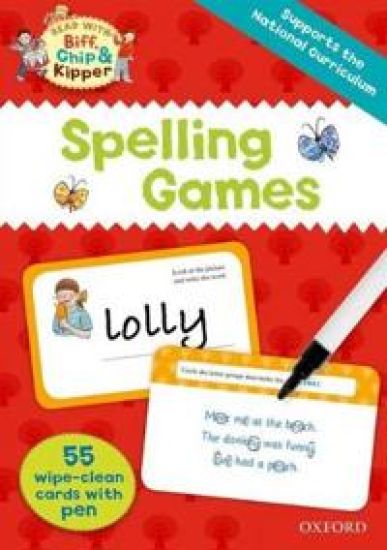
Read with Biff, Chip and Kipper Spelling Games wipe-clean flashcards with pen are a fun way for children to develop their spelling skills, and they support the way children are taught to write at school. These fun spelling games have been specially created to support the National Curriculum and complement the Read with Biff, Chip & Kipper My Grammar, Punctuation and Spelling Kit. Playing these spelling games will help children to: ·learn and practise alternative spellings ·become familiar with phoneme/grapheme variations ·practise writing skills This set of 55 cards includes support for parents,fun games and useful tips for using the flashcards. The series provides essential support for parents through www.oxfordowl.co.uk. Visit Oxford Owl for practical advice for helping children learn to read, all you need to know about grammar, as well as lots of fun activities and free eBooks.
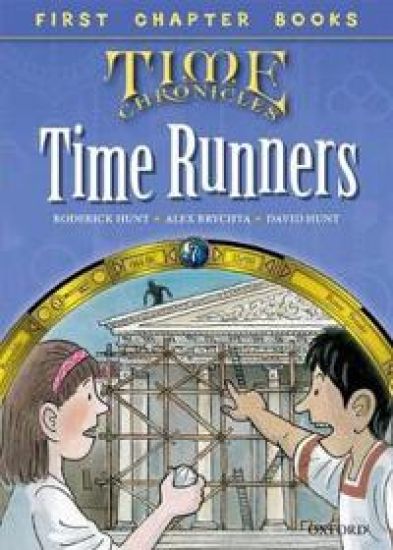
Read With Biff, Chip and Kipper: Level 11 First Chapter Books: The Time Runners
Biff, Chip, Kipper and friends are older now and their true destiny is about to be revealed. Join them as they embark on the mission of a lifetime! In Book 7, The Time Runners, the TimeWeb is finally up and running and the children are training to fight the Virans. But a trip to Ancient Rome makes it clear that there is still lots to learn. Time Chronicles is a series of fun and accessible first chapter books that are perfect for moving your child on from picture books to longer stories. Each book in the series is an exciting story in its own right, as the children fight to save the world from the evil Virans. The books are carefully levelled to boost the confidence of the child, whilst also introducing more vibrant and interesting vocabulary. They are perfect for keeping the attention of all children with fast paced action, lots of authentic historical facts and cool gadgets! Set in a real historical time with characters from the past, these books are packed full of extras including questions, historical fact files, character information, photos, artwork and glossaries. Support for parents is also included. Time Chronicles are part of Read with Biff, Chip & Kipper - the UK's most popular home reading series.