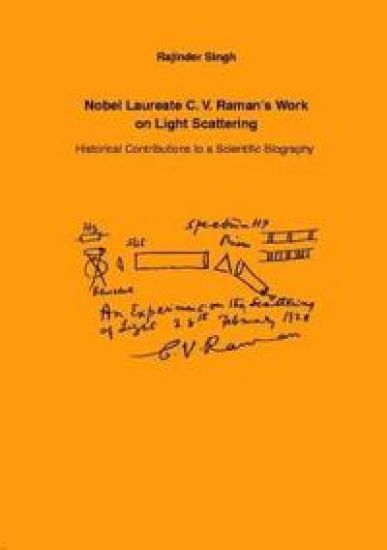
C.V. Raman, the founder of Raman spectroscopy, was the first Asian to receive the Nobel Prize in physics. How physics emerged as an academic discipline in India can be illustrated with his life story: His initial research in acoustics and optics brought him international reputation. However, the discovery of the Raman effect in 1928 and subsequently the Nobel Prize for physics in 1930 put him in the list of the "immortal ones." The present work shows the details of his finding and its reception by the western scientific community. Employing the Nobel Committee's documents the author explores why the prize was not shared with his co-worker or with a competing group of Russian physicists. Raman was an uncompromising, dominant, power seeking and intuitive scientist. His disputes with his colleagues on the issues of several scientific institutions in India were not only a part of his personality but also connected to India's internal politics. So far Raman's scientific controversies with German and British scientists are concerned, they were rather due to his way of thinking about the relation between theory and experiment than to be interpreted in terms of an "East-West conflict." Hundreds of hitherto unknown letters and newspaper cuttings are employed to discuss unknown facets of Raman's interaction with the most eminent and influential physicists of his time. It is aimed to adopt a critical and objective approach and present Sir C.V. Raman FRS not as a legend and myth but as a scientist and science organizer with a complex personality.








![Memorie Ecclesiastiche E Civili Di Citta Di Castello. Raccolte Da M. G. M. A. V. Di C. Di C. [I.E. G. Muzi, Bishop of Citta Di Castello.] Con Dissertazione Preliminare Sull'antichita Ed Antiche Denominazion Di Detta Citta .](/covers/9781241767365.jpg)
![Memorie Ecclesiastiche E Civili Di Citta Di Castello. Raccolte Da M. G. M. A. V. Di C. Di C. [I.E. G. Muzi, Bishop of Citta Di Castello.] Con Dissertazione Preliminare Sull'antichita Ed Antiche Denominazion Di Detta Citta .](/covers/9781241767389.jpg)
![Memorie Ecclesiastiche E Civili Di Citta Di Castello. Raccolte Da M. G. M. A. V. Di C. Di C. [I.E. G. Muzi, Bishop of Citta Di Castello.] Con Dissertazione Preliminare Sull'antichita Ed Antiche Denominazion Di Detta Citta .](/covers/9781241767396.jpg)
![Memorie Ecclesiastiche E Civili Di Citta Di Castello. Raccolte Da M. G. M. A. V. Di C. Di C. [I.E. G. Muzi, Bishop of Citta Di Castello.] Con Dissertazione Preliminare Sull'antichita Ed Antiche Denominazion Di Detta Citta.](/covers/9781241768560.jpg)

![Memorie Ecclesiastiche E Civili Di Citta Di Castello. Raccolte Da M. G. M. A. V. Di C. Di C. [I.E. G. Muzi, Bishop of Citta Di Castello.] Con Dissertazione Preliminare Sull'antichita Ed Antiche Denominazion Di Detta Citta.](/covers/9781249015451.jpg)