
Kirjahaku
Etsi kirjoja tekijän nimen, kirjan nimen tai ISBN:n perusteella.
1000 tulosta hakusanalla Vector Hasting

Blood Vector: We never understood the warning
Robert Kiesling
Createspace Independent Publishing Platform
2017
nidottu
Quick summary: an investigation into a paranormal event happening around the world uncovers an otherworldly threat to humankind...Expanded: Three People. One Chance. On the verge of losing her sanity from visions of otherworldly creatures destroying mankind, journalist Khloe Marks discovers that those who share her rare blood type also have the nightmares. Her search for the connection between them leads to a disgraced lawyer, locked away in a mental institution for his belief that a young girl is a key to stopping the imminent destruction of mankind. Together, they must solve an ancient mystery to save humanity-even if it costs them their own lives. If they fail: In Memory of Man
With many new concrete examples and historical notes, Topological Vector Spaces, Second Edition provides one of the most thorough and up-to-date treatments of the Hahn–Banach theorem. This edition explores the theorem’s connection with the axiom of choice, discusses the uniqueness of Hahn–Banach extensions, and includes an entirely new chapter on vector-valued Hahn–Banach theorems. It also considers different approaches to the Banach–Stone theorem as well as variations of the theorem.The book covers locally convex spaces; barreled, bornological, and webbed spaces; and reflexivity. It traces the development of various theorems from their earliest beginnings to present day, providing historical notes to place the results in context. The authors also chronicle the lives of key mathematicians, including Stefan Banach and Eduard Helly. Suitable for both beginners and experienced researchers, this book contains an abundance of examples, exercises of varying levels of difficulty with many hints, and an extensive bibliography and index.
From Vector Spaces to Function Spaces
Yutaka Yamamoto
Society for Industrial Applied Mathematics,U.S.
2012
sidottu
Provides a treatment of analytical methods of applied mathematics. It starts with a review of the basics of vector spaces and brings the reader to an advanced discussion of applied mathematics, including the latest applications to systems and control theory. The text is designed to be accessible to those not familiar with the material and useful to working scientists, engineers, and mathematics students. The author provides the motivations of definitions and the ideas underlying proofs but does not sacrifice mathematical rigour. From Vector Spaces to Function Spaces presents an easily-accessible discussion of analytical methods of applied mathematics from vector spaces to distributions, Fourier analysis, and Hardy spaces with applications to system theory; an introduction to modern functional analytic methods to better familiarize readers with basic methods and mathematical thinking; and an understandable yet penetrating treatment of such modern methods and topics as function spaces and distributions, Fourier and Laplace analyses, and Hardy spaces.
Support Vector Machines
Nova Science Publishers Inc
2012
sidottu
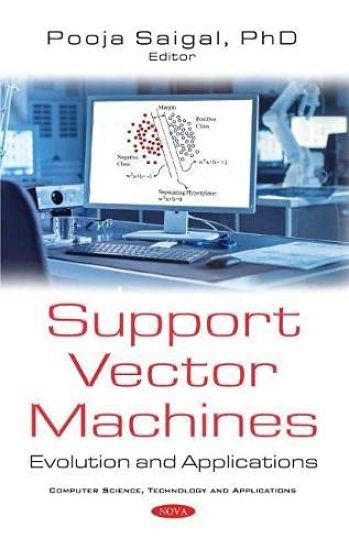
This book presents topical research in the study of support vector machines. Topics discussed include the support vector machine in medical imaging; monthly air pollution modeling using support vector machine techniques in Spain; support vector machines for image interpolation schemes in image zooming and color array interpolation; using SVM for the prediction of the ultimate capacity of driven piles in cohesionless soils; SVM in medical classification tasks and pattern recognition for machine fault diagnosis using support vector machines.

Viral Vector Approaches in Neurobiology and Brain Diseases
Humana Press Inc.
2013
sidottu
Aiming toward improvement in the safety, efficiency, and specificity of viral vectors for neurobiological research and clinical applications, Viral Vector Approaches in Neurobiology and Brain Diseases covers key aspects related to the use of viral vectors in neuroscience, with a major emphasis on basic mechanisms of synaptic plasticity, learning, and memory, as well as molecular neuropharmacology and experimental animal models of brain disorders. The volume begins by delving into features of the viral vectors currently available in neuroscience and their production methods, and it then continues onward to examples of successful applications of viral vector technology to psychiatric and memory research, current applications of viral vector technology in the context of neurological disorders, as well as various cutting-edge applications of viral vector technology to neuroscience, including optogenetics. Written for the Neuromethods series, the chapters of this book contain the kind of detailed description and implementation advice that promotes successful, repeatable results. Practical and up to date, Viral Vector Approaches in Neurobiology and Brain Diseases will be useful not only to neurobiologists wishing to routinely use viral vectors in the laboratory but also to experienced scientists needing detailed new protocols for a variety of experimental applications.
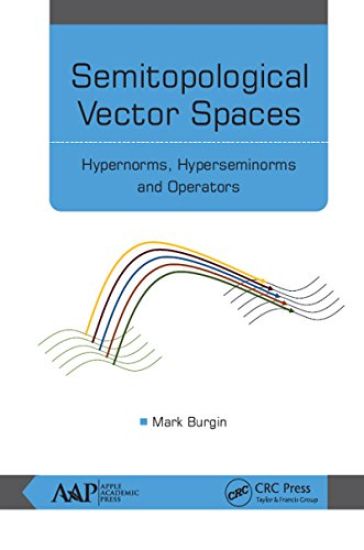
This new volume shows how it is possible to further develop and essentially extend the theory of operators in infinite-dimensional vector spaces, which plays an important role in mathematics, physics, information theory, and control theory. The book describes new mathematical structures, such as hypernorms, hyperseminorms, hypermetrics, semitopological vector spaces, hypernormed vector spaces, and hyperseminormed vector spaces. It develops mathematical tools for the further development of functional analysis and broadening of its applications. Exploration of semitopological vector spaces, hypernormed vector spaces, hyperseminormed vector spaces, and hypermetric vector spaces is the main topic of this book. A new direction in functional analysis, called quantum functional analysis, has been developed based on polinormed and multinormed vector spaces and linear algebras. At the same time, normed vector spaces and topological vector spaces play an important role in physics and in control theory.To make this book comprehendible for the reader and more suitable for students with some basic knowledge in mathematics, denotations and definitions of the main mathematical concepts and structures used in the book are included in the appendix, making the book useful for enhancing traditional courses of calculus for undergraduates, as well as for separate courses for graduate students. The material of Semitopological Vector Spaces: Hypernorms, Hyperseminorms and Operators is closely related to what is taught at colleges and universities. It is possible to use a definite number of statements from the book as exercises for students because their proofs are not given in the book but left for the reader.
This new volume shows how it is possible to further develop and essentially extend the theory of operators in infinite-dimensional vector spaces, which plays an important role in mathematics, physics, information theory, and control theory. The book describes new mathematical structures, such as hypernorms, hyperseminorms, hypermetrics, semitopological vector spaces, hypernormed vector spaces, and hyperseminormed vector spaces. It develops mathematical tools for the further development of functional analysis and broadening of its applications. Exploration of semitopological vector spaces, hypernormed vector spaces, hyperseminormed vector spaces, and hypermetric vector spaces is the main topic of this book. A new direction in functional analysis, called quantum functional analysis, has been developed based on polinormed and multinormed vector spaces and linear algebras. At the same time, normed vector spaces and topological vector spaces play an important role in physics and in control theory.To make this book comprehendible for the reader and more suitable for students with some basic knowledge in mathematics, denotations and definitions of the main mathematical concepts and structures used in the book are included in the appendix, making the book useful for enhancing traditional courses of calculus for undergraduates, as well as for separate courses for graduate students. The material of Semitopological Vector Spaces: Hypernorms, Hyperseminorms and Operators is closely related to what is taught at colleges and universities. It is possible to use a definite number of statements from the book as exercises for students because their proofs are not given in the book but left for the reader.

When Wendy Chen, an IT professional, learns the software in her possession is a malware designed to trigger a missile attack, her first thought is to exploit the position she finds herself in. After confiding in her colleague Guy, an expert in cybersecurity, her plan quickly turns to fear when the true implications of the malware become clear. Together with John, a friend and white hat hacker, they find themselves embattled in a gripping race against time, triads, North Korea's army, and a highly skilled contract killer in order to prevent a global catastrophe.


A guide on the use of SVMs in pattern classification, including a rigorous performance comparison of classifiers and regressors. The book presents architectures for multiclass classification and function approximation problems, as well as evaluation criteria for classifiers and regressors. Features: Clarifies the characteristics of two-class SVMs; Discusses kernel methods for improving the generalization ability of neural networks and fuzzy systems; Contains ample illustrations and examples; Includes performance evaluation using publicly available data sets; Examines Mahalanobis kernels, empirical feature space, and the effect of model selection by cross-validation; Covers sparse SVMs, learning using privileged information, semi-supervised learning, multiple classifier systems, and multiple kernel learning; Explores incremental training based batch training and active-set training methods, and decomposition techniques for linear programming SVMs; Discusses variable selection for support vector regressors.

When an alien society embroiled in a civil war fires their ultimate weapon, instead of destroying their enemies, it opens a portal from their galaxy to an orbit above Earth, bringing their conflict to our world. What if Star Wars crash-landed on Earth? Brought to life by the creators behind Morning Star and Crush Depth Cora Martinez has seen her fair share of conflict-- as a Sonoran Desert Park Ranger, she straddles the line between sheltering desperate immigrants and steering others away from an uncertain fate. She longs for a place where disputes such as these no longer exist. But a clash far bigger than any on Earth is about to rip the heavens apart and crash land upon her doorstep with the arrival of two opposing combatants in an alien civil war through a rift in space The earthbound space opera from the creators of Morning Star and Crush Depth begins When the stars fell, war came to Earth.

Mapped Vector Basis Functions for Electromagnetic Integral Equations
Andrew F. Peterson
Springer International Publishing AG
2007
nidottu
The method-of-moments solution of the electric field and magnetic field integral equations (EFIE and MFIE) is extended to conducting objects modeled with curved cells. These techniques are important for electromagnetic scattering, antenna, radar signature, and wireless communication applications. Vector basis functions of the divergence-conforming and curl-conforming types are explained, and specific interpolatory and hierarchical basis functions are reviewed. Procedures for mapping these basis functions from a reference domain to a curved cell, while preserving the desired continuity properties on curved cells, are discussed in detail. For illustration, results are presented for examples that employ divergence-conforming basis functions with the EFIE and curl-conforming basis functions with the MFIE. The intended audience includes electromagnetic engineers with some previous familiarity with numerical techniques.

Support Vector Machines for Antenna Array Processing and Electromagnetics
Manel Martínez-Ramón; Christos Christodoulou
Springer International Publishing AG
2007
nidottu
Support Vector Machines (SVM) were introduced in the early 90's as a novel nonlinear solution for classification and regression tasks. These techniques have been proved to have superior performances in a large variety of real world applications due to their generalization abilities and robustness against noise and interferences. This book introduces a set of novel techniques based on SVM that are applied to antenna array processing and electromagnetics. In particular, it introduces methods for linear and nonlinear beamforming and parameter design for arrays and electromagnetic applications.
Guiding Vector Fields for Robot Motion Control
Weijia Yao
Springer International Publishing AG
2023
sidottu
Using a designed vector field to guide robots to follow a given geometric desired path has found a range of practical applications, such as underwater pipeline inspection, warehouse navigation, and highway traffic monitoring. It is thus in great need to build a rigorous theory to guide practical implementations with formal guarantees. It is even so when multiple robots are required to follow predefined desired paths or maneuver on surfaces and coordinate their motions to efficiently accomplish repetitive and laborious tasks. The book introduces guiding vector fields on Euclidean spaces and Riemannian manifolds for single-robot and multi-robot path-following and motion coordination, provides rigorous theoretical guarantees of vector field guided motion control of robotic systems, and elaborates on the practical implementation of the proposed algorithms on mobile wheeled robots and fixed-wing aircraft. It provides guidelines for the robust, reliable, and safe practical implementations for robotic tasks, including path-following navigation, obstacle-avoidance, and multi-robot motion coordination. In particular, the book reveals fundamental theoretic underpinnings of guiding vector fields and applies to addressing various robot motion control problems. Notably, it answers many crucial and challenging questions such as: · How to generate a general guiding vector field on any n-dimensional Riemannian manifold for robot motion control tasks? · Do singular points always exist in a general guiding vector field? · How to generate a guiding vector field that is free of singular points? · How to design control algorithms based on guiding vector fields for different robot motion control tasks including path-following, obstacle-avoidance, and multi-robot distributed motion coordination? Answering these questions has led to the discovery of fundamental assumptions, a “topological surgery” to create a singularity-free guiding vector field, a robot navigation algorithm with the global convergence property, a provably safe collision-avoidance algorithm and an effective distributed motion control algorithm, etc
Support Vector Machines Applications
Springer International Publishing AG
2014
sidottu
Support vector machines (SVM) have both a solid mathematical background and practical applications. This book focuses on the recent advances and applications of the SVM, such as image processing, medical practice, computer vision, and pattern recognition, machine learning, applied statistics, and artificial intelligence. The aim of this book is to create a comprehensive source on support vector machine applications.

Support Vector Machines and Evolutionary Algorithms for Classification
Catalin Stoean; Ruxandra Stoean
Springer International Publishing AG
2014
sidottu
When discussing classification, support vector machines are known to be a capable and efficient technique to learn and predict with high accuracy within a quick time frame. Yet, their black box means to do so make the practical users quite circumspect about relying on it, without much understanding of the how and why of its predictions. The question raised in this book is how can this ‘masked hero’ be made more comprehensible and friendly to the public: provide a surrogate model for its hidden optimization engine, replace the method completely or appoint a more friendly approach to tag along and offer the much desired explanations? Evolutionary algorithms can do all these and this book presents such possibilities of achieving high accuracy, comprehensibility, reasonable runtime as well as unconstrained performance.
Support Vector Machines Applications
Springer International Publishing AG
2016
nidottu
Support vector machines (SVM) have both a solid mathematical background and practical applications. This book focuses on the recent advances and applications of the SVM, such as image processing, medical practice, computer vision, and pattern recognition, machine learning, applied statistics, and artificial intelligence. The aim of this book is to create a comprehensive source on support vector machine applications.

Support Vector Machines and Evolutionary Algorithms for Classification
Catalin Stoean; Ruxandra Stoean
Springer International Publishing AG
2016
nidottu
When discussing classification, support vector machines are known to be a capable and efficient technique to learn and predict with high accuracy within a quick time frame. Yet, their black box means to do so make the practical users quite circumspect about relying on it, without much understanding of the how and why of its predictions. The question raised in this book is how can this ‘masked hero’ be made more comprehensible and friendly to the public: provide a surrogate model for its hidden optimization engine, replace the method completely or appoint a more friendly approach to tag along and offer the much desired explanations? Evolutionary algorithms can do all these and this book presents such possibilities of achieving high accuracy, comprehensibility, reasonable runtime as well as unconstrained performance.
Support Vector Machines and Perceptrons
M.N. Murty; Rashmi Raghava
Springer International Publishing AG
2016
nidottu
This work reviews the state of the art in SVM and perceptron classifiers. A Support Vector Machine (SVM) is easily the most popular tool for dealing with a variety of machine-learning tasks, including classification. SVMs are associated with maximizing the margin between two classes. The concerned optimization problem is a convex optimization guaranteeing a globally optimal solution. The weight vector associated with SVM is obtained by a linear combination of some of the boundary and noisy vectors. Further, when the data are not linearly separable, tuning the coefficient of the regularization term becomes crucial. Even though SVMs have popularized the kernel trick, in most of the practical applications that are high-dimensional, linear SVMs are popularly used. The text examines applications to social and information networks. The work also discusses another popular linear classifier, the perceptron, and compares its performance with that of the SVM in different application areas.>