Kirjahaku
Etsi kirjoja tekijän nimen, kirjan nimen tai ISBN:n perusteella.
1000 tulosta hakusanalla Brian H Appleton

Learning Disabilities and Brain Function
William H. Gaddes; G.W. Hynd; Dorothy Edgell
Springer-Verlag New York Inc.
2010
nidottu
The present edition of this book is a revision and expansion of the first two editions which appeared in 1980 and 1985, and in German translation in 1991. More than half of the present volume includes new material, and what has been retained from the former editions has been largely rewritten and updated with new research findings. A completely new chapter has been added on "Attention Deficit Disorder. " The author of the earlier editions (W.H.G.) has been joined by a coauthor (D.E.), and their combined elementary, high school, and university teaching and clinical experience totals approximately seventy-five years. Both of us have directed our professional en ergies to understanding the puzzle of human learning, especially academic learning, of those students who, despite apparently nor mal intelligence and opportunity, have varying degrees of difficulty in acquiring ideas and skills that are easily mastered by others. Until about fifty years ago there was a common tendency to equate academic success with intelligence, and those students who could not meet the demands of the prescribed program were usually required to repeat the same grade with a repetition of the same discouraging treatment that had been unsuccessful the first time.
An Odyssey Through the Brain, Behavior and the Mind
Case H. Vanderwolf
Springer-Verlag New York Inc.
2010
nidottu
Much of contemporary behavioral or cognitive neuroscience is concerned with discovering the neural basis of psychological processes such as attention, cognition, consciousness, perception, and memory. In sharp divergence from this field, An Odyssey Through the Brain, Behavior and the Mind can be regarded as an elaborate demonstration that the large scale features of brain electrical activity are related to sensory and motor processes in various ways but are not organised in accordance with conventional psychological concepts. It is argued that much of the traditional lore concerning the mind is based on prescientific philosophical assumptions and has little relevance to brain function. The first ten chapters of An Odyssey Through the Brain, Behavior and the Mind give a personal account of how the various discoveries that gave rise to these views came to be made. This is followed by discussions of brain organization in relation to behavior, learning and memory, sleep and consciousness, and the general problem of the mind.

Horse Diseases - The Brain and Nervous System - A Historical Article on Equine Health
Geo H Dadd
READ BOOKS
2011
pokkari
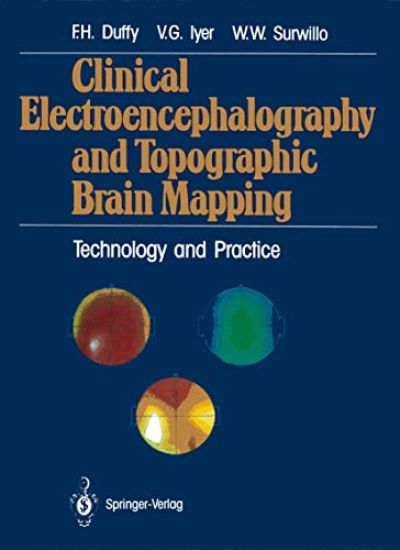
Clinical Electroencephalography and Topographic Brain Mapping
Frank H. Duffy; Vasudeva G. Iyer; Walter W. Surwillo
Springer-Verlag New York Inc.
2012
nidottu
Electroencephalography is truly an interdisciplinary endeavor, involving concepts and techniques from a variety of different disciplines. Included are basic physics, neuro physiology, electrophysiology, electrochemistry, electronics, and electrical engineer ing, as well as neurology. Given this interesting and diverse mixture of areas, the train ing of an EEG technician, a neurology resident, or an EEG researcher in the basics of clinical electroencephalography presents an uncommon challenge. In the realm of technology, it is relatively easy to obtain a technically adequate EEG simply by learning to follow a protocol and by correctly setting the various switches on the EEG machine at the right time. But experience has shown that the ability to obtain high-quality EEGs on a routine, day-to-day basis from a wide variety of patients requires understanding and knowledge beyond what is learned by rote. Likewise, knowledge above and beyond what is gained by simple participation in an EEG reading is necessary to correctly and comprehensively interpret the record. Such knowledge comes from an understanding of the basic principles upon which the practice of clinical EEG is founded - principles that derive from the various disciplines cited.
Cognitive Remediation for Brain Injury and Neurological Illness
Marvin H Podd
Springer-Verlag New York Inc.
2011
sidottu
The purpose of this book is to teach psychologists with a neuropsychology background about cognitive remediation, the evidence in the research literature, and how to develop and conduct a treatment plan and evaluate the effectiveness of the interventions. The approach is illustrated using the computer-assisted cognitive remediation program developed by the author (NeurXercise). Twenty-nine different cases are presented in depth, following the outline presented in the earlier portions of the book. Treatment planning emphasizes Luria’s concepts of alternate functional systems and double dissociation. Pre- and post-treatment neuropsychological testing results are presented along with ecological validity and generalization to daily functioning. The cases are presented by etiology and each section concludes with what can be learned about that etiologic process from the cognitive remediation results. This section includes blast injuries, which are still being characterized in the literature, as well as effective treatment of patients with head injury, stroke, post-neurosurgical sequelae, co-morbid disorders, subcortical disorders, attention deficit disorder, and learning disabilities. The book identifies the most commonly used neuropsychological test instruments for evaluating cognitive deficits, discusses their input and output characteristics, and does the same for the NeurXercise computer-based exercises so that the connection between testing and treatment is easy to see and develop. In addition to discussing this in the appropriate sections of the book, these are summarized in the appendixes as a reference for correlating test findings and appropriate exercises for remediating deficits.

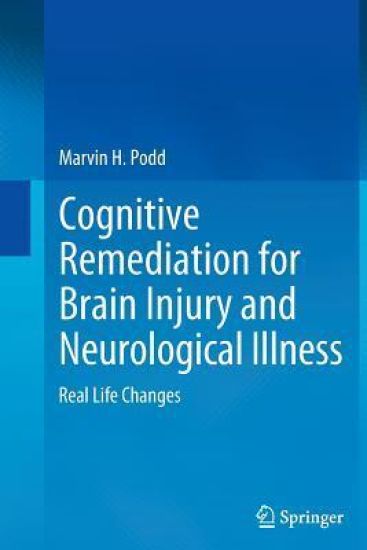
Cognitive Remediation for Brain Injury and Neurological Illness
Marvin H Podd
Springer-Verlag New York Inc.
2014
nidottu
The purpose of this book is to teach psychologists with a neuropsychology background about cognitive remediation, the evidence in the research literature, and how to develop and conduct a treatment plan and evaluate the effectiveness of the interventions. The approach is illustrated using the computer-assisted cognitive remediation program developed by the author (NeurXercise). Twenty-nine different cases are presented in depth, following the outline presented in the earlier portions of the book. Treatment planning emphasizes Luria’s concepts of alternate functional systems and double dissociation. Pre- and post-treatment neuropsychological testing results are presented along with ecological validity and generalization to daily functioning. The cases are presented by etiology and each section concludes with what can be learned about that etiologic process from the cognitive remediation results. This section includes blast injuries, which are still being characterized in the literature, as well as effective treatment of patients with head injury, stroke, post-neurosurgical sequelae, co-morbid disorders, subcortical disorders, attention deficit disorder, and learning disabilities. The book identifies the most commonly used neuropsychological test instruments for evaluating cognitive deficits, discusses their input and output characteristics, and does the same for the NeurXercise computer-based exercises so that the connection between testing and treatment is easy to see and develop. In addition to discussing this in the appropriate sections of the book, these are summarized in the appendixes as a reference for correlating test findings and appropriate exercises for remediating deficits.
""The Brain As An Organ Of Mind"" is a book written by H. Charlton Bastian, a British physician and neurologist, that explores the relationship between the brain and the mind. The book was first published in 1880 and is considered a seminal work in the field of neuroscience.Bastian argues that the brain is not simply a passive organ that receives and processes sensory information, but rather an active participant in the creation of conscious experience. He contends that the mind is not a separate entity from the brain, but rather a product of its activity.The book is divided into three sections. The first section provides an overview of the anatomy and physiology of the brain. Bastian discusses the different parts of the brain and their functions, as well as the ways in which the brain processes sensory information.The second section delves deeper into the relationship between the brain and the mind. Bastian argues that the mind is not a separate entity from the brain, but rather a product of its activity. He explores the ways in which the brain creates consciousness, memory, and emotion.The final section of the book focuses on the implications of Bastian's ideas for the study of psychology and philosophy. He argues that a better understanding of the brain and its relationship to the mind can help us to better understand human behavior and the nature of consciousness itself.Overall, ""The Brain As An Organ Of Mind"" is a groundbreaking work that helped to lay the foundation for modern neuroscience. It remains a valuable resource for anyone interested in the relationship between the brain and the mind.This Is A New Release Of The Original 1890 Edition.This scarce antiquarian book is a facsimile reprint of the old original and may contain some imperfections such as library marks and notations. Because we believe this work is culturally important, we have made it available as part of our commitment for protecting, preserving, and promoting the world's literature in affordable, high quality, modern editions, that are true to their original work.
The Brain Book and How to Read It: Being an Exposition of Phrenology in Theory and Practice
H. C. Donovan
Literary Licensing, LLC
2014
nidottu
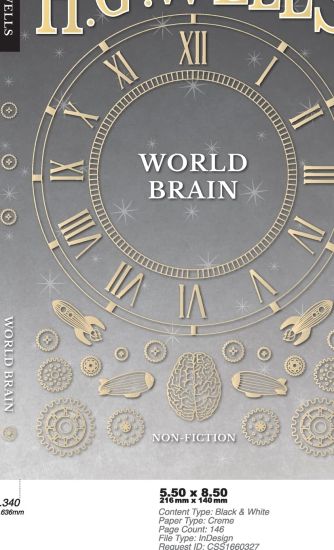
World Brain is an article written by H. G. Wells and first contributed to the new "Encyclop die Fran aise" in 1937. It explores the idea of a "permanent world encyclopaedia" that would contain "the whole human memory" and that would be "a world synthesis of bibliography and documentation with the indexed archives of the world." Fascinating and arguably prophetic reading, "World Brain" will appeal to fan Wells' work. Herbert George Wells (1866 - 1946) was a prolific English writer who wrote in a variety of genres, including the novel, politics, history, and social commentary. Today, he is perhaps best remembered for his contributions to the science fiction genre thanks to such novels as "The Time Machine" (1895), "The Invisible Man" (1897), and "The War of the Worlds" (1898). "The Father of Science Fiction" was also a staunch socialist, and his later works are increasingly political and didactic. Many vintage books such as this are becoming increasingly scarce and expensive. We are republishing this book now in an affordable, modern, high-quality edition complete with a specially commissioned new biography of the author.

170u can climb back up a stream of radiance to the sky, and back through history up the stream of time. 1 -Robert Frost topics that he judged to be important in brain his From the last years of the second millennium, tory leading into the end of the century, and was we can look back on antecedent events in neuro undertaken in response to the enthusiasm gener science with amazement that so much of modern ated by exhibition at several national and interna biomedical science was anticipated, or even said or done, in an earlier time. That surprise can be tional meetings of a series oflarge posters for which matched by appreciation for what the pioneer Magoun wrote a 27-page brochure. The posters investigators, with no inkling that they were creat were viewed by a multitude of young neuroscien ing a discipline, contributed to its emergence as a tists who wanted more, as well as by mature inves productive force in human progress. In today's tigators who were warmly pleased to see familiar names and faces from the past. The acclaim was reductionist atmosphere, in which research at the molecular level is producing breathtaking new accompanied by a veritable deluge of requests for knowledge throughout biology, the student may an illustrated, expanded publication.