Kirjojen hintavertailu. Mukana 12 016 292 kirjaa ja 12 kauppaa.

Kirjahaku

Etsi kirjoja tekijän nimen, kirjan nimen tai ISBN:n perusteella.

1000 tulosta hakusanalla Carlo Gozzi

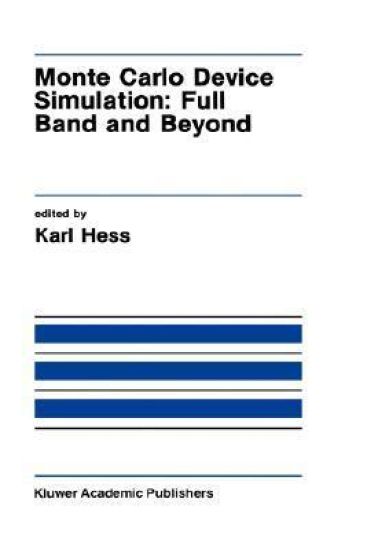
Monte Carlo Device Simulation
Monte Carlo simulation is now a well established method for studying semiconductor devices and is particularly well suited to highlighting physical mechanisms and exploring material properties. Not surprisingly, the more completely the material properties are built into the simulation, up to and including the use of a full band structure, the more powerful is the method. Indeed, it is now becoming increasingly clear that phenomena such as reliabil­ ity related hot-electron effects in MOSFETs cannot be understood satisfac­ torily without using full band Monte Carlo. The IBM simulator DAMOCLES, therefore, represents a landmark of great significance. DAMOCLES sums up the total of Monte Carlo device modeling experience of the past, and reaches with its capabilities and opportunities into the distant future. This book, therefore, begins with a description of the IBM simulator. The second chapter gives an advanced introduction to the physical basis for Monte Carlo simulations and an outlook on why complex effects such as collisional broadening and intracollisional field effects can be important and how they can be included in the simulations. References to more basic intro­ the book. The third chapter ductory material can be found throughout describes a typical relationship of Monte Carlo simulations to experimental data and indicates a major difficulty, the vast number of deformation poten­ tials required to simulate transport throughout the entire Brillouin zone. The fourth chapter addresses possible further extensions of the Monte Carlo approach and subtleties of the electron-electron interaction.
Monte Carlo Simulation

Monte Carlo Simulation

Christopher Z. Mooney

SAGE Publications Inc
1997
nidottu
Monte Carlo Simulation is a method of evaluating substantive hypotheses and statistical estimators by developing a computer algorithm to simulate a population, drawing multiple samples from this pseudo-population, and evaluating estimates obtained from these samples. Christopher Z. Mooney explains the logic behind Monte Carlo Simulation and demonstrates its uses for social and behavioral research in conducting inference using statistics with only weak mathematical theory, testing null hypotheses under a variety of plausible conditions, assessing the robustness of parametric inference to violations of its assumptions, assessing the quality of inferential methods, and comparing the properties of two or more estimators. In addition, Mooney carefully demonstrates how to prepare computer algorithms using GAUSS code and illustrates these principles using several research examples. is a method of evaluating substantive hypotheses and statistical estimators by developing a computer algorithm to simulate a population, drawing multiple samples from this pseudo-population, and evaluating estimates obtained from these samples. Christopher Z. Mooney explains the logic behind and demonstrates its uses for social and behavioral research in conducting inference using statistics with only weak mathematical theory, testing null hypotheses under a variety of plausible conditions, assessing the robustness of parametric inference to violations of its assumptions, assessing the quality of inferential methods, and comparing the properties of two or more estimators. In addition, Mooney carefully demonstrates how to prepare computer algorithms using GAUSS code and illustrates these principles using several research examples. Monte Carlo Simulation will enable researchers to effectively execute Monte Carlo Simulation and to interpret the estimated sampling distribution generated from its use. will enable researchers to effectively execute Monte Carlo Simulation and to interpret the estimated sampling distribution generated from its use.
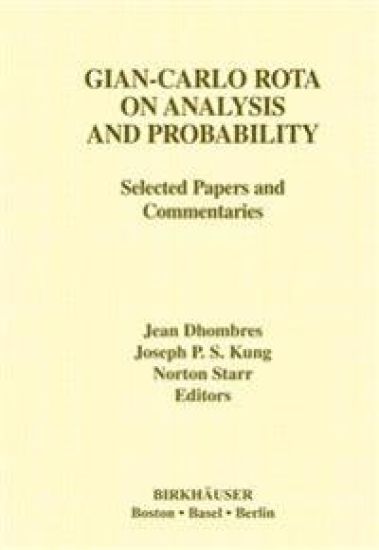
Gian-Carlo Rota on Analysis and Probability

Gian-Carlo Rota on Analysis and Probability

Jean Dhombres

Birkhauser Boston Inc
2002
sidottu
Gian-Carlo Rota was born in Vigevano, Italy, in 1932. He died in Cambridge, Mas­ sachusetts, in 1999. He had several careers, most notably as a mathematician, but also as a philosopher and a consultant to the United States government. His mathe­ matical career was equally varied. His early mathematical studies were at Princeton (1950 to 1953) and Yale (1953 to 1956). In 1956, he completed his doctoral thesis under the direction of Jacob T. Schwartz. This thesis was published as the pa­ per "Extension theory of differential operators I", the first paper reprinted in this volume. Rota's early work was in analysis, more specifically, in operator theory, differ­ ential equations, ergodic theory, and probability theory. In the 1960's, Rota was motivated by problems in fluctuation theory to study some operator identities of Glen Baxter (see [7]). Together with other problems in probability theory, this led Rota to study combinatorics. His series of papers, "On the foundations of combi­ natorial theory", led to a fundamental re-evaluation of the subject. Later, in the 1990's, Rota returned to some of the problems in analysis and probability theory which motivated his work in combinatorics. This was his intention all along, and his early death robbed mathematics of his unique perspective on linkages between the discrete and the continuous. Glimpses of his new research programs can be found in [2,3,6,9,10].
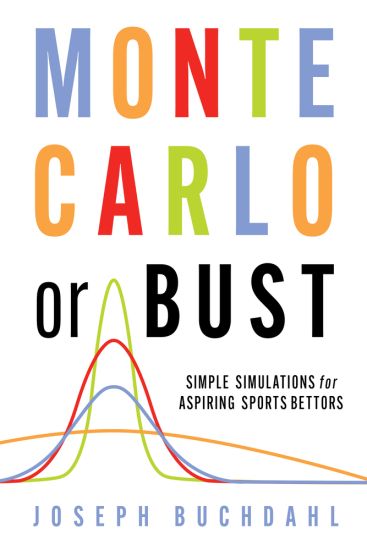
Monte Carlo or Bust

Monte Carlo or Bust

Joseph Buchdahl

OLDCASTLE BOOKS LTD
2021
pokkari
Almost everyone is familiar with Monte Carlo's association with gambling, and its famous Casino. Many may also have come across the Monte Carlo fallacy, so-called after the Casino's roulette wheel ball fell on black 26th times in a row, costing players, who believed that the law of averages made such streaks impossible, millions of dollars. However, the Casino also lends its name to a tool of statistical forecasting, the Monte Carlo simulation, used to model the probability of uncertain outcomes that cannot be easily predicted from mathematical equations. This book provides a detailed account for how aspiring sports bettors can use a Monte Carlo simulation to improve the quality, and hopefully profitability, of their betting, and in doing so unravels the mystery of probability and variance that lies at the heart of all gambling.
Monte Carlo Methods

Monte Carlo Methods

Thomas Michael Keegan

Hassell Street Press
2021
nidottu
This work has been selected by scholars as being culturally important and is part of the knowledge base of civilization as we know it.This work is in the public domain in the United States of America, and possibly other nations. Within the United States, you may freely copy and distribute this work, as no entity (individual or corporate) has a copyright on the body of the work.Scholars believe, and we concur, that this work is important enough to be preserved, reproduced, and made generally available to the public. To ensure a quality reading experience, this work has been proofread and republished using a format that seamlessly blends the original graphical elements with text in an easy-to-read typeface.We appreciate your support of the preservation process, and thank you for being an important part of keeping this knowledge alive and relevant.
Monte Carlo Methods

Monte Carlo Methods

Thomas Michael Keegan

Hassell Street Press
2023
sidottu
This book provides a comprehensive guide to the principles and applications of Monte Carlo methods in scientific computing. With clear explanations and examples drawn from a variety of fields, Thomas Michael Keegan offers readers an accessible introduction to this powerful tool for solving problems in physics, engineering, mathematics, and other disciplines.This work has been selected by scholars as being culturally important, and is part of the knowledge base of civilization as we know it.This work is in the "public domain in the United States of America, and possibly other nations. Within the United States, you may freely copy and distribute this work, as no entity (individual or corporate) has a copyright on the body of the work.Scholars believe, and we concur, that this work is important enough to be preserved, reproduced, and made generally available to the public. We appreciate your support of the preservation process, and thank you for being an important part of keeping this knowledge alive and relevant.
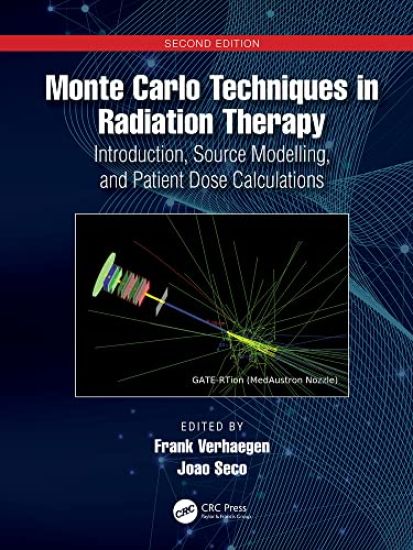
Monte Carlo Techniques in Radiation Therapy
About ten years after the first edition comes this second edition of Monte Carlo Techniques in Radiation Therapy: Introduction, Source Modelling, and Patient Dose Calculations, thoroughly updated and extended with the latest topics, edited by Frank Verhaegen and Joao Seco. This book aims to provide a brief introduction to the history and basics of Monte Carlo simulation, but again has a strong focus on applications in radiotherapy. Since the first edition, Monte Carlo simulation has found many new applications, which are included in detail.The applications sections in this book cover the following: Modelling transport of photons, electrons, protons, and ions Modelling radiation sources for external beam radiotherapy Modelling radiation sources for brachytherapy Design of radiation sources Modelling dynamic beam delivery Patient dose calculations in external beam radiotherapy Patient dose calculations in brachytherapy Use of artificial intelligence in Monte Carlo simulationsThis book is intended for both students and professionals, both novice and experienced, in medical radiotherapy physics. It combines overviews of development, methods, and references to facilitate Monte Carlo studies.
Monte Carlo Techniques in Radiation Therapy
About ten years after the first edition comes this second edition of Monte Carlo Techniques in Radiation Therapy: Introduction, Source Modelling, and Patient Dose Calculations, thoroughly updated and extended with the latest topics, edited by Frank Verhaegen and Joao Seco. This book aims to provide a brief introduction to the history and basics of Monte Carlo simulation, but again has a strong focus on applications in radiotherapy. Since the first edition, Monte Carlo simulation has found many new applications, which are included in detail.The applications sections in this book cover the following: Modelling transport of photons, electrons, protons, and ions Modelling radiation sources for external beam radiotherapy Modelling radiation sources for brachytherapy Design of radiation sources Modelling dynamic beam delivery Patient dose calculations in external beam radiotherapy Patient dose calculations in brachytherapy Use of artificial intelligence in Monte Carlo simulationsThis book is intended for both students and professionals, both novice and experienced, in medical radiotherapy physics. It combines overviews of development, methods, and references to facilitate Monte Carlo studies.
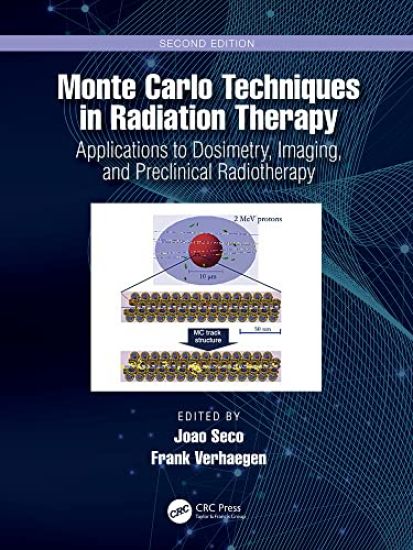
Monte Carlo Techniques in Radiation Therapy
Thoroughly updated throughout, this second edition of Monte Carlo Techniques in Radiation Therapy: Applications to Dosimetry, Imaging, and Preclinical Radiotherapy, edited by Joao Seco and Frank Verhaegen, explores the use of Monte Carlo methods for modelling various features of internal and external radiation sources.Monte Carlo methods have been heavily used in the field of radiation therapy in applications such as dosimetry, imaging, radiation chemistry, modelling of small animal irradiation units, etc. The aim of this book is to provide a compendium of the Monte Carlo methods that are commonly used in radiation therapy applications, which will allow students, postdoctoral fellows, and university professors to learn and teach Monte Carlo techniques. This book provides concise but detailed information about many Monte Carlo applications that cannot be found in any other didactic or scientific book.This second edition contains many new chapters on topics such as: Monte Carlo studies of prompt gamma emission Developments in proton imaging Monte Carlo for cone beam CT imaging Monte Carlo modelling of proton beams for small animal irradiation Monte Carlo studies of microbeam radiation therapy Monte Carlo in micro- and nano-dosimetry GPU-based fast Monte Carlo simulations for radiotherapyThis book is primarily aimed at students and scientists wishing to learn and improve their knowledge of Monte Carlo methods in radiation therapy.
Monte Carlo Techniques in Radiation Therapy
Thoroughly updated throughout, this second edition of Monte Carlo Techniques in Radiation Therapy: Applications to Dosimetry, Imaging, and Preclinical Radiotherapy, edited by Joao Seco and Frank Verhaegen, explores the use of Monte Carlo methods for modelling various features of internal and external radiation sources.Monte Carlo methods have been heavily used in the field of radiation therapy in applications such as dosimetry, imaging, radiation chemistry, modelling of small animal irradiation units, etc. The aim of this book is to provide a compendium of the Monte Carlo methods that are commonly used in radiation therapy applications, which will allow students, postdoctoral fellows, and university professors to learn and teach Monte Carlo techniques. This book provides concise but detailed information about many Monte Carlo applications that cannot be found in any other didactic or scientific book.This second edition contains many new chapters on topics such as: Monte Carlo studies of prompt gamma emission Developments in proton imaging Monte Carlo for cone beam CT imaging Monte Carlo modelling of proton beams for small animal irradiation Monte Carlo studies of microbeam radiation therapy Monte Carlo in micro- and nano-dosimetry GPU-based fast Monte Carlo simulations for radiotherapyThis book is primarily aimed at students and scientists wishing to learn and improve their knowledge of Monte Carlo methods in radiation therapy.
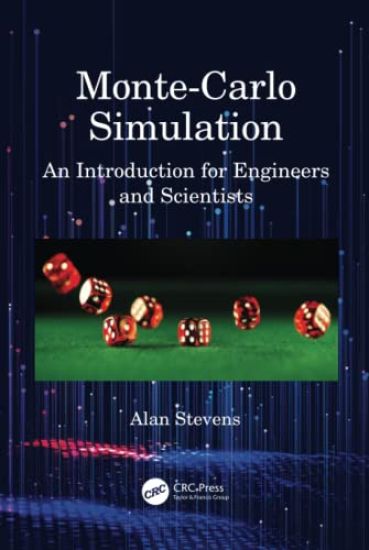
Monte-Carlo Simulation

Monte-Carlo Simulation

Alan Stevens

TAYLOR FRANCIS LTD
2022
sidottu
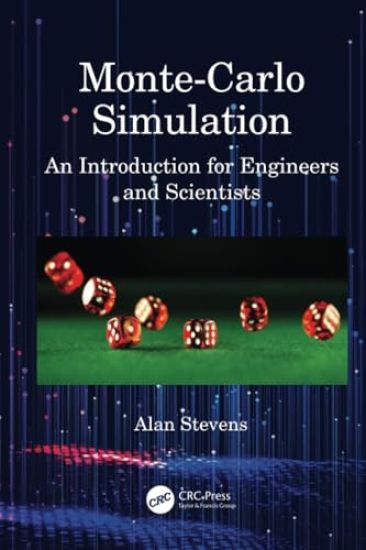
Monte-Carlo techniques have increasingly become a key method used in quantitative research. This book introduces engineers and scientists to the basics of using the Monte-Carlo simulation method which is used in Operations Research and other fields to understand the impact of risk and uncertainty in prediction and forecasting models.Monte-Carlo Simulation: An Introduction for Engineers and Scientists explores several specific applications in addition to illustrating the principles behind the methods. The question of accuracy and efficiency with using the method is addressed thoroughly within each chapter and all program listings are included in the discussion of each application to facilitate further research for the reader using Python programming language.Beginning engineers and scientists either already in or about to go into industry or commercial and government scientific laboratories will find this book essential. It could also be of interest to undergraduates in engineering science and mathematics, as well as instructors and lecturers who have no prior knowledge of Monte-Carlo simulations.
Monte-Carlo Simulation

Monte-Carlo Simulation

Alan Stevens

TAYLOR FRANCIS LTD
2024
nidottu
Monte-Carlo techniques have increasingly become a key method used in quantitative research. This book introduces engineers and scientists to the basics of using the Monte-Carlo simulation method which is used in Operations Research and other fields to understand the impact of risk and uncertainty in prediction and forecasting models.Monte-Carlo Simulation: An Introduction for Engineers and Scientists explores several specific applications in addition to illustrating the principles behind the methods. The question of accuracy and efficiency with using the method is addressed thoroughly within each chapter and all program listings are included in the discussion of each application to facilitate further research for the reader using Python programming language.Beginning engineers and scientists either already in or about to go into industry or commercial and government scientific laboratories will find this book essential. It could also be of interest to undergraduates in engineering science and mathematics, as well as instructors and lecturers who have no prior knowledge of Monte-Carlo simulations.
Monte Carlo Methods and Models in Finance and Insurance

Monte Carlo Methods and Models in Finance and Insurance

Ralf Korn; Elke Korn; Gerald Kroisandt

TAYLOR FRANCIS LTD
2023
nidottu
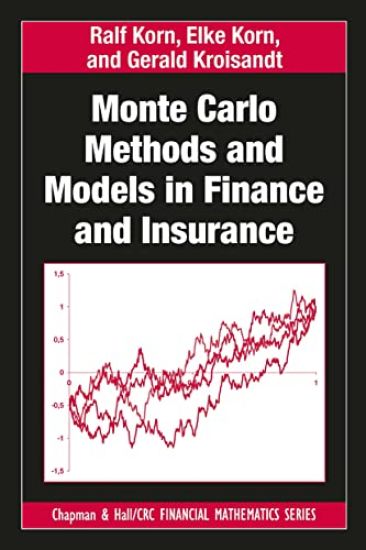
Offering a unique balance between applications and calculations, Monte Carlo Methods and Models in Finance and Insurance incorporates the application background of finance and insurance with the theory and applications of Monte Carlo methods. It presents recent methods and algorithms, including the multilevel Monte Carlo method, the statistical Romberg method, and the Heath–Platen estimator, as well as recent financial and actuarial models, such as the Cheyette and dynamic mortality models.The authors separately discuss Monte Carlo techniques, stochastic process basics, and the theoretical background and intuition behind financial and actuarial mathematics, before bringing the topics together to apply the Monte Carlo methods to areas of finance and insurance. This allows for the easy identification of standard Monte Carlo tools and for a detailed focus on the main principles of financial and insurance mathematics. The book describes high-level Monte Carlo methods for standard simulation and the simulation of stochastic processes with continuous and discontinuous paths. It also covers a wide selection of popular models in finance and insurance, from Black–Scholes to stochastic volatility to interest rate to dynamic mortality.Through its many numerical and graphical illustrations and simple, insightful examples, this book provides a deep understanding of the scope of Monte Carlo methods and their use in various financial situations. The intuitive presentation encourages readers to implement and further develop the simulation methods.
Deciphering Carlo Ginzburg

Deciphering Carlo Ginzburg

Deivy F. Carneiro; Daniel R. B. Dias

TAYLOR FRANCIS LTD
2024
sidottu
This book offers an original reading of Carlo Ginzburg’s work, tracing his trajectory in the context of Italian micro-history, his debates on the objectivity of historical knowledge, and the connection of his work to the expanded perspectives constructed in recent decades by global history.Ginzburg's theories have achieved notoriety not only in the field of history but also among the wider public. This volume uses Ginzburg’s own aesthetic and intellectual practices in its analysis, and it deciphers the elements that drove and influenced the making of his work. By highlighting the procedures that Ginzburg has constructed to respond to problems of cultural history, the book also pays close attention to Erich Auerbach and Aby Warburg, whose influences played a crucial role in reformulating Ginzburg’s conception of micro-history. From there, the volume demonstrates the radicality of Ginzburg's micro-history through the discussion of some of his most recent contributions to international historiographical debates.Thought-provoking and thoroughly researched, Deciphering Carlo Ginzburg is an innovative study in Ginzburg’s methods and theories.