Kirjojen hintavertailu. Mukana 12 390 323 kirjaa ja 12 kauppaa.

Kirjahaku

Etsi kirjoja tekijän nimen, kirjan nimen tai ISBN:n perusteella.

1000 tulosta hakusanalla Emanuel Herrmann

Documents Concerning The Life And Character Of Emanuel Swedenborg; Volume 3
This work has been selected by scholars as being culturally important, and is part of the knowledge base of civilization as we know it. This work was reproduced from the original artifact, and remains as true to the original work as possible. Therefore, you will see the original copyright references, library stamps (as most of these works have been housed in our most important libraries around the world), and other notations in the work.This work is in the public domain in the United States of America, and possibly other nations. Within the United States, you may freely copy and distribute this work, as no entity (individual or corporate) has a copyright on the body of the work.As a reproduction of a historical artifact, this work may contain missing or blurred pages, poor pictures, errant marks, etc. Scholars believe, and we concur, that this work is important enough to be preserved, reproduced, and made generally available to the public. We appreciate your support of the preservation process, and thank you for being an important part of keeping this knowledge alive and relevant.
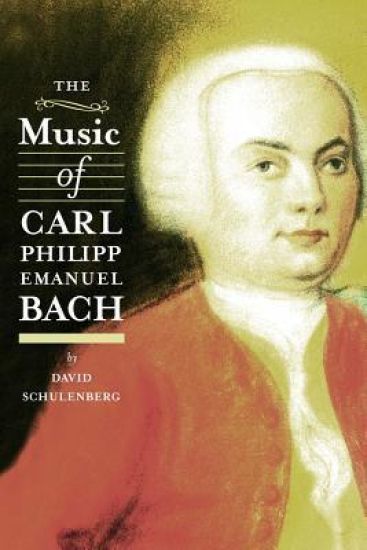
The Music of Carl Philipp Emanuel Bach

The Music of Carl Philipp Emanuel Bach

David Schulenberg

University of Rochester Press
2014
sidottu
In this first comprehensive examination of the music of the most prolific Bach son, David Schulenberg offers new perspectives on the career, style, and originality of Carl Philipp Emanuel Bach. Of Bach's four sons who became composers, Carl Philipp Emanuel Bach (1714-88) was the most prolific, the most original, and the most influential both during and after his lifetime. This is the first comprehensive study of his music, examining not only the famous keyboard sonatas and concertos but also the songs, the chamber music, and the sacred works, many of which resurfaced only recently and have not previously been evaluated. A compositional biography,the book surveys C. P. E. Bach's extensive output of nearly a thousand works while tracing his musical development-from his student days at Leipzig and Frankfurt (Oder), through his nearly three decades as court musician to Prussian King Frederick "the Great," to his final twenty years as cantor and music director at Hamburg. David Schulenberg, author of important books on the music of J. S. Bach and his first son, W. F. Bach, here considers the legacy of the second son from a compelling new perspective. Focusing on C. P. E. Bach's compositional choices within his social and historical context, Schulenberg shows how C. P. E. Bach deliberately avoided his father's style whileborrowing from the manner of his Berlin colleagues, who were themselves inspired by Italian opera. Schulenberg also shows how C. P. E. Bach, now best known for his virtuoso keyboard works, responded to changing cultural and aesthetic trends by refashioning himself as a writer of vocal music and popular chamber compositions. Audio versions of the book's musical examples, as well as further examples and supplementary tables and texts, are available on a companion website. David Schulenberg is professor of music at Wagner College and teaches historical performance at the Juilliard School. He is the author of The Music of Wilhelm Friedemann Bach (University of Rochester Press, 2010).
Die theologische Deutung des Todes bei Emanuel Hirsch

Die theologische Deutung des Todes bei Emanuel Hirsch

Anna-Maria Herta Klassen

Mohr Siebeck
2018
nidottu
Emanuel Hirschs theologischer Ansatz zeichnet sich durch das Bestreben aus, evangeliumsgemäß und zugleich den Bedingungen der Moderne verpflichtet zu sein. Anna-Maria Klassen entfaltet seine an diesem Maßstab ausgerichtete Transformation der Eschatologie, deren Thema das Verhältnis des Einzelnen zu seinem Tod ist. Hirschs Todesdeutung überzeugt, weil sie die Negativität des Todes mit dem christlichen Gottesbild verbindet. Auch der Glaubende kann sich über das Jenseits des Todes nicht sicher sein. Er steht in der unauflöslichen Spannung zwischen Vollendungsgewissheit und Todesangst. Gott wird zugleich als der Gnädige und der Richtende erfahren. Hirsch liefert mit verschiedenen Formen der Todesangst eine Phänomenologie der modernen Gerichtserfahrung. Diese ist, wie die Autorin in drei exemplarischen Skizzen zeigt, auch für die Reflexion über gegenwärtige glaubenspraktische Fragen hilfreich.