Kirjojen hintavertailu. Mukana 11 717 486 kirjaa ja 12 kauppaa.

Kirjahaku

Etsi kirjoja tekijän nimen, kirjan nimen tai ISBN:n perusteella.

1000 tulosta hakusanalla Felix Geronimo

Félix et moi À la recherche du patrimoine

Félix et moi À la recherche du patrimoine

Jill A Culiner

Association Boule d
2022
pokkari
F lix Desille (1869-1952) peintre amateur, passa soixante-deux ans sillonner le d partement de la Mayenne. Quand il tait inspir par un b timent remarquable - par son ge, son histoire, sa beaut , son originalit ou par la n cessit de le pr server - il en faisait un croquis et l'accompagnait d'une note avis e.Plus d'un demi-si cle plus tard, l'artiste Jill Culiner, accompagn e de Bernard Tisserand, est partie la recherche du patrimoine recens et dessin par Desille. Et ils ont constat que ces anciens b timents sous pr textes de r novation et de propret ont t remplac s par des parkings, ou d form s par des mat riaux comme le b ton, l'aluminium ou le PVC. R sultat des villages tristes, sans me, des maisons banalis es, et une v g tation bien domestiqu e.
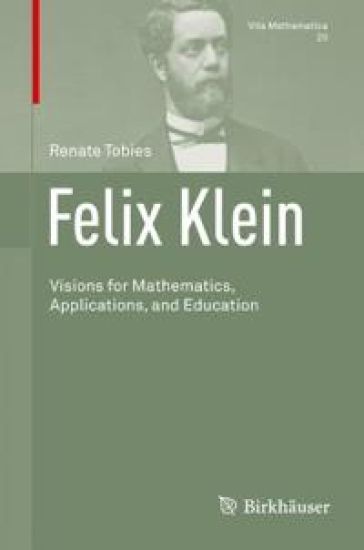
Felix Klein

Felix Klein

Renate Tobies

Springer Nature Switzerland AG
2021
sidottu
About Felix Klein, the famous Greek mathematician Constantin Carathéodory once said: “It is only by illuminating him from all angles that one can come to understand his significance.” The author of this biography has done just this. A detailed study of original sources has made it possible to uncover new connections; to create a more precise representation of this important mathematician, scientific organizer, and educational reformer; and to identify misconceptions.Because of his edition of Julius Plücker’s work on line geometry and due to his own contributions to non-Euclidean geometry, Klein was already well known abroad before he received his first full professorship at the age of 23. By exchanging ideas with his most important cooperation partner, the Norwegian Sophus Lie, Klein formulated his Erlangen Program. Various other visionary programs followed, in which Klein involved mathematicians from Germany and abroad. Klein was the most active promoter of Riemann’s geometric-physical approach to function theory, but he also integrated the analytical approaches of the Weierstrass school into his arsenal of methods.Klein was a citizen of the world who repeatedly travelled to France, Great Britain, Italy, the United States, and elsewhere. Despite what has often been claimed, it must be emphasized that Klein expressly opposed national chauvinism. He promoted mathematically gifted individuals regardless of their nationality, religion, or gender. Many of his works have been translated into English, French, Italian, Russian, and other languages; more than 300 supporters from around the world made it possible for his portrait to be painted by the prominent impressionist Max Liebermann.Inspired by international developments, Klein paved the way for women to work in the field of mathematics. He was instrumental in reforming mathematical education, and he endorsed an understanding of mathematics that affirmed its cultural importance as well as itsfundamental significance to scientific and technological progress.
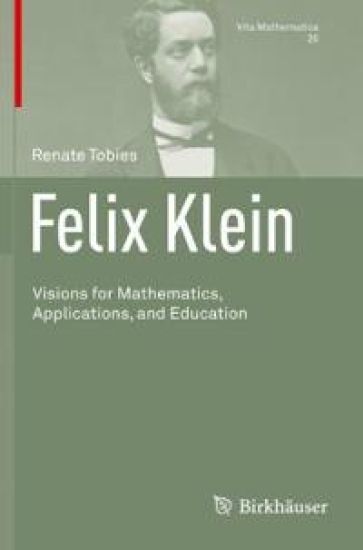
Felix Klein

Felix Klein

Renate Tobies

Springer Nature Switzerland AG
2022
nidottu
About Felix Klein, the famous Greek mathematician Constantin Carathéodory once said: “It is only by illuminating him from all angles that one can come to understand his significance.” The author of this biography has done just this. A detailed study of original sources has made it possible to uncover new connections; to create a more precise representation of this important mathematician, scientific organizer, and educational reformer; and to identify misconceptions.Because of his edition of Julius Plücker’s work on line geometry and due to his own contributions to non-Euclidean geometry, Klein was already well known abroad before he received his first full professorship at the age of 23. By exchanging ideas with his most important cooperation partner, the Norwegian Sophus Lie, Klein formulated his Erlangen Program. Various other visionary programs followed, in which Klein involved mathematicians from Germany and abroad. Klein was the most active promoter of Riemann’s geometric-physical approach to function theory, but he also integrated the analytical approaches of the Weierstrass school into his arsenal of methods.Klein was a citizen of the world who repeatedly travelled to France, Great Britain, Italy, the United States, and elsewhere. Despite what has often been claimed, it must be emphasized that Klein expressly opposed national chauvinism. He promoted mathematically gifted individuals regardless of their nationality, religion, or gender. Many of his works have been translated into English, French, Italian, Russian, and other languages; more than 300 supporters from around the world made it possible for his portrait to be painted by the prominent impressionist Max Liebermann.Inspired by international developments, Klein paved the way for women to work in the field of mathematics. He was instrumental in reforming mathematical education, and he endorsed an understanding of mathematics that affirmed its cultural importance as well as itsfundamental significance to scientific and technological progress.
Felix Hausdorff

Felix Hausdorff

Egbert Brieskorn; Walter Purkert

BIRKHAUSER VERLAG AG
2024
sidottu
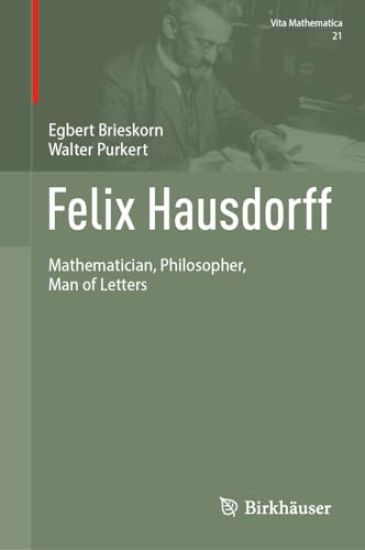
Felix Hausdorff is a singular phenomenon in the history of science. As a mathematician, he played a major role in shaping the development of modern mathematics in the 20th century. He founded general topology as an independent mathematical discipline, while enriching set theory with a number of fundamental concepts and results. His general approach to measure and dimension led to profound developments in numerous mathematical disciplines, and today Hausdorff dimension plays a central role in fractal theory with its many fascinating applications by means of computer graphics. Hausdorff ’s remarkable mathematical versatility is reflected in his published work: today, no fewer than thirteen concepts, theorems and procedures carry his name. Yet he was not only a creative mathematician – Hausdorff was also an original philosophical thinker, a poet, essayist and man of letters. Under the pseudonym Paul Mongré, he published a volume of aphorisms, an epistemological study, abook of poetry, an oft-performed play, and a number of notable essays in leading literary journals. As a Jew, Felix Hausdorff was increasingly persecuted and humiliated under the National Socialist dictatorship. When deportation to a concentration camp was imminent, he, along with his wife and sister-in law, decided to take their own lives. This book will be of interest to historians and mathematicians already fascinated by the rich life of Felix Hausdorff, as well as to those readers who wish to immerse themselves in the intricate web of intellectual and political transformations during this pivotal period in European history.
Felix Hausdorff

Felix Hausdorff

Egbert Brieskorn; Walter Purkert

BIRKHAUSER VERLAG AG
2025
nidottu
Felix Hausdorff is a singular phenomenon in the history of science. As a mathematician, he played a major role in shaping the development of modern mathematics in the 20th century. He founded general topology as an independent mathematical discipline, while enriching set theory with a number of fundamental concepts and results. His general approach to measure and dimension led to profound developments in numerous mathematical disciplines, and today Hausdorff dimension plays a central role in fractal theory with its many fascinating applications by means of computer graphics. Hausdorff ’s remarkable mathematical versatility is reflected in his published work: today, no fewer than thirteen concepts, theorems and procedures carry his name. Yet he was not only a creative mathematician – Hausdorff was also an original philosophical thinker, a poet, essayist and man of letters. Under the pseudonym Paul Mongré, he published a volume of aphorisms, an epistemological study, abook of poetry, an oft-performed play, and a number of notable essays in leading literary journals. As a Jew, Felix Hausdorff was increasingly persecuted and humiliated under the National Socialist dictatorship. When deportation to a concentration camp was imminent, he, along with his wife and sister-in law, decided to take their own lives. This book will be of interest to historians and mathematicians already fascinated by the rich life of Felix Hausdorff, as well as to those readers who wish to immerse themselves in the intricate web of intellectual and political transformations during this pivotal period in European history.