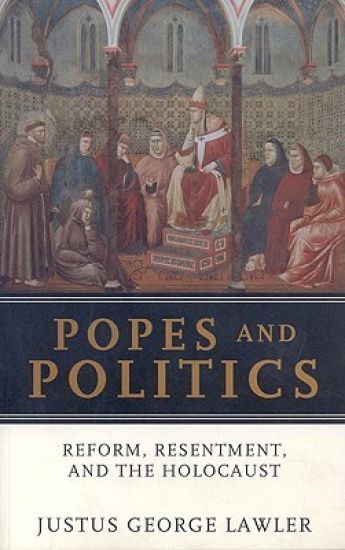
In the last three decades, many books have been published on the role of the Vatican in the modern world. Popes and Politics shows that many recent authors, whether devoted or antagonistic to the papacy, have been guilty of factual distortions and biased interpretations that lead to a flawed picture of the Church and its relation to contemporary society. Among the authors analyzed are James Carroll, John Cornwell, Margherita Marchione, Ralph McInerny, Michael Phayer, Garry Willas and Susan Zuccotti. Lawler cites 'chapter and verse' to illustrate that many of these critics are doing to the church what the Church historically did to the Jews - methodically scapegoating an imaginary enemy.
Elected an unprecedented four times to the presidency, Franklin D. Roosevelt led the United States through some of the most dramatic and trying foreign and domestic episodes in its history. Coming to power in the throws of a crippling depression, Roosevelt quickly found himself having to juggle the need for tremendous domestic revitalization in a world menaced by burgeoning aggressor states. In Debating Franklin D. Roosevelt's Foreign Policies, noted historians Justus D. Doenecke and Mark A. Stoler offer differing perspectives on the Roosevelt years, finding disparate meanings from common data. Finding Roosevelt astute at choosing the most effective option of those available, Stoler generally defends FDR's policies against their traditional critics. Conversely, Doenecke emphasizes a dangerous shallowness and superficiality in FDR's approach to foreign affairs, particularly in his first two terms. The contrary viewpoints of the authors, supplemented by carefully chosen documents, provide an ideal introduction allowing readers to examine the issues and draw their own conclusions about Franklin Roosevelt's foreign policy.
This work provides an accessible introduction to Hegel's logic. The text is suitable for students about to embark on the study of this most challenging subject, as well as readers at any level of sophistication.
Justus Hartnack provides a highly accessible, philosopically astute Introduction to Hegel's Logic, one of those rare books that rewards readers at any level of sophistication, and the ideal text for students about to embark on the study of this challenging topic.
A reprint of the Macmillan edition of 1968. While most interpretive studies of the Critique of Pure Reason are either too scholarly or too superficial to be of practical use to students, Hartnack has achieved a concise comprehensive analysis of the work in a lucid style that communicates the essence of extraordinarily complex arguments in the simplest possible way. An ideal companion to the First Critique , especially for those grappling with the work for the first time.
A reprint of the Macmillan edition of 1968. While most interpretive studies of the Critique of Pure Reason are either too scholarly or too superficial to be of practical use to students, Hartnack has achieved a concise comprehensive analysis of the work in a lucid style that communicates the essence of extraordinarily complex arguments in the simplest possible way. An ideal companion to the First Critique , especially for those grappling with the work for the first time.
Our world is one of many. They bleed into each other, spawning horrors and threatening apocalyptic consequences. Humans with god-like powers pass through society without notice, healing the wounds of bleeding worlds. A seemingly never-ending cycle of chaos and order. Some tire of this stagnant dance. They want change--or they want destruction. Gwynn Dormath knows none of this. He's simply a kid going through the motions of his day, but a mysterious accident leaves him injured, confused, and able to see our world's wounds. And they are spreading.
Suture. An organization created by immortals who once walked the Earth as Gods. A place containing eras worth of secret agendas.Gwynn joins believing he will learn about his abilities, assisting to protect the world from the Veil.Instead, he finds an ancient evil stalking him. A face from his past shows up in an unexpected place. And ghosts that prove to be very much alive.Faith, friendship, family. All are tested within Suture.Book Two of The Bleeding Worlds Series
Trillions of existences wiped out in a single moment. The remaining worlds left battered and bleeding. At the center of the disaster stands Gwynn Dormath. He has been called both a hero and a harbinger of the end of all things. A single boy thrust unwittingly into a game of old gods and ancient horrors. Now, injured both in body and mind, if he hopes to save the ones he loves, he must undertake his most perilous and strange journey. Between all things lies the Veil. Home of the souls of humanity and the power source for all Anunnaki, it is a place of great power and even greater danger. If Gwynn is to move forward, he must plunge into its murkiest depths and face not only its own guardians, but the darkness within himself. Meanwhile, the former members of Suture fight to find their own place in these damaged worlds. As alliances are formed and new enemies battled, they inch forward to a conflict only prophecies and myths could predict, or hope to understand.
A broken family, racing across worlds to reunite with their stolen daughter. A man so old, angry, and tired that he would rather destroy all of existence than play by its rules. An All-Father so obsessed with his vision of a better world, he would sacrifice anything for its achievement. A race to obtain godhood. An oppressed people on a mission to free themselves from their nightmares and rise up in a conflict foretold by prophecy. An end to The Bleeding Worlds.
How does a trained physician beat terminal cancer when he, himself, gets it?- The answer will both shock and surprise you, as it is often NOT the same treatment that physicians prescribe for their patients. - Dr.Hope takes you through successful survival stories of doctor after doctor -and he explains how they did it - how they conquered their own terminal cancers. - This book explains in easy-to-understand words the science behind repurposed drugs, commonly used pills already in your medicine cabinet that can kill cancer stem cells, the roots of cancer. Cancer stem cells are STIMULATED to REGROW and SPREAD and create resistance by standard treatments of chemotherapy, surgery, and radiation - THIS is the reason "cancers return and kill patients almost half the time."- There are ways to stop cancer stem cells and he explains them in the book.Dr. Hope wrote this book to help save his friend's life from Glioblastoma, the most aggressive form of brain cancer. Butit can also help anyone suffering from terminal cancer. He now shares all of what he found with you: - Which repurposed drug cocktails to add- Which diet changes to make- Which exercises to do- Which supplements to add- About IV Vitamin C- About Fasting- About IV Vitamin DAll of this is supported by MAINSTREAM SCIENCE. - The book has been praised by cancer researchers around the world: - "I consider this a great work." by Marc-Eric Halatsch, MD, PhD, Head, Brain Tumor Research, Ulm University Hospital- "This is a monumental treatise which should educate and inform...and be of immense benefit to patients with cancer..." George Fareed, MD. Former Assistant Professor Harvard Medical School, Soma Weiss Award for DNA Research- "This book is an important resource for all cancer patients." Ben Williams PhD, 25 year survivor of Glioblastoma and Professor Emeritus at UC San DiegoThis book was written specifically for Dr. Hope's colleague of 30 years to help save him from terminal brain cancer. It can offer ADDITIONAL strategies that can make the difference for anyone suffering from terminal cancer. "This book should be required reading for all patients when they start chemotherapy." Justus Hope, M.D.
How does a trained physician beat terminal cancer when he, himself, gets it?- The answer will both shock and surprise you, as it is often NOT the same treatment that physicians prescribe for their patients. - Dr. Hope takes you through successful survival stories of doctor after doctor - and he explains how they did it - how they conquered their own terminal cancers. - This book explains in easy-to-understand words the science behind repurposed drugs, commonly used pills already in your medicine cabinet that can kill cancer stem cells, the roots of cancer. Cancer stem cells are STIMULATED to REGROW and SPREAD and create resistance by standard treatments of chemotherapy, surgery, and radiation - THIS is the reason "cancers return and kill patients almost half the time."- There are ways to stop cancer stem cells and he explains them in the book.Dr. Hope wrote this book to help save his friend's life from Glioblastoma, the most aggressive form of brain cancer. But it can also help anyone suffering from terminal cancer. He now shares all of what he found with you: - Which repurposed drug cocktails to add- Which diet changes to make- Which exercises to do- Which supplements to add- About IV Vitamin C- About Fasting- About IV Vitamin DAll of this is supported by MAINSTREAM SCIENCE. - The book has been praised by cancer researchers around the world: - "I consider this a great work." by Marc-Eric Halatsch, MD, PhD, Head, Brain Tumor Research, Ulm University Hospital- "This is a monumental treatise which should educate and inform...and be of immense benefit to patients with cancer..." George Fareed, MD. Former Assistant Professor Harvard Medical School, Soma Weiss Award for DNA Research- "This book is an important resource for all cancer patients." Ben Williams PhD, 25 year survivor of Glioblastoma and Professor Emeritus at UC San DiegoThis book was written specifically for Dr. Hope's colleague of 30 years to help save him from terminal brain cancer. It can offer ADDITIONAL strategies that can make the difference for anyone suffering from terminal cancer. "This book should be required reading for all patients when they start chemotherapy." Justus Hope, M.D.BONUS MATERIAL An Informed Consent Form for your doctor to provide when requesting repurposed drug prescriptions A listing of 310 different off-label FDA-approved drugs that have anti-tumor effectsA section on Repurposed Drugs that are effective against the CoronavirusThe famous "Open Letter to Dr. Anthony Fauci" authored by Harvard-trained Dr. George Fareed and discussed in the news
The Coffee Cure Diet is a four-pillar weight loss program designed to lower insulin resistance. It secondarily reduces oxidation and inflammation which in turn reduce risks for related diseases such as heart, stroke, dementia, cancer, diabetes, hypertension, obesity, and overweight. It produces a loss of visceral fat while encouraging the strengthening of bone and muscle. It helps prevent the progression of pre-hypertension to hypertension and the progression of pre-diabetes to diabetes.The book is divided into three sections, the first introduces the Coffee Cure Diet against a backdrop of the Metabolic Syndrome, a chapter on the genetics of obesity, and finally the fundamentals of the Coffee Cure Diet, including an introduction to the four pillars and the four phases.The second section contains a detailed review of the medical effects of the four pillars on ten different organ systems including the brain, heart, pancreas, liver, skin, bones, kidneys, cells, mind, and body. The final section deals with fine-tuning or details of the Coffee Cure for those people who wish to master all four phases.Section three is highlighted by a discussion of various cancer-preventing strategies that leverage the four pillars to maximum life-extending benefit. The book is followed by an Afterword section on the effects of the diet on global warming and an appendix detailing the Shopping List, a recommended grocery purchase summary that the author and his wife personally use.There are additional appendices covering Frequently Asked Questions and Myths and Misconceptions. Finally, there is a 400-word Glossary of terms that helps a non-scientist understand Section II, and an easy-to-read set of References where an interested reader can check the sources.
Explore the foundations of modern chemistry with "Familiar Letters on Chemistry," a timeless collection of correspondence from the renowned scientist Justus Liebig. This meticulously prepared edition offers a unique window into the development of chemical thought and industrial processes during a pivotal era in scientific history. Through these letters, Liebig elucidates complex chemical concepts in an accessible manner, revealing the intricate relationships between chemistry and everyday life. Readers will gain insights into the scientific debates and discoveries that shaped the field, as well as Liebig's own contributions to agricultural and industrial chemistry. Perfect for anyone interested in the history of science, chemistry, or the evolution of scientific thought, this volume presents a fascinating perspective on the enduring legacy of one of chemistry's most influential figures. Discover the insights that propelled scientific understanding and continue to resonate today.This work has been selected by scholars as being culturally important, and is part of the knowledge base of civilization as we know it.This work is in the public domain in the United States of America, and possibly other nations. Within the United States, you may freely copy and distribute this work, as no entity (individual or corporate) has a copyright on the body of the work.Scholars believe, and we concur, that this work is important enough to be preserved, reproduced, and made generally available to the public. We appreciate your support of the preservation process, and thank you for being an important part of keeping this knowledge alive and relevant.







![The Hanson Family From Roger De Rastrich, 1251, to the Change of Name by English Parliment [sic] in 1330, Down to Thomas Hanson, 1568 (the Emigrant) a](/covers/9781014153111.jpg)