

Kirjahaku
Etsi kirjoja tekijän nimen, kirjan nimen tai ISBN:n perusteella.
1000 tulosta hakusanalla Max Well

Peter Maxwell Davies
VDM Publishing House
2010
nidottu
Observera att förlaget som ger ut denna produkt baserar innehållet i sina produkter på fria källor som Wikipedia. Boken är med stor sannolikhet endast ett utdrag ur dessa informationskällor, alltså inte en vanlig bok i den bemärkelsen.

Wally Maxwell
VDM Publishing House
2010
nidottu
Observera att förlaget som ger ut denna produkt baserar innehållet i sina produkter på fria källor som Wikipedia. Boken är med stor sannolikhet endast ett utdrag ur dessa informationskällor, alltså inte en vanlig bok i den bemärkelsen.

Anna Maxwell Martin
Vertpress
2012
nidottu

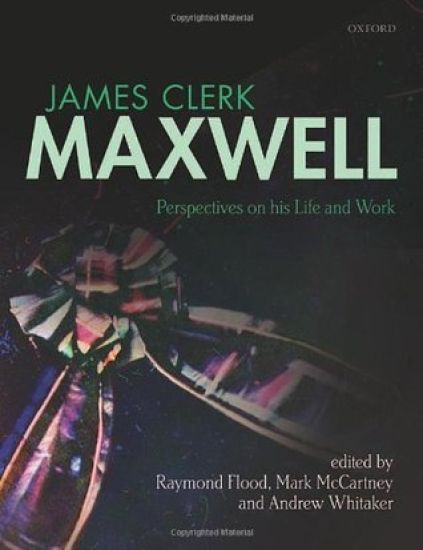
James Clerk Maxwell
Oxford University Press
2014
sidottu
James Clerk Maxwell (1831-1879) had a relatively brief, but remarkable life, lived in his beloved rural home of Glenlair, and variously in Edinburgh, Aberdeen, London and Cambridge. His scholarship also ranged wide - covering all the major aspects of Victorian natural philosophy. He was one of the most important mathematical physicists of all time, coming only after Newton and Einstein. In scientific terms his immortality is enshrined in electromagnetism and Maxwell's equations, but as this book shows, there was much more to Maxwell than electromagnetism, both in terms of his science and his wider life. Maxwell's life and contributions to science are so rich that they demand the expertise of a range of academics - physicists, mathematicians, and historians of science and literature - to do him justice. The various chapters will enable Maxwell to be seen from a range of perspectives. Chapters 1 to 4 deal with wider aspects of his life in time and place, at Aberdeen, King's College London and the Cavendish Laboratory. Chapters 5 to 12 go on to look in more detail at his wide ranging contributions to science: optics and colour, the dynamics of the rings of Saturn, kinetic theory, thermodynamics, electricity, magnetism and electromagnetism with the concluding chapters on Maxwell's poetry and Christian faith.
Vorlesungen Über Maxwells Theorie Der Elektricität Und Des Lichtes, Part 2
Ludwig Boltzmann
Wentworth Press
2018
sidottu
General William Maxwell and the New Jersey Continentals
Harry M. Ward
Praeger Publishers Inc
1997
sidottu
The first biography of one of George Washington's most able and controversial generals examines the military career of William Maxwell from British army commissary to commander of the New Jersey Continental troops in major northern battles and campaigns and numerous confrontations with British incursionary forces into New Jersey. As Washington's first commander of the light infantry troops, Maxwell had crucial roles in the battles of Cooch's Bridge (Iron Hill), Brandywine, Germantown, Monmouth, and Springfield, and led the New Jersey brigade in the Sullivan Indian expedition. Maxwell and his brigade frequently served as a probing arm for Washington's army. This book addresses the role of Maxwell as commander and describes the participation and ordeals of his New Jersey brigade. It offers insights into the quality of leadership both of Washington and the officer corps in general, giving a rare view of the Revolutionary War at the brigade level and the politics of command.
From the Preface. THE task of giving some account of Maxwell's work -- of describing the share that he has taken in the advance of Physical Science during the latter halt of this nineteenth century -- has proved no light labour. The problems which he attacked are of such magnitude and complexity, that the attempt to explain them and their importance, satisfactorily, without the aid of symbols, is almost foredoomed to failure. However, the attempt has been made, in the belief that there are many who, though they cannot follow the mathematical analysis of Maxwell's work, have sufficient general knowledge of physical ideas and principles to make an account of Maxwell and of the development of the truths that he discovered, subjects of intelligent interest. Maxwell's life was written in 1882 by two of those who were most intimately connected with him, Professor Lewis Campbell and Dr. Garnett. Many of the biographical details of the earlier part of this book are taken from their work....

A William Maxwell Portrait
WW Norton Co
2004
sidottu
William Maxwell, who died in July 2000, was revered as one of the twentieth century's great American writers and a longtime fiction editor at The New Yorker. Now writers who knew Maxwell and were inspired by him—both the man and his work—offer intimate essays, most specifically written for this volume, that "bring him back to life, right there in front of us." Alec Wilkinson writes of Maxwell as mentor; Edward Hirsch remembers him in old age; Charles Baxter illuminates the magnificent novel So Long, See You Tomorrow; Ben Cheever recalls Maxwell and his own father; Donna Tartt vividly describes Maxwell's kindness to herself as a first novelist; and Michael Collier admires him as a supreme literary correspondent. Other appreciations include insightful pieces by Alice Munro, Anthony Hecht, a poem by John Updike, and a brief tribute from Paula Fox. Ending this splendid collection is Maxwell himself, in the unpublished speech "The Writer as Illusionist."

The Scientific Letters and Papers of James Clerk Maxwell: Volume 1, 1846–1862
James Clerk Maxwell
Cambridge University Press
2009
pokkari
This is a comprehensive edition of Maxwell's manuscript papers published virtually complete and largely for the first time. Maxwell's work was of central importance in establishing and developing the major themes of the physics of the nineteenth century: his theory of the electromagnetic field and the electromagnetic theory of light and his special place in the history of physics. His fecundity of imagination and the sophistication of his examination of the foundations of physics give particular interest and importance to his writings. Volume I: 1846–1862 documents Maxwell's education and early scientific work and his major period of scientific innovation - his first formulation of field theory, the electromagnetic theory of light and the statistical theory of gases. Important letters and manuscript drafts illuminate this fundamental early work and the volume includes his letters to friends and family, general essays and lectures and juvenilia.

The Scientific Letters and Papers of James Clerk Maxwell: Volume 3, 1874–1879
James Clerk Maxwell
Cambridge University Press
2002
sidottu
This is a comprehensive edition of Maxwell's manuscript papers published virtually complete and largely for the first time. Maxwell's work was of central importance in establishing and developing the major themes of the physics of the nineteenth century: his theory of the electromagnetic field and the electromagnetic theory of light and his special place in the history of physics. His fecundity of imagination and the sophistication of his examination of the foundations of physics give particular interest and importance to his writings. Volume III: 1874–1879 covers the period of Maxwell's direction of the Cavendish Laboratory and documents the espousal of his theories by a wider circle of physicists. During this last period of his life his work began to achieve the pre-eminence in the classical physics of the nineteenth century, which it has retained ever since.
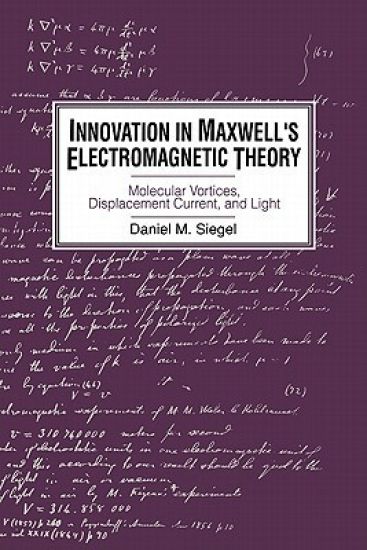
Innovation in Maxwell's Electromagnetic Theory
Daniel M. Siegel
Cambridge University Press
2003
pokkari
James Clerk Maxwell’s (1831–1879) contributions to twentieth-century science and technology - in particular, the displacement current and the electromagnetic theory of light - are among the most spectacular innovations in the history of physics, but the technical complexities and thematic subtleties of his work have been difficult to unravel. In considering the historical development of Maxwell’s work, Dr Siegel’s close analysis of the original texts - with careful attention to the equations as well as to the words - reveals that mechanical modeling played a crucial role in Maxwell’s initial conceptualizations of the displacement current and the electromagnetic character of light. Beyond this, Siegel locates Maxwell’s work in the full sweep of nineteenth-century electromagnetic theory - from Oersted, Ampere, and Faraday, through Hertz and Lorentz - and in the context of the methodological traditions and perspectives of early physics research at the Universities of Edinburgh and Cambridge.
The Scientific Letters and Papers of James Clerk Maxwell 3 Volume Paperback Set (5 physical parts)
James Clerk Maxwell
Cambridge University Press
2008
muu
Originally published between 1990 and 2002 this set is now available in paperback for the first time. This is a comprehensive edition of Maxwell's manuscript papers, published in a virtually complete form. Maxwell's work was of central importance in establishing and developing the major themes of the physics of the nineteenth century. His theory of the electromagnetic field and the electromagnetic theory of light, and his development of statistical molecular theory, have established his special place in the history of physics. His fecundity of imagination and the sophistication of his examination of the foundation of physics give particular interest and importance to his writings. This edition includes Maxwell's letters to William Thomson (Lord Kelvin), Michael Faraday, George Gabriel Stokes, Lord Rayleigh, Peter Guthrie Tait, and many other physicists, mathematicians and scholars. These letters, together with numerous drafts of his published scientific papers and reports on papers submitted to the Royal Society, illuminate his scientific thought, providing a unique perspective on classical physics at a crucial stage in its development.

LIFE OF MAXWELL ANDERSON
RowmanLittlefield
2035
sidottu


A probing, comedic exploration of Passover and its food and culture in one Midwestern family. These poems navigate tradition and commercialism while highlighting the Jewish enclaves of Cleveland, Ohio.
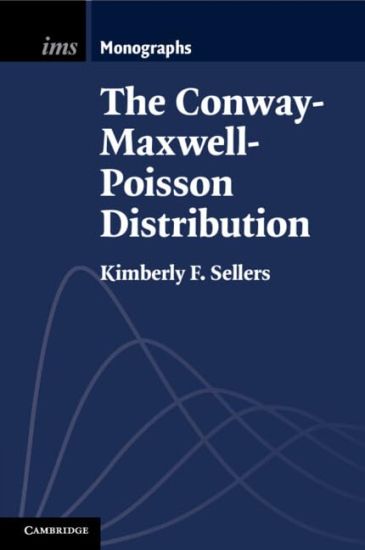
While the Poisson distribution is a classical statistical model for count data, the distributional model hinges on the constraining property that its mean equal its variance. This text instead introduces the Conway-Maxwell-Poisson distribution and motivates its use in developing flexible statistical methods based on its distributional form. This two-parameter model not only contains the Poisson distribution as a special case but, in its ability to account for data over- or under-dispersion, encompasses both the geometric and Bernoulli distributions. The resulting statistical methods serve in a multitude of ways, from an exploratory data analysis tool, to a flexible modeling impetus for varied statistical methods involving count data. The first comprehensive reference on the subject, this text contains numerous illustrative examples demonstrating R code and output. It is essential reading for academics in statistics and data science, as well as quantitative researchers and data analysts in economics, biostatistics and other applied disciplines.
