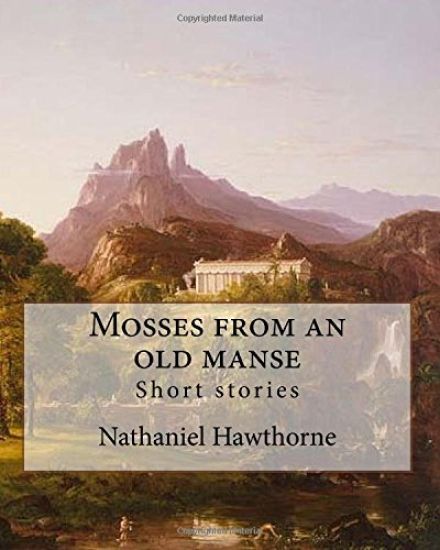
Mosses from an Old Manse is a short story collection by Nathaniel Hawthorne, first published in 1846. Background and publication history edit] The collection includes several previously-published short stories, and was named in honor of The Old Manse where Hawthorne and his wife lived for the first three years of their marriage. The first edition was published in 1846. Hawthorne seems to have been paid $75 for the publication. Critical reception After the book's first publication, Hawthorne sent copies to critics including Margaret Fuller, Rufus Wilmot Griswold, Edgar Allan Poe, and Henry Theodore Tuckerman.Poe responded with a lengthy review in which he praised Hawthorne's writing but faulted him for associating with New England journals, Ralph Waldo Emerson, and the Transcendentalists. He wrote, "Let him mend his pen, get a bottle of visible ink, come out from the Old Manse, cut Mr. Alcott, hang (if possible) the editor of 'The Dial, ' and throw out of the window to the pigs all his odd numbers of the North American Review. A young Walt Whitman wrote that Hawthorne was underpaid, and it was unfair that his book competed with imported European books. He asked, "Shall real American genius shiver with neglect while the public runs after this foreign trash?" Generally, most contemporary critics praised the collection and considered it better than Hawthorne's earlier collection, Twice-Told Tales. Regarding the second edition, published in 1854, Hawthorne wrote to publisher James Thomas Fields that he no longer understood the messages he was sending in these stories. He shared, "I remember that I always had a meaning-or, at least, thought I had", and noted, "Upon my honor, I am not quite sure that I entirely comprehend my own meaning in some of these blasted allegories... I am a good deal changed since those times; and to tell you the truth, my past self is not very much to my taste, as I see in this book.".......................................... Nathaniel Hawthorne ( born Nathaniel Hathorne; July 4, 1804 - May 19, 1864) was an American novelist, dark romantic, and short story writer. He was born in 1804 in Salem, Massachusetts to Nathaniel Hathorne and the former Elizabeth Clarke Manning. His ancestors include John Hathorne, the only judge involved in the Salem witch trials who never repented of his actions. He entered Bowdoin College in 1821, was elected to Phi Beta Kappa in 1824, and graduated in 1825. He published his first work in 1828, the novel Fanshawe; he later tried to suppress it, feeling that it was not equal to the standard of his later work. He published several short stories in periodicals, which he collected in 1837 as Twice-Told Tales. The next year, he became engaged to Sophia Peabody. He worked at the Boston Custom House and joined Brook Farm, a transcendentalist community, before marrying Peabody in 1842. The couple moved to The Old Manse in Concord, Massachusetts, later moving to Salem, the Berkshires, then to The Wayside in Concord. The Scarlet Letter was published in 1850, followed by a succession of other novels. A political appointment as consul took Hawthorne and family to Europe before their return to Concord in 1860. Hawthorne died on May 19, 1864, and was survived by his wife and their three children. Much of Hawthorne's writing centers on New England, many works featuring moral metaphors with an anti-Puritan inspiration. His fiction works are considered part of the Romantic movement and, more specifically, dark romanticism. His themes often center on the inherent evil and sin of humanity, and his works often have moral messages and deep psychological complexity. His published works include novels, short stories, and a biography of his college friend Franklin Pierce, the 14th President of the United States...........
Nathaniel Hawthorne ( born Nathaniel Hathorne; July 4, 1804 - May 19, 1864) was an American novelist, dark romantic, and short story writer. He was born in 1804 in Salem, Massachusetts to Nathaniel Hathorne and the former Elizabeth Clarke Manning. His ancestors include John Hathorne, the only judge involved in the Salem witch trials who never repented of his actions. He entered Bowdoin College in 1821, was elected to Phi Beta Kappa in 1824, and graduated in 1825. He published his first work in 1828, the novel Fanshawe; he later tried to suppress it, feeling that it was not equal to the standard of his later work. He published several short stories in periodicals, which he collected in 1837 as Twice-Told Tales. The next year, he became engaged to Sophia Peabody. He worked at the Boston Custom House and joined Brook Farm, a transcendentalist community, before marrying Peabody in 1842. The couple moved to The Old Manse in Concord, Massachusetts, later moving to Salem, the Berkshires, then to The Wayside in Concord. The Scarlet Letter was published in 1850, followed by a succession of other novels. A political appointment as consul took Hawthorne and family to Europe before their return to Concord in 1860. Hawthorne died on May 19, 1864, and was survived by his wife and their three children. Much of Hawthorne's writing centers on New England, many works featuring moral metaphors with an anti-Puritan inspiration. His fiction works are considered part of the Romantic movement and, more specifically, dark romanticism. His themes often center on the inherent evil and sin of humanity, and his works often have moral messages and deep psychological complexity. His published works include novels, short stories, and a biography of his college friend Franklin Pierce, the 14th President of the United States. In April 1846, Hawthorne was officially appointed as the "Surveyor for the District of Salem and Beverly and Inspector of the Revenue for the Port of Salem" at an annual salary of $1,200. He had difficulty writing during this period, as he admitted to Longfellow: I am trying to resume my pen ... Whenever I sit alone, or walk alone, I find myself dreaming about stories, as of old; but these forenoons in the Custom House undo all that the afternoons and evenings have done. I should be happier if I could write. This employment, like his earlier appointment to the custom house in Boston, was vulnerable to the politics of the spoils system. Hawthorne was a Democrat and lost this job due to the change of administration in Washington after the presidential election of 1848. He wrote a letter of protest to the Boston Daily Advertiser which was attacked by the Whigs and supported by the Democrats, making Hawthorne's dismissal a much-talked about event in New England. He was deeply affected by the death of his mother in late July, calling it "the darkest hour I ever lived". He was appointed the corresponding secretary of the Salem Lyceum in 1848. Guests who came to speak that season included Emerson, Thoreau, Louis Agassiz, and Theodore Parker. Hawthorne returned to writing and published The Scarlet Letter in mid-March 1850, including a preface that refers to his three-year tenure in the Custom House and makes several allusions to local politicians-who did not appreciate their treatment. It was one of the first mass-produced books in America, selling 2,500 volumes within ten days and earning Hawthorne $1,500 over 14 years.The book was pirated by booksellers in London citation needed] and became a best-seller in the United States; it initiated his most lucrative period as a writer.....
Nathaniel Hawthorne ( born Nathaniel Hathorne; July 4, 1804 - May 19, 1864) was an American novelist, dark romantic, and short story writer. He was born in 1804 in Salem, Massachusetts to Nathaniel Hathorne and the former Elizabeth Clarke Manning. His ancestors include John Hathorne, the only judge involved in the Salem witch trials who never repented of his actions. He entered Bowdoin College in 1821, was elected to Phi Beta Kappa in 1824, and graduated in 1825. He published his first work in 1828, the novel Fanshawe; he later tried to suppress it, feeling that it was not equal to the standard of his later work. He published several short stories in periodicals, which he collected in 1837 as Twice-Told Tales. The next year, he became engaged to Sophia Peabody. He worked at the Boston Custom House and joined Brook Farm, a transcendentalist community, before marrying Peabody in 1842. The couple moved to The Old Manse in Concord, Massachusetts, later moving to Salem, the Berkshires, then to The Wayside in Concord. The Scarlet Letter was published in 1850, followed by a succession of other novels. A political appointment as consul took Hawthorne and family to Europe before their return to Concord in 1860. Hawthorne died on May 19, 1864, and was survived by his wife and their three children. Much of Hawthorne's writing centers on New England, many works featuring moral metaphors with an anti-Puritan inspiration. His fiction works are considered part of the Romantic movement and, more specifically, dark romanticism. His themes often center on the inherent evil and sin of humanity, and his works often have moral messages and deep psychological complexity. His published works include novels, short stories, and a biography of his college friend Franklin Pierce, the 14th President of the United States.
Cassiop e peine se remettre du d c s pr matur de son p re. Elle se noie dans le travail, bien d cid e tenir les r nes de l'entreprise familiale. Mais tout s' croule le soir o deux hommes font irruption chez elle pour l'agresser.Bless e et terroris e, elle va devoir s'armer de courage pour faire face aux menaces qu'elle re oit. Nathaniel dirige une agence de s curit priv e. Submerg par la culpabilit depuis sept ans, il refuse toute relation amoureuse. C' tait sans compter sur sa rencontre avec la courageuse Cassiop e. Sous le charme, il r ve un avenir aupr s de la belle brune, mais un dangereux corbeau se dresse sur leur chemin et il est bien d cid la faire tomber. Nathaniel parviendra-t-il la prot ger ? _____________________________________ Landrat S curit tome 1/4Romance suspense_____________________________________★ AVIS DE LECTRICES ★ "Du suspense du d but la fin, au milieu d'une belle histoire d'amour." "Coup de coeur pour Nathaniel, j'ai ador " "Une r ussite, j'ai h te de lire les autres tomes de la saga."_____________________________________★ MOT DE L'AUTEURE ★Si vous aimez les romances suspense, alors la saga Landrat S curit est faite pour vous. De l'amour, de l'amiti , du danger, des rebondissements. Vous allez adorer d couvrir Nathaniel, Benjamin, Rebecca et les autres membres de cette famille au grand coeur.
Passages from the French and Italian Note-Books of Nathaniel Hawthorne - Vol. 2 is an unchanged, high-quality reprint of the original edition of 1871. Hansebooks is editor of the literature on different topic areas such as research and science, travel and expeditions, cooking and nutrition, medicine, and other genres. As a publisher we focus on the preservation of historical literature. Many works of historical writers and scientists are available today as antiques only. Hansebooks newly publishes these books and contributes to the preservation of literature which has become rare and historical knowledge for the future.
Passages from the American note-books of Nathaniel Hawthorne - Vol. 1 is an unchanged, high-quality reprint of the original edition of 1868. Hansebooks is editor of the literature on different topic areas such as research and science, travel and expeditions, cooking and nutrition, medicine, and other genres. As a publisher we focus on the preservation of historical literature. Many works of historical writers and scientists are available today as antiques only. Hansebooks newly publishes these books and contributes to the preservation of literature which has become rare and historical knowledge for the future.
Passages from the American note-books of Nathaniel Hawthorne - Vol. 2 is an unchanged, high-quality reprint of the original edition of 1868. Hansebooks is editor of the literature on different topic areas such as research and science, travel and expeditions, cooking and nutrition, medicine, and other genres. As a publisher we focus on the preservation of historical literature. Many works of historical writers and scientists are available today as antiques only. Hansebooks newly publishes these books and contributes to the preservation of literature which has become rare and historical knowledge for the future.