Kirjojen hintavertailu. Mukana 11 717 486 kirjaa ja 12 kauppaa.

Kirjahaku

Etsi kirjoja tekijän nimen, kirjan nimen tai ISBN:n perusteella.

1000 tulosta hakusanalla Nigel Robson

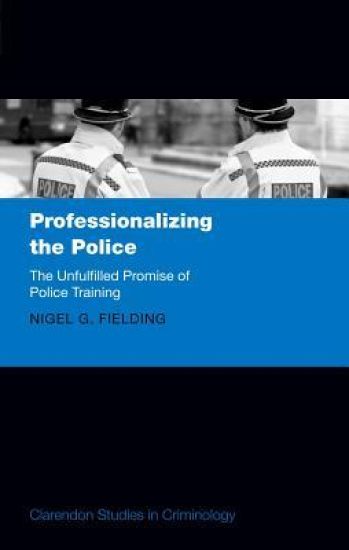
Professionalizing the Police

Professionalizing the Police

Nigel G. Fielding

Oxford University Press
2018
sidottu
Professionalizing the Police is a timely reassessment of the development of British police training and its contribution to the furtherance of the police professionalism agenda. The police have long struggled with the concept of professionalism. The Victorians veered from regarding police as servants to sanctifying policing as a special calling, while the supposed Golden Age of Policing was riven by divisions of class as sharp as those of the social diversity that poses one of contemporary policing's harshest tests. Police training has reflected these ambiguities and uncertainties. The ground its curriculum covers, pedagogy it employs, and structures through which it operates have been contested, troublesome to manage, and blamed for policing's failures. Behind these frictions lie large issues of governance, policing's place in society and what it means to be professional. Late modernity is marked by uncertainty and scepticism. In 'post-truth' times, professionalism must accommodate ambiguities of class, ethnicity and sexuality. The police languish as last believers in a monochrome vision of society while the norms that make for contemporary sociality have moved on to a multiplex of diversities that harbour new extremes both of tolerance and intolerance. True professionalism alerts practitioners to other ways of delivering social control and just societies: empowering citizens and encouraging autonomy; supporting new modes of social relationships and lifestyle; fitting provision to cases; pluralizing services. This yardstick is used to assess and challenge the recruit and in-service curriculum and to tease out the options around which professionalism can be configured and embedded such that it plays its part in a humane, coherent, and accountable framework of police governance. The book will appeal to academics and postgraduate students in police research (across criminology, sociology, psychology, socio-legal studies) and the professions (sociology, political science), as well as senior police managers and trainers in the police service and other applied government bodies.
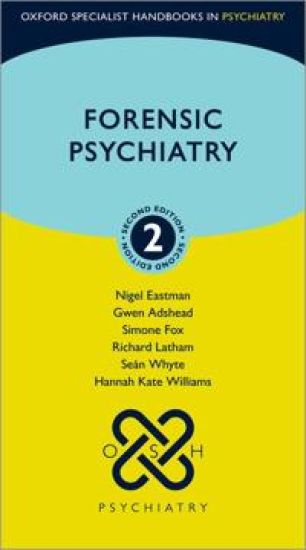
Forensic Psychiatry

Forensic Psychiatry

Nigel Eastman; Gwen Adshead; Simone Fox; Richard Latham; Seán Whyte; Hannah Kate Williams

Oxford University Press
2023
nidottu
This Second Edition of Forensic Psychiatry covers the clinical, legal, and ethical issues for the treatment of mentally disordered offenders for all of the United Kingdom and Republic of Ireland jurisdictions. Written by an expert interdisciplinary team from the fields of both law and psychiatry, this is a comprehensive and up-to-date guide which includes clinical observations, guidance, and ethical advice across the psychiatric discipline. The title has been updated with expanded topics on developmental disorders, neuroscience and its use in legal settings, human rights law, dementia, and traumatic brain injury. New legal cases have also been incorporated to reflect changes in legislation, including but not limited to diminished responsibility, deprivation of liberty, and automatism. There are also new parts on forensic psychotherapy, cross-cultural diagnostic validity, and radicalisation. Alongside practical advice on managing clinical and legal situations, the handbook provides concise examples, summaries of relevant legislation, and introductions to different ethical approaches and clinical observations. Uniquely focusing on the interface between psychiatry and law, this title is essential reading for the forensic psychiatrist, as well as lawyers and judges.
Oxford Casebook of Forensic Psychiatry

Oxford Casebook of Forensic Psychiatry

Nigel Eastman; Gwen Adshead; Simone Fox; Richard Latham; Seán Whyte

Oxford University Press
2023
nidottu
Designed as a companion to the Forensic Psychiatry (Oxford Specialist Handbook), Second Edition, this new casebook complements the domains of both theory and practice put forward in the handbook, but also works as a standalone volume for those who wishes to enhance their decision making in cases they may confront in their discipline. Organised into three sections, the casebook allows the practitioner to think through not only the technical medical aspects of real-life clinical cases, but also the legal and ethical aspects. Part A provides an introduction to the theory and practice of decision-making; Part B presents cases across clinical, legal, and ethical domains; and Part C offers frameworks for critiquing decisions. This robustly discursive approach to a fact-based but also value-laden discipline enhances the opportunity to put knowledge into practice. The Oxford Casebook of Forensic Psychiatry expresses the concept that 'knowing is the only part of deciding', offering an essential practitioner's guide to decision making in clinical, forensic, and legal psychiatry.
Medieval and Early Modern Portrayals of Julius Caesar

Medieval and Early Modern Portrayals of Julius Caesar

Nigel Mortimer

Oxford University Press
2020
sidottu
Julius Caesar, ancient Rome's most colourful leader, has been a subject of controversy for more than two thousand years. In the classical world he was celebrated as an inspired military commander, as a law-giver and orator possessed of outstanding drive and intellect. He was also denounced for his ambition, cruelty, concupiscence, and for his overthrow of a noble republic. Over the centuries almost every conceivable characteristic has been attributed to him. His murder--the world's most famous political assassination--began a process which led to the inauguration of the imperial rule that would last for the rest of Roman time. Throughout the medieval and early modern periods Caesar was central to narratives of conquest and resistance, of kingship and subjecthood, of liberty and despotism. There was a time, however, when he was not the most storied figure from classical antiquity. The post-classical phenomenon of a chimerical and ambiguous Caesar is born in thirteenth-century France when the author of the Li Fet des Romains, a monumental prose life of Caesar, chose to complicate the influential view of a monstrous Caesar found in Lucan's epic poem Bellum civile: this decision gave birth to the complex figure that has fascinated ever since. This book offers original translations of texts written between 1170 and 1574 in French, Latin, Italian, and Middle English, accompanied by commentaries which enable the reader to chart the evolution of the Caesar phenomenon throughout the medieval period right up to his first appearances on the early modern stage.
Stepping Westward

Stepping Westward

Nigel Leask

Oxford University Press
2020
sidottu
Stepping Westward is the first book dedicated to the literature of the Scottish Highland tour of 1720-1830, a major cultural phenomenon that attracted writers and artists like Pennant, Johnson and Boswell, William and Dorothy Wordsworth, Coleridge, Scott, Hogg, Keats, Daniell, and Turner, as well as numerous less celebrated travellers and tourists. Addressing more than a century's worth of literary and visual representations of the Highlands, the book casts new light on how the tour developed a modern literature of place, acting as a catalyst for thinking about improvement, landscape, and the shaping of British, Scottish, and Gaelic identities. It pays attention to the relationship between travellers and the native Gaels, whose world was plunged into crisis by rapid and forced social change. At the book's core lie the best-selling tours of Pennant and Dr Johnson, associated with attempts to 'improve' the intractable Gaidhealtachd in the wake of Culloden. Alongside the Ossian craze and Gilpin's picturesque, their books stimulated a wave of 'home tours' from the 1770s through the romantic period, including writing by women like Sarah Murray and Dorothy Wordsworth. The incidence of published Highland Tours (many lavishly illustrated), peaked around 1800, but as the genre reached exhaustion, the 'romantic Highlands' were reinvented in Scott's poems and novels, coinciding with steam boats and mass tourism, but also rack-renting, sheep clearance, and emigration.
Concentrate Questions and Answers EU Law

Concentrate Questions and Answers EU Law

Nigel Foster

Oxford University Press
2020
nidottu
Concentrate Q&A EU Law is part of the Concentrate Q&A series, the result of a collaboration involving hundreds of law students and lecturers from universities across the UK. The series offers you better support and a greater chance to succeed on your law course than any of the competitors. 'A sure-fire way to get a 1st class result' (Naomi M, Coventry University) 'My grades have dramatically improved since I started using the OUP Q&A guides' (Glen Sylvester, Bournemouth University) 'These first class answers will transform you into a first class student' (Ali Mohamed, University of Hertfordshire) 'I can't think of better revision support for my study' (Quynh Anh Thi Le, University of Warwick) 'I would strongly recommend Q&A guides. They have vastly improved my structuring of exam answers and helped me identify key components of a high quality answer' (Hayden Roach, Bournemouth University) '100% would recommend. Makes you feel like you will pass with flying colours' (Elysia Marie Vaughan, University of Hertfordshire) 'My fellow students rave about this book' (Octavia Knapper, Lancaster University) 'The best Q&A books that I've read; the content is exceptional' (Wendy Chinenye Akaigwe, London Metropolitan University) 'I would not hesitate to recommend this book to a friend' (Blessing Denhere, Coventry University)
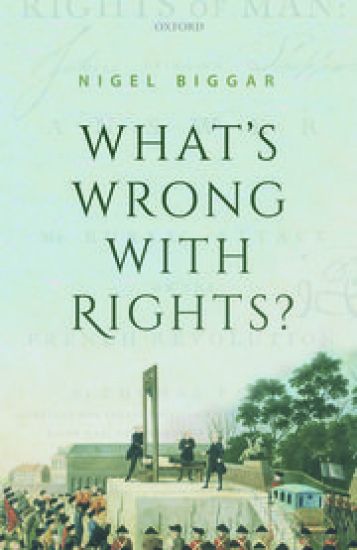
What's Wrong with Rights?

What's Wrong with Rights?

Nigel Biggar

Oxford University Press
2020
sidottu
Are natural rights 'nonsense on stilts', as Jeremy Bentham memorably put it? Must the very notion of a right be individualistic, subverting the common good? Should the right against torture be absolute, even though the heavens fall? Are human rights universal or merely expressions of Western neo-imperial arrogance? Are rights ethically fundamental, proudly impervious to changing circumstances? Should judges strive to extend the reach of rights from civil Hamburg to anarchical Basra? Should judicial oligarchies, rather than legislatures, decide controversial ethical issues by inventing novel rights? Ought human rights advocates learn greater sympathy for the dilemmas facing those burdened with government? These are the questions that What's Wrong with Rights? addresses. In doing so, it draws upon resources in intellectual history, legal philosophy, moral philosophy, moral theology, human rights literature, and the judgments of courts. It ranges from debates about property in medieval Christendom, through Confucian rights-scepticism, to contemporary discussions about the remedy for global hunger and the justification of killing. And it straddles assisted dying in Canada, the military occupation of Iraq, and genocide in Rwanda. What's Wrong with Rights? concludes that much contemporary rights-talk obscures the importance of fostering civic virtue, corrodes military effectiveness, subverts the democratic legitimacy of law, proliferates publicly onerous rights, and undermines their authority and credibility. The solution to these problems lies in the abandonment of rights-fundamentalism and the recovery of a richer public discourse about ethics, one that includes talk about the duty and virtue of rights-holders.
Blackstone's EU Treaties & Legislation

Blackstone's EU Treaties & Legislation

Nigel Foster

Oxford University Press
2023
nidottu
Unsurpassed in authority, reliability and accuracy; Blackstone's Statutes, trusted by students for over 30 years. Celebrating over 30 years as the market-leading series, Blackstone's Statutes have an unrivalled tradition of trust and quality. With a rock-solid reputation for accuracy, reliability and authority, they remain first-choice for students and lecturers, providing a careful selection of up-to-date legislation for exams and course use. - Clear and easy-to-use, helping you find what you need instantly - Edited by experts and covering all the key legislation needed for EU law courses, so you can use alongside your textbook to ensure you approach your assessments with confidence - Unannotated legislation - perfect for exam use - Also available as an e-book with functionality and navigation features
Blackstone's EU Treaties & Legislation

Blackstone's EU Treaties & Legislation

Nigel Foster

Oxford University Press
2024
nidottu
Unsurpassed in authority, reliability and accuracy; Blackstone's Statutes, trusted by students for over 30 years. Celebrating over 30 years as the market-leading series, Blackstone's Statutes have an unrivalled tradition of trust and quality. With a rock-solid reputation for accuracy, reliability and authority, they remain first-choice for students and lecturers, providing a careful selection of up-to-date legislation for exams and course use. - Clear and easy-to-use, helping you find what you need instantly - Edited by experts and covering all the key legislation needed for EU law courses, so you can use alongside your textbook to ensure you approach your assessments with confidence - Unannotated legislation - perfect for exam use - Also available as an e-book with functionality and navigation features
Blackstone's EU Treaties & Legislation

Blackstone's EU Treaties & Legislation

Nigel Foster

Oxford University Press
2025
nidottu
Celebrating over 30 years as the market-leading series, Blackstone's Statutes have an unrivalled tradition of trust and quality. With a rock-solid reputation for accuracy, reliability, and authority, they remain first-choice for students and lecturers, providing a careful selection of up-to-date legislation for exams and course use. - Clear and easy-to-use, helping you find what you need instantly - Edited by experts and covering all the key legislation needed for criminal law courses, so you can use alongside your textbook to ensure you approach your assessments with confidence - Unannotated legislation - perfect for exam use - Also available as an e-book
The Treatment of Prisoners under International Law

The Treatment of Prisoners under International Law

Nigel Rodley; Matt Pollard

Oxford University Press
2009
sidottu
This is the third edition of the pioneering work that has become the standard text in the field. The first edition was one of the earliest to establish that the newly developing international law of human rights could be set down as any other branch of international law. It also incorporates the complementary fields of international humanitarian law and international criminal law, while addressing the problems associated with their interaction with human rights law. The book is more than a descriptive analysis of the field. It acknowledges areas of unclarity or where developments may be embryonic. Solutions are offered. Recent developments have confirmed the value of solutions proposed in the previous editions. Central to most of the chapters is the prohibition of torture and cruel, inhuman, or degrading treatment or punishment. The early chapters focus on the period of first detention, when detainees are most at risk of having information or confessions, however unreliable, extracted by unlawful means. Voices contemplating the legitimacy of such treatment to combat terrorism have been heard in the wake of the atrocities of 11 September 2001. The book finds that the evidence clearly suggests that the absolute prohibition of such treatment remains firm. Other chapters deal with problems of poor prison conditions and of certain extraordinary penalties, notably corporal and capital punishment. A chapter explores ethical codes for members of professions capable of inflicting or preventing the prohibited behaviour (police and medical and legal professionals). Chapters are also devoted to the extreme practice of enforced disappearance and the contribution of the new convention on this phenomenon, as well as to extra-legal executions.
Democracy goes to War

Democracy goes to War

Nigel White

Oxford University Press
2009
sidottu
With the end of the Second World War a new world order arose based on the prohibition of military force in international relations, and yet since 1945 British troops have been regularly deployed around the globe: most notably to Korea, Suez, Cyprus, and the Falklands during the Cold War; and Kuwait, Bosnia, Kosovo, Afghanistan and Iraq since the fall of the Berlin Wall. British forces have been involved in many different capacities: as military observers, peacekeepers, peace-enforcers, state-builders and war-fighters. The decisions to deploy forces are political ones made within several constitutional frameworks, national, regional and international. After considering the various legal and institutional regimes, this book examines the decision to deploy troops from the perspective of international law. In its military interventions Britain has consistently tried to utilize international law to justify its actions, though often it argues against orthodox interpretation of the laws. In gauging whether its actions are in breach of international law we can again make judgments at different levels using various forms of accountability - from judicial fora (for example the International Court of Justice in The Hague or the European Court of Human Rights in Strasbourg), to political ones (the UN General Assembly in New York or the House of Commons in Westminster). While this book examines international and regional mechanisms, tumultuous debates on the Suez crisis, Afghanistan, Iraq and others in the House of Commons and its Committees are highlighted to show how international law impacts upon domestic politics. In considering whether democratic accountability is effective in upholding the principles of international law, this book throws new light on an old democracy, and thereby makes a contribution to the current reform proposals that are aimed at improving democratic decision-making.
Free Speech

Free Speech

Nigel Warburton

Oxford University Press
2009
nidottu
'I disapprove of what you say, but I will defend to the death your right to say it' This slogan, attributed to Voltaire, is frequently quoted by defenders of free speech. Yet it is rare to find anyone prepared to defend all expression in every circumstance, especially if the views expressed incite violence. So where do the limits lie? What is the real value of free speech? Here, Nigel Warburton offers a concise guide to important questions facing modern society about the value and limits of free speech: Where should a civilized society draw the line? Should we be free to offend other people's religion? Are there good grounds for censoring pornography? Has the Internet changed everything? This Very Short Introduction is a thought-provoking, accessible, and up-to-date examination of the liberal assumption that free speech is worth preserving at any cost. ABOUT THE SERIES: The Very Short Introductions series from Oxford University Press contains hundreds of titles in almost every subject area. These pocket-sized books are the perfect way to get ahead in a new subject quickly. Our expert authors combine facts, analysis, perspective, new ideas, and enthusiasm to make interesting and challenging topics highly readable.
German Legal System and Laws

German Legal System and Laws

Nigel Foster; Satish Sule

Oxford University Press
2010
nidottu
German Legal System and Laws provides a comprehensive introduction to the German legal system and the core areas of substantive law. Constitutional law is the foundation of German law and this area has been given fuller consideration in this fourth edition. The constitutional organs of state, basic rights and administrative law are all thoroughly explained. The text has been fully amended and updated with regard to a wealth of legislation and case law which has radically altered the course of German law with considerable attention being given to the development of private law. Also included are expanded and updated extracts from the Grundgesetz and fully revised glossaries of German legal terms.
The Religious Condition of Ireland 1770-1850

The Religious Condition of Ireland 1770-1850

Nigel Yates

Oxford University Press
2006
sidottu
Nigel Yates provides a major reassessment of the religious state of Ireland between 1770 and 1850. He argues that this was both a period of intense reform across all the major religious groups in Ireland and also one in which the seeds of religious tension, which were to dominate Irish politics and society for most of the nineteenth and twentieth centuries, were sown. He examines in detail, from a wide range of primary sources, the mechanics of this reform programme and the growing tensions between religious groups in this period, showing how political and religious issues became inextricably mixed and how various measures that might have been taken to improve the situation were not politically or religiously possible.
Enlightened Oxford

Enlightened Oxford

Nigel Aston

Oxford University Press
2023
sidottu
Enlightened Oxford aims to discern, establish, and clarify the multiplicity of connections between the University of Oxford, its members, and the world outside; to offer readers a fresh, contextualised sense of the University's role in the state, in society, and in relation to other institutions between the Williamite Revolution and the first decade of the nineteenth century, the era loosely describable (though not without much qualification) as England's ancien regime. Nigel Aston asks where Oxford fitted in to the broader social and cultural picture of the time, locating the University's importance in Church and state, and pondering its place as an institution that upheld religious entitlement in an ever-shifting intellectual world where national and confessional boundaries were under scrutiny. Enlightened Oxford is less an inside history than a consideration of an institutional presence and its place in the life of the country and further afield. While admitting the degree of corporate inertia to be found in the University, there was internal scope for members so inclined to be creative in their teaching, open new research lines, and be unapologetic Whigs rather than unrepentant Tories. For if Oxford was a seat of learning rooted in its past - and with an increasing antiquarian awareness of its inheritance - yet it had a surprising capacity for adaptation, a scope for intellectual and political pluralism that was not incompatible with enlightened values.
Curiosity and the Aesthetics of Travel-Writing, 1770-1840
The decades between 1770 and 1840 are rich in exotic accounts of the ruin-strewn landscapes of Ethiopia, Egypt, India, and Mexico. Yet it is a field which has been neglected by scholars and which - unjustifiably - remains outside the literary canon. In this pioneering book, Nigel Leask studies the Romantic obsession with these 'antique lands', drawing generously on a wide range of eighteenth- and nineteenth-century travel books, as well as on recent scholarship in literature, history, geography, and anthropology. Viewing the texts primarily as literary works rather than 'transparent' adventure stories or documentary sources, he sets out to challenge the tendency in modern academic work to overemphasize the authoritative character of colonial discourse. Instead, he addresses the relationship between narrative, aesthetics, and colonialism through the unstable discourse of antiquarianism, exploring the effects of problems of creditworthiness, and the nebulous epistemologicial claims of 'curiosity' (a leitmotif of the accounts studied here), on the contemporary status of travel writing. Attentive to the often divergent idioms of elite and popular exoticism, Curiosity and the Aesthetics of Travel Writing plots the transformation of the travelogue through the period, as the baroque particularism of curiosity was challenged by picturesque aesthetics, systematic 'geographical narrative', and the emergence of a 'transcendental self' axiomatic to Romantic culture. In so doing it offers an important reformulation of the relations between literature, aesthetics, and empire in the late Enlightenment and Romantic periods.
Richard Hooker and Reformed Theology

Richard Hooker and Reformed Theology

Nigel Voak

Oxford University Press
2003
sidottu
Richard Hooker (1554-1600) has traditionally been seen as the first systematic defender of an Anglican via media between Rome and Geneva. Revisionists have argued recently, however, that Hooker was in fact a thoroughly Reformed theologian. Dr Voak takes issue with this interpretation, arguing that Hooker over time became highly critical of numerous Reformed positions. Beginning with philosophical principles underlying Hooker's theology (e.g. free will, resistibility of grace), the book then considers issues such as original sin, justification and sanctification, merit and the religious authority of scripture, reason, and tradition. Finally, Hooker's late manuscripts are examined, in which he defends himself from the charge of heresy.
Curiosity and the Aesthetics of Travel-Writing, 1770-1840
The decades between 1770 and 1840 are rich in exotic accounts of the ruin-strewn landscapes of Ethiopia, Egypt, India, and Mexico. Yet it is a field which has been neglected by scholars and which - unjustifiably - remains outside the literary canon. In this pioneering book, Nigel Leask studies the Romantic obsession with these 'antique lands', drawing generously on a wide range of eighteenth and nineteenth-century travel books, as well as on recent scholarship in literature, history, geography, and anthropology. Viewing the texts primarily as literary works rather than 'transparent' adventure stories or documentary sources, he sets out to challenge the tendency in modern academic work to overemphasize the authoritative character of colonial discourse. Instead, he addresses the relationship between narrative, aesthetics, and colonialism through the unstable discourse of antiquarianism, exploring the effects of problems of credit worthiness, and the nebulous epistemological claims of 'curiosity' (a leitmotif of the accounts studied here), on the contemporary status of travel writing. Attentive to the often divergent idioms of elite and popular exoticism, Curiosity and the Aesthetics of Travel Writing plots the transformation of the travelogue through the period, as the baroque particularism of curiosity was challenged by picturesque aesthetics, systematic 'geographical narrative', and the emergence of a 'transcendental self' axiomatic to Romantic culture. In so doing it offers an important reformulation of the relations between literature, aesthetics, and empire in the late Enlightenment and Romantic periods.
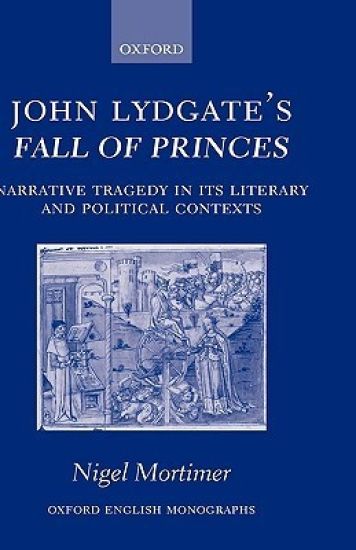
John Lydgate's Fall of Princes

John Lydgate's Fall of Princes

Nigel Mortimer

Clarendon Press
2005
sidottu
The Benedictine monk John Lydgate was the most admired poet of the fifteenth century. He received commissions from some of the most powerful men in the land (including Henry V); he is spoken of with constant admiration; manuscripts of his work are abundant; many of his poems were put into print by England's earliest printers, ensuring that his influence extended well into the sixteenth century. The Fall of Princes, probably the longest poem in the language, is arguably Lydgate's masterwork; yet, until now, it has received only cursory critical attention. This book offers the first extended discussion of the poem. The Fall of Princes accumulates accounts of nearly 500 figures from mythology and history (biblical, classical, and medieval) who have fallen from their positions of fame and power into obscurity, adversity, or poverty. In presenting these tragedies Lydgate probes the causes of the reversal of their fortunes; how far can the caprice of a blind Lady Fortune be blamed? How far are the protagonists themselves responsible for their undoing? Most pressingly of all, why is it that bad things happen to seemingly innocent people? In drawing its conclusions about the downfalls of powerful men and women, Lydgate's poem operates within the popular medieval genre of 'advice to princes' literature. This book locates Lydgate's work within its contexts, exploring the nature of his relationship with the uneasy Lancastrian dynasty during the minority of Henry VI as well as his response to contemporary conflicts between ecclesiastical and secular authority. In particular, this book closely analyses Lydgate's manipulations of his French source text, allowing readers to see in detail for the first time what it is that Lydgate was setting out to achieve. Finally, the book identifies the readership of Lydgate's poem in the fifteenth and sixteenth centuries, discussing its influence on the evolution of narrative tragedy in English.