Kirjojen hintavertailu. Mukana 12 130 747 kirjaa ja 12 kauppaa.

Kirjahaku

Etsi kirjoja tekijän nimen, kirjan nimen tai ISBN:n perusteella.

1000 tulosta hakusanalla Reid B. Locklin

Problems from Reid

Problems from Reid

James Van Cleve

Oxford University Press Inc
2015
sidottu
James Van Cleve here shows why Thomas Reid (1710-96) deserves a place alongside the other canonical figures of modern philosophy. He expounds Reidâs positions and arguments on a wide range of topics, taking interpretive stands on points where his meaning is disputed and assessing the value of his contributions to issues philosophers are discussing today. Among the topics Van Cleve explores are Reid's account of perception and its relation to sensation, conception, and belief; his nativist account of the origin of the concepts of space and power; his attempt to clear the way for the belief that the things we directly perceive are external things, not ideas in our minds; his stand on the distinction between primary and secondary qualities; his account of "acquired perception," whereby we come to stand in a quasi-perceptual relation to qualities not originally perceived; his claim that visual space is non-Euclidean; his answers to the questions why we see the world right side up with inverted retinal images and whether a newly sighted person would recognize by sight the shapes he previously knew by touch; whether memory, like perception, is a form of direct awareness; and how we manage to conceive of things that are utterly nonexistent. Also examined are Reid's account of human knowledge by means of "first principles," his externalist reply to philosophical skepticism, his volitional theory of action, his use of the distinction between event causation and agent causation to understand freedom of the will, and his criticism of Hume and anticipation of Moore on the analysis of moral judgment. The most comprehensive work on Reid in a quarter century, this book will be welcomed by students of early modern philosophy, epistemology, the philosophy of perception, and the philosophy of action.
The Correspondence of Thomas Reid

The Correspondence of Thomas Reid

Pennsylvania State University Press
2003
sidottu
Thomas Reid (1710–1796) is now recognized as one of the towering figures of the Enlightenment. Best known for his published writings on epistemology and moral theory, he was also an accomplished mathematician and natural philosopher, as an earlier volume of his manuscripts edited by Paul Wood for the Edinburgh Reid Edition, Thomas Reid on the Animate Creation, has shown. The Correspondence of Thomas Reid collects all of the known letters to and from Reid in a fully annotated form. Letters already published by Sir William Hamilton and others have been reedited, and roughly half of the letters included appear in print for the first time.Writing in 1802, Reid's disciple and biographer Dugald Stewart doubted that Reid's correspondence "would be generally interesting." This collection proves otherwise, for the letters illuminate virtually every aspect of Reid's life and career and, in some instances, provide us with invaluable evidence about activities otherwise undocumented in his manuscripts or published works. Through his correspondence we can trace Reid's relations with contemporaries such as David Hume and his colleagues at both King's College, Aberdeen, and the University of Glasgow, as well as his engagement with the most controversial philosophical, scientific, and political issues of his day. If anything, the letters assembled here serve as the starting point for understanding Reid and his place in the Enlightenment.
The Mont Reid Surgical Handbook

The Mont Reid Surgical Handbook

Amy Makley

Elsevier - Health Sciences Division
2017
nidottu
Essential reading for residents and medical students, this popular handbook is a must-have resource for convenient, quick access to information on managing common surgical problems. Written by current surgery residents at the University of Cincinnati, the completely updated 7th Edition focuses on the surgical treatments, guidelines, procedures, and topics you need to know - both in print and online. Provides comprehensive guidelines for the treatment of the most common surgical conditions, including preoperative and postoperative care, as well as relevant pathophysiology. Includes surgical management that encompasses state-of-the-art technology and emphasizes minimally invasive techniques, including important coverage of laparoscopic cholecystectomy, appendectomy, and herniorrhaphy. Provides guidelines for proper medical record keeping as well as other mediocolegal aspects of surgical care. Offers detailed figures depicting important anatomical structures and operative techniques. New chapters cover Surgical Risk Assessment, Head and Neck Malignancy, Mediastinal Tumors, Dialysis Access, and Robotics. Rapid References section offers handy formulas and charts in one easy-access location. Thoroughly revised content throughout ensures that you stay up to date. Expert ConsultT eBook version included with purchase. This enhanced eBook experience allows you to search all of the text, figures, Q&As, and references from the book on a variety of devices.
Love & City Dreaming Poems by Margaret Havill Reid
Award-winning Poet of the Year, Margaret Havill "Mandi" Reid, is represented by a rich assortment of verse in "Love & City Dreaming". While the focus remains firmly on her love poetry and urban verses, this anthology also includes limericks and other humorous offerings, religious and political themes, philosophic conundrums and even some children's verse. In fact, unlike her previous collection, "Song of the Wayward Wind", care has been taken on this occasion to make all the contents of "Love & City Dreaming", including Mandi's own illustrations, suitable for all readers.
Claude Buffier and Thomas Reid

Claude Buffier and Thomas Reid

Louise Marcil-Lacoste

McGill-Queen's University Press
1982
sidottu
Claude Buffier (1661-1737) was a French Jesuit whose philosophy earned Voltaire's praise. Thomas Reid (1710-96) was the one Scottish philosopher whose response to David Hume is still taken seriously. In this comparative study Professor Marcil-Lacoste not only refutes common assumptions, but also shows that, despite their similar concerns and the unfounded charge that Reid plagiarized from Buffier, a comparison of Reid and Buffier illuminates a range of significant epistemological issues. Further, she demonstrates that common-sense philosophies can be varied, subtle, and original. This book also includes an edited and annotated version of Reid's hitherto unpublished curâ primâ on common sense prepared by David Fate Norton.
The Philosophy of Thomas Reid
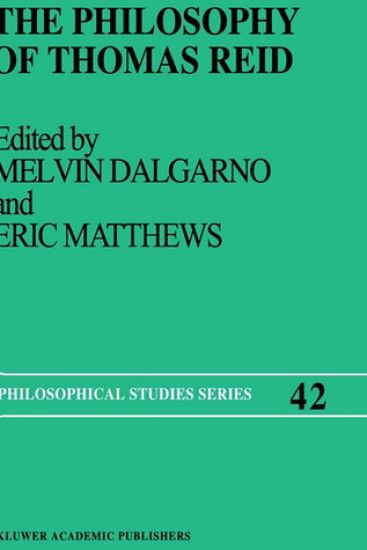
Note on references to the works of Thomas Reid 5 SECTION 1 - Perception Yves Michaud (University of Paris, France) 9 'Reid's Attack on the Theory of Ideas' William P. Alston (Syracuse University, U. S. A. ) 35 'Reid on Perception and Conception' Vere Chappell (University of Massachusetts, U. S. A. ) 49 'The Theory of Sensations' Norton Nelkin (University of New Orleans, U. S. A. ) 65 'Reid's View of Sensations Vindicated' A. E. Pitson (University of Stirling, Scotland) 79 'Sensation, Perception and Reid's Realism' Aaron Ben-Zeev (University of Haifa, Israel) 91 'Reid's Opposition to the Theory of Ideas' Michel Malherbe (University of Nantes, France) 103 'Thomas Reid on the Five Senses' SECTION 2 - Knowledge and COlIIOOn Sense Keith Lehrer (University of Arizona, U. S. A. ) 121 'Reid on Evidence and Conception' Dennis Charles Holt (Southeast Missouri State 145 University, U. S. A. ) 'The Defence of Common Sense in Reid and Moore' T. J. Sutton (University of Oxford, England) 159 'The Scottish Kant?' Daniel Schulthess (university of Berne, Switzerland) 193 'Did Reid Hold Coherentist Views?' VI Claudine Engel-Tiercelin (University of Rouen, France) 205 'Reid and Peirce on Belief' C. A. J. Coady (University of Melbourne, Australia) 225 'Reid on Testimony' SECTION 3 - Mind and Action James Somerville (University of Hull, England) 249 'Making out the Signatures: Reid's Account of the Knowledge of Other Minds' R. F.
Doppelgänger: An Iris Reid Mystery
"The plot becomes more unnerving as it progresses, and an impressive twist leads to a lengthy final act featuring Rosica at her most ferocious...Cory's concise prose establishes a consistent pace that never wavers, and even her descriptions of architecture are exhilarating." The KIRKUS REVIEWThis third installment in the Iris Reid mystery series introduces Rosica, Iris's beautiful but treacherous doppelganger, a sinister creature guaranteed to send a shiver down the reader's spine. P. M. Steffen, best-selling author of The Profiler's Daughter and Killing UlyssesDuring a robbery, a bank guard is shot. The license of the getaway car is traced to Architect Iris Reid. When Iris is arrested and shown security footage of the robbery, she sees her own face looking back.Scrambling to defend herself against an airtight case, Iris discovers that her mail's been diverted to an abandoned apartment in the next town. She's able to pick up her doppelganger's trail.But someone is watching her every move.Doppelg nger, the third Iris Reid mystery from real-life architect Susan Cory, is a psychological thriller about obsession, identity and what it means to have parts of your life stripped away.
I Choose BTEC Sharmadean Reid Postcard
LONDON 1600. Though Queen Elizabeth has ordered the Earl of Essex's release from confinement, she's thwarted his return to social and military grace by barring him from court for an indefinite term. Unsatisfied with this humiliation, the Queen considers whether to cut off his sole remaining income, as well. Noah Ames strongly advises against it on grounds that the Queen will thereby lose any remaining influence over Essex's conduct and also place him in desperate financial straits. When several seemingly unrelated men are found murdered, Noah begins to suspect that such murders reveal Essex's treasonous intention to return to court in bloody defiance of the Queen's order.
New Essays on Thomas Reid
Thomas Reid (1710-96) was a contemporary of both David Hume and Immanuel Kant, and a central figure in the Scottish School of Common Sense. Until recently, his work has been largely neglected, and often misunderstood. Like Kant, Reid cited Hume’s Treatise as the main spur to his own philosophical work. In Reid’s case, this led him to challenge ‘the theory of ideas’, which he saw as the cornerstone of Hume’s (and many other philosophers’) theories. For those familiar with Reid’s work, it is clear that its significance extends well beyond his challenging the theory of ideas. The variety of topics which this book covers attests to the richness and variety of Reid’s philosophical contributions, and the persisting relevance of his work to contemporary philosophical debates. The work included in this book, by leading figures in Reid scholarship, deals with aspects of Reid’s views on topics ranging from perception, to epistemology, to ethics and meta-ethics, through to language, mind, and metaphysics. This book was originally published as a special issue of the Canadian Journal of Philosophy.
New Essays on Thomas Reid
Thomas Reid (1710-96) was a contemporary of both David Hume and Immanuel Kant, and a central figure in the Scottish School of Common Sense. Until recently, his work has been largely neglected, and often misunderstood. Like Kant, Reid cited Hume’s Treatise as the main spur to his own philosophical work. In Reid’s case, this led him to challenge ‘the theory of ideas’, which he saw as the cornerstone of Hume’s (and many other philosophers’) theories. For those familiar with Reid’s work, it is clear that its significance extends well beyond his challenging the theory of ideas. The variety of topics which this book covers attests to the richness and variety of Reid’s philosophical contributions, and the persisting relevance of his work to contemporary philosophical debates. The work included in this book, by leading figures in Reid scholarship, deals with aspects of Reid’s views on topics ranging from perception, to epistemology, to ethics and meta-ethics, through to language, mind, and metaphysics. This book was originally published as a special issue of the Canadian Journal of Philosophy.