Kirjojen hintavertailu. Mukana 11 244 527 kirjaa ja 12 kauppaa.

Kirjahaku

Etsi kirjoja tekijän nimen, kirjan nimen tai ISBN:n perusteella.

1000 tulosta hakusanalla Rodney Simpson

Woody Plants and Woody Plant Management
A presentation of strategies for managing woody plants and using research data to select the most appropriate control methods. It analyzes the responses of over 370 North American woody plants to commercially available herbicides. The authors provide methods to manage woody plants that interfere with recreation, watershed yield, animal and plant diversity, resource conservation, wildlife and livestock needs, and wood production on grazing, forest, and related land.
Fraud Prevention and Detection

Fraud Prevention and Detection

Rodney T. Stamler; Hans J. Marschdorf; Mario Possamai

Routledge
2019
nidottu
Lessons can be learned from major fraud cases. Whether the victim is a company, public agency, nonprofit, foundation, or charity, there is a high likelihood that many of these frauds could have been prevented or detected sooner if early Red Flag warning signs had been identified and acted upon. Fraud Prevention and Detection: Warning Signs and the Red Flag System will enable officers and directors, internal and external stakeholders, as well as outside analysts to protect themselves and their organizations against fraud by effectively detecting, analyzing, and acting on early Red Flag warning signs. Based on an empirically tested strategy, the Red Flag System reflects the authors’ more than 100 years combined experience in the investigation of fraud in high-profile, global cases in North America, Africa, Europe, and the Far East.Readers of this book will:Acquire a general awareness of the nature, characteristics, and dynamics of fraudUnderstand the process for determining whether a fraud has been committedDevelop an understanding of enterprise risk management approaches for fraud risk management, compliance risk management, and managing the risk of fraudulent financial reporting—including an understanding of the limitations inherent in these approachesLearn how to find Red Flag indicators of fraud or suspicious transactions in financial statements, budgets, and contractsKnow how to ensure that, once a Red Flag has been identified, appropriate action is taken Fraud can lead to significant financial loss as well as bad press and publicity with significant reputational impact for officers, directors, corporations, and their stakeholders. This book’s no-nonsense approach empowers those charged with protecting organizations to stop these frauds before the organization’s livelihood is jeopardized or to mitigate damage when fraud has occurred.
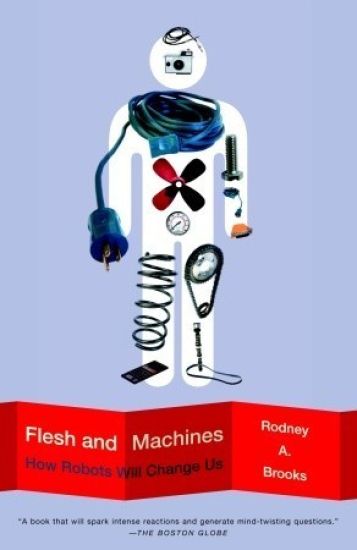
Flesh and Machines: How Robots Will Change Us
From the director of the MIT Artificial Intelligence Laboratory--"a stimulating book written by one of the major players in the field--perhaps the major player.... Offers surprisingly deep glimpses into what it is to be human" (The New York Times Book Review). Are we really on the brink of having robots to mop our floors, do our dishes, mow our lawns, and clean our windows? And are researchers that close to creating robots that can think, feel, repair themselves, and even reproduce? Rodney A. Brooks believes we are. In this lucid and accessible book, Brooks vividly depicts the history of robots and explores the ever-changing relationships between humans and their technological brethren, speculating on the growing role that robots will play in our existence. Knowing the moral battle likely to ensue, he posits a clear philosophical argument as to why we should not fear that change. What results is a fascinating book that offers a deeper understanding of who we are and how we can control what we will become.
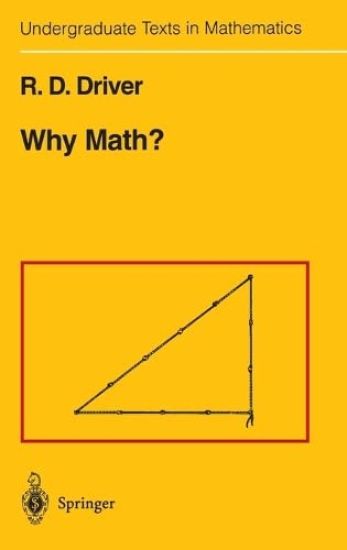
Why Math?

Why Math?

Rodney D Driver; R D Driver

SPRINGER-VERLAG NEW YORK INC.
1984
sidottu
1 Arithmetic Review.- 1.1 Basis Rules.- 1.2 Division, Fractions, and Exponents.- 1.3 Percentages.- 1.4 Rates.- 2 Prime Numbers and Fractions.- 2.1 Prime Numbers and Factorization.- 2.2 Greatest Common Factor.- 2.3 Rationals and Irrationals.- 3 The Pythagorean Theorem and Square Roots.- 3.1 The Theorem.- 3.2 Square Roots Which Are Irrational.- 3.3 Computation of Square Roots by Successive Approximation.- 4 Elementary Equations.- 4.1 Equations in One Unknown.- 4.2 The Use of Two or More Unknowns.- 4.3 Graphing.- 5 Quadratic Polynomials and Equations.- 5.1 Solution of Quadratic Equations.- 5.2 Applications of Quadratic Equations.- 5.3 Quadratic Polynomials.- 6 Powers and Geometric Sequences.- 6.1 Applications of Powers.- 6.2 More on Half-Lives.- 6.3 Compound Interest and Related Matters.- 6.4 IRAs and Similar Tax Sheltered Accounts.- 6.5 Geometric Series-the "Sum" of a Geometric Sequence.- 7 Areas and Volumes.- 7.1 Areas.- 7.2 Volumes.- 7.3 Surface Area of a Solid (versus Volume).- 7.4 Computation of Cube Roots.- 8 Galilean Relativity.- 8.1 Displacement and Velocity Vectors.- 8.2 Doppler Effect.- 8.3 Components of Vectors.- 9 Special Relativity.- 9.1 Simultaneity and Einstein's Postulate.- 9.2 Time Dilation.- 9.3 Length Contraction.- 10 Binary Arithmetic.- 10.1 Decimal, Binary, and Ternary Representation of Integers.- 10.2 Subtraction and Division in Base Two.- 10.3 Applications.- 11 Sets and Counting.- 11.1 Set Notation.- 11.2 Counting.- 12 Probability.- 12.1 Elementary Ideas and Examples.- 12.2 Mutually Exclusive Events.- 12.3 The Basic Rules.- 12.4 Quality Control (optional).- 12.5 Expectation.- 12.6 Conditional Probability.- 13 Cardinality.- 13.1 Countable Sets.- 13.2 Countably Many Countable Sets.- 13.3 The Reals vs. the Rationals.- Answers to Odd-Numbered Problems.
Parameterized Complexity

Parameterized Complexity

Rodney G. Downey; M.R. Fellows

Springer-Verlag New York Inc.
1998
sidottu
The idea for this book was conceived over the second bottle of Villa Maria's Caber­ net Medot '89, at the dinner of the Australasian Combinatorics Conference held at Palmerston North, New Zealand in December 1990, where the authors first met and discovered they had a number of interests in common. Initially, we embarked on a small project to try to formulate reductions to address the apparent parame­ terized intractability of DOMINATING SET, and to introduce a structure in which to frame our answers. Having spent several months trying to get the definitions for the reductions right (they now seem so obvious), we turned to our tattered copies of Garey and Johnson's work [239]. We were stunned to find that virtually none of the classical reductions worked in the parameterized setting. We then wondered if we'd be able to find any interesting reductions. Several years, many more bottles, so many papers, and reductions later it [3] seemed that we had unwittingly stumbled upon what we believe is a truly central and new area of complexity theory. It seemed to us that the material would be of great interest to people working in areas where exact algorithms for a small range of parameters are natural and useful (e. g. , Molecular Biology, VLSI design). The tractability theory was rich with distinctive and powerful techniques. The intractability theory seemed to have a deep structure and techniques all of its own.
Algorithmic Randomness and Complexity

Algorithmic Randomness and Complexity

Rodney G. Downey; Denis R. Hirschfeldt

Springer-Verlag New York Inc.
2010
sidottu
Intuitively, a sequence such as 101010101010101010… does not seem random, whereas 101101011101010100…, obtained using coin tosses, does. How can we reconcile this intuition with the fact that both are statistically equally likely? What does it mean to say that an individual mathematical object such as a real number is random, or to say that one real is more random than another? And what is the relationship between randomness and computational power. The theory of algorithmic randomness uses tools from computability theory and algorithmic information theory to address questions such as these. Much of this theory can be seen as exploring the relationships between three fundamental concepts: relative computability, as measured by notions such as Turing reducibility; information content, as measured by notions such as Kolmogorov complexity; and randomness of individual objects, as first successfully defined by Martin-Löf. Although algorithmic randomness has been studied for several decades, a dramatic upsurge of interest in the area, starting in the late 1990s, has led to significant advances. This is the first comprehensive treatment of this important field, designed to be both a reference tool for experts and a guide for newcomers. It surveys a broad section of work in the area, and presents most of its major results and techniques in depth. Its organization is designed to guide the reader through this large body of work, providing context for its many concepts and theorems, discussing their significance, and highlighting their interactions. It includes a discussion of effective dimension, which allows us to assign concepts like Hausdorff dimension to individual reals, and a focused but detailed introduction to computability theory. It will be of interest to researchers and students in computability theory, algorithmic information theory, and theoretical computer science.
Supreme Folly

Supreme Folly

Rodney R. Jones; Gerald F. Uelmen

WW Norton Co
1993
pokkari
Lawyers and non-lawyers alike fell delightedly on the authors previous collection of ridiculous excerpts from actual court cases. Now Rodney R. Jones and Gerald F. Uelmen return with an all-new assortment of unintentionally amusing incidents from legal cases of all kinds, including folly in the Supreme Court itself."
The Knossos Labyrinth

The Knossos Labyrinth

Rodney Castleden

Routledge
1989
sidottu
Knossos, like the Acropolis or Stonehenge, is a symbol for an entire culture. The Knossos Labyrinth was first built in the reign of a Middle Kingdom Egyptian pharaoh, and was from the start the focus of a glittering and exotic culture. Homer left elusive clues about the Knossian court and when the lost site of Knossos gradually re-emerged from obscurity in the nineteenth century, the first excavators - Minos Kalokairinos, Heinrich Schliemann, and Arthur Evans - were predisposed to see the site through the eyes of the classical authors. Rodney Castleden argues that this line of thought was a false trail and gives an alternative insight into the labyrinth which is every bit as exciting as the traditional explanations, and one which he believes is much closer to the truth. Rejecting Evans' view of Knossos as a bronze age royal palace, Castleden puts forward alternative interpretations - that the building was a necropolis or a temple - and argues that the temple interpretation is the most satisfactory in the light of modern archaeological knowledge about Minoan Crete.
The Stonehenge People

The Stonehenge People

Rodney Castleden

Routledge
1990
nidottu
First published in 1990. Of all the monuments left by the past, Stonehenge is the most evocative, the most memorable and the most mysterious. Whilst the monuments of other cultures have gradually surrendered their mysteries, Stonehenge alone seems to stimulate endless conjecture. Rodney Castleden's vivid presentation of the world of the megaliths answers many of the most baffling questions about Stonehenge. There are, he stresses, few absolute certainties, but from the vast body of evidence assembled during the last hundred years it is now possible to get much closer to the truth than ever before. Who built the monuments and for what purpose? How were the bluestones moved from the sacred mountains of the west to Salisbury Plain? Who were the people responsible for this amazing undertaking, and what did they think and believe?
Political Ideas in Modern Britain

Political Ideas in Modern Britain

Rodney Barker

Routledge
1997
nidottu
The rise of the New Right and the collapse of state communism in 1989 has fundamentally changed political thinking in the late twentieth century. Rodney Barker has revised and extended his classic text - Political Ideas in Modern Britain - in the light of these changes. His accessible account of political thinking in Britain since the 1880s now includes detailed analysis of:* the demise of traditional conservatism and socialism* the rise and decline of the New Right* the growth of feminism, liberalism and pluralismPolitical Ideas in Modern Britain charts the changing intellectual landscape of political thinking, illustrating how contemporary political thought is both rooted in tradition and a radical transformation of it. Whether the future is liberal, communitarian, pluralist, or simply uncertain, this is an essential guide for students of British politics.Rodney Barker is Senior Lecturer in Government at the London School of Economics and Political Science.
The Making of Stonehenge

The Making of Stonehenge

Rodney Castleden

Routledge
1993
sidottu
Every generation has created its own interpretation of Stonehenge, but rarely do these relate to the physical realities of the monument. Rodney Castleden begins with those elements which made possible the building of this vast stone circle: the site, the materials and the society that undertook the enormous task of transporting and raising the great vertical stones, then capping them, all to a carefully contrived plan. What emerges from this detailed examination is a much fuller sense of Stonehenge, both in relation to all the similar sites close by, and in terms of the uses to which it was put. Castleden suggests that there is no one 'meaning' or 'purpose' for Stonehenge, that from its very beginning it has filled a variety of needs. The Romans saw it as a centre of resistance; the antiquaries who 'rediscovered' it in the seventeenth century saw a long line of continuity leading back into the nation's past. The archaeologists see it as a subject for rational, scientific investigation; The National Trust and English Heritage view it as an unfailing magnet for visitors; UNESCO has declared it a World Heritage Site, the cultural property of the whole of humanity. Lost to view amid competing interests over the millenia are the uses it has served for those who live within its penumbra, for whom Stonehenge has never been 'lost' or 'rediscovered'. It exists in local myth and legend, stretching back beyond history.
Political Ideas in Modern Britain

Political Ideas in Modern Britain

Rodney Barker

Routledge
1997
sidottu
The rise of the New Right and the collapse of state communism in 1989 has fundamentally changed political thinking in the late twentieth century. Rodney Barker has revised and extended his classic text - Political Ideas in Modern Britain - in the light of these changes. His accessible account of political thinking in Britain since the 1880s now includes detailed analysis of:* the demise of traditional conservatism and socialism* the rise and decline of the New Right* the growth of feminism, liberalism and pluralismPolitical Ideas in Modern Britain charts the changing intellectual landscape of political thinking, illustrating how contemporary political thought is both rooted in tradition and a radical transformation of it. Whether the future is liberal, communitarian, pluralist, or simply uncertain, this is an essential guide for students of British politics.Rodney Barker is Senior Lecturer in Government at the London School of Economics and Political Science.
Atlantis Destroyed

Atlantis Destroyed

Rodney Castleden

Routledge
1998
sidottu
Plato's legend of Atlantis has become notorious among scholars as the absurdest lie in literature. Atlantis Destroyed explores the possibility that the account given by Plato is historically true. Rodney Castleden first considers the location of Atlantis re-examining two suggestions put forward in the early twentieth century; Minoan Crete and Minoan Thera. He outlines the latest research findings on Knossos and Bronze Age Thera, discussing the material culture, trade empire and agricultural system, writing and wall paintings, art, religion and society of the Minoan civilization. Castleden demonstrates the many parallels between Plato's narrative and the Minoan Civilization in the Aegean.Fired by the imagination a new vision of Atlantis has arisen over the last one hundred and fifty years as a lost utopia. Rodney Castleden discusses why this picture arose and xplains how it has become confused with Plato's genuine account.
King Arthur

King Arthur

Rodney Castleden

Routledge
1999
sidottu
King Arthur is often written off as a medieval fantasy, the dream of those yearning for an age of strong, just rulers and a contented kingdom. Those who accept his existence at all generally discard the stories that surround him. This exciting new investigation argues not only that Arthur did exist, as a Dark Age chieftain, but that many of the romantic tales - of Merlin, Camelot and Excalibur - are rooted in truth.In his quest for the real King Arthur, Rodney Castleden uses up-to-date archaeological and documentary evidence to recreate the history and society of Dark Age Britain and its kings. He revives the possibility that Tintagel was an Arthurian legend, and proposes a radical new theory - that Arthur escaped alive from his final battle. A location is even suggested for perhaps the greatest mystery, the whereabouts of Arthur's grave.King Arthur: The Truth Behind the Legend offers a more complete picture of Arthur's Britain and his place in it than ever before. The book's bold approach and compelling arguments will be welcomed by all readers with an interest in Arthuriana.
Atlantis Destroyed

Atlantis Destroyed

Rodney Castleden

Routledge
2001
nidottu
Plato's legend of Atlantis has become notorious among scholars as the absurdest lie in literature. Atlantis Destroyed explores the possibility that the account given by Plato is historically true. Rodney Castleden first considers the location of Atlantis re-examining two suggestions put forward in the early twentieth century; Minoan Crete and Minoan Thera. He outlines the latest research findings on Knossos and Bronze Age Thera, discussing the material culture, trade empire and agricultural system, writing and wall paintings, art, religion and society of the Minoan civilization. Castleden demonstrates the many parallels between Plato's narrative and the Minoan Civilization in the Aegean.Fired by the imagination a new vision of Atlantis has arisen over the last one hundred and fifty years as a lost utopia. Rodney Castleden discusses why this picture arose and xplains how it has become confused with Plato's genuine account.
The Mycenaeans

The Mycenaeans

Rodney Castleden

Routledge
2005
sidottu
Following on from Rodney Castleden's best-selling study Minoans, this major contribution to our understanding of the crucial Mycenaean period clearly and effectively brings together research and knowledge we have accumulated since the discovery of the remains of the civilization of Mycenae in the 1870s.In lively prose, informed by the latest research and using a full bibliography and over 100 illustrations, this vivid study delivers the fundamentals of the Mycenaean civilization including its culture, hierarchy, economy and religion. Castleden introduces controversial views of the Mycenaean palaces as temples, and studies their impressive sea empire and their crucial interaction with the outside Bronze Age world before discussing the causes of the end of their civilization. Providing clear, easy information and understanding, this is a perfect starting point for the study of the Greek Bronze Age.