A major academic controversy has raged in recent years over the analysis of the political and religious commitments of Samuel Johnson, the most commanding of the 'commanding heights' of eighteenth-century English letters. This book, one of a trilogy from Palgrave, brings that debate to a decisive conclusion, retrieving the 'historic Johnson.'
A major academic controversy has raged in recent years over the analysis of the political and religious commitments of Samuel Johnson, the most commanding of the 'commanding heights' of eighteenth-century English letters. This book, one of a trilogy from Palgrave, brings that debate to a decisive conclusion, retrieving the 'historic Johnson.'
Starting from the youthful influences that helped to form Samuel Johnson's mature religious thought, Chester F. Chapin goes on to consider the development of this thought and its relation to Anglican orthodoxy and to social and political questions. The second and major part of the book is devoted to an analysis of Johnson's mature position on certain basic issues. Chapin considers Johnson's attitude toward evidences, arguing that Johnson attempted to establish revelation by grounding it in history. He maintains that Johnson did not distinguish between Christian and non-Christian ethics, and that it was the eschatology of Christianity that he valued particularly. The intensity of Johnson's fear of death and judgment is a measure of the intensity of his faith. Chapin considers problems of evil, of free will, and of foreknowledge and necessity as Johnson struggled with them. Writers that Johnson referred to argued that foreknowledge does not imply necessity, but Chapin maintains that Johnson was not convinced by these arguments. Experience, Johnson saw, was on the side of free will, and for him this took precedence over theory. The author then turns to Johnson's social and political attitudes. His loyalty to the Church shaped other conservative attitudes. Johnson did not assert that the ultimate conversion of all men to Christianity was part of God's plan, and his attitude toward the non-Christian world approached that of live and let live. Johnson was not a relativist. Since men have the ability to distinguish good from evil, it follows that there is an objective moral order in the world. Finally, Chapin reviews the problem of human life, which so occupied Johnson's mind, and states that for Johnson religion was the only rational solution to this problem. Chapin also presents the position of Hume and other 18th-century intellectuals and provides a carefully reasoned argument concerning various questions of theology.
Samuel Johnson was a deeply religious man and he came to depend on his Christian faith as the principal means by which to endure the pain of existence. He sought throughout his life to render himself worthy of salvation, but the difficulties which he ecperienced in trying to maintain a high degree of reigious discipline - as well as his doubts about God's ultimate concern for man and his fears of his own spiritual unworthiness - led him in to periods of madness and a perpetual dread of damnation. Charles Pierce examines the effect of Johnson's religious concerns upon the formation of his complex character, and on the great moral writing that began with The Vanity of Human Wishes and ended with Rasselas. He explores the paradox of a life which was dedicated to the Christian ideal and tormented by that same ideal. Previous works on Johnson's religious beliefs have been concerned with ascertaining whether what those beliefs were, and not with their effect. The main theme of this study is the importance of Johnson's beleifs in the formation of his character and their effect on the moral values expressed in his greatest writing and on the conduct of his life.It will be essential to anyone interested in the life and thought of one of the greatest English literary figures. Charles E. Pierce, Jr., is Associate Professor of English at Vassar College, N.Y.
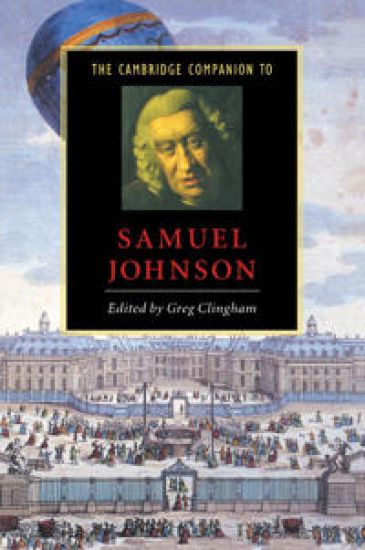
The Cambridge Companion to Samuel Johnson provides a unique introduction to the works and intellectual life of one of the most challenging and wide-ranging writers in English literary history. Compiler of the first great English dictionary, editor of Shakespeare, biographer and critic of the English poets, author both of the influential journal Rambler and the popular fiction Rasselas, and one of the most engaging conversationalists in literary culture, Johnson is here illuminatingly discussed from a different point of view. Essays on his main works are complemented by thematic discussion of his views on the experience of women in the eighteenth century, politics, imperialism, religion, and travel as well as by chapters covering his life, conversation, letters, and critical reception. Useful reference features include a chronology and guide to further reading. The keynote to the volume is the seamlessness of Johnson’s life and writing, and the extraordinary humane intelligence he brought to all his activities. Accessibly written by a distinguished group of international scholars, this volume supplies a stimulating range of approaches, making Johnson newly relevant for our time.
With these two volumes Princeton University Press concludes the first scholarly edition of the letters of Samuel Johnson to appear in forty years. Volume IV chronicles the last three years of Johnson's life, an epistolary endgame that includes the breakup of the friendship with Hester Thrale and a poignant reaching out to new friends and new experiences. Volume V includes not only the comprehensive index but those undated letters that cannot confidently be assigned to a specific year, "ghost" letters (those whose existence is documented in other sources), three letters that have recently been recovered, and translations of Johnson's letters in Latin. Bruce Redford is Professor of English at the University of Chicago and the author of The Converse of the Pen: Acts of Intimacy in the Eighteenth-Century Familiar Letter (Chicago).Originally published in 1994.The Princeton Legacy Library uses the latest print-on-demand technology to again make available previously out-of-print books from the distinguished backlist of Princeton University Press. These editions preserve the original texts of these important books while presenting them in durable paperback and hardcover editions. The goal of the Princeton Legacy Library is to vastly increase access to the rich scholarly heritage found in the thousands of books published by Princeton University Press since its founding in 1905.
The Hyde Edition offers scores of texts transcribed for the first time from the original documents a feature of special importance in the case of Johnson's revealing letters to Hester Thrale, many of which have been available only in expurgated form. The Hyde Edition is also the first systematically to record substantive deletions, which can yield intimate knowledge of Johnson's stylistic procedures, mental habits, and chains of association. Furthermore, its ownership credits document the current disposition of the manuscripts, hundreds of which have changed hands during the last four decades. Finally, the annotation of the letters incorporates the many significant discoveries of postwar Johnsonian scholarship, as well as decoding references that had previously resisted explanation. The result is a far richer understanding of Samuel Johnson's life, work, and milieu.Originally published in 1992.The Princeton Legacy Library uses the latest print-on-demand technology to again make available previously out-of-print books from the distinguished backlist of Princeton University Press. These editions preserve the original texts of these important books while presenting them in durable paperback and hardcover editions. The goal of the Princeton Legacy Library is to vastly increase access to the rich scholarly heritage found in the thousands of books published by Princeton University Press since its founding in 1905.
"It is now become so much the fashion to publish letters, that in order to avoid it, I put as little into mine as I can," Samuel Johnson declared, according to Boswell. And Boswell answered, "Do what you will, Sir, you cannot avoid it. Should you even write as ill as you can, your letters would be published as curiosities." But Johnson's letters are far more than that. Even at their most cursory and casual, they are never less than precious biographical documents, and many of them mirror, define, and re-create a vivid likeness of the most versatile writer of eighteenth-century England. With these three volumes Princeton University Press inaugurates the first scholarly edition of this remarkable material to appear in forty years--the planned five-volume series The Letters of Samuel Johnson. Known as the Hyde Edition, the project will be completed with the fourth volume, covering the years 1782 through 1784, and the fifth, containing the comprehensive index and appendices. The series as a whole will present fifty-two previously unknown letters or parts of letters that have come to light since the publication of R. W. Chapman's three-volume set (Oxford, 1952). Such "new" letters, however, are scarcely more important than those for which only inferior printed texts or copies of varying reliability had previously been recovered. The Hyde Edition offers scores of texts transcribed for the first time from the original documents--a feature of special importance in the case of Johnson's revealing letters to Hester Thrale, many of which have been available only in expurgated form. The Hyde Edition is also the first systematically to record substantive deletions, which can yield intimate knowledge of Johnson's stylistic procedures, mental habits, and chains of association. Furthermore, its ownership credits document the current disposition of the manuscripts, hundreds of which have changed hands during the last four decades. Finally, the annotation of the letters incorporates the many significant discoveries of postwar Johnsonian scholarship, as well as decoding references that had previously resisted explanation. The result is a far richer understanding of Samuel Johnson's life, work, and milieu.Originally published in 1992.The Princeton Legacy Library uses the latest print-on-demand technology to again make available previously out-of-print books from the distinguished backlist of Princeton University Press. These editions preserve the original texts of these important books while presenting them in durable paperback and hardcover editions. The goal of the Princeton Legacy Library is to vastly increase access to the rich scholarly heritage found in the thousands of books published by Princeton University Press since its founding in 1905.
The Hyde Edition offers scores of texts transcribed for the first time from the original documents a feature of special importance in the case of Johnson's revealing letters to Hester Thrale, many of which have been available only in expurgated form. The Hyde Edition is also the first systematically to record substantive deletions, which can yield intimate knowledge of Johnson's stylistic procedures, mental habits, and chains of association. Furthermore, its ownership credits document the current disposition of the manuscripts, hundreds of which have changed hands during the last four decades. Finally, the annotation of the letters incorporates the many significant discoveries of postwar Johnsonian scholarship, as well as decoding references that had previously resisted explanation. The result is a far richer understanding of Samuel Johnson's life, work, and milieu.Originally published in 1992.The Princeton Legacy Library uses the latest print-on-demand technology to again make available previously out-of-print books from the distinguished backlist of Princeton University Press. These editions preserve the original texts of these important books while presenting them in durable paperback and hardcover editions. The goal of the Princeton Legacy Library is to vastly increase access to the rich scholarly heritage found in the thousands of books published by Princeton University Press since its founding in 1905.