Kirjojen hintavertailu. Mukana 12 390 323 kirjaa ja 12 kauppaa.

Kirjahaku

Etsi kirjoja tekijän nimen, kirjan nimen tai ISBN:n perusteella.

1000 tulosta hakusanalla Uwe Eichenbrenner

Blessings and Victims of Globalization: Economic and social development, relative impoverishment, unemployment, economic crises, right-wing and left-w
The fact that we must deal with the problems of the whole world today is a result of globalization. We must be aware of the fact that globalization is a globalization of our European spirit, our way of life, our technology, including the atomic bomb, our economy and society, and so we are responsible for what is happening worldwide. As a result of globalization, we cannot only observe a growing standard of living and a faster population growth due to improved health care and medicines, but we also have to complain about relative impoverishment, unemployment, economic crises, left-wing and right-wing extremism, religious wars and huge refugee flows. To the extent that the negative consequences of globalization affect the Western world, they lead to general uncertainty, which then manifests itself in a loss of confidence in political institutions. Even the greatest achievements of the post-war period, the overcoming of nationalism and the unification of Europe, are questioned and disproved, and salvation is sought in foreclosure and national autonomous regions. Their ray of hope is that Donald Trump would help countries leaving the EU. He only thinks of America and only recognizes strength. Of course, he is interested in the fact that the power factor of Europe is disintegrating. Since the European Trumps do not recognize the need for a strengthening of Europe, in order to be able to confront America and other great powers, they also prove to be political twits. The increasing dissatisfaction with the given circumstances is not unfounded. It is the result of an inadequate development of the economic and social theories and ideals and the policy determined by them. Disharmonies developed in this way. In order to understand economic development and globalization, we must analyze the underlying motivations. It will be shown that the driving forces and objectives of economic development and globalization are based on the special intellectual development of Europe, as it grew out of an antique and Jewish / Christian heritage. It may come as a surprise to the contemporary reader that we trace the discussion of the problems of globalization back to religion. But if one considers how far other religious denominations, especially Islam, determine the social ideals of Muslim countries and international politics, then it should really be possible to understand that Europeans should also refer to their intellectual heritage and the resulting behavior, especially in order to meet other religious demands and to understand their own position. Thus, it should be allowed, since Europeanism has as its roots in antiquity and, Christianity, to reflect on their essence. In the discussion of Europeanism, it must not be overlooked that it is divided into a western and an eastern component, both of which have been globalized. The leading countries for Western Europeanism were Great Britain and later the Anglo-Saxon world, dominated by the United States. The Eastern Europeanism is represented by the Eastern European countries, initially most notably by Poland, but then more and more by Russia with its expansion to the Black Sea and to Vladivostok. In order to understand current political problems, the essence of the East-West opposition and the position of Europe must therefore also be discussed. The lessons to be gained from this can help to understand the responsibility and task of Europe and, as the strongest economic power of Central Europe, of Germany in overcoming and mediating the East-West opposition. This results in an outline of this elaboration: A.Europeanism as the source of Globalization. B.Western and Eastern Europeanism as the origin of the East-West Opposition and their Globalization C.The crisis and the further development of Europeanism in the globalized world.

Benedictions Et Victimes de la Mondialisation: Développement Économique Et Social, Appauvrissement Relatif, Chômage, Crises Économiques, Radicalisme d
La mondialisation entra ne non seulement une am lioration du niveau de vie et une croissance d mographique plus rapide gr ce de meilleurs soins et m dicaments, mais aussi un appauvrissement relatif, le ch mage, les crises conomiques, l'extr misme de gauche et de droite, les guerres de religion et d' normes flux de r fugi s. En ce qui concerne les effets n gatifs de la mondialisation sur le monde occidental, ils conduisent l'incertitude g n rale, qui se manifeste alors par une perte de confiance dans les institutions politiques. Dans le processus, m me les plus grandes r alisations de l'apr s-guerre - le d passement du nationalisme et l'unification de l'Europe - sont remises en question et compromises; en cons quence le salut est recherch dans l'isolement et les r gions autonomes nationales. Cette aversion pour les institutions tablies et les march s a atteint son point culminant lors de l' lection du pr sident am ricain Donald Trump, qui - et c'est la nature discutable de son programme politique - comme milliardaire avec le soutien d'autres milliardaires et avec la promotion des jeux du march des capitaux veut ramener l' conomie en arri re vers une nouvelle prosp rit et une nouvelle taille. Pour ce faire, il veut dissocier les tats-Unis du march mondial et ramener les industries perdues dans le pays. Comme les Trumpis europ ens ne reconnaissent pas la n cessit de renforcer l'Europe pour d fier l'Am rique et les autres grandes puissances, ils se r v lent aussi inaptes politiquement. Pour comprendre le d veloppement conomique et la mondialisation, nous devons analyser les pulsions sous-jacentes. On d montrera que les forces motrices et les objectifs du d veloppement conomique et de la mondialisation sont enracin s dans le d veloppement intellectuel particulier de l'Europe, qui s'est d velopp partir de l'h ritage antique et jud o-chr tien. L'analyse des conditions conomiques, sociales et politiques du monde montre aussi qu'il ne suffit pas de comparer les relations de pouvoir, le d veloppement conomique et les ressources naturelles, mais que les motivations spirituelles et surtout religieuses peuvent tre des moteurs beaucoup plus importants de l'action politique et sociale. L' chec des Etats-Unis au Vietnam, la r volution iranienne, la l g re progression de l'EI et son affirmation ne peuvent tre expliqu s autrement. Si l'on consid re quel point d'autres confessions religieuses, en particulier l'Islam, d terminent aujourd'hui les id aux sociaux des pays musulmans et de la politique internationale, il faut comprendre que les europ ens r fl chissent aussi leur h ritage intellectuel et au comportement qui en r sulte. Cela doit tre pris en compte en particulier afin de r pondre d'autres revendications religieuses et de comprendre sa propre position. Donc, puisque l'europ isme a comme racines, d'une part, l'antiquit et, d'autre part, le christianisme, il est permis de r fl chir leur nature. Quand on parle d'europ isme, il ne faut pas oublier qu'il est partag lui-m me en une composante occidentale et une composante orientale, toutes deux devenues mondialis es. Les pays faisant autorit pour l'europ isme occidental taient le Royaume-Uni et plus tard le monde anglo-saxon, domin par les tats-Unis. L'europ isme oriental tait repr sent par les pays d'Europe de l'Est, d'abord la Pologne, mais ensuite de plus en plus la Russie avec son expansion de la Mer Noire Vladivostok. Ces deux europ ismes et leur globalisation sont en conflit depuis la fondation de l'Empire britannique et de l'Empire russe.
Segen und Opfer der Globalisierung: Wirtschaftliche und gesellschaftliche Entwicklung, relative Verarmung, Arbeitslosigkeit, Wirtschaftskrisen, Links-
Dass wir uns heute mit den Problemen der ganzen Welt besch ftigen m ssen, ist eine Folge der Globalisierung. Dabei m ssen wir uns bewusst sein, dass die Globalisierung eine Globalisierung unseres europ ischen Geistes, unserer Lebensform, unserer Technik bis hin zur Atombombe, unserer Wirtschaft und Gesellschaft ist und wir somit insoweit selbst mitverantwortlich sind, was weltweit geschieht. Als Folgen der Globalisierung k nnen wir weltweit nicht nur einen steigenden Lebensstandard und eine raschere Bev lkerungsvermehrung aufgrund besserer Gesundheitsvorsorge und Medikamente beobachten, wir m ssen auch eine relative Verarmung, Arbeitslosigkeit, Wirtschaftskrisen, Links- und Rechtsradikalismus, Religionskrie-ge und riesige Fl chtlingsstr me beklagen. Soweit die negativen Folgen der Globalisierung auf die westliche Welt zur ckwirken, f hren sie zur allgemeinen Verunsicherung, die sich dann in einem Vertrauensverlust gegen ber den politischen Institutionen u ert. Dabei werden selbst die gr ten Errungenschaften der Nachkriegszeit: die berwindung des Nationalismus und die Einigung Europas, infrage und zur Disposition gestellt und wird das Heil in Abschottung und nationalen autarken Regionen gesucht. Einen m glicherweise erst vorl ufigen H hepunkt hat diese Aversion gegen die etablierten Institutionen und M chte in der Wahl des US-Pr sidenten Donald Trump gefunden, der, und darin liegt schon die Fragw rdigkeit seiner programmierten Politik, als Milliard r zu-sammen mit anderen Milliard ren und unter F rderung von Kapitalmarktspielen die Masse der wirtschaftlich Zur ckgebliebenen zu neuem Wohlstand und neuer Gr e f hren will. Dazu will er die USA vom Weltmarkt abkoppeln und verlorene Industrien ins Land zur ckholen. Ihr Hoffnungstr ger Donald Trump w rde den Aus-trittswilligen nicht helfen. Er denkt nur an Amerika und anerkennt nur Starke. Deswegen ist er nat rlich interes-siert, dass der Machtfaktor Europa zerf llt. Da die europ ischen Trumps die Notwendigkeit einer St rkung Eu-ropas nicht erkennen, um Amerika und anderen Gro m chten Paroli bieten zu k nnen, erweisen sie sich zudem noch als politische Deppen. Um die Wirtschaftsentwicklung und die Globalisierung zu verstehen, m ssen wir die ihnen zugrundeliegenden Antriebe analysieren. Dabei wird sich zeigen, dass die Triebkr fte und Zielsetzungen der Wirtschaftsentwicklung und der Globalisierung in der besonderen geistigen Entwicklung Europas gr nden, wie es aus dem antiken und j disch/christlichen Erbe hervorgewachsen ist Bei der Er rterung des Europ ismus darf nicht bersehen werden, dass sich dieser selbst in eine westliche und stliche Komponente teilt, die beide globalisiert wurden. Die ma gebenden L nder f r den westlichen Europ is-mus waren Gro britannien und dann sp ter die angels chsische Welt, dominiert von den USA. Den stlichen Europ ismus repr sentierten die osteurop ischen L nder, zun chst ma gebend vor allem Polen, dann aber immer mehr Russland mit seiner Expansion bis an das Schwarze Meer und nach Wladiwostok. Diese beiden Europ ismen und deren Globalisierung traten seit der Gr ndung des britischen Imperiums und des russischen Reiches in ein Spannungsverh ltnis zueinander. Der daraus erwachsende Ost-West-Gegensatz bestimmte weiter-hin nahezu alle Konflikte im Nahen und Mittleren Osten, war Ursache der Ost-West-Spaltung nach der Russi-schen Oktoberrevolution und berlagert die gegenw rtigen Konflikte in der Ukraine und im Nahen Osten. Zum Verst ndnis der gegenw rtigen politischen Probleme wird daher auch das Wesen des Ost-West Gegensatzes und der Stellung Europas darin zu er rtern sein. Die daraus zu gewinnenden Erkenntnisse k nnen helfen, die Verantwortung und Aufgabe Europas und, als st rkste wirtschaftliche Macht Mitteleuropas, Deutschlands, bei der berwindung und Vermittlung des Ost-West Gegensatzes zu verstehen.
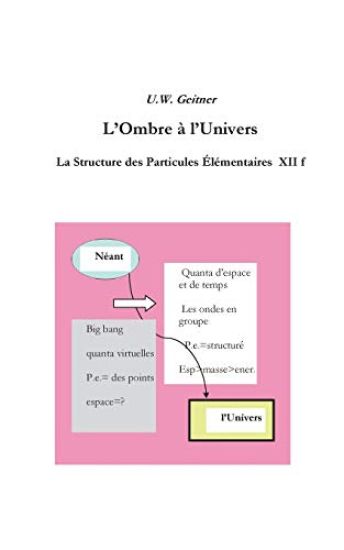
L'Ombre à l'Univers

L'Ombre à l'Univers

Uwe Geitner

Books on Demand
2016
pokkari
Les livres La Structure des Particules l mentaires d veloppent un arbre g n alogique pour ces particules qui commence au d but de l'univers. Les id es actuelles de physique sont discut es. On peut bien comprendre ces conceptions sans conna tre la math matique ou la physique. Le tome XIIf construit l'univers sans aucune mati re et nergie des quanta d'espace et du temps seulement. On discute la physique et trouve quelques r gions peu clair es. Par ramassant des id es d j bien connues on peut reconna tre des explications simples.
Sekulare Stagnation unser Schicksal?: Grenzen der Angebotsorientierten Wirtschaftspolitik
Am 21.November 2013 hat Larry Summers in einem Vortrag auf der j hrli-chen Research-Konferenz des IWF das Bild einer Zukunft mit chronisch schwacher Nachfrage und schleppendem Wirtschaftswachstum gezeichnet, die "secular stagnation". Vor ihm hatte bereits Paul Krugman die Hypothese der "secular stagnation" aus den fr hen Nachkriegszeiten aufgegriffen. In-zwischen beherrscht das Gespenst einer drohenden Deflation insbesondere die W hrungsh ter, denn deren M glichkeiten durch Zinssenkungen und Geldvermehrung diese Gefahr zu bannen, versiegen. Von der herrschenden neo-klassischen angebotsorientierten Wirtschaftstheo-rie und -politik werden das Ph nomen und die Ursachen der s kularen Stagnation nicht verstanden. Ihre wirtschaftspolitischen Ma nahmen be-k mpfen daher nur die Symptome und, soweit sie berhaupt noch wirken, befl geln sie Kapitalmarktspiele und Kapitalverbrennung, erh hen dabei aber zugleich die Fragilit t des Wirtschaftssystems. Deutschland erkauft seine wirtschaftliche Prosperit t durch seine Export- bersch sse und entsprechenden Kapitalexport, durch den die berschus-sersparnisse ins Ausland transferiert werden. Deutschland verschiebt damit Arbeitslosigkeit ins Ausland. Da Deutschland aber auch alle Kriterien einer s kularen Stagnation erf llt, lebt es wirtschaftlich auf einem Vulkan. Die Merkel-Regierung versteht nicht das Ph nomen der s kularen Stagnation, die wirtschaftlichen Probleme der Not leidenden europ ischen L nder und die Geldpolitik der Europ ischen Zentralbank, ohne die die Euro-Zone schon zusammengebrochen w re. Deshalb versch rfen ihre Ma nahmen und wirt-schaftspolitischen Forderungen die Krisengefahr, anstatt durch eine Be-k mpfung der Krisenkriterien im Lande zugleich Vorbild f r die kleineren L nder zu sein.
Fatigue and Fracture of Weldments

Fatigue and Fracture of Weldments

Uwe Zerbst; Mauro Madia; Benjamin Schork; Jonas Hensel; Pawel Kucharczyk; DesireTchoffo Ngoula; Didi Tchuindjang; Julian Bernhard; Carla Beckmann

Springer Nature Switzerland AG
2019
sidottu
This book provides a comprehensive and thorough guide to those readers who are lost in the often-confusing context of weld fatigue. It presents straightforward information on the fracture mechanics and material background of weld fatigue, starting with fatigue crack initiation and short cracks, before moving on to long cracks, crack closure, crack growth and threshold, residual stress, stress concentration, the stress intensity factor, J-integral, multiple cracks, weld geometries and defects, microstructural parameters including HAZ, and cyclic stress-strain behavior. The book treats all of these essential and mutually interacting parameters using a unique form of analysis.
Embedded Microprocessor System Design using FPGAs

Embedded Microprocessor System Design using FPGAs

Uwe Meyer-Baese

Springer Nature Switzerland AG
2021
sidottu
This textbook for courses in Embedded Systems introduces students to necessary concepts, through a hands-on approach. It gives a great introduction to FPGA-based microprocessor system design using state-of-the-art boards, tools, and microprocessors from Altera/Intel® and Xilinx®. HDL-based designs (soft-core), parameterized cores (Nios II and MicroBlaze), and ARM Cortex-A9 design are discussed, compared and explored using many hand-on designs projects. Custom IP for HDMI coder, Floating-point operations, and FFT bit-swap are developed, implemented, tested and speed-up is measured. Downloadable files include all design examples such as basic processor synthesizable code for Xilinx and Altera tools for PicoBlaze, MicroBlaze, Nios II and ARMv7 architectures in VHDL and Verilog code, as well as the custom IP projects. Each Chapter has a substantial number of short quiz questions, exercises, and challenging projects. Explains soft, parameterized, and hard core systems design tradeoffs;Demonstrates design of popular KCPSM6 8 Bit microprocessor step-by-step;Discusses the 32 Bit ARM Cortex-A9 and a basic processor is synthesized;Covers design flows for both FPGA Market leaders Nios II Altera/Intel and MicroBlaze Xilinx system;Describes Compiler-Compiler Tool development;Includes a substantial number of Homework’s and FPGA exercises and design projects in each chapter.
Embedded Microprocessor System Design using FPGAs

Embedded Microprocessor System Design using FPGAs

Uwe Meyer-Baese

Springer Nature Switzerland AG
2022
nidottu
This textbook for courses in Embedded Systems introduces students to necessary concepts, through a hands-on approach. It gives a great introduction to FPGA-based microprocessor system design using state-of-the-art boards, tools, and microprocessors from Altera/Intel® and Xilinx®. HDL-based designs (soft-core), parameterized cores (Nios II and MicroBlaze), and ARM Cortex-A9 design are discussed, compared and explored using many hand-on designs projects. Custom IP for HDMI coder, Floating-point operations, and FFT bit-swap are developed, implemented, tested and speed-up is measured. Downloadable files include all design examples such as basic processor synthesizable code for Xilinx and Altera tools for PicoBlaze, MicroBlaze, Nios II and ARMv7 architectures in VHDL and Verilog code, as well as the custom IP projects. Each Chapter has a substantial number of short quiz questions, exercises, and challenging projects. Explains soft, parameterized, and hard core systems design tradeoffs;Demonstrates design of popular KCPSM6 8 Bit microprocessor step-by-step;Discusses the 32 Bit ARM Cortex-A9 and a basic processor is synthesized;Covers design flows for both FPGA Market leaders Nios II Altera/Intel and MicroBlaze Xilinx system;Describes Compiler-Compiler Tool development;Includes a substantial number of Homework’s and FPGA exercises and design projects in each chapter.
Template-based Management

Template-based Management

Uwe G. Seebacher

Springer Nature Switzerland AG
2020
sidottu
The Template-based management (TBM) approach has been used since 2003 across the world in diverse contexts. It has evolved hand-in-hand with the evolution of business: Agile, Blueprints, Canvas, Design Thinking, or Kanban are only few of the many current concepts based on the approach. This book expands and upgrades the author's 2003 book 'Template-driven Consulting' (Springer) by tracing this evolution and offering the current state-of-the-art to practitioners. TBM combines structure and method: pre-structuring diverse processes, it helps to present complex activities and procedures in a simple, clear, and transparent manner and then implement them. The use of TBM ranges from conception or creative work in agencies to designing organizations and strategies, planning and monitoring initiatives and projects, to innovation management and optimizing cost structures, processes, or entire departments and divisions. The book also demonstrates how successful organizations use TBM to methodically and structurally apply the internal know-how in a cost and time-optimal way for attaining sustainable business success. Readers will learn to apply and use TBM, identify its importance, and benefit from a variety of case studies that illustrate the application and use for the entire business and management practice.
Template-based Management

Template-based Management

Uwe G. Seebacher

Springer Nature Switzerland AG
2021
nidottu
The Template-based management (TBM) approach has been used since 2003 across the world in diverse contexts. It has evolved hand-in-hand with the evolution of business: Agile, Blueprints, Canvas, Design Thinking, or Kanban are only few of the many current concepts based on the approach. This book expands and upgrades the author's 2003 book 'Template-driven Consulting' (Springer) by tracing this evolution and offering the current state-of-the-art to practitioners. TBM combines structure and method: pre-structuring diverse processes, it helps to present complex activities and procedures in a simple, clear, and transparent manner and then implement them. The use of TBM ranges from conception or creative work in agencies to designing organizations and strategies, planning and monitoring initiatives and projects, to innovation management and optimizing cost structures, processes, or entire departments and divisions. The book also demonstrates how successful organizations use TBM to methodically and structurally apply the internal know-how in a cost and time-optimal way for attaining sustainable business success. Readers will learn to apply and use TBM, identify its importance, and benefit from a variety of case studies that illustrate the application and use for the entire business and management practice.
Predictive Intelligence for Data-Driven Managers
This book describes how companies can easily and pragmatically set up and realize the path to a data-driven enterprise, especially in the marketing practice, without external support and additional investments. Using a predictive intelligence (PI) ecosystem, the book first introduces and explains the most important concepts and terminology. The PI maturity model then describes the phases in which you can build a PI ecosystem in your company. The book also demonstrates a PI self-test which helps managers identify the initial steps. In addition, a blueprint for a PI tech stack is defined for the first time, showing how IT can best support the topic. Finally, the PI competency model summarizes all elements into an action model for the company. The entire book is underpinned with practical examples, and case studies show how predictive intelligence, in the spirit of data-driven management, can be used profitably in the short, medium, and long terms.
Predictive Intelligence for Data-Driven Managers

Predictive Intelligence for Data-Driven Managers

Uwe Seebacher

Springer Nature Switzerland AG
2022
nidottu
This book describes how companies can easily and pragmatically set up and realize the path to a data-driven enterprise, especially in the marketing practice, without external support and additional investments. Using a predictive intelligence (PI) ecosystem, the book first introduces and explains the most important concepts and terminology. The PI maturity model then describes the phases in which you can build a PI ecosystem in your company. The book also demonstrates a PI self-test which helps managers identify the initial steps. In addition, a blueprint for a PI tech stack is defined for the first time, showing how IT can best support the topic. Finally, the PI competency model summarizes all elements into an action model for the company. The entire book is underpinned with practical examples, and case studies show how predictive intelligence, in the spirit of data-driven management, can be used profitably in the short, medium, and long terms.
The Digital Transformation of the Automotive Industry

The Digital Transformation of the Automotive Industry

Uwe Winkelhake

Springer Nature Switzerland AG
2021
sidottu
Building on his decades of experience as a consultant and project manager in the automotive industry, the author develops comprehensive and pragmatic recommendations for action regarding the digital transformation of the automotive and supplier industries. At the heart is the transition from a vehicle-focused to a mobility-oriented business model. Based on the catalysts of the digital change, four digitizsation fields are structured, and a roadmap for their transformation is presented. The topics of comprehensive change in corporate culture and an agile and efficient information technology are covered in detail as vital success factors. Selected practical examples of innovative digitizsation projects provide additional ideas and impulses. An outlook on the automotive industry in the year 2040 completes the discourse.
The Digital Transformation of the Automotive Industry

The Digital Transformation of the Automotive Industry

Uwe Winkelhake

Springer Nature Switzerland AG
2022
nidottu
Building on his decades of experience as a consultant and project manager in the automotive industry, the author develops comprehensive and pragmatic recommendations for action regarding the digital transformation of the automotive and supplier industries. At the heart is the transition from a vehicle-focused to a mobility-oriented business model. Based on the catalysts of the digital change, four digitizsation fields are structured, and a roadmap for their transformation is presented. The topics of comprehensive change in corporate culture and an agile and efficient information technology are covered in detail as vital success factors. Selected practical examples of innovative digitizsation projects provide additional ideas and impulses. An outlook on the automotive industry in the year 2040 completes the discourse.
Reengineering Corporate Communication

Reengineering Corporate Communication

Uwe Seebacher

Springer International Publishing AG
2022
sidottu
This book employs the latest insights from modern marketing into the theory and practice of corporate communication, including the main stages and goals, and highlights the key potentials for the field. It briefly presents the essential features of the methodological and structural sciences in order to illustrate to the reader how, from a marketer's point of view, these new insights can be derived objectively, reliably, and validly for the field of corporate communication according to scientific criteria. The book then introduces the maturity model for modern corporate communication and describes which fields of activity must be gone through in order to be able to implement the change management process towards corporate communication excellence efficiently and effectively. Building on this, it introduces and defines the most important new concepts of corporate communication in the twenty-first century and thus clearly delineates the field of research for this corporate function in the coming years. The book goes on to address the important areas of IT and HR in order to provide a 360° view of the developments to be realized in the field of corporate communication. A “CC self-test” at the end of the book is intended to help the reader immediately recognize where their own organization stands and, against this backdrop, to be able to start the necessary activities towards corporate communication excellence immediately on the basis of the maturity model. “Prof. Dr. Uwe Seebacher takes us on a timely and informative read on what could be the biggest crisis for Corporate Communications – remaining stagnant in a time of great change. With rich context and fine detail, he illuminates the opportunities to reengineer Corporate Communications and quantify its role in truly impacting business. From the importance of predictive intelligence underpinned by authenticity and empathy to building trust, this book is a guide for successful business in the 21stCentury. I highly recommend it.”Heidi Eusebio, Strategist and Executive Director, Edelman "Uwe Seebacher has once again demonstrated in a well-founded manner what methodological and structural science is capable of - namely, to precisely logically derive the long overdue process of change in the field of corporate communications and thereby make it comprehensible. But he also takes the important next step of operationalizing his thoughts in a directly measurable way by providing an easy applicable concrete process model for reengineering corporate communication with many tips, templates and inputs for HR and IT.“ Miguel Gimenez de Castro, Head Of Communications Spain, Portugal, Greece and Israel, IBM