Kirjojen hintavertailu. Mukana 12 392 065 kirjaa ja 12 kauppaa.

Kirjahaku

Etsi kirjoja tekijän nimen, kirjan nimen tai ISBN:n perusteella.

1000 tulosta hakusanalla Virginia Woolf

Virginia Woolf's Garden: The Story of the Garden at Monk's House
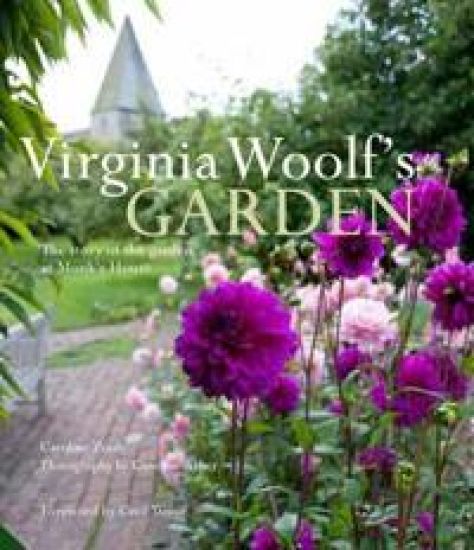
Monk's House in Sussex is the former home of Leonard and Virginia Woolf. It was bought by them in 1919 as a country retreat, somewhere they came to read, write and work in the garden. From the overgrown land behind the house they created a brilliant patchwork of garden rooms, linked by brick paths, secluded behind flint walls and yew hedges. The story of this magical garden is the subject of this book and the author has selected quotations from the writings of the Woolfs which reveal how important a role the garden played in their lives, as a source of both pleasure and inspiration. Virginia wrote most of her major novels at Monk's House, at first in a converted tool shed, and later in her purpose-built wooden writing lodge tucked into a corner of the orchard. Caroline Zoob lived with her husband, Jonathan, at Monk's House for over a decade as tenants of the National Trust, and has an intimate knowledge of the garden they tended and planted. The photographer, Caroline Arber, was a frequent visitor to the house during their tenancy and her spectacular photographs, published here for the first time, often reveal the garden as it is never seen by the public: at dawn, in the depths of winter, at dusk. The photographs and text, enriched with rare archive images and embroidered garden plans, take the reader on a journey through the various garden 'rooms', (including the Italian Garden, the Fishpond Garden, the Millstone Terrace and the Walled Garden). Each garden room is presented in the context of the lives of the Woolfs, with fascinating glimpses into their daily routines at Rodmell. This beautiful book is an absorbing account of the creation of a garden which will appeal equally to gardeners and those with an interest in Virginia and Leonard Woolf.
Virginia Woolf at Home

Virginia Woolf at Home

Hilary Macaskill; Cecil Woolf

Pimpernel Press Ltd
2019
sidottu
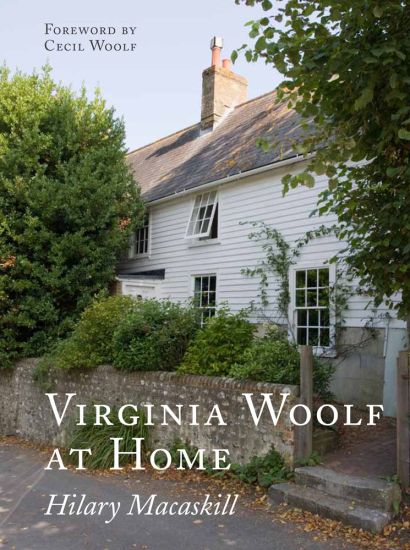
Virginia Woolf, figurehead of the Bloomsbury Group and an innovative writer whose experimental style and lyrical prose ensured her position as one of the most influential of modern novelists, was also firmly anchored in the reality of the houses she lived in and those she visited regularly. Detailed and evocative accounts appear in her letters and diaries, as well as in her fiction, where they appear as backdrops or provide direct inspiration. Hilary Macaskill examines the houses that meant the most to Woolf, including: 22 Hyde Park Gate, London - where Virginia Woolf was born in 1882 Talland House, St Ives, Cornwall - the summer home of Virginia's family until 1895 46 Gordon Square, Bloomsbury, London - the birthplace of the Bloomsbury Group - Virginia lived here from 1904 to 1912 Hogarth House, Richmond, London - where the newly married Woolfs set up home and founded the Hogarth Press Asheham House, East Sussex - the summer home of the Woolfs, 1912-1919 52 Tavistock Square, London - a return to Bloomsbury, the heart of London Monk's House, Rodmell, East Sussex - where Virginia lived from 1919 until her death in 1941
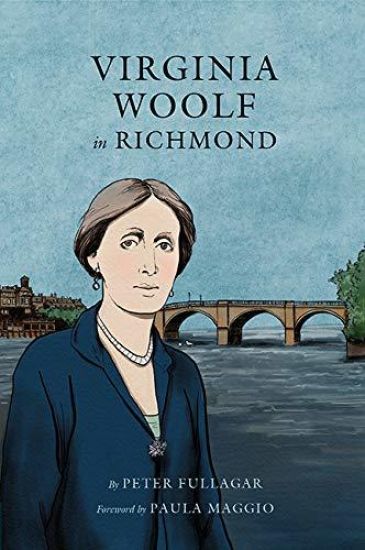
Virginia Woolf in Richmond

Virginia Woolf in Richmond

Virginia Woolf; Leonard Woolf; Peter Fullagar; Paula Maggio

Aurora Metro Books
2018
sidottu
“I ought to be grateful to Richmond & Hogarth, and indeed, whether it’s my invincible optimism or not, I am grateful.” - Virginia Woolf Although more commonly associated with Bloomsbury, Virginia and her husband Leonard Woolf lived in Richmond-upon-Thames for ten years from the time of the First World War (1914-1924). Refuting the common misconception that she disliked the town, this book explores her daily habits as well as her intimate thoughts while living at the pretty house she came to love – Hogarth House. Drawing on information from her many letters and diaries, the editor reveals how Richmond’s relaxed way of life came to influence the writer, from her experimentation as a novelist to her work with her husband and the Hogarth Press, from her relationships with her servants to her many famous visitors.
Virginia Woolf in Richmond

Virginia Woolf in Richmond

Peter Fullagar; Paula Maggio

AURORA METRO PUBLICATIONS
2022
nidottu
NEW EDITION IN PAPERBACK to coincide with a new project to unveil a statue of the author in Richmond on Thames in 2022 "I ought to be grateful to Richmond & Hogarth, and indeed, whether it's my invincible optimism or not, I am grateful." - Virginia Woolf Although more commonly associated with Bloomsbury, Virginia and her husband Leonard Woolf lived in Richmond-upon-Thames for ten years from the time of the First World War (1914-1924). Refuting the common misconception that she disliked the town, this book explores her daily habits as well as her intimate thoughts while living at the pretty house she came to love - Hogarth House. Drawing on information from her many letters and diaries, as well as Leonard's autobiography, the editor reveals how Richmond's relaxed way of life came to influence the writer, from her experimentation as a novelist to her work with her husband and the Hogarth Press, from her relationships with her servants to her many famous visitors.
Virginia Woolf: Killing the Angel

Virginia Woolf: Killing the Angel

Lucy Stevens

AURORA METRO PUBLICATIONS
2022
nidottu
Acclaimed one-woman play with music that weaves the life and writing of Virginia Woolf with songs by British women composers who were Woolf's contemporaries. It reveals Virginia's troubled childhood, her views on literature, the Bloomsbury group and the challenges women artists face.
Virginia Woolf and the World of Books

Virginia Woolf and the World of Books

Clemson University Digital Press
2018
sidottu
Virginia Woolf and the World of Books will examine Leonard and Virginia Woolf's Hogarth Press as a key intervention in modernist and women's writing and mark its importance to independent publishing, bookselling, and print culture at large. The research in this volume coincides with the centenary of the founding of Hogarth Press in 1917, thus making a timely addition to scholarship on the Woolfs and print culture.
Virginia Woolf, Europe, and Peace

Virginia Woolf, Europe, and Peace

Clemson University Digital Press
2020
sidottu
Virginia Woolf, Europe, and Peace: Transnational Circulations enlarges our understanding of Virginia Woolf's pacifist ideology and aesthetic response to the World Wars by re-examining her writings and cultural contexts transnationally and comparatively through the complex interplay between modernism, politics, and aesthetics. The "transnational" paradigm that undergirds this collection revolves around the idea of transnational cultural communities of writers, artists, and musicians worldwide who were intellectually involved in the war effort through the forging of pacifist cultural networks that arose as a form of resistance to war, militarism, and the rise of fascism. The book also offers philosophical approaches to notions of transnational pacifism, anti-war ethics, and decolonization, examining how Woolf's prose undermines center/edge or self/other bifurcations. Breathing new life into Woolf's anti-war writings through a transnational lens and presenting us with the voices and perspectives of a range of significant scholars and critics, the chapters in this volume engage with mobile and circulatory pacifisms, calling attention to the intersections of modernist inquiries across the arts (art, music, literature, and performance) and transnational critical spaces (Asia, Europe, and the Americas) to show how the convergence of different cultural and linguistic horizons can significantly expand and enrich our understanding of Woolf's modernist legacy.
Virginia Woolf, Europe, and Peace

Virginia Woolf, Europe, and Peace

Clemson University Digital Press
2020
sidottu
From the "prying," "insidious" "fingers of the European War" that Septimus Warren Smith would never be free of in Mrs Dalloway to the call to "think peace into existence" during the Blitz in "Thoughts on Peace in an Air Raid," questions of war and peace pervade the writings of Virginia Woolf. This volume asks how Woolf conceptualised peace by exploring the various experimental forms she created in response to war and violence. Comprised of fifteen chapters by an international array of leading and emerging scholars, this book both draws out theoretical dimensions of Woolf's modernist aesthetic and draws on various critical frameworks for reading her work, in order to deepen our understanding of her writing about the politics of war, ethics, feminism, class, animality, and European culture. The chapters collected here look at how we might re-read Woolf and her contemporaries in the light of new theoretical and aesthetical innovations, such as peace studies, post-critique, queer theory, and animal studies. It also asks how we might historicise these frameworks through Woolf's own engagement with the First and Second World Wars, while also bringing her writings on peace into dialogue with those of others in the Bloomsbury Group. In doing so, this volume reassesses the role of Europe and peace in Woolf's work and opens up new ways of reading her oeuvre.
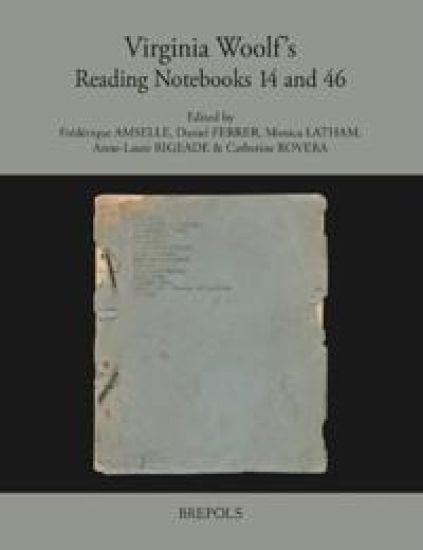
Virginia Woolf's Reading Notebooks 14 and 46
Virginia Woolf's reading notes offer a fascinating insight into her mind at work, reading "with a pen and notebook, seriously", engaged in a lively dialogue with the literary tradition, receptive to the books she is reading and preparing at the same time the critical work that she intends to produce. The two notebooks published and presented in this volume, notebooks XIV and XLVI (according to Brenda Silver's classification) were used for the preparation of "Phases of Fiction", one of her most original works, and for several essays and reviews. They include quotations, comments on the spur of the moment, and tentative planning for the writing in progress. This edition situates the notes in the immediate context of Woolf's writing project and in the general context of her relationship to the authors being read. It provides a full transcription of each note and whenever possible quotes the passage in the source from which it derives, and identifies the place where it has been used. It offers a stimulating demonstration of practical intertextuality in progress.
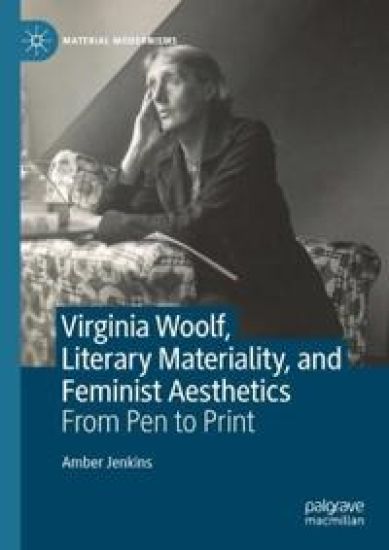
Virginia Woolf, Literary Materiality, and Feminist Aesthetics

Virginia Woolf, Literary Materiality, and Feminist Aesthetics

Amber Jenkins

Springer International Publishing AG
2023
sidottu
This book interrogates the relationship between the material conditions of Woolf's writing practices and her work as a printer and publisher at the Hogarth Press. In bringing to light her embodied literary processes, from drafting and composition to hand-printing and binding, this study foregrounds the interactions between Woolf's modernist experimentation and the visual and material aspects of her printed works. By drawing on the field of print culture, as well as the materialist turn in Woolf scholarship, it explores how her experience in print, book-design and publishing underlines her experimental writing, and how her literary texts are conditioned by the context of their production. This book, therefore, provides new ways of reading Woolf's modernism in the context of twentieth-century print, material, and visual cultures. By suggesting that Woolf's work at the Hogarth Press sensitized her to the significant role the visual aspects of a text play in its system ofrepresentation, it also considers the extent to which materiality informs both her work, as well as her engagement with Bloomsbury formalist aesthetics, which often exaggerate the distinction between visual and verbal modes of expression.
Virginia Woolf and the Aesthetics of Vision
The category of vision is significant for Modernist texts as well as for the unfolding discourse of Modernism itself. Within the general Modernist fascination with the artistic and experimental possibilities of vision and perception this study looks at Virginia Woolf’s novels and her critical writings and examines the relation between visuality and aesthetics. An aesthetics of vision, as this study argues, becomes a productive principle of narrative. The visual is not only pertinent to Woolf’s processes of composition, but her works create a kind of vision that is proper to the text itself – a vision that reflects on the experience of seeing and renegotiates the relation between the reader and the text. The study investigates key dimensions of aesthetic vision. It addresses vision in the context of theories of aesthetic experience and identifies a semantics of seeing. It analyses functions of symbolic materiality in the presentation of boundaries of perception, modes of temporality and poetic potentialities. In exploring the connections between vision and language, it seeks to provide new perspectives for a reassessment of what occurs in Modernism's relation to vision.
Virginia Woolf and the Aesthetics of Vision

Virginia Woolf and the Aesthetics of Vision

Claudia Olk

De Gruyter
2017
isokokoinen pokkari
The category of vision is significant for Modernist texts as well as for the unfolding discourse of Modernism itself. Within the general Modernist fascination with the artistic and experimental possibilities of vision and perception this study looks at Virginia Woolf’s novels and her critical writings and examines the relation between visuality and aesthetics. An aesthetics of vision, as this study argues, becomes a productive principle of narrative. The visual is not only pertinent to Woolf’s processes of composition, but her works create a kind of vision that is proper to the text itself – a vision that reflects on the experience of seeing and renegotiates the relation between the reader and the text. The study investigates key dimensions of aesthetic vision. It addresses vision in the context of theories of aesthetic experience and identifies a semantics of seeing. It analyses functions of symbolic materiality in the presentation of boundaries of perception, modes of temporality and poetic potentialities. In exploring the connections between vision and language, it seeks to provide new perspectives for a reassessment of what occurs in Modernism's relation to vision.
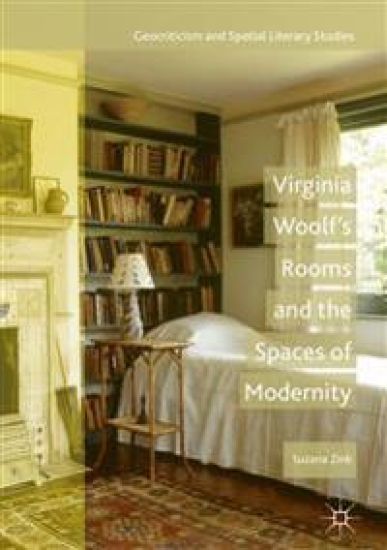
Virginia Woolf's Rooms and the Spaces of Modernity

Virginia Woolf's Rooms and the Spaces of Modernity

Suzana Zink

Springer International Publishing AG
2018
sidottu
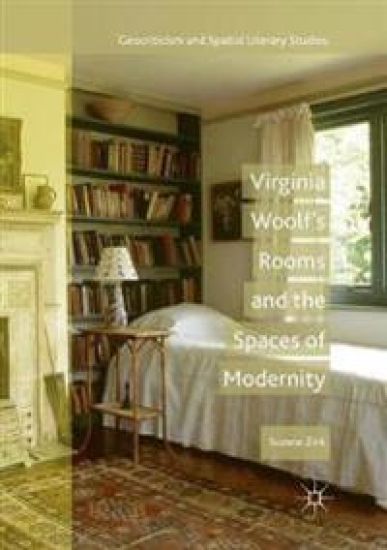
This book provides a fascinating account of rooms in selected works by Virginia Woolf. Casting them as spaces which are at once material, textual and emotional, the volume shows Woolf’s rooms to be consistently connected to wider geographies of modernity and therefore central to her writing of gender, class, empire and the nation. The discussion moves “in and out of rooms,” from the focus on travel in Woolf’s debut novel, to the archival function of built space and literary heritage in Night and Day, the university as a male space of learning in Jacob’s Room, the iconic A Room of One’s Own and its historical readers, interior space as spatial history in The Years, and rooms as loci of memory in her unfinished memoir. Zink masterfully shows the spatial formation of rooms to be at the heart of Woolf’s interweaving of the political and the aesthetic, revealing an understanding of space as dynamic and relational.
Virginia Woolf's Rooms and the Spaces of Modernity

Virginia Woolf's Rooms and the Spaces of Modernity

Suzana Zink

Springer International Publishing AG
2019
nidottu
This book provides a fascinating account of rooms in selected works by Virginia Woolf. Casting them as spaces which are at once material, textual and emotional, the volume shows Woolf’s rooms to be consistently connected to wider geographies of modernity and therefore central to her writing of gender, class, empire and the nation. The discussion moves “in and out of rooms,” from the focus on travel in Woolf’s debut novel, to the archival function of built space and literary heritage in Night and Day, the university as a male space of learning in Jacob’s Room, the iconic A Room of One’s Own and its historical readers, interior space as spatial history in The Years, and rooms as loci of memory in her unfinished memoir. Zink masterfully shows the spatial formation of rooms to be at the heart of Woolf’s interweaving of the political and the aesthetic, revealing an understanding of space as dynamic and relational.