Kirjojen hintavertailu. Mukana 12 178 521 kirjaa ja 12 kauppaa.

Kirjahaku

Etsi kirjoja tekijän nimen, kirjan nimen tai ISBN:n perusteella.

1000 tulosta hakusanalla Wauter Mannaert

Water-Rock Interaction XIII
In the late 18th century, Neptunists and Plutonists had controversial opinions about the formation of the Earth and its lithological units. The former believed that rocks formed from the crystallization of minerals in the early Earth’s oceans, the latter believed that rocks were formed in fire. Both theories ignored the importance of continuous water-rock interaction processes at Earth´s surface and underground, which can enhance and define the type of volcanic activity, can cause the formation of secondary hydrothermal minerals and respective ore deposits, or simply alter the natural landscape by weathering. Although not visible at first glance, water-rock interaction plays a significant role in the daily life of humans. Many primary necessities of modern society, such as the availability of high-quality drinking water, the supply of fossil fuel and renewable energy types, the abundance of precious minerals, the remediation of contaminated natural sites, and the reconnaissance of geological hazards require a profound understanding of physicochemical processes interacting between liquid, solid and gas phases.Since 1974, when the first Water-Rock Interaction Symposia (WRI-1) was held in Prague (Czechoslovakia, now the Czech Republic), the Working Group on Water-Rock Interaction of the International Association of GeoChemistry (IAGC) has organized an international meeting every three years to present and discuss the most recent results in geochemical technologies. In 2010, WRI-13 attracted about 300 geoscientists affiliated with universities, research institutions, regulatory agencies and from private industry, from 35 countries to Guanajuato, Mexico. The 231 papers published in this volume describe novel advances in research related to interactive processes between the hydrosphere and the lithosphere. Innovative field-based studies, theoretical approaches and small-scale lab experiments are applied to reconstruct and combine pieces of the complex hydrological puzzle, and to confront society´s impact on the environment. The papers reveal details on high-temperature reactions during the formation of hydrothermal ore deposits and geothermal reservoirs, practical case studies on groundwater quality and karst systems, environmental issues by mine tailings, novel technologies for the attenuation and remediation of contaminated sites, water/mineral interfacial processes on a micro- to macroscopic scale, the kinetics of weathering during low temperature conditions, examples for the advanced modeling of flow and transport processes as well as for CO2 reservoir injection, biochemical factors in surface and underground media, and the application of novel isotope techniques in rock/water/gas systems. Special emphasis in many papers is given on environmental concerns in abandoned mining districts, the occurrence and hazards of non-metals (especially arsenic) in exploited groundwater systems, and an increasing interest in mitigating CO2 emission by its injection into underground reservoirs.The papers in this volume are of wide-ranging interest to professionals and students in Earth sciences, including geochemistry, hydrochemistry, hydrology, geology, mineralogy, volcanology and environmental sciences, but also to decision-makers and engineers involved in the management of energy and natural resources, as well as professionals concerned about environmental issues.
Water for Food in a Changing World
There is not enough water globally for all the things humans need and want water to do for us. Water supply bubbles are bursting in China, the Middle East and India with potentially serious implications for the global economy and for political stability. Even the United States is depleting groundwater on average 25% faster than it is being replenished. Our thirst for water grows with our population, but the amount of fresh water available on Earth is fixed. If we assume "business as usual" by 2050 about 40% of the projected global population of 9.4 billion is expected to be facing water stress or scarcity. With increasing climate variability being predicted by global climate models, we are likely also to have more people without adequate water more of the time, even in water-rich regions. Irrigation productivity rose dramatically over the past 40 years as a result of the Green Revolution. However, even if we disregard the environmental impacts caused by that revolution, we are no nearer to achieving global food security than we were 40 years ago, as every time we come close to filling the food production gap population growth and ecosystem decline associated with water diversions to human purposes set us back. Our natural and agricultural ecosystems are trying to tell us something.This book pursues these overarching themes connecting to water and food production at global and regional scales. The collection offers a comprehensive discussion of all relevant issues, and offers a wide-ranging discussion with the aim of contributing to the global debate about water and food crises.
Water Management, Food Security and Sustainable Agriculture in Developing Economies
This book addresses strategies for food security and sustainable agriculture in developing economies. The book focuses primarily on India, a fast developing economy, whose natural resource base comprising land and water supporting agricultural production is not only under enormous stress, but also complex and not amenable to a uniform strategy. It critically reviews issues which continue to dominate the debate on water management for agricultural and food production. The book examines the validity of the claim that large water resources projects cause serious social and environmental damages using global and national datasets. The authors examine claims that the future of Indian agriculture is in rain-fed farming supported by small water harvesting. They question whether water-abundant eastern India could become the granary of India, through a groundwater revolution with the right policy inputs. In the process, they look at the less researched aspect of the food security challenge, which is land scarcity in eastern India. The book analyzes the physical, economic and social impacts of large-scale adoption of micro irrigation systems, using a farming system approach for north Gujarat. Through an economic valuation of the multiple use benefits from tank systems in western Orissa, it shows how value of water from large public irrigation systems could be enhanced. The book also looks at the reasons for the limited success in bringing about the much needed institutional reforms in canal irrigation for securing higher productivity and equity using case studies of Gujarat, Madhya Pradesh and Maharashtra. Finally it addresses how other countries in the developing world, particularly Sub-Saharan Africa could learn from Indian experience.
Water Governance, Policy and Knowledge Transfer
In an increasingly global community of researchers and practitioners, new technologies and communication means have made the transfer of policies from one country or region to another progressively more prevalent. There has been a lot of attention in the field of public administration paid to policy transfer and institutional transplantation. This book aims to create a better understanding of such transfers in the water management sector. These include the adoption of modern water management concepts, such as integrated water resources management and forms of water governance, which are strongly promoted and sometimes also imposed by various international organizations. Transfers also occur within the scope of development aid or for the purpose of creating business opportunities. In addition, many research organisations, consultancies and governmental agencies are involved in cross-border work. The purpose of this book is therefore to present practical examples of the transfer of modern water management from one locality to another and to critically discuss the transferability of policy and governance concepts by analysing the contextual needs and factors. Case studies are included from North America, Europe, the Middle East and Asia. It is argued that in many cases context matters in water management and that there is no panacea or universal concept that can be applied to all countries or regions with different political, economic, cultural and technological contexts. Yet it is also shown that some countries are facing pressing and similar water management issues that cut across national borders, and hence the transfer of knowledge may be beneficial.
Water Policy Processes in India

Water Policy Processes in India

Vandana Asthana

Routledge
2012
nidottu
The privatization of water is a keenly contested issue in an economically-liberalizing India. Since the 1990s, large social groups across India's diverse and disparate peoples have been re-negotiating their cultural relationships with each other as to whether they support or oppose pro-privatization water policy reforms. These claims and counter claims are seen as an impending war over water resources, one that includes many different players with many different agendas located across a wide variety of sites whose actions and interactions shape policy production in India.This book is the first to assess the dynamics of water policy processes in India. Using the case study of Delhi’s water situation, this book analyses emergent dynamics of policy process in India in general and, more specifically, in the post-economic reform era. Taking as its starting point a critique of linear version of policy making, the author explains both how and why particular types of knowledge, practices and values get established in policy as well as the complex interplay of knowledge, power and agency in water policy processes. Water Policy Processes in India covers a critical gap in the literature by analyzing how governments in practice make policies that greatly affect the welfare of their people; the process through which policies are developed and implemented; investigating the aims and motives behind policies; and identifying the potential areas of intervention in order to improve the policy process in both its development and implementation stages.
Water, Agriculture and the Environment in Spain: can we square the circle?
"The world water problems are a due to bad governance, not to physical water scarcity."This book is inspired by this statement and explores whether it holds in a specific country, Spain, where climatic conditions – Spain is one of the most arid countries of the European Union - would fully justify saying that water problems are due to physical water scarcity. The metrification of water uses and their monetary value is a first important step in understanding how reallocation of water among users could help mitigating many of current water problems in Spain. However, water reallocation among users or from users to nature is far from simple. Initiatives portrayed as the solution to the water governance ‘jigsaw’ – e.g. water trade, improved water use efficiency, users collective action, public participation – are not free of difficulties and shortcomings. The book explores the growing need for maintaining Spain’s natural capital and the human component of water governance – people’s needs, wishes, (vested) interests, aspirations – that often determine the result of decisions and, sometimes, lead water management to a deadlock. This book takes a step forward in showing a more complex - and also closer to reality - picture of water governance in Spain.
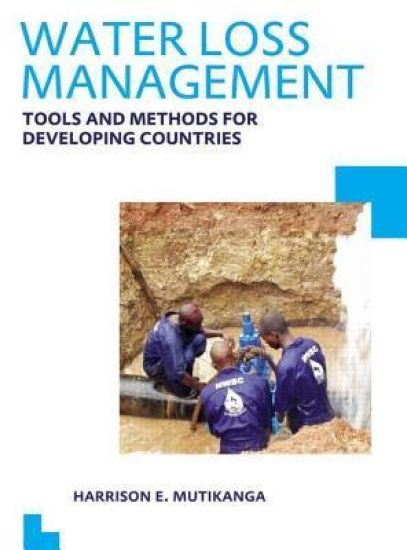
Water Loss Management: Tools and Methods for Developing Countries
Water losses occur in all water distribution systems worldwide and high levels are indicative of poor governance and poor physical condition of the system. Water losses vary from 3% of system input volume in the developed countries to 70% in the developing countries. This high contrast suggests that probably the existing tools and methodologies are not appropriate or cannot be directly applied for water loss reduction in the developing countries. This study highlights the challenges and prospects of managing water losses in developing countries and provides a toolbox of appropriate tools and methodologies to help water utilities in the developing countries assess inefficiencies in their water distribution systems and take corrective action. Included is a step-by-step approach for water accountability, performance improvement through benchmarking techniques, economic optimization techniques for minimizing revenue losses due to metering inaccuracies, pressure management planning for proactive leakage control, and strategic planning for water loss reduction based on multi-criteria decision analysis. The developed tools and methodologies have been tested and validated in practice on real case studies in Uganda.It is envisaged that this thesis will be of considerable value to utility managers, researchers, and other agencies involved in managing water distribution losses in developing countries.
Water Trading and Global Water Scarcity
Water scarcity is an increasing problem in many parts of the world, yet conventional supply-side economics and management are insufficient to deal with it. In this book the role of water trading as an instrument of integrated water resources management is explored in depth. It is also shown to be an instrument for conflict resolution, where it may be necessary to reallocate water in the context of increasing scarcity. Recent experiences of implementation in different river basins have shown their potential as instruments for improving allocation. These experiences, however, also show that there are implementation challenges and some limitations to trading that need to be considered. This book explores the various types of water trading formulas through the experience of using them in different parts of the world. The final result is varied because, in most cases, trading is conditioned by the legal and institutional framework in which the transactions are carried out. The role of government and the definition of water rights and licenses are critical for the success of water trading. The book studies the institutional framework and how transactions have been undertaken, drawing some lessons on how trading can improve. It also analyses whether trading has really been a positive instrument to manage scarcity and improve water ecosystems and pollution emission problems in those parts of the world which are most affected. The book concludes by making policy proposals to improve the implementation of water trading.
Water, Democracy and Neoliberalism in India
Since the early 1990s, the achievement of ‘good governance’ has been a dominant discourse in the pursuit of social and economic development. This book presents a critical challenge to the contemporary development paradigm of good governance.Based on original ethnographic fieldwork on urban water governance reforms in south India (Karnataka), the book examines the two propositions that underlie the current good governance debate. The first refers to a claim that good governance is both democratic and pro-market. The second to the claim that commercially-oriented water services, whether private or public, are good for poor and marginalised citizens. The book analyses these propositions as they intersect on three levels: policy, practice (process) and outcome. It argues that a number of tensions and contradictions exist within and between what the discourse promises, the everyday practises of how good governance policies are implemented and in the outcomes of such. It reveals the networks of power and the complexity of local reforms and their relation to global discourses as well as the motivations and every day practises of those who currently possess the power to reform.The book is of interest to academics in the fields of Development Studies, Asian Studies and Comparative Politics.
Water as a Catalyst for Peace

Water as a Catalyst for Peace

Ahmed Abukhater

Routledge
2013
sidottu
Examining international water allocation policies in different parts of the world, this book suggests that they can be used as a platform to induce cooperation over larger political issues, ultimately settling conflicts. The main premise is that water can and should be used as a catalyst for peace and cooperation rather than conflict. Evidence is provided to support this claim through detailed case studies from the Middle East and the Lesotho Highlands in Africa. These international cases – including bilateral water treaties and their development and formation process and aftermath – are analyzed to draw conclusions about the outcomes as well as the processes by which these outcomes are achieved. It is demonstrated that the perception of a particular treaty as being equitable and fair is mainly shaped by the negotiation process used to reach certain outcomes, rather than being determined mechanistically by the quantitative allocation of water to each party. The processes and perceptions leading to international water conflict resolutions are emphasized as key issues in advancing cooperation and robust implementation of international water treaties. The key messages of the book are therefore relevant to the geo-political and hydro-political aspects of water resources in the context of bilateral and multilateral conflicts, and the trans-boundary management of water resources, which contributes insights to political ecology, geo-politics, and environmental policy.
Water Law for the Twenty-First Century
In the face of growing freshwater scarcity, most countries of the world are taking steps to conserve their water and foster its sustainable use. Water crises range from concerns of drinking water availability and/or quality, the degradation or contamination of freshwater, and the allocation of water to different users. To meet the challenge, many countries are undergoing systemic changes to the use of freshwater and the provision of water services, thereby leading to greater commercialization of the resource as well as a restructuring of the legal, regulatory, technical and institutional frameworks for water.The contributions to this book critically analyse legal issues arising under international law, such as environment and human rights provisions, concerning the economic, environmental and social consequences of proposed water regulatory changes and their implementation at the national level. The book examines the situation in India which is currently in the midst of implementing several World Bank led water restructuring projects which will have significant impacts on the realisation of the right to water and all other aspects of water regulation for decades to come. In analysing the situation in India the volume is able to detail the interactions between international law and national law in the field of water, and to ask broader questions about the compliance with international law at the national level and the relevance of international law in national law and policy-making.
Water Quality Management
The global attention in recent years has focused primarily on water quantity and allocation issues. Water quality has received significantly less attention than water quantity. Commendable progress has been made by the developed world to control point sources of pollution, but commensurate progress in reducing non-point sources has not been made. In the third world countries both point and non-point sources of pollution are becoming increasingly a serious concern. Already, nearly all water bodies in such countries near and around urban centres have been severely polluted, with very high health and environmental costs.The book assesses the current status of water quality management in both developed and developing worlds, as well as analysing the effectiveness of economic instruments and legal and institutional frameworks to control water contamination. It outlines the importance of building up social and political awareness to reverse the trend of continuing water quality deterioration, which is likely to be a most challenging task in the coming years.This book was published as a special issue of International Journal of Water Resources Development.
Water Governance and Civil Society Responses in South Asia
This book addresses paradigm shifts in water policy and governance, and examines the role of civil society organizations in influencing public policy, while focusing on social equity and democratic participation. It illustrates a range of interesting developments in policy formulation, donor–state nexus, and interventions by civil society and voluntary organizations. The collection of articles provides a comprehensive and current narrative of the state–society relations in South Asia under neoliberal governance reforms, their implications and key responses with regard to water policies. Using case studies, it closely investigates the impact, effectiveness, drawbacks and challenges faced by voluntary organizations and social movements working at various levels in the water sector. The work will interest researchers and students of development studies, environmental studies, natural resource management, water governance, and public administration, as also water sector professionals, policymakers, civil society activists and governmental and non-governmental organizations.
Water Politics and Spiritual Ecology
As water resources diminish with increasing population and economic pressures as well as global climate change, this book addresses a subject of ever increasing local and global importance. In many areas water is not only a vital resource but is also endowed with an agency and power that connects people, spirit beings, place and space. The culmination of a decade of ethnographic research in Timor Leste, this book gives a critical account of the complex social and ecological specificities of a water-focused society in one of the world’s newest nations. Comparatively framed by international examples from Asia, South America and Africa that reveal the need to incorporate and foreground cultural diversity in water governance, it provides deep insight into the global challenge of combining customary and modern water governance regimes. In doing so it addresses a need for sustained critical ecological inquiry into the social issues of water governance.Focusing on the eastern region of Timor Leste, the book explores local uses, beliefs and rituals associated with water. It identifies the ritual ecological practices, contexts and scales through which the use, negotiation over and sharing of water occurs and its influence on the entire sociocultural system. Building on these findings, the book proposes effective conceptual and methodological tools for advancing community engagement and draws out lessons for more integrated and sustainable water governance approaches that can be applied elsewhere. This book will be of great interest to students and researchers in environmental studies, environmental policy and governance.
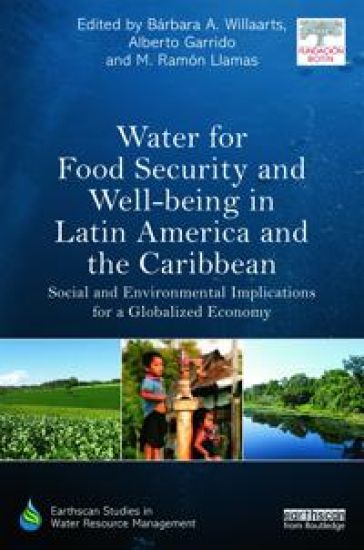
Water for Food Security and Well-being in Latin America and the Caribbean
This volume provides an analytical and facts-based overview on the progress achieved in water security in Latin America and the Caribbean (LAC) region over during the last decade, and its links to regional development, food security and human well-being. Although the book takes a regional approach, covering a vast of data pertaining to most of the LAC region, some chapters focus on seven countries (Argentina, Brazil, Chile, Colombia, Costa Rica, Mexico and Peru).A full understanding of LAC’s trends progress requires framing this region in the global context: an ever more globalized world where LAC has an increasing geopolitical power and a growing presence in international food markets. The book’s specific objectives are: (1) exploring the improvements and links between water and food security in LAC countries; (2) assessing the role of the socio-economic ‘megatrends’ in LAC, identifying feedback processes between the region’s observed pattern of changes regarding key biophysical, economic and social variables linked to water and food security; and (3) reviewing the critical changes that are taking place in the institutional and governance water spheres, including the role of civil society, which may represent a promising means to advancing towards the goal of improving water security in LAC.The resulting picture shows a region where recent socioeconomic development has led to important advances in the domains of food and water security. Economic growth in LAC and its increasingly important role in international trade are intense in terms of use of natural resources such as land, water and energy. This poses new and important challenges for sustainable development. The reinforcement of national and global governance schemes and their alignment on the improvement of human well-being is and will remain an inescapable prerequisite to the achievement of long-lasting security. Supporting this bold idea with facts and science-based conclusions is the ultimate goal of the book.
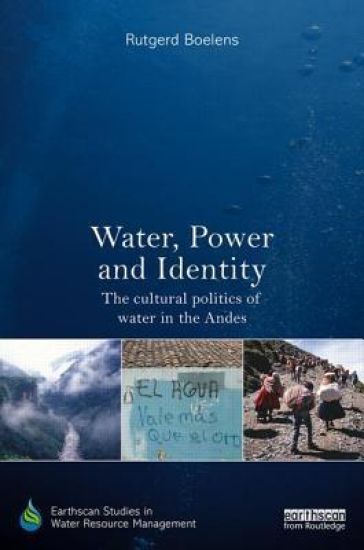
Water, Power and Identity

Water, Power and Identity

Rutgerd Boelens

Routledge
2015
sidottu
This book addresses two major issues in natural resource management and political ecology: the complex conflicting relationship between communities managing water on the ground and national/global policy-making institutions and elites; and how grassroots defend against encroachment, question the self-evidence of State-/market-based water governance, and confront coercive and participatory boundary policing (‘normal’ vs. ‘abnormal’). The book examines grassroots building of multi-layered water-rights territories, and State, market and expert networks’ vigorous efforts to reshape these water societies in their own image – seizing resources and/or aligning users, identities and rights systems within dominant frameworks. Distributive and cultural politics entwine. It is shown that attempts to modernize and normalize users through universalized water culture, ‘rational water use’ and de-politicized interventions deepen water security problems rather than alleviating them. However, social struggles negotiate and enforce water rights. User collectives challenge imposed water rights and identities, constructing new ones to strategically acquire water control autonomy and re-moralize their waterscapes. The author shows that battles for material control include the right to culturally define and politically organize water rights and territories. Andean illustrations from Peru, Ecuador, Bolivia and Chile, from peasant-indigenous life stories to international policy-making, highlight open and subsurface hydro-social networks. They reveal how water justice struggles are political projects against indifference, and that engaging in re-distributive policies and defying ‘truth politics,’ extends context-particular water rights definitions and governance forms.
Water and Rural Communities

Water and Rural Communities

Lia Bryant; with Jodie George

Routledge
2016
sidottu
The overall theme of this book concerns the multiplicity and complexities of discursive constructions of water in Western economies in relation to irrigation communities. The authors argue that the politics of place is given meaning in relation to local knowledges and within multiple and multiscalar institutional frameworks involved with the social, physical, economic and political practices associated with water. They are particularly concerned with water at the local level, including how it is exchanged, managed and given meaning. Using case studies from Australia and the United States of America, it is shown how water use and community relations, particularly during times of drought, are central to developing understandings about how communities challenge, adapt and respond to policy developments. The book also brings to light how unequal distribution of resources and risk conspicuously come to the surface during times of drought illustrating that water is a political subject occupying a unique position, moving between the natural and social worlds.
Water Scarcity, Livelihoods and Food Security
This volume reviews the evolution of ten years’ learning and discovery about water scarcity, livelihoods, and food security within the CGIAR Challenge Program on Water and Food. It draws on the experiences of over 100 projects conducted in ten river basins in the developing world. The book describes how the program’s design evolved from an emphasis on water scarcity, water productivity, and water access to an emphasis on using water innovations to improve livelihoods and address development challenges in specific river basins. It shows how the research was used to foster change in stakeholder behavior, linking it to improved knowledge, attitudes, and skills, which were fostered by stakeholder participation, innovation, dialogue, and negotiation. The authors describe development challenges, their drivers and their political context, how to address them through technical, institutional, and policy innovations; and the consequences of change at different scales, time frames on equity, resilience, and ecosystem services. Overall, the work represents a major synthesis and landmark publication for all concerned with water resource management and sustainable development.
Water Scarcity, Livelihoods and Food Security
This volume reviews the evolution of ten years’ learning and discovery about water scarcity, livelihoods, and food security within the CGIAR Challenge Program on Water and Food. It draws on the experiences of over 100 projects conducted in ten river basins in the developing world. The book describes how the program’s design evolved from an emphasis on water scarcity, water productivity, and water access to an emphasis on using water innovations to improve livelihoods and address development challenges in specific river basins. It shows how the research was used to foster change in stakeholder behavior, linking it to improved knowledge, attitudes, and skills, which were fostered by stakeholder participation, innovation, dialogue, and negotiation. The authors describe development challenges, their drivers and their political context, how to address them through technical, institutional, and policy innovations; and the consequences of change at different scales, time frames on equity, resilience, and ecosystem services. Overall, the work represents a major synthesis and landmark publication for all concerned with water resource management and sustainable development.
Water and Cities in Latin America
Approximately 80 per cent of the population of Latin America is concentrated in urban centres. Pressure on water resources and water management in cities therefore provide major challenges. Despite the importance of the issues, there has been little systematic coverage of the topic in book form. This work fills a gap in the literature by providing both thematic overviews and case study chapters. It reviews key aspects of why water matters in cities and presents case studies on topics such as groundwater management, green growth and water services, inequalities in water supply, the financing of water services and flood management. Detailed examples are described from Argentina, Brazil, Colombia, Ecuador, Mexico and Peru, and there is also a chapter comparing lessons which might be learnt from US cities. Contributing authors are drawn from both within and outside the region, including from the Inter-American Development Bank, OECD and World Bank to set the issues in a global context.