

Kirjahaku
Etsi kirjoja tekijän nimen, kirjan nimen tai ISBN:n perusteella.
1000 tulosta hakusanalla Baris Calikoglu

Basis Sets in Computational Chemistry
Springer Nature Switzerland AG
2021
sidottu
This book addresses the construction and application of the major types of basis sets for computational chemistry calculations. In addition to a general introduction, it includes mathematical basics and a discussion of errors arising from incomplete or inappropriate basis sets. The different chapters introduce local orbitals and orbital localization as well as Slater-type orbitals and review basis sets for special applications, such as those for correlated methods, solid-state calculations, heavy atoms and time-dependent adaptable Gaussian bases for quantum dynamics simulations. This detailed review of the purpose of basis sets, their design, applications, possible problems and available solutions provides graduate students and beginning researchers with information not easily obtained from the available textbooks and offers valuable supporting material for any quantum chemistry or computational chemistry course at the graduate and/or undergraduate level. This book is also useful asa guide for researchers who are new to computational chemistry but are willing to extend their research tools by applying such methods.

Basis Sets in Computational Chemistry
Springer Nature Switzerland AG
2022
nidottu
This book addresses the construction and application of the major types of basis sets for computational chemistry calculations. In addition to a general introduction, it includes mathematical basics and a discussion of errors arising from incomplete or inappropriate basis sets. The different chapters introduce local orbitals and orbital localization as well as Slater-type orbitals and review basis sets for special applications, such as those for correlated methods, solid-state calculations, heavy atoms and time-dependent adaptable Gaussian bases for quantum dynamics simulations. This detailed review of the purpose of basis sets, their design, applications, possible problems and available solutions provides graduate students and beginning researchers with information not easily obtained from the available textbooks and offers valuable supporting material for any quantum chemistry or computational chemistry course at the graduate and/or undergraduate level. This book is also useful asa guide for researchers who are new to computational chemistry but are willing to extend their research tools by applying such methods.

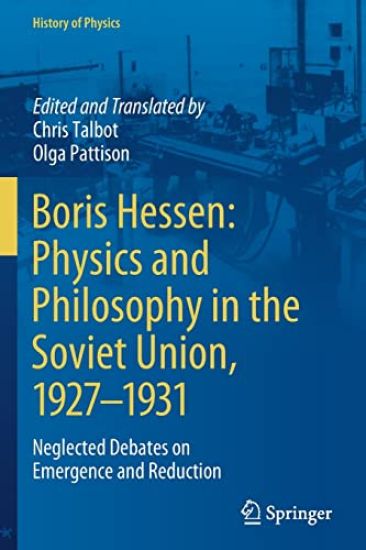
Boris Hessen: Physics and Philosophy in the Soviet Union, 1927–1931
Springer Nature Switzerland AG
2021
sidottu
This book presents key works of Boris Hessen, outstanding Soviet philosopher of science, available here in English for the first time. Quality translations are accompanied by an editors' introduction and annotations. Boris Hessen is known in history of science circles for his “Social and Economic Roots of Newton’s Principia” presented in London (1931), which inspired new approaches in the West. As a philosopher and a physicist, he was tasked with developing a Marxist approach to science in the 1920s. He studied the history of physics to clarify issues such as reductionism and causality as they applied to new developments. With the philosophers called the “Dialecticians”, his debates with the opposing “Mechanists” on the issue of emergence are still worth studying and largely ignored in the many recent works on this subject. Taken as a whole, the book is a goldmine of insights into both the foundations of physics and Soviet history.
Boris Hessen: Physics and Philosophy in the Soviet Union, 1927–1931
Springer Nature Switzerland AG
2022
nidottu
This book presents key works of Boris Hessen, outstanding Soviet philosopher of science, available here in English for the first time. Quality translations are accompanied by an editors' introduction and annotations. Boris Hessen is known in history of science circles for his “Social and Economic Roots of Newton’s Principia” presented in London (1931), which inspired new approaches in the West. As a philosopher and a physicist, he was tasked with developing a Marxist approach to science in the 1920s. He studied the history of physics to clarify issues such as reductionism and causality as they applied to new developments. With the philosophers called the “Dialecticians”, his debates with the opposing “Mechanists” on the issue of emergence are still worth studying and largely ignored in the many recent works on this subject. Taken as a whole, the book is a goldmine of insights into both the foundations of physics and Soviet history.

Since the rheumatic diseases are among the most prevalent of conditions, the anti-rheumatic drugs make up one of the largest groups of drugs prescribed. They vary from the non-steroidal anti-inflammatory drugs through to the complex imrnunomodulators. There are significant differences between these groups of drugs as regards their mechanism of action and within each spectrum of adverse reactions, yet there is also some overlap. class there are also subtle individual differences between the drugs despite a sharing of the basic mechanisms of action and range of side effects. It is this individual variation and, in particular, the individual reaction of the patient to the drug that we attempted to address at this symposium. The first symposium on Individual Variation in Response to Non Steroidal Anti-inflammatory Drugs was held at Leura, New South Wales, Australia as a satellite symposium to the XVI International Congress of Rheumatology in August, 1985. Following a successful meeting, proceedings of which were published in a supplement to Agents and Actions (Suppl. 17, 1986), it was decided to organise a second symposium as a satellite meeting of the International Congressof Pharmacology Meeting in Sydney, August, 1987. The meeting was held at the Manly Pacific and focused on variability in response to anti-rheumatic drugs in general rather than just concentrating on the non-steroidal drugs.

Boris Ondreicka: Hi Lo
JRP Ringier
2012
pokkari
Artist, singer, curator and visual poet Boris Ondreicka (born 1969) compiles two series in this volume: the long poem "John Doe & Joe Bloggs," typeset in a portrait orientation; and "Spoken Word/Written World," which compiles what the artist calls "autonomous artworks, theoretical performances, list of titles, etc," created between 1994 and 2011, typeset in a landscape orientation.

Exclusive cocktails at a bar, excessive partying at a club, or relaxed chilling at a lounge – people need to occasion - ally escape from their everyday life into another world. This is made possible by the individual character and the very own atmosphere of each special location, which are strongly defined by architectural and design visions. Apart from the drinks, the music and the people, lighting and space, form and furnishing are decisive success factors for all good concepts. Nowhere else can a de - signed space have such a strong effect and impact. While the range of styles has grown enormously recently, this field has become one of the most exciting tasks for interior designers. This volume takes the reader on a tour of very remarkable bars, clubs and lounges from around the world.

Basis for Business B1 - Workbook mit Audios als Augmented Reality
Cornelsen Verlag GmbH
2019
nidottu
Basis for Business B1 - Kursbuch mit Audios und Videos als Augmented Reality
Carole Eilertson; Mike Hogan
Cornelsen Verlag GmbH
2018
nidottu

Basis for Business B2 - Kursbuch mit PagePlayer-App inkl. Audios und Videos
Carole Eilertson; Mike Hogan
Cornelsen Verlag GmbH
2019
nidottu

Basis for Business B2 - Workbook
Cornelsen Verlag GmbH
2020
nidottu

Basis for Business - New Edition.B2 - Teaching Guide
Cornelsen Verlag GmbH
2020
nidottu


Basis Beruf. Betreuen und Pflegen
Heike Jacobi-Wanke; Christina Polzin
Cornelsen Verlag GmbH
2019
nidottu

Basis for business
Cornelsen Verlag GmbHCo
2011
muu

Basis for business
Cornelsen Verlag GmbHCo
2012
muu

Basis for business
Cornelsen Verlag GmbHCo
2012
muu

Basis for business
Cornelsen Verlag GmbHCo
2012
muu