
Kirjahaku
Etsi kirjoja tekijän nimen, kirjan nimen tai ISBN:n perusteella.
1000 tulosta hakusanalla C G Addison

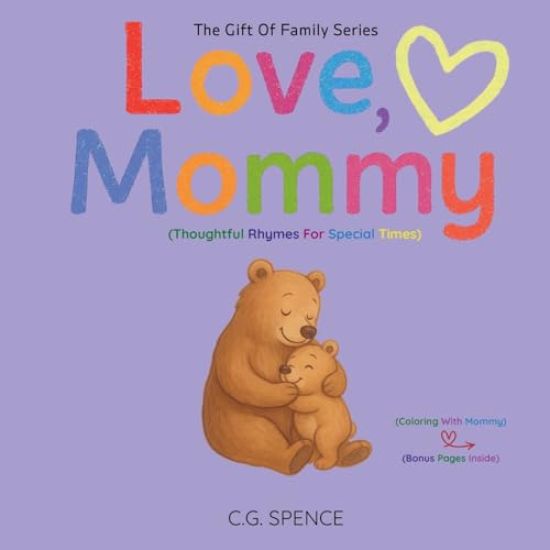
Love, Mommy is more than a bedtime story; it's a love letter from a mother's heart to her child. This beautifully illustrated picture book captures the gentle, unconditional love between Mommy Bear and her little cub through simple rhymes and heartfelt moments. From quiet snuggles to adventurous play, every page is a reminder that no matter where life takes you, a mother's love is always there; strong, safe, and everlasting. Perfect for baby showers, new mothers, Mother's Day, or any moment you want to remind a child how deeply they are cared for. Love, Mommy is a timeless keepsake that turns ordinary reading time into something truly special. Suppose you're looking for a story that speaks to the soul of motherhood: The fierce protectiveness, the warm comfort, the endless devotion. Love, Mommy delivers all of that and more, wrapped in the tender voice of a mother who wants her child to know: You will always be loved. You will always be enough. You will always have me.
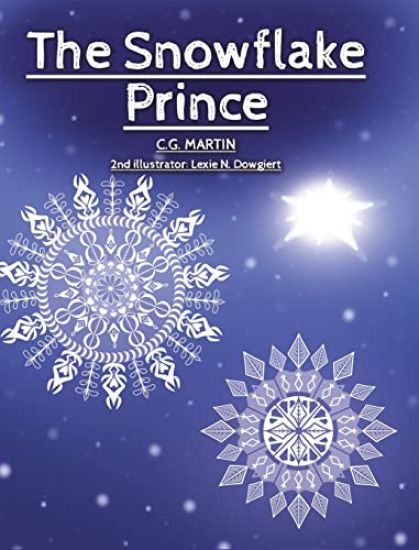
"The Snowflake Prince" has been born in the Land of Snow. He has much to learn about who he is and what his joy will be. The Land of Snow exists in the time-frame realm of infinity plus. The King and Queen of the Land of Snow are the most caring parents in the entire land and they love and guide their little Prince through the early years of his life. Ultimately, as the little Prince was growing, he learned more and more about his beautiful Land of Snow, and how and why he was changing and getting bigger and stronger. He even felt he was born to do something very special. From a great distance, he saw a world floating far, far away and seemed to be drawn to it. His loving parents tell him why he is so drawn to this world as he grows bigger and stronger, and all the elements in the Land of Snow will also be by his side to help and protect him, when he is ready for his great journey. The Snowflake Prince has many adventures while taking this great journey, all of which are amazing, thrilling, exciting, and also comforting. The young Snowflake Prince learns of his importance during a celestial event that would forever change the world he journeyed to and then managed to find his way home to the Land of Snow and his loving parents intact.

Law and society treats law and the legal process viewed from both a societal and the individual's point of view, from the perspective of a small European country, Sweden. The material has a strong sense of reality with the knowledge necessary to understand the legal system. The book includes six chapters dealing separately with different parts of the legal system. The last chapter treats European and international common law. The book is written from the perspective of a country, Sweden, with a long tradition of democracy and human rights and with a comparison to a country in the former Soviet Union, Belarus. It can be used as a textbook and a manual for how a functional legal system can be designed.
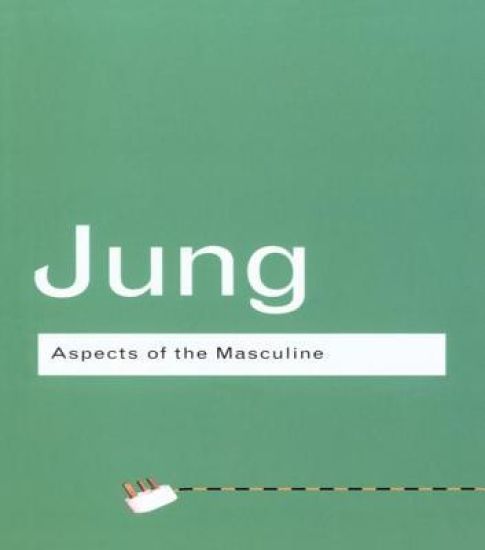
The concept of masculinity was crucial not only to Jung's revolutionary theories of the human psyche, but also to his own personal development. If, as Jung believed, "modern man is already so darkened that nothing beyond the light of his own intellect illuminates his world," then it is essential to show every man the limits of his understanding and how to overcome them. In Aspects of the Masculine Jung does this by revealing his most significant insights concerning the nature and motivations of masculinity, both conscious and unconscious, and explaining how this affects the development of the personality. Offering a unique perspective on the masculine, based upon both his personal and clinical experiences, Jung asks questions that remain as insistent as ever. He offers answers that--whether they surprise, shock or edify--challenge us to re-examine our contemporary understanding of masculinity.
The Spirit in Man, Art and Literature offers unique and penetrating insights into the lives and opinions of some of the most significant players in the cultural life of the twentieth century. Carl Gustav Jung was at the heart of that cultural life, pioneering, along with Freud, a new interpretation of what it meant to be human in the modern age. This volume reveals the full range of Jung's involvement in this process, from his famous analysis of 'Psychology and Literature' to his landmark texts on Joyce's Ulysses and Picasso's paintings. Jung writes of Freud from the perspective of one who was "permitted a deep glimpse into the mind of this remarkable man," and through the memories and opinions recorded in The Spirit in Man, Art and Literature, the reader is offered a similar privilege.
The Practice of Psychotherapy brings together Jung's essays on general questions of analytic therapy and dream analysis. It also contains his profoundly interesting parallel between the transference phenomena and alchemical processes.The transference is illustrated and interpreted by means of a set of symbolic pictures, and the bond between psychotherapist and patient is shown to be a function of the kinship libido. Far from being pathological in its effects, kinship libido has an essential role to play in the work of individuation and in establishing an organic society based on the psychic connection of its members with one another and with their own roots.
Aion is one of a number of major works that Jung wrote during his seventies that were concerned with the relations between psychology, alchemy and religion.He is particularly concerned in this volume with the rise of Christianity and with the figure of Christ. He explores how Christianity came about when it did, the importance of the figure of Christ and the identification of the figure of Christ with the archetype of the Self. A matter of special importance to Jung in his seventies - the problem of opposites, particularly good and evil - is further discussed and the importance of the symbolism of the fish, which recurs as a symbol of both Christ and the devil, is examined.As a study of the archetype of the self, Aion complements The Archetypes and the Collective Unconscious, which is also published in paperback.
Gnosticism was for C.G. jung the chief prefiguration of his analytical psychology. In this volume Robert Segal, an authority on theories of myth and Gnosticism, has searched the Jungian corpus for Jung's main discussions of this ancient form of spirituality. The progression in Gnosticism from sheer bodily existence to the release of the immaterial spark imprisoned in the body - and the reunion of that spark with the godhead - represents for Jung the psychological progression from ego consciousness to the ego's rediscovery of the unconscious, and the ego's integration with the unconscious to forge the self. Included in this volume are both Jung's sole work devoted entirely to Gnosticism, "Gnostic Symbols of the Self," and his own Gnostic myth, "Seven Sermons to the Dead." The book also contains key essays by Father Victor White and Gilles Quispel, whose "C.G. Jung und die Gnosis" is here translated for the first time. In his extensive introduction Segal discusses the parallel for Jung between ancient Gnostic and contemporary Jungian patients, the Jungian meaning of Gnostic myths and of the Seven Sermons, Jung's possible misinterpretation of Gnosticism, and the common characterization of Jung himself as a Gnostic.
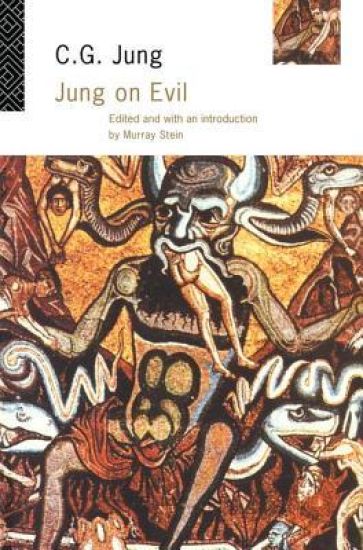
Evil became a central issue for Jung as he grew older. His early investigations of the place of evil in the mental processes of the severely disturbed led him to consider the concept of evil in greater depth when exploring the role of analysis in ethical and cultural transformation.Jung on Evil brings together his important writings on good and evil. It includes his attempts to comprehend the worst excesses of the Second World War, as well as discussions about moral choices, conscience and the continual ethical reflection that is necessary for all of us.Leading analyst Murray Stein provides a clear and concise introduction that gives an accessible account of Jung's ideas about evil. It will be invaluable to all those interested in the problems of ethics, religion and psychology in the modern world.
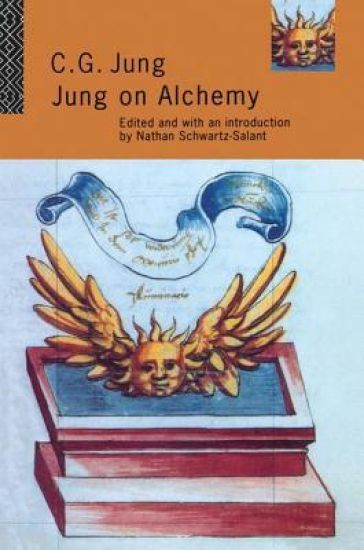
Jung realized that the fantastic images of alchemy - fire-breathing dragons, hermaphrodites, lions giving birth to the sun - are not so far from our daily lives. He made sense of such seemingly incomprehensible symbols and showed how, in fact, such images represent a usually unseen level that has immense power over how we feel, think and imagine our existence. Nathan Schwartz-Salant, a leading Jungian analyst with a special interest in alchemy, has brought together a key selection of Jung's writings on alchemy. His lucid introduction provides a clear account of the basics of alchemy and explains to the reader Jung's ideas on alchemical studies.Jung on Alchemy provides an excellent introduction to one of Jung's most exciting, yet most challenging, fields of study.

Jung's interest in the East was deep-rooted and life-long, and the traditional teachings of China and India played an important role in his personal and intellectual development, as well as in the formations of the ideas and practices that are central to Jungian psychology.Jung on the East brings together key selections from his work on Buddhism, yoga and Taoism, and on such classic texts as the I Ching and The Tibetan Book of the Dead. It also includes accounts on his own journey to India.The clear and perceptive introduction sets the context for Jung's encounter with the East, and provides an excellent framework that will enable the reader to get the most out of Jung's writings in this area. The book will be of interest to everyone seeking to further their understanding both of Jung, and of Eastern thought and spirituality.
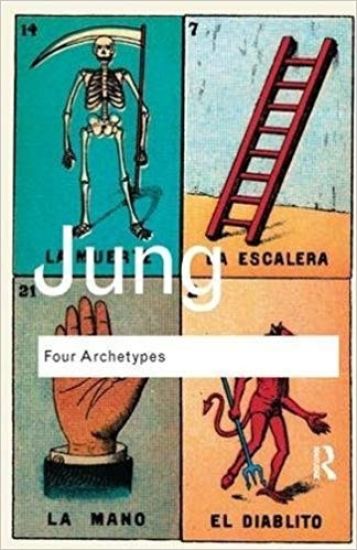
The concept of the archetype is crucial to Jung's radical interpretation of the human mind. Jung believed that every person partakes of a universal or collective unconscious that persists through generations. The origins of the concept can be traced to his very first publication in 1902 and it remained central to his thought throughout his life. As well as explaining the theoretical background behind the idea, in Four Archetypes Jung describes the four archetypes that he considers fundamental to the psychological make-up of every individual: mother, rebirth, spirit and trickster. Exploring their role in myth, fairytale and scripture, Jung engages the reader in discoveries that challenge and enlighten the ways we perceive ourselves and others.
An account of Jung's handling of the transference between psychologist and patient in the light of his conception of the archetypes. Based on the symbolic illustrations in a sixteenth century alchemical text.
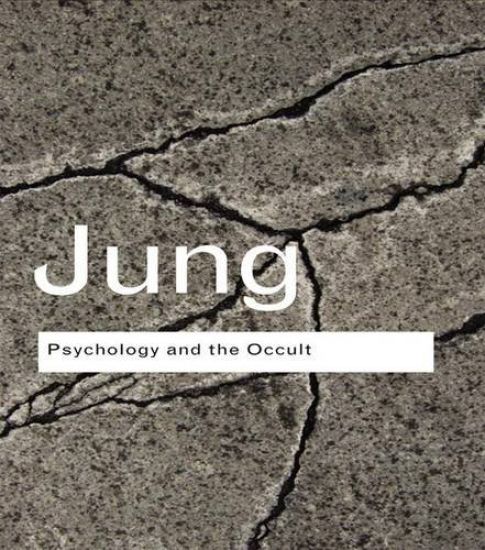
A fifteen-year-old girl who claimed regular communications with the spirits of her dead friends and relatives was the subject of the very first published work by the now legendary psychoanalyst C.G. Jung. Collected here, alongside many of his later writings on such subjects as life after death, telepathy and ghosts, it was to mark just the start of a professional and personal interest—even obsession—that was to last throughout Jung’s lifetime. Written by one of the greatest and most controversial thinkers of the twentieth century, Psychology and the Occult represents a fascinating trawl through both the dark, unknown world of the occult and the equally murky depths of the human psyche.Carl Gustav Jung (1875–1961). Founded the analytical school of psychology and developed a radical new theory of the unconscious that has made him one of the most familiar names in twentieth-century thought.
'Love is a force of destiny whose power reaches from heaven to hell.' So Jung advises while reflecting on 'The Love Problem of a Student', an essay contained in this volume. But it is not just love that Jung speaks of in this book. Taking as its theme Jung's interpretation of the feminine principle in his hugely influential theories about the inner world of the individual, it guides the reader from the mythological archetype of the mother-figure to the experience of women in twentieth-century Europe, explaining along the way concepts crucial to Jung's understanding of the personality, such as animus and anima. Many of his contentions have become the assumptions of the generations growing up in the twenty-first century. Aspects of the Feminine is a provocative, controversial book which offers readers the opportunity to discover at first hand just how radical Jung's arguments were.
'These writings of his are strongly alive; in most instances Jung does not present us with final solutions and last words about any of the great East-West problems, but rather with suggestions for a deeper kind of approach, thus opening up new planes of investigation.' - Journal of Analytical Psychology“My own world of European consciousness had become peculiarly thin… it is quite possible that India is the real world and that the white man lives in a madhouse of abstractions.” C.G. Jung was inspired to write these words after his very first visit to India. Long concerned with the hold that myth and archetype had on the human psyche, it was inevitable that the legendary psychoanalyst would turn his attention to Eastern modes of thought. Psychology and the East collects together many of Jung’s most memorable writings on the subject, including his Psychological commentaries on the I Ching and The Tibetan Book of the Dead, his thoughts on Buddhism and Islam and a full travelogue of that fateful first encounter with India in 1936.
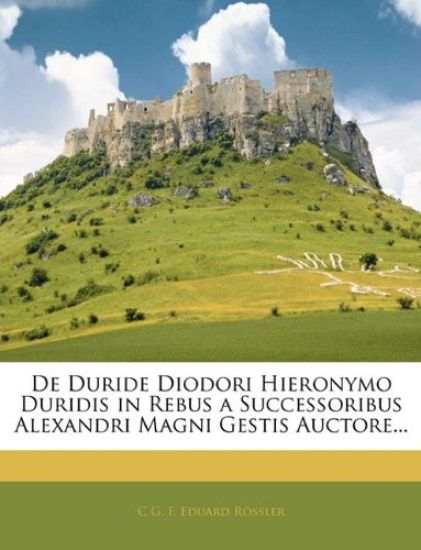
de Duride Diodori Hieronymo Duridis in Rebus a Successoribus Alexandri Magni Gestis Auctore...
C G F Eduard Rssler; C G F Eduard Rossler
Nabu Press
2010
pokkari
Beneath Parnassian Clouds and Olympian Sunshine.
C G Saunders Forster
British Library, Historical Print Editions
2011
pokkari