
Kirjahaku
Etsi kirjoja tekijän nimen, kirjan nimen tai ISBN:n perusteella.
1000 tulosta hakusanalla Goethe
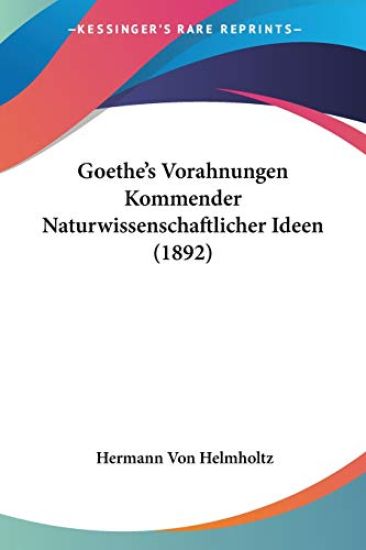
Goethe's Vorahnungen Kommender Naturwissenschaftlicher Ideen (1892)
Hermann Von Helmholtz
KESSINGER PUBLISHING, LLC
2009
pokkari
Goethe's Correspondence With A Child (1879)
Johann Wolfgang von Goethe
KESSINGER PUBLISHING, LLC
2009
pokkari



Goethe's Hermann And Dorothea (1862)
Johann Wolfgang von Goethe
KESSINGER PUBLISHING, LLC
2009
pokkari
Goethe, J: Goethe's Iphigenie (1882)
Johann Wolfgang von Goethe; H. F. Muller
KESSINGER PUBLISHING, LLC
2009
nidottu
Goethe, J: Leiden Des Jungen Werthers (1787)
Johann Wolfgang von Goethe
KESSINGER PUBLISHING, LLC
2009
nidottu
Goethe, J: J. W. Goethens Schriften V1 (1779)
Johann Wolfgang von Goethe
KESSINGER PUBLISHING, LLC
2009
nidottu
Originally published during the early part of the twentieth century, the Cambridge Manuals of Science and Literature were designed to provide concise introductions to a broad range of topics. They were written by experts for the general reader and combined a comprehensive approach to knowledge with an emphasis on accessibility. Goethe and the Twentieth Century by J. G. Robertson was first published in 1912. In it, Robertson assesses the value and importance attached to Goethe at the beginning of the twentieth century from a strictly English perspective.
First published in 1949, as the second edition of a 1942 original, this book presents a concise discussion of Goethe's relationship with science and nature. It was formed from the content of the Philip Maurice Deneke Lecture for 1942, which was delivered by Sir Charles Sherrington at Lady Margaret Hall, Oxford. Notes are incorporated at the end of the text. This book will be of value to anyone with an interest in Goethe and the history of science.
In his autobiography, Goethe half-apologetically admits the youthful enthusiasm he experienced for alchemical and mystical readings: Georg von Welling's obscure Opus Mago-Cabbalisticum et Theosophicum and the anonymously published Aurea Catena Homeri, as well as works by Paracelsus, Basilis Valentinus and van Helmont. Originally published in 1952, this study shows how the symbols and concepts of alchemy played a key role in the genesis of Goethe's later works, both scientific and literary. Author of, among other books on German literature, Goethe: A Critical Introduction (1967) and An Introduction to German Poetry (1965), Ronald D. Gray details Goethe's alchemical readings, and shows how these influences were processed and transformed into a unique blend of scientific and poetic accounts of reality. Unprecedented in its approach, this study will be of interest to readers of German literature, as well as to anyone interested in the history and evolution of mysticism.
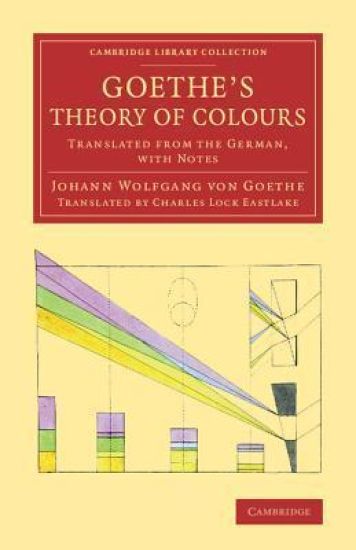
This work by Johann Wolfgang von Goethe (1749–1832) was translated into English in 1840 by Sir Charles Eastlake (1793–1865), painter and later keeper of the National Gallery. Goethe's 1810 work was rejected by many contemporary scientists because it appeared to contradict the physical laws laid down by Newton. However, its focus on the human perception of the colour spectrum, as opposed to the observable optical phenomenon, was attractive to, and influential upon, artists and philosophers. As Eastlake says in his preface, the work's dismissal on scientific grounds had caused 'a well-arranged mass of observations and experiments, many of which are important and interesting', to be overlooked. Eastlake also puts Goethe's work into its aesthetic and scientific context and describes its original reception. His clear translation of Goethe's observations and experiments on colour and light will appeal to anyone interested in our responses to art.
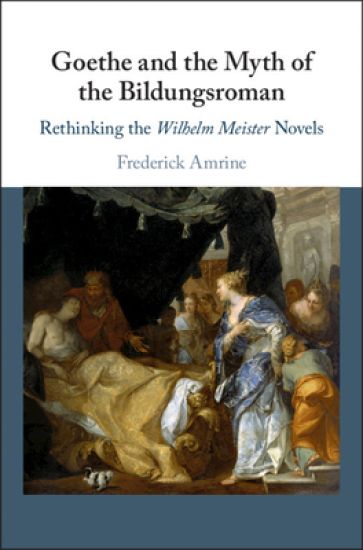
Goethe's Willhelm Meister novels, widely held to be the most significant and influential in all of German literature, have traditionally been classed as Bildungsroman, or 'novels of formation'. In Goethe and the Myth of Bildungsroman, Frederick Amrine offers a unique reading of Wilhelm Meister's Lehrjahre and Wilhelm Meister's Wanderjahre, which posits the second novel as a sequel to the first. Deconstructing and jettisoning the notion of the Bildungsroman, the features of the novels which have historically proved problematic for critics, seeming to testify to the novels' disunity, become instead the articulation points of a subtle concord between thematic and formal elements. Reading the novels in light of the eminent criticism of Northrop Frye, this book productively shifts away from social commentary towards the archetypal and symbolic, showing Goethe not to be an exception within world literature; rather, that he participates deeply in its overarching structures.