Kirjojen hintavertailu. Mukana 11 699 587 kirjaa ja 12 kauppaa.

Kirjahaku

Etsi kirjoja tekijän nimen, kirjan nimen tai ISBN:n perusteella.

1000 tulosta hakusanalla HENRY CONSTABLE

Henry Fielding

Henry Fielding

Andrew Wright

University of California Press
2021
sidottu
This title is part of UC Press's Voices Revived program, which commemorates University of California Press’s mission to seek out and cultivate the brightest minds and give them voice, reach, and impact. Drawing on a backlist dating to 1893, Voices Revived makes high-quality, peer-reviewed scholarship accessible once again using print-on-demand technology. This title was originally published in 1965.
Henry Irving's Waterloo

Henry Irving's Waterloo

W. D. King

University of California Press
2022
sidottu
In this creative study of history and popular culture, W. D. King ingeniously illustrates how a long-forgotten instance in theatre history can reveal the very process of historical change itself. Late in the nineteenth century, Henry Irving, the leading actor-manager of the English stage, was scathingly attacked by George Bernard Shaw for his popular performance in Conan Doyle's play, A Story of Waterloo. Shaw's review was one of the first onslaughts in a war against the old guard of the English stage, against Victorianism, against England and Empire itself. King's depiction of this event and its aftermath illuminates the period's crucial values and cultural issues, and is presented in a manner that is both convincing and highly entertaining. This title is part of UC Press's Voices Revived program, which commemorates University of California Press’s mission to seek out and cultivate the brightest minds and give them voice, reach, and impact. Drawing on a backlist dating to 1893, Voices Revived makes high-quality, peer-reviewed scholarship accessible once again using print-on-demand technology. This title was originally published in 1993.
Henry Christophe and Thomas Clarkson

Henry Christophe and Thomas Clarkson

University of California Press
2022
sidottu
Henry Christophe and Thomas Clarkson: A Correspondence provides a detailed and illuminating exploration of the correspondence between Henry Christophe, the self-declared king of Haiti, and Thomas Clarkson, the renowned English abolitionist. Preserved in the British Museum, these letters shed light on Haitian history, particularly during Christophe’s reign in the early 19th century. The letters, remarkable for their clarity and coherence, reveal Christophe as a visionary monarch dedicated to improving his nation’s welfare, countering the common portrayal of him as a ruthless despot. Clarkson, on the other hand, emerges as a diligent and verbose writer, striving to foster understanding and collaboration despite the cultural and political chasm between them. The collection includes Christophe’s communications, his decrees reflecting administrative foresight, and vivid accounts of his tragic downfall, including his paralysis, suicide, and the subsequent dissolution of his kingdom. These writings highlight Christophe’s grand ambitions to uplift Haiti from poverty and ignorance to self-sufficient dignity. His rule, though marked by authoritarian measures, was aimed at creating a prosperous Black state in a post-slavery world. This correspondence, alongside historical context provided in the volume, not only enriches our understanding of Christophe’s complex legacy but also showcases Clarkson’s pivotal role in supporting Haiti’s development during a turbulent era. This title is part of UC Press's Voices Revived program, which commemorates University of California Press’s mission to seek out and cultivate the brightest minds and give them voice, reach, and impact. Drawing on a backlist dating to 1893, Voices Revived makes high-quality, peer-reviewed scholarship accessible once again using print-on-demand technology. This title was originally published in 1952.
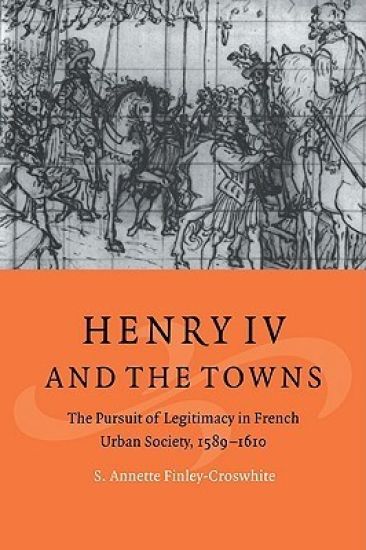
Henry IV and the Towns

Henry IV and the Towns

S. Annette Finley-Croswhite

Cambridge University Press
2006
pokkari
This 1999 book is a serious study of Henry IV's relationship with the towns of France, and offers an in-depth analysis of a crucial aspect of his craft of kingship. Set in the context of the later Wars of Religion, it examines Henry's achievement in reforging an alliance with the towns by comparing his relationship with Catholic League, royal and Protestant towns. Annette Finley-Croswhite focuses on the symbiosis of three key issues: legitimacy, clientage and absolutism. Henry's pursuit of political legitimacy and his success at winning the support of his urban subjects is traced over the course of his reign. Clientage is examined to show how Henry used patron-client relations to win over the towns and promote acceptance of his rule. By restoring legitimacy to the monarchy, Henry not only ended the religious wars but also strengthened the authority of the crown and laid the foundations of absolutism.
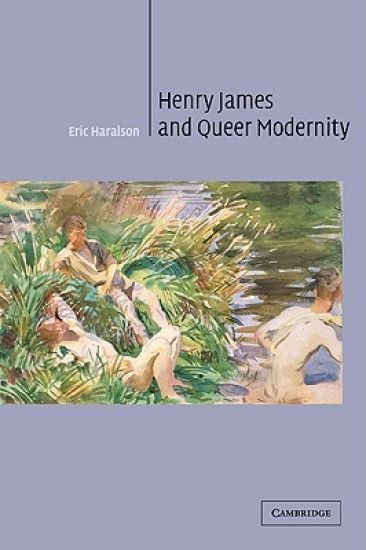
Henry James and Queer Modernity

Henry James and Queer Modernity

Eric Haralson

Cambridge University Press
2007
pokkari
In Henry James and Queer Modernity, first published in 2003, Eric Haralson examines far-reaching changes in gender politics and the emergence of modern male homosexuality as depicted in the writings of Henry James and three authors who were greatly influenced by him: Willa Cather, Gertrude Stein and Ernest Hemingway. Haralson places emphasis on American masculinity as portrayed in fiction between 1875 and 1935, but the book also treats events in England, such as the Oscar Wilde trials, that had a major effect on American literature. He traces James's engagement with sexual politics from his first novels of the 1870s to his 'major phase' at the turn of the century. The second section of this study measures James's extraordinary impact on Cather's representation of 'queer' characters, Stein's theories of writing and authorship as a mode of resistance to modern sexual regulation, and Hemingway's very self-constitution as a manly American author.
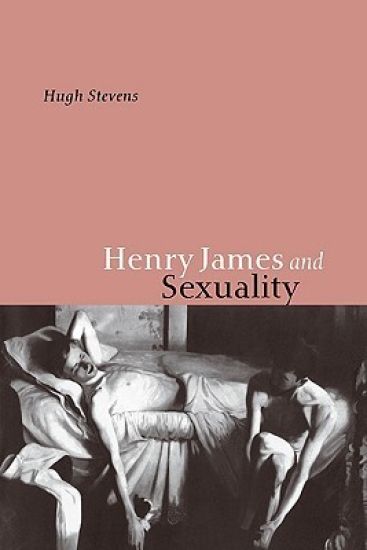
Henry James and Sexuality

Henry James and Sexuality

Hugh Stevens

Cambridge University Press
2008
pokkari
In Henry James and Sexuality, Hugh Stevens argues for a new interpretation of James's fiction. Stevens argues that James's writing contains daring and radical representations of transgressive desires and marginalized sexual identities. He demonstrates the importance of incestuous desire, masochistic fantasy, and same-sex passions in a body of fiction which ostensibly conforms to, while ironically mocking, the contemporary moral and publishing codes James faced. James critiques the very notion of sexual identity, and depicts the radical play of desires which exceed and disrupt any stable construction of identity. In a number of his major novels and tales, Stevens argues, James anticipates the main features of modern 'gay' or 'queer' fiction through plots and narrative strategies, which opposes heterosexual marriage and homo-erotic friendship. This original and exciting work will transform our understanding of this most enigmatic of writers.
Henry James and the Culture of Publicity

Henry James and the Culture of Publicity

Richard Salmon

Cambridge University Press
2009
pokkari
This book examines the relationship between the writings of Henry James and the historical formation of mass culture. Throughout his career, James was concerned with such characteristically modern cultural forms as advertising, biography and the New Journalism, forms which together constituted the 'devouring publicity' of modern life. Richard Salmon's study situates James's fiction and criticism within the context of the contemporary debates surrounding these rival discursive practices. He explores both the nature of James's contribution to the critique of mass culture and the extent of his immersion within it. James's persistent and ambivalent negotiation of the boundaries between private and public experience ranged from a defence of the artist's right to privacy, to his own counter-practice of publicity.
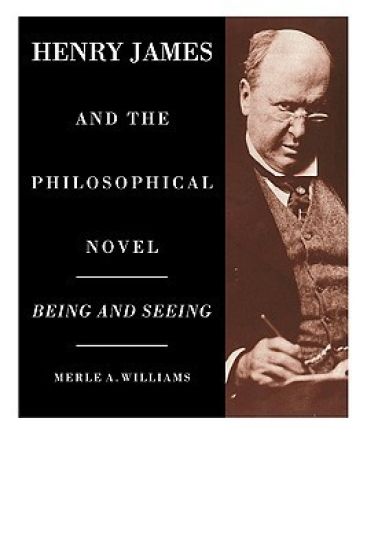
Henry James and the Philosophical Novel

Henry James and the Philosophical Novel

Merle A. Williams

Cambridge University Press
2009
pokkari
Henry James and the Philosophical Novel examines James's unique position as a philosophical novelist, closely associated with the climate of ideas generated by his brother, William and his father, the elder Henry. The book offers a detailed consideration of story-telling as a mode of philosophical enquiry, showing how a range of distinguished thinkers have relied on fictional narrative as a vital technique for formulating and clarifying their ideas. At the same time, it investigates (with close reference to his novels) the affiliations between James's practice as a novelist and the epistemological, moral and linguistic concerns pursued by members of the Phenomenological movement. The study brings to light striking similarities between James's later works and the philosophical project of Merleau-Ponty; it emphasises James's growing attraction to and versatility with deconstructive strategies such as those later employed by Jacques Derrida.
Henry Purcell and the London Stage

Henry Purcell and the London Stage

C. A. Price

Cambridge University Press
2009
pokkari
This book was the first comprehensive survey of Purcell's dramatic music. It is concerned as much with the London theatre world - playhouses, poets, actors, singers, producers - as with the music itself. Purcell wrote music for more than fifty plays of various types, most of them produced at the Theatre Royal, Drury Lane, between 1690 and 1695. The songs, dialogues, choruses, act tunes and larger musical scenes are often active participants in the spoken drama, not simply grafted-on entertainments. The extraordinary semi-operas - Dioclesian, King Arthur, and The Fairy-Queen - are placed in the context of a theatre that thrived mainly on plays that, though less lavish, were no less musical. The traditional picture of a composer trapped within a degraded musical society, his natural predilection for opera ignored, is redrawn to show a consummate dramatist exploiting a remarkably musical theatre.
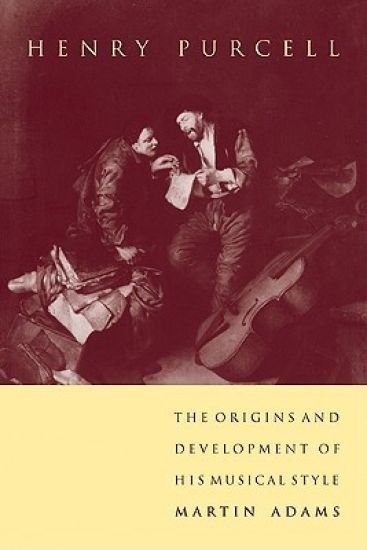
Henry Purcell

Henry Purcell

Martin Adams

Cambridge University Press
2009
nidottu
This is the first book thoroughly to explore the musical style of Henry Purcell. In this comprehensive study, Martin Adams identifies music by other composers, both within England and from abroad, which influenced Purcell's compositional decisions. Using a mix of broad stylistic observation and detailed analysis, Adams distinguishes between late seventeenth-century English style in general and Purcell's style in particular and chronicles the changes in the composer's approach to the main genres in which he worked, especially the newly emerging ode and English opera. As a result, Adams reveals that although Purcell went through a marked stylistic development, encompassing an unusually wide range of surface changes, special elements of his style remained constant. The book will be of interest to students and scholars of music and theatre history and of British cultural and social history.
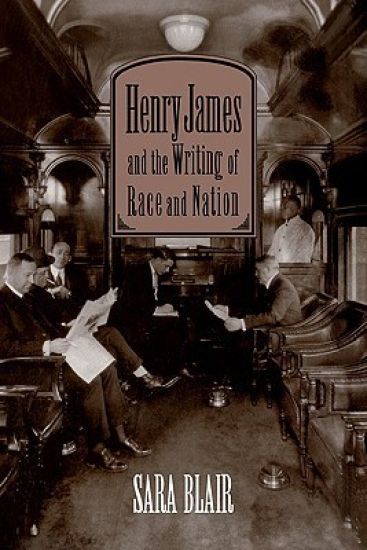
Henry James and the Writing of Race and Nation

Henry James and the Writing of Race and Nation

Sara Blair

Cambridge University Press
2009
pokkari
This 1996 book describes a new Henry James who, rather than being paraded as a beacon of high culture, actually expresses a nuanced understanding of, and engagement with, popular culture. Arguing against recent trends in critical studies which locate racial resistance in popular culture, Sara Blair uncovers this resistance within literature and high modernism. She analyses a variety of texts from early travel writing to The Princess Casamassima, The American Scene and The Tragic Muse, always setting the scene through descriptions of key events of the time such as Jack the Ripper's murders. Blair makes a powerful case for reading James with a sense of sustained contradiction and her project absorbingly argues for the historical and ongoing importance of literary texts and discourses to the study of culture and cultural value.
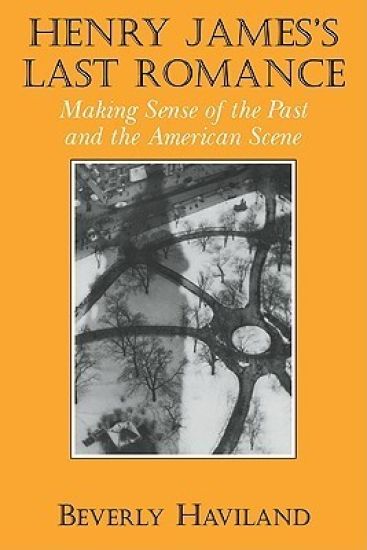
Henry James' Last Romance

Henry James' Last Romance

Beverly Haviland

Cambridge University Press
2009
pokkari
In this 1998 study of Henry James's classic text of cultural criticism, The American Scene, Beverly Haviland shows how James confronted the vexing problem of making sense of the past so that he could make culture work. In this record of James's 1904–5 return to America and in his unfinished novels, The Sense of the Past and The Ivory Tower, he interpreted the social conflicts that seemed to be paralysing relations between men and women, between black and white Americans, between 'natives' and 'aliens', between defenders of taste and censors of waste. Although James has been represented as conservative by liberal critics, it is just such simplifying oppositions that his method of interpretation works to transform. Haviland's own metonymical method follows James's interpretative practice by bringing historical and theoretical readings of these texts into conversation with each other.
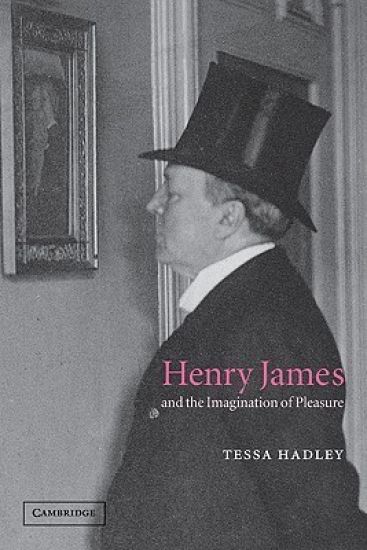
Henry James and the Imagination of Pleasure

Henry James and the Imagination of Pleasure

Tessa Hadley

Cambridge University Press
2009
pokkari
Tessa Hadley examines how Henry James progressively disentangled himself from the moralizing frame through which English-language novels in the nineteenth century had imagined sexual passion. Hadley argues that his relationship with the European novel tradition was crucial, helping to leave behind a way of seeing in which only 'bad' women could be sexual. She reads James's transitional fictions of the 1890s as explorations of how disabling and distorting ideals of women's goodness and purity were learned and perpetuated within English and American cultural processes. These explorations, Hadley argues, liberate James to write the great heterosexual love affairs of the late novels, with their emphasis on the power of pleasure and play: themes which are central to James's ambitious enterprise to represent the privileges and the pains of turn-of-the-century leisure class society.
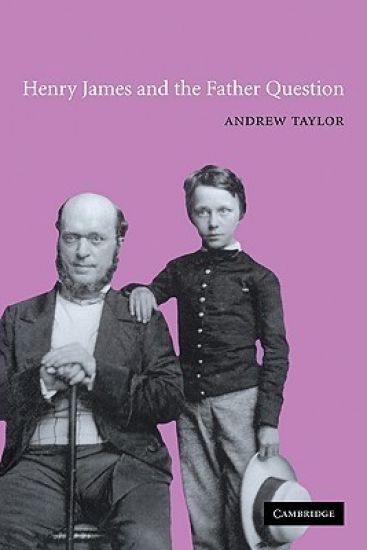
Henry James and the Father Question

Henry James and the Father Question

Andrew Taylor

Cambridge University Press
2009
pokkari
The intellectual relationship between Henry James and his father, who was a philosopher and theologian, proved to be an influential resource for the novelist. Andrew Taylor explores how James's writing responds to James Senior's epistemological, thematic and narrative concerns, and relocates these concerns in a more secularised and cosmopolitan cultural milieu. Taylor examines the nature of both men's engagement with autobiographical strategies, issues of gender reform, and the language of religion. He argues for a reading of Henry James that is informed by an awareness of paternal inheritance. Taylor's study reveals the complex and at times antagonistic dialogue between the elder James and his peers, particularly Emerson and Whitman, in the vanguard of mid nineteenth-century American Romanticism. Through close readings of a wide range of novels and texts, he demonstrates how this dialogue anticipates James's own theories of fiction and selfhood.
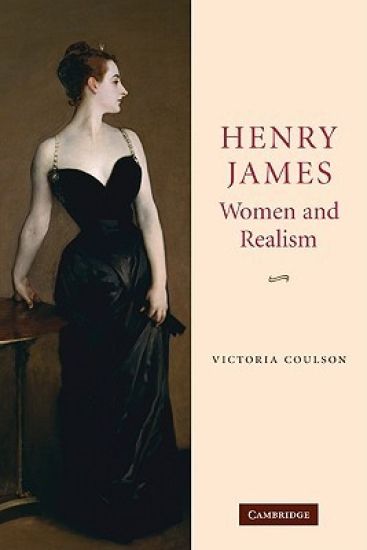
Henry James, Women and Realism

Henry James, Women and Realism

Victoria Coulson

Cambridge University Press
2009
pokkari
Women were hugely important to Henry James, both in his vividly drawn female characters and in his relationships with female relatives and friends. Combining biography with literary criticism and theoretical inquiry, Victoria Coulson explores James's relationships with three of the most important women in his life: his friends, the novelists Constance Fenimore Woolson and Edith Wharton, and his sister Alice James, who composed a significant diary in the last years of her life. These writers shared not only their attitudes to gender and sexuality, but also their affinity for a certain form of literary representation, which Coulson defines as 'ambivalent realism'. The book draws on a diverse range of sources from fiction, autobiography, theatre reviews, travel writing, private journals, and correspondence. Coulson argues, compellingly, that the personal lives and literary works of these four writers manifest a widespread cultural ambivalence about gender identity at the end of the nineteenth century.
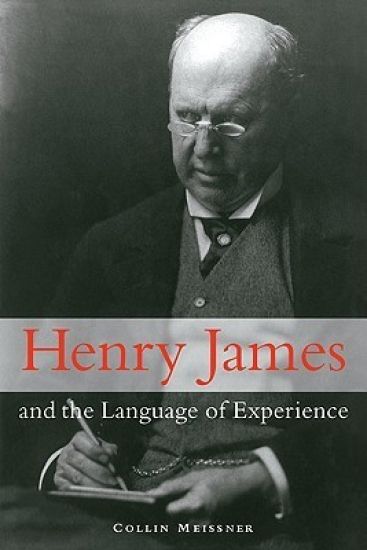
Henry James and the Language of Experience

Henry James and the Language of Experience

Meissner Collin

Cambridge University Press
2009
pokkari
In Henry James and the Language of Experience, Collin Meissner examines the political dimension to the representation of experience as it unfolds throughout James's work. Meissner argues that, for James, experience was a private and public event, a dialectical process that registered and expressed his consciousness of the external world. Adapting recent work in hermeneutics and phenomenology, Meissner shows how James's understanding of the process of consciousness is not simply an aspect of literary form; it is in fact inherently political, as it requires an active engagement with the full complexity of social reality. For James, the civic value of art resided in this interactive process, one in which the reader becomes aware of the aesthetic experience as immediate and engaged. This wide-ranging study combines literary theory and close readings of James's work to argue for a redefinition of the aesthetic as it operates in James's work.
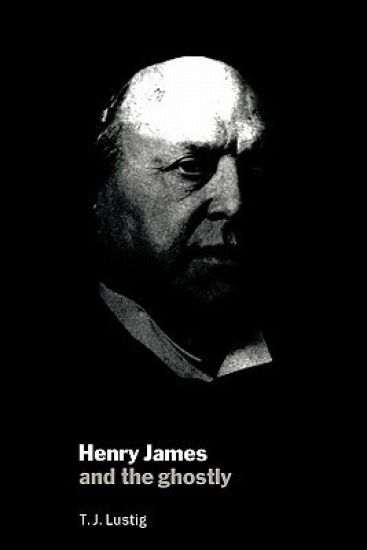
Henry James and the Ghostly

Henry James and the Ghostly

T. J. Lustig

Cambridge University Press
2011
pokkari
Ghosts - dead and yet alive, absent and yet present - are able to cross the borders of experience; in literature their evocation has been enduringly important. In Henry James and the Ghostly Dr Lustig explores the ghost stories that James produced throughout his career and relates them to the great dynamic forces which may well represent James's most original contribution to literature. The centrepiece of the book is a detailed analysis of James's classic ghost story, The Turn of the Screw, set in the context of work by earlier Victorian writers, and developments in James's own treatment of the ghostly. Dr Lustig evaluates the ghostly charge attached to the many scenes in James's novels and tales which turn on thresholds, perspectives, windows and doors, and the many moments when James's characters seem almost to encounter the margins of the texts which enclose them.
Henry James

Henry James

Cambridge University Press
2011
pokkari
Henry James: The Contemporary Reviews presents the most thorough gathering of newspaper and magazine reviews of James's work ever assembled. Other volumes in the American Critical Archives series have concentrated on reviews from American publications, but because of the importance of James's British connection, this issue generously samples reviews from British newspapers and periodicals. The focus here is on the novels, but reviews of James's most important travel narrative are included as well. The volume ends with reviews of The American Scene, James's impressionistic narrative of his relationship with his birthplace. This collection also reprints many rarely seen notices written by the most important women reviewers of the late nineteenth and early twentieth centuries. Each chapter ends with a checklist of additional reviews not presented here. The introduction surveys the major themes of the reviews and also shows the extent to which they personally influenced James and his work.
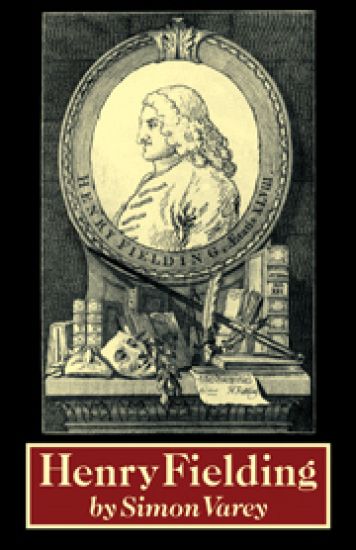
Henry Fielding

Henry Fielding

Simon Varey

Cambridge University Press
1986
sidottu
This concise and lucid study provides an ideal introduction to the major work of Henry Fielding for all students. Fielding's stature as a great comic novelist is assured, but as Professor Varey illustrates, he was a remarkably versatile writer. In his day Fielding was one of England's leading dramatists and also pursued a career in law. He founded, edited, and contributed essays for four different periodicals, and wrote a political-satirical novel Jonathan Wild, in addition to a work of powerful social protest Amelia and his two outstanding contributions to the development of English prose fiction: Tom Jones and Joseph Andrews. Professor Varey clarifies and explains this varied body of writing, concentrating on Fielding's technique of combining opposites or apparently ill-matched elements - of language, character, narrative made, and even philosophical thought.