Reprint of the original, first published in 1872. The publishing house Anatiposi publishes historical books as reprints. Due to their age, these books may have missing pages or inferior quality. Our aim is to preserve these books and make them available to the public so that they do not get lost.
Reprint of the original, first published in 1872. The publishing house Anatiposi publishes historical books as reprints. Due to their age, these books may have missing pages or inferior quality. Our aim is to preserve these books and make them available to the public so that they do not get lost.
Studienarbeit aus dem Jahr 2008 im Fachbereich Germanistik - Neuere Deutsche Literatur, Note: 1,3, Universit t Regensburg (Germanistik), 12 Quellen im Literaturverzeichnis, Sprache: Deutsch, Abstract: Das 18. Jahrhundert war charakteristisch f r einen gesellschaftlichen Umbruch und die Emanzipation des B rgertums, die an den Grundsteinen der St ndeordnung r ttelte. In dieser Zeit konnte sich auch das berlieferte strenge Regelsystem der Dramentheorie nicht mehr unver ndert halten. Lenz war einer der gro en Schriftsteller, die dieses System in Frage stellten. Er wird in seiner Zeit unterschiedlich eingesch tzt: Einerseits in seinem k nstlerischen Schaffen verachtet, da seine Werke keine gerade tragische oder komische Linie aufweisen, andererseits f r eben diese Tatsache als Sch pfer der realistischen b rgerlichen Trag die gelobt, f r das unter anderen Werken "Der Hofmeister" so ber hmt wurde. Die Bezeichnung des "Hofmeisters" als "b rgerliche Trag die" birgt jedoch schon die erste Schwierigkeit. Von Lenz selbst wurde das Werk zun chst als "Kom die" bezeichnet. In weiteren Stellungnahmen schwankte er jedoch zwischen "Kom die," "Lust- und Trauerspiel," "Trauerspiel" und "Rarit tskasten." Auch Kritiker und Leser haben von jeher unterschiedliche Meinungen zu Gattung des Werkes gehabt: "B rgerliches Trauerspiel," "Tragikom die," "Lustspiel," etc. Einig waren sich jedoch viele zeitgen ssische und sp tere Autoren dar ber, dass das Werk der Gattung des Dramas neue Dimensionen er ffnete und Lenz einen neuen Dramentypus geschaffen habe. Das Werk "Der Hofmeister oder die Vorteile der Privaterziehung" ist ein ironisches gesellschaftskritisches Drama, in dem Lenz auch die eigenen biographischen Erfahrungen einflie en lie . Dieser war selbst eine zeitlang Hofmeister gewesen, ein Lebensabschnitt, der ihn im negativen Sinne stark gepr gt hatte. In diesen Ausf hrungen wird auf das Problem der Gattungsbezeichnung f r dieses Werk eingegangen und beleuchtet, inwiefern die Schwank
Are you looking for a children's book that entertains and teaches at the same time? Your search ends here Embracing the ABC with Love (part 2, from J to R) will help your children learn the English alphabet, while taking them on a magical journey through the world of letters The books adopt a learning method based on the view of Prof. Gerhard Roth, an esteemed neurologist."Embracing the ABC with Love" series offer: Implications and teasers to stimulate children and spark their interest in the entire series of books; Letter-shaped objects (both uppercase and lowercase), floating trains and a BIG SECRET, revealed only in the last book, to engage our little readers and keep them amused A creative way of learning and absorbing new information Children get: Command over the English alphabet as a by-product of reading an interesting story A great preparation for their primary education Less stress while passing from preschool to school Learning habits developed naturally, rather than being forced upon them A positive experience that they will have fond memories of You want to help your children learn? These books do more than that Get them and help your children fall in love with learning
Die abenteuerliche Queste des tapferen und edlen Artus-Ritters Gawain, dessen Tugenden durch eine schöne Frau auf die Probe gestellt werden, zeichnet sich durch eine einfühlsame Beschreibung des mittelalterlichen Lebens aus. Ein Nachwort des Übersetzers und vor allem der fulminante Essay J.R.R. Tolkiens erschließen diese ungewöhnliche Aventiure.
This study traces the development of methodology in philosophy and economics with particular focus on the work of Raymond Chambers. As well as analysing the reception on methodological lines, afforded his work by both academic and professional communities, the volume discusses some significant contributions by French and German scholars to the debate about why scientific communities have accepted some theories and rejected others.
In this corporate history of the R. J. Reynolds Tobacco Company, Nannie M. Tilley recounts the story of Richard Joshua Reynolds and the vast R. J. Reynolds tobacco complex with precision and drama.Reynolds's rise in the tobacco industry began in 1891 when he introduced saccharin as an ingredient in chewing tobacco. Forced into James B. Duke's American Tobacco Company in 1899, the Reynolds company became the agency for consolidating the flat plug industry. In 1907, as the government began its antitrust suit against Duke, Reynolds himself bucked the trust and introduced another bestseller: Prince Albert smoking tobacco. The government won its suit in 1911; Duke's Tobacco Combination was dissolved, and Reynolds, left with a free and independent company, a much larger plant, and improved machinery, immediately began an expansion program.In 1913 Reynolds introduced Camels, a blend of Burley and flue-cured tobacco with some Turkish leaf. Perhaps the best-known cigarette ever produced, Camels swept the market and generally led the way until the development of filter-tipped cigarettes in the 1950s.Other important Reynolds advances include the systematic purchase and storage of leaf tobacco, the development of a stemming machine, the adoption of cellophane for wrapping cigarettes, and the production of cigarette paper. For its employees, the company established a medical department, introduced lunch rooms and day nurseries, and installed group life insurance. Perhaps more important than any of these items was the development of reconstituted leaf, a method of combining scrap tobacco and stems into a fine elastic leaf entirely suitable for use in any tobacco product. This achievement represented a savings of 25 percent in the cost of leaf and was followed by the development of the filter-tipped Winstons and Salems.The R. J. Reynolds Tobacco Company includes absorbing accounts of the company's steady technological progress, its labor problems and advances, and its influential role in North Carolina and in the industry through 1962.
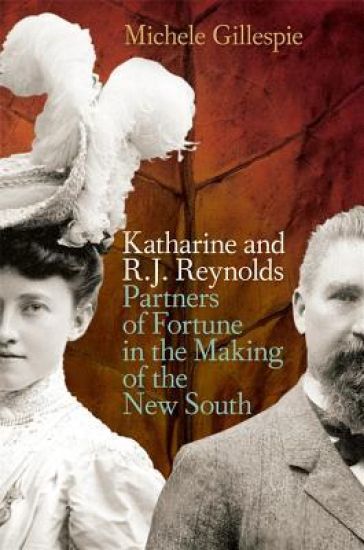
Separately they were formidable—together they were unstoppable. Despite their intriguing lives and the deep impact they had on their community and region, the story of Richard Joshua Reynolds (1850–1918) and Katharine Smith Reynolds (1880–1924) has never been fully told. Now Michele Gillespie provides a sweeping account of how R. J. and Katharine succeeded in realizing their American dreams.From relatively modest beginnings, R. J. launched the R. J. Reynolds Tobacco Company, which would eventually develop two hugely profitable products, Prince Albert pipe tobacco and Camel cigarettes. His marriage in 1905 to Katharine Smith, a dynamic woman thirty years his junior, marked the beginning of a unique partnership that went well beyond the family. As a couple, the Reynoldses conducted a far-ranging social life and, under Katharine's direction, built Reynolda House, a breathtaking estate and model farm. Providing leadership to a series of progressive reform movements and business innovations, they helped drive one of the South's best examples of rapid urbanization and changing race relations in the city of Winston-Salem, North Carolina. Together they became one of the New South's most influential elite couples. Upon R. J.'s death, Katharine reinvented herself, marrying a World War I veteran many years her junior and engaging in a significant new set of philanthropic pursuits.Katharine and R. J. Reynolds reveals the broad economic, social, cultural, and political changes that were the backdrop to the Reynoldses' lives. Portraying a New South shaped by tensions between rural poverty and industrial transformation, white working-class inferiority and deeply entrenched racism, and the solidification of a one-party political system, Gillespie offers a masterful life-and-times biography of these important North Carolinians.
This study traces the development of methodology in philosophy and economics with particular focus on the work of Raymond Chambers. As well as analysing the reception on methodological lines, afforded his work by both academic and professional communities, the volume discusses some significant contributions by French and German scholars to the debate about why scientific communities have accepted some theories and rejected others.
















![Obituaries of J. Losh, J. Bruce, R. H. Williamson and R. Wasney. [edited by J. F., i.e. John Fenwick.]](/covers/9781241024406.jpg)
