Kirjojen hintavertailu. Mukana 12 016 292 kirjaa ja 12 kauppaa.

Kirjahaku

Etsi kirjoja tekijän nimen, kirjan nimen tai ISBN:n perusteella.

1000 tulosta hakusanalla JAMES JOYCE

Leopold Bloom's Sexuality in James Joyce's 'ulysses'
Seminar paper from the year 2010 in the subject English - Literature, Works, grade: 1,0, University of Osnabr ck, course: James Joyce, Ulysses, language: English, abstract: The topic of sexuality is an essential one in James Joyce's Ulysses. This novel is full of sexual hints and passages that contain sexual action. The omnipresence of sexuality leads the reader through the novel as a central theme: most of the actions centre on Marion (Molly) Bloom's four- -clock date with Hugh Boylan. This date gives Leopold Bloom's day a certain structure as there are a lot references towards this time: "Funny my watch stopped at half past four" (U 353) and "He's coming in the afternoon" (U 89) are only two passages, which refer towards Molly's date with Boylan and therefore her affair with another man. Since its publication Ulysses affected great controversies due to its obscene passages, so the book was rated as scandalous and became an object of censorship. This paper is going to examine the obscenity of Ulysses and by doing so concentrate on the character of Leopold Bloom. It will be analysed in what degree the novel can be classified as 'obscene' and, furthermore, how the topic of sexuality is presented. Afterwards, these results will be brought into a wider context, concerning the topic of sexuality as a mental process in Ulysses.
A critique of mariolatry in James Joyce "Ulysses". Incongruities in Gerty McDowell's self-depiction and actions
Seminar paper from the year 2013 in the subject English - Discussion and Essays, grade: 1,0, Johannes Gutenberg University Mainz, course: Modernism, language: English, abstract: For Gerty McDowell, it is mariolatry that conceals her personal philosophy. It is mariolatry she uses as a hideout and it is mariolatry she uses as a Mask. To see her true face, we must have a look at her mask, for it is what she wants us to think of her, a look at her actions, for it is her most objective description, and finally a look at her dreams, for they are whom she wishes to be. It is her being in all its contradictions, that gives Gerty her purpose in Joyce's "Ulysses." Despite her relatively brief appearance, her character is integral as it represents the aspect of woman that is connected with piety. By looking at the incongruities in Gerty McDowell's self-depiction and her actions, we see Joyce's criticism that women hide their true personality behind the mask of mariolatry.
Der Wille zum Wissen bei James Joyce

Der Wille zum Wissen bei James Joyce

Wolfgang Streit

Books on Demand
2000
pokkari
"Betrachtet man James Joyces text in progress unter dem Gesichtspunkt der Sexualität, entsteht folgende Genealogie: Das Thema wird zwischen Chamber Music und Finnegans Wake erstens exakter geordnet, so daß symmetrische Beziehungen zwischen den Figuren entstehen. Zweitens präzisiert sich der Versprachlichungszwang, unter dem Figuren, vor allem Künstlerfiguren und somit auch der Text selbst stehen. Und schließlich rücken der von Anfang an präsente Wille zum Wissen und der Widerstand gegen ihn ins Zentrum des Textes. Sie lösen sich völlig von ihrer, besonders in den Dubliners vorherrschenden, gesellschaftlichen Einbindung, um bis in Finnegans Wake zur Triebkraft der Handlung und des Schreibens zu werden."9319336September 1939. England is at war with Nazi Germany. In Southampton, the world's most luxurious airliner - the legendary Pan Am clipper - takes off for its final flight to neutral America. Aboard are the cream of society and the dregs of humanity, all fleeing the war for reasons of their own... shadowed by a danger they do not know exists... and heading straight into a storm of violence, intrigue, and betrayal...
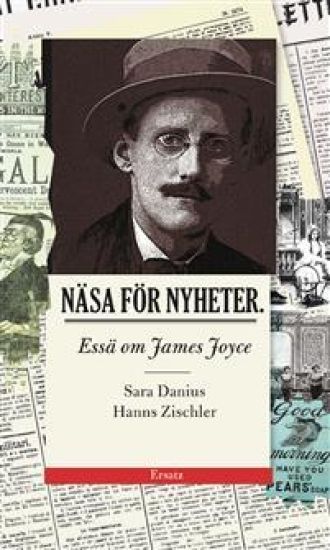
Näsa för nyheter : essä om James Joyce

Näsa för nyheter : essä om James Joyce

Sara Danius; Hanns Zischler

Ersatz
2013
sidottu
Denna bok handlar om vad som gör den moderna romanen modern. James Joyce visste detta bättre än de flesta. Han var en tidningsslukare av stora mått, och Ulysses vore otänkbar utan denna omättliga hunger - såväl innehållsligt som formmässigt. Oktober 1904 till mars 1905: den medellöse irländske författaren upptäcker mitt i den habsburgska monarkins falnande glans ett nytt sätt att berätta som kommer att revolutionera romankonsten. Sara Danius är litteraturhistoriker, kritiker och essäist. Tidigare böcker: »Prousts motor« (2000), »The senses of modernism: technology, perception, and aesthetics« (2002), »The prose of the world: Flaubert and the art of making things visible« (2006), »Proust-Benjamin: om fotografin« (2011) och »Den blå tvålen« (2013). Hanns Zischler är författare, översättare, film- och litteraturkritiker. Han är också en av Tysklands mest kända skådespelare. År 1996 utkom hans bok »Kafka går på bio«, som översatts till flera språk. »Det djupt tilltalande med den här essän, som dessutom tryfferas med en mängd fotografier och tidningsklipp, är den lekfulla lättheten med vilken den ger en initierad kulturhistorisk inblick i Joyces verk.« Frankfurter Allgemeine Zeitung »Det är en fröjd att följa de här två författarnas intelligenta lek.« Buchkultur
Das Kuenstlerische Bewusstsein Und Seine Gestaltung in James Joyces «A Portrait of the Artist as a Young Man» Und «Ulysses»
Joyce definiert Kunst in einer ideologischen Welt als ein Mittel zur Selbstverwirklichung. Die Identitatssuche fuhrt ihn zum hermeneutischen Begriff von Wahrheit. Sprache, Religion und Vaterland werden als Traditionsmachte gezeigt, die nur ein wirkungsgeschichtliches Bewusstsein kritisch aufzuheben vermag. Der Kunstler ist gleichzeitig Luzifer und Christus: nur die Rebellion gegen die Autoritat bringt Erkenntnis, die rechtglaubige Gemeinde aber steinigt die Propheten. Die Wahrheit ist relativ, entwicklungsgeschichtlich bestimmt. Die Form der Romane spiegelt den hermeneutischen Zirkel. Parallelen zu Nietzsches -Geburt der Tragodie-."
Christian Heresy, James Joyce, and the Modernist Literary Imagination
Shortlisted for the AAR Book Award for Excellence in the Study of Religion 2023Organized by heretical movements and texts from the Gnostic Gospels to The Book of Mormon, this book uses the work of James Joyce – particularly Ulysses and Finnegan’s Wake – as a prism to explore how the history of Christian heresy remains part of how we read, write, and think about books today.Erickson argues that the study of classical, medieval, and modern debates over heresy and orthodoxy provide new ways of understanding modernist literature and literary theory. Using Joyce’s works as a springboard to explore different perspectives and intersections of 20th century literature and the modern literary and religious imagination, this book gives us new insights into how our modern and “secular” reading practices unintentionally reflect how we understand our religious histories.
Christian Heresy, James Joyce, and the Modernist Literary Imagination
Shortlisted for the AAR Book Award for Excellence in the Study of Religion 2023Organized by heretical movements and texts from the Gnostic Gospels to The Book of Mormon, this book uses the work of James Joyce – particularly Ulysses and Finnegan’s Wake – as a prism to explore how the history of Christian heresy remains part of how we read, write, and think about books today.Erickson argues that the study of classical, medieval, and modern debates over heresy and orthodoxy provide new ways of understanding modernist literature and literary theory. Using Joyce’s works as a springboard to explore different perspectives and intersections of 20th century literature and the modern literary and religious imagination, this book gives us new insights into how our modern and “secular” reading practices unintentionally reflect how we understand our religious histories.
A Portrait of the Artist as a Young Man by James Joyce: A Portrait of the Artist as a Young Man by James Joyce
A Portrait of the Artist as a Young Man is the first novel by Irish writer James Joyce. A K nstlerroman in a modernist style, it traces the religious and intellectual awakening of young Stephen Dedalus, a fictional alter ego of Joyce and an allusion to Daedalus, the consummate craftsman of Greek mythology. Stephen questions and rebels against the Catholic and Irish conventions under which he has grown, culminating in his self-exile from Ireland to Europe. The work uses techniques that Joyce developed more fully in Ulysses (1922) and Finnegans Wake (1939). A Portrait began life in 1904 as Stephen Hero-a projected 63-chapter autobiographical novel in a realistic style. After 25 chapters, Joyce abandoned Stephen Hero in 1907 and set to reworking its themes and protagonist into a condensed five-chapter novel, dispensing with strict realism and making extensive use of free indirect speech that allows the reader to peer into Stephen's developing consciousness. American modernist poet Ezra Pound had the novel serialised in the English literary magazine The Egoist in 1914 and 1915, and published as a book in 1916 by B. W. Huebsch of New York. The publication of A Portrait and the short story collection Dubliners (1914) earned Joyce a place at the forefront of literary modernism.