Kirjojen hintavertailu. Mukana 11 627 670 kirjaa ja 12 kauppaa.

Kirjahaku

Etsi kirjoja tekijän nimen, kirjan nimen tai ISBN:n perusteella.

1000 tulosta hakusanalla James M. Hutchisson

Bruges, Cradle of Capitalism, 1280–1390

Bruges, Cradle of Capitalism, 1280–1390

James M. Murray

Cambridge University Press
2009
pokkari
Teeming with merchants from all over Europe, medieval Bruges provides an early model of a great capitalist city. Bruges established a sophisticated money market and an elaborate network of agents and brokers. Moreover, it promoted co-operation between merchants of various nations. In this book James Murray explores how Bruges became the commercial capital of northern Europe in the late fourteenth century. He argues that a combination of fortuitous changes such as the shift to sea-borne commerce and the extraordinary efforts of the city's population served to shape a great commercial centre. Areas explored include the political history of Bruges, its position as a node and network, the wool, cloth and gold trade and the role of women in the market. This book serves not only as a case-study in medieval economic history, but also as a social and cultural history of medieval Bruges.
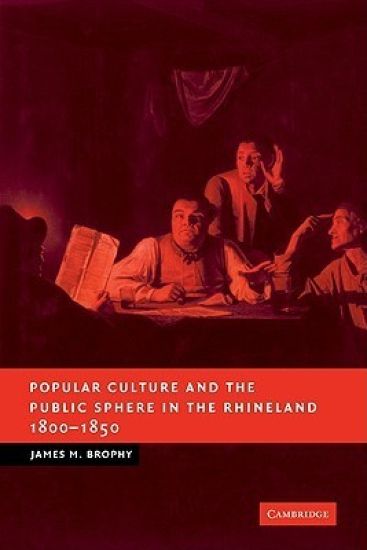
Popular Culture and the Public Sphere in the Rhineland, 1800–1850
The age of revolution challenged the ancien régime's political world, introducing Europeans to fresh ideals of citizenship. German society was no less affected. Following the Napoleonic era, a political culture of partisan choice undermined the official restoration of absolutism. Bourgeois and popular classes took part in the political landscape of civil society, producing an impressive social base for participatory politics by the 1830s. Because of severe restrictions on speech and assembly, ordinary Germans formed political opinions in irregular ways. This book looks at the sites and forms of culture that facilitated political communication. With chapters devoted to reading, singing, public space, carnival, violence and religion, James Brophy argues that popular culture played a critical role in linking ordinary Rhinelanders to the public sphere. Moving beyond conventional explanations of opinion formation, he exposes the broad cultural infrastructure that enabled popular classes to join the political nation.
The Spatial Theory of Voting

The Spatial Theory of Voting

James M. Enelow; Melvin J. Hinich

Cambridge University Press
1984
pokkari
This book provides an introduction to an important approach to the study of voting and elections: the spatial theory of voting. In contrast to the social-psychological approach to studying voting behaviour, the spatial theory of voting is premised on the idea of self-interested choice. Voters cast votes on the basis of their evaluation of the candidates or policy alternatives competing for their vote. Candidates fashion their appeals to the voters in an effort to win votes. The spatial theory provides explicit definitions for these behavioural assumptions to determines the form that self-interested behaviour will take. The consequences of this behaviour for the type of candidate or policy that voters will select is the major focus of the theory. There is a twofold purpose to this work. The first is to provide an elementary but rigourous introduction to an important body of political science research. The second is to design and test a spatial theory of elections that provides insights into the nature of election contests. The book will appeal to a wide audience, since the mathematics is kept to an accessible level.
Politics by Principle, Not Interest

Politics by Principle, Not Interest

James M. Buchanan; Roger D. Congleton

Cambridge University Press
1998
sidottu
The very logic of majority rule implies unequal treatment or discrimination. If left unconstrained, majority coalitions will promote the interests of their own members at the expense of other persons. This book focuses on the effects of applying a generality constraint on the political process. Under this requirement, majorities would be constitutionally prohibited from treating different persons and groups differently. The generality principle is familiar in that all persons are to be treated equally. In summary, this book extends the generality norm to politics. Several defenses or equal treatment or generality are developed and applied. These include the familiar intuition that invokes fairness. But the primary argument here is centred on political efficiency, which is increased when governments are constrained to treat persons or groups generally rather than differentially. The political efficiency defense of the generality constraint is based on a public choice analysis of the implication of majoritarian discrimination.
The Foundations of Causal Decision Theory

The Foundations of Causal Decision Theory

James M. Joyce

Cambridge University Press
1999
sidottu
This book defends the view that any adequate account of rational decision making must take a decision maker’s beliefs about causal relations into account. The early chapters of the book introduce the non-specialist to the rudiments of expected utility theory. The major technical advance offered by the book is a ‘representation theorem’ that shows that both causal decision theory and its main rival, Richard Jeffrey’s logic of decision, are both instances of a more general conditional decision theory. The book solves a long-standing problem for Jeffrey’s theory by showing for the first time how to obtain a unique utility and probability representation for preferences and judgments of comparative likelihood. The book also contains a major new discussion of what it means to suppose that some event occurs or that some proposition is true. The most complete and robust defence of causal decision theory available.
Inventing Vietnam

Inventing Vietnam

James M. Carter

Cambridge University Press
2008
pokkari
This book considers the Vietnam war in light of U.S. foreign policy in Vietnam, concluding that the war was a direct result of failed state-building efforts. This U.S. nation building project began in the mid-1950s with the ambitious goal of creating a new independent, democratic, modern state below the 17th parallel. No one involved imagined this effort would lead to a major and devastating war in less than a decade. Carter analyzes how the United States ended up fighting a large-scale war that wrecked the countryside, generated a flood of refugees, and brought about catastrophic economic distortions, results which actually further undermined the larger U.S. goal of building a viable state. Carter argues that, well before the Tet Offensive shocked the viewing public in late January, 1968, the campaign in southern Vietnam had completely failed and furthermore, the program contained the seeds of its own failure from the outset.
Geography in Early Judaism and Christianity

Geography in Early Judaism and Christianity

James M. Scott

Cambridge University Press
2002
sidottu
In this 2002 book, James M. Scott focuses on a particular Old Testament pseudepigraphon - the Book of Jubilees, the revelation of an angel to Moses announcing the expectation of a messiah from Judah. He traces the appropriation of the Book of Jubilees in early Christian sources from the New Testament to Hippolytus and beyond, and more specifically focuses on the reception of Jubilees 8–9, an expansion of the so-called Table of Nations in Genesis 10 (1 Chronicles 1). The book takes an interdisciplinary approach based on detailed analysis of primary sources, much of which is seldom considered by New Testament scholars, and explores the neglected topic of ancient geographical conceptions. By studying geographical aspects of the work, Dr Scott is able to relate Jubilees to both Old and New Testament traditions, bringing important new insights into Christian concepts of annunciation.
Bruges, Cradle of Capitalism, 1280–1390

Bruges, Cradle of Capitalism, 1280–1390

James M. Murray

Cambridge University Press
2005
sidottu
Teeming with merchants from all over Europe, medieval Bruges provides an early model of a great capitalist city. Bruges established a sophisticated money market and an elaborate network of agents and brokers. Moreover, it promoted co-operation between merchants of various nations. In this book James Murray explores how Bruges became the commercial capital of northern Europe in the late fourteenth century. He argues that a combination of fortuitous changes such as the shift to sea-borne commerce and the extraordinary efforts of the city's population served to shape a great commercial centre. Areas explored include the political history of Bruges, its position as a node and network, the wool, cloth and gold trade and the role of women in the market. This book serves not only as a case-study in medieval economic history, but also as a social and cultural history of medieval Bruges.
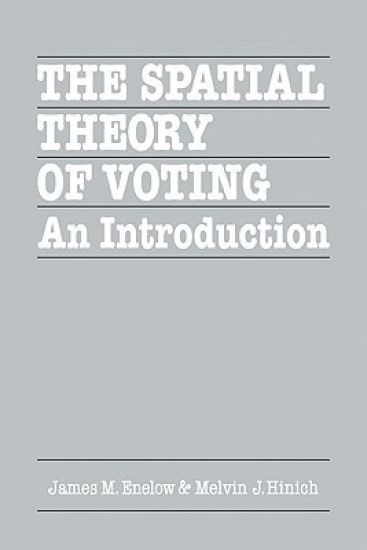
Popular Culture and the Public Sphere in the Rhineland, 1800–1850
The age of revolution challenged the ancien régime's political world, introducing Europeans to fresh ideals of citizenship. German society was no less affected. Following the Napoleonic era, a political culture of partisan choice undermined the official restoration of absolutism. Bourgeois and popular classes took part in the political landscape of civil society, producing an impressive social base for participatory politics by the 1830s. Because of severe restrictions on speech and assembly, ordinary Germans formed political opinions in irregular ways. This book looks at the sites and forms of culture that facilitated political communication. With chapters devoted to reading, singing, public space, carnival, violence and religion, James Brophy argues that popular culture played a critical role in linking ordinary Rhinelanders to the public sphere. Moving beyond conventional explanations of opinion formation, he exposes the broad cultural infrastructure that enabled popular classes to join the political nation.
Language and Emotion

Language and Emotion

James M. Wilce

Cambridge University Press
2009
sidottu
Language is a means we use to communicate feelings; we also reflect emotionally on the language we and others use. James Wilce analyses the signals people use to express emotion, looking at the social, cultural and political functions of emotional language around the world. His book demonstrates that speaking, feeling, reflecting, and identifying are interrelated processes and shows how desire or shame are attached to language. Drawing on nearly one hundred ethnographic case studies, it demonstrates the cultural diversity, historical emergence, and political significance of emotional language. Wilce brings together insights from linguistics and anthropology to survey an extremely broad range of genres, cultural concepts, and social functions of emotional expression.
Inventing Vietnam

Inventing Vietnam

James M. Carter

Cambridge University Press
2008
sidottu
This book considers the Vietnam war in light of U.S. foreign policy in Vietnam, concluding that the war was a direct result of failed state-building efforts. This U.S. nation building project began in the mid-1950s with the ambitious goal of creating a new independent, democratic, modern state below the 17th parallel. No one involved imagined this effort would lead to a major and devastating war in less than a decade. Carter analyzes how the United States ended up fighting a large-scale war that wrecked the countryside, generated a flood of refugees, and brought about catastrophic economic distortions, results which actually further undermined the larger U.S. goal of building a viable state. Carter argues that, well before the Tet Offensive shocked the viewing public in late January, 1968, the campaign in southern Vietnam had completely failed and furthermore, the program contained the seeds of its own failure from the outset.