Kirjojen hintavertailu. Mukana 12 390 323 kirjaa ja 12 kauppaa.

Kirjahaku

Etsi kirjoja tekijän nimen, kirjan nimen tai ISBN:n perusteella.

1000 tulosta hakusanalla John Class

Class Formations and Inequality Structures in Contemporary African Migration
This book examines the influences of social class and inequality structures on migration in Africa using information from Ghana. As the country achieves moderate to significant economic gains driven (in part) by the country’s diaspora communities, the desire to migrate has intensified. Migration is now synonymous with social mobility and self-improvement. It has been found that existing class and status inequalities are analytically inseparable from the social and cultural processes underpinning the motivations behind Ghanaian migration. Migrant class and socioeconomic attributes are closely intertwined, reinforcing and operating at every level of the migration decision-making to influence the motivation to migrate, the type and form of migration, the direction of the migration, its timing, and ultimately the outcomes and expectations that migrants associate with their decision to migrate. From a historical and contemporary perspective, this book argues that power and class-based structural relationships are significant components in understanding how migratory diasporas shape and are shaped in turn by social class and inequality. The social class identities that Ghanaian immigrants manifest in the United States are often based on immigrant formulations and importation of class dynamics from the home country. These identities are then transformed in the countries of destination and replayed or relived back home, thereby creating multiple class identities that are powerful forces in inducing social changes. In essence, migrant social class attributes formed before and post-migration is significant because it holds the possibilities of transforming the social structures of migrant-sending countries. As migrants return home and seek reintegration into the body polity of the home society, conflicts emanating from changes in their class dynamics may hinder or promote sociocultural and economic development. Hence, the imperative of the central government is to understand and incorporate into national development planning the social class characteristics of its citizens who are leaving, as well as those who are returning.
Class Dismissed

Class Dismissed

John Marsh

Monthly Review Press,U.S.
2011
sidottu
In Class Dismissed, John Marsh debunks a myth cherished by journalists, politicians, and economists: that growing poverty and inequality in the United States can be solved through education. Using sophisticated analysis combined with personal experience in the classroom, Marsh not only shows that education has little impact on poverty and inequality, but that our mistaken beliefs actively shape the way we structure our schools and what we teach in them.Rather than focus attention on the hierarchy of jobs and power--where most jobs require relatively little education, and the poor enjoy very little political power--money is funneled into educational endeavors that ultimately do nothing to challenge established social structures, and in fact reinforce them. And when educational programs prove ineffective at reducing inequality, the ones whom these programs were intended to help end up blaming themselves. Marsh's struggle to grasp the connection between education, poverty, and inequality is both powerful and poignant.
Class and Status in America: A Contemporary Perspective

Class and Status in America: A Contemporary Perspective

John F. Sullivan

Dorrance Publishing Co.
2021
sidottu
Which Americans are upper-class, middle-class, and lower-class? How important is money, family background, education, appearance and behavior in determining one's socioeconomic class? This book attempts to answer these questions as well as related questions focusing on income inequality, economic segregation and inter-class mobility. The author also offers specific recommendations for reducing economic inequality and making America a better, happier, and more optimistic place, How many socioeconomic classes are there in 21st century America?How do members of the upper class and lower class live? What criteria are used to determine the socioeconomic class of individual Americans?How important is money and family background in determining socioeconomic class?What role does education play in determining the socioeconomic class of Americans?What is or was the socioeconomic class of JFK, Tiger Woods, George H. W. Bush, Elvis Presley, Mitt Romney, Bill Gates, Jeff Bezos, and Martin Luther King Junior"?How easy is it to move up or down in socioeconomic class?How has the American class structure evolved since the Country was founded?What is the meaning and derivation of the following terms: "Boston Brahmin,""Patrician," "The Elite," "The Social Register," "The Working Class" and "WASP"?How is income inequality measured and is it growing or declining?Do members of the upper class look any different than other Americans?Is there an unwritten dress code for the upper class?Is there an unwritten code of conduct/behavior for the upper class?What is a "moral compass" and does having one matter?What do the homes of the upper class look like and how are they decorated?Can one accurately "guesstimate" the socioeconomic class of an American by simply observing and/or listening to him or her? What "clues" to look for.How much "class warfare" is there in America and what can be done about it?What should be done to improve America's culture, school systems, colleges and universities, health care, and income protection programs?About the AuthorJohn F. Sullivan is a former professor in the College of Social Science, Michigan State University and a founder of Sullivan, Cotter and Associates, a nationwide human resources consulting firm. He is the author of several articles in professional journals and the author of the first edition of this book which was published under a pen name.
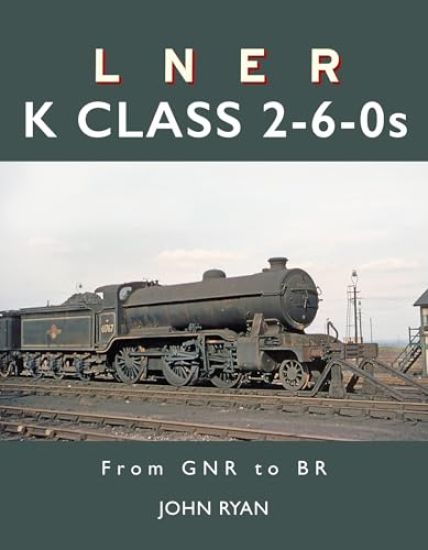
LNER K Class 2-6-0's

LNER K Class 2-6-0's

John Ryan

GREAT NORTHERN BOOKS LTD
2024
sidottu
Sir Nigel Gresley was one of the pioneers in developing the 2-6-0 wheel arrangement in Britain during the early 20th century. He also used the type to examine several distinguishing features that were used in his subsequent designs.Producing 85 2-6-0 locomotives for the Great Northern Railway, he built a further 189 for the London & North Eastern Railway, whilst his successors constructed 70 engines. These 344 LNER K Class 2-6-0s were a mainstay of secondary passenger and goods services along the East Coast Main Line from 1912 to the end of steam in the 1960s, whilst finding new areas of operation after Grouping. The K4 Class also took a specialised role on the West Highland Railway in Scotland.LNER K Class 2-6-0s uses over 160 excellent colour and black-and-white images to present the development of the type from introduction to their final days under British Railways.The engines are pictured at a number of locations, such as stations, sheds, from the lineside, as well as workshops.Only one LNER K Class 2-6-0 has been preserved and is currently out of service. This collection provides a welcome reminder of the importance of the LNER K Classes over a remarkable period in the history of the steam locomotive.
The Key Class: The Keys to Job Search Success

The Key Class: The Keys to Job Search Success

John J. Daly Jr

Troll River Publications
2013
nidottu
Etiquette as a Winning Formula for Job Search Success?Why not? Seventy, that's right, 70 percent of people lose their jobs because they don't fit into the work environment. It has become even more difficult to get a job. When John Daly explains to people that the reason they aren't appearing to "fit in" leads back to their not understanding business and personal etiquette, he's often met with, "You mean that stuffy, eat-with-the-right-fork stuff?" Far from it. Daly encourages people to think of job hunting as a game. Job hunting depends on knowing the rules of the game. Like playing football, you need to know all the rules, particularly the ones you don't want to break, such as being out-of-bounds.The point of the game in job searching and in life is to know how to be comfortable and make others comfortable with you in every situation. And that's why etiquette So, why are so many people lacking in an understanding of the rules? Daly's response is simple: No one has ever taught them Over the past several years, Daly has been mentoring young people in Santa Barbara, California. In the process, he launched The Key Class, a course on business and social manners to help both students and unemployed workers secure jobs and gain college entrance. This book is a compilation of articles he's written over the past few years, even snagging a few guest bloggers along the way. Get ready to download a winning formula for job search success contained in the pages of this book
Class and Social Honour

Class and Social Honour

John Scott

Springer International Publishing AG
2024
sidottu
This book develops a theoretical approach to social stratification and applies it to the development of the official system of state honours in Britain. It examines both class and status, and sets out an innovative framework for understanding social status – an important but often ignored and misunderstood dimension of social stratification. It is shown that a system of peerages, knighthoods, and other state-based royal honours emerged from feudal patterns of political rule and became an unplanned framework of social integration in the UK that has, since the nineteenth century, decayed and been challenged by alternative criteria of status. The book explores the class basis of the rise and decay of royal honours and includes a review of contemporary attempts to reconstruct and renew a system of social honour that reflects contemporary relations of power and class in Britain. It will be of interest to scholars and students of class, social inequality and British social structure.
Class and Social Honour

Class and Social Honour

John Scott

Springer International Publishing AG
2025
nidottu
This book develops a theoretical approach to social stratification and applies it to the development of the official system of state honours in Britain. It examines both class and status, and sets out an innovative framework for understanding social status – an important but often ignored and misunderstood dimension of social stratification. It is shown that a system of peerages, knighthoods, and other state-based royal honours emerged from feudal patterns of political rule and became an unplanned framework of social integration in the UK that has, since the nineteenth century, decayed and been challenged by alternative criteria of status. The book explores the class basis of the rise and decay of royal honours and includes a review of contemporary attempts to reconstruct and renew a system of social honour that reflects contemporary relations of power and class in Britain. It will be of interest to scholars and students of class, social inequality and British social structure.
Class of 1882 Baccalaureate Sermon, Class Day Oration, etc
Class of 1882 Baccalaureate Sermon, Class Day Oration, etc is an unchanged, high-quality reprint of the original edition of 1882. Hansebooks is editor of the literature on different topic areas such as research and science, travel and expeditions, cooking and nutrition, medicine, and other genres. As a publisher we focus on the preservation of historical literature. Many works of historical writers and scientists are available today as antiques only. Hansebooks newly publishes these books and contributes to the preservation of literature which has become rare and historical knowledge for the future.
Whiteness and Class in Education
Like many of my friends I didn’t really realise that I was working class until I went to university. Suddenly, what I thought as normal became subtly and not so subtly differentiated as I came into close contact with the middle classes. I had not known a time, though, when I hadn’t been white, but I didn’t really realise that I was white until I read David Roediger’s (1991) book ‘The Wages of Whiteness’. Through reading this work and others on the topic of whiteness the sense of my own whiteness became palpable to me. Namely, that what I naively thought to be a timeless property of my skin was a social construction that had acquired so much symbolic weight over time that it had become seemingly real: a racial formation and project. This was with consequences, in that a good part of my actual and psychological labour market and other employment benefits were not part of a meritocratic system, but due to the oppression of people of colour. This might be part of a system that I at the time associated only with the far-right, a system of white supremacy. Fundamentally, my skin was property and the gains that I had made through it were at the expense of others. I was a ‘so called white’ (Ignatiev and Garvey, 1996) who everyday made a political decision to not commit ‘treason’ to whiteness.
The Working Class in Britain

The Working Class in Britain

John Benson

I.B. Tauris
2003
nidottu
Who made up the working class in Britain, who were the ordinary men and women and what were their aspirations? The first generation of postwar British labour historians tended to be preoccupied with working class activism. This texts attempts to chart not only this struggle, but to describe and analyse the rich and varied tapestry of working-class history as a whole. It demonstrates that "class" both existed and mattered although ordinary men and women had diverse lives and lifestyles. Professor Benson examines work, wages, incomes and the cost of living, family, kinship and community relations and the individual in the context of nation and class.