Kirjojen hintavertailu. Mukana 12 083 983 kirjaa ja 12 kauppaa.

Kirjahaku

Etsi kirjoja tekijän nimen, kirjan nimen tai ISBN:n perusteella.

1000 tulosta hakusanalla John R. Fitzpatrick

Imagining Wild America

Imagining Wild America

John R. Knott

The University of Michigan Press
2002
sidottu
At a time when the idea of wilderness is being challenged by both politicians and intellectuals, Imagining Wild America examines writing about wilderness and wildness and makes a case for its continuing value. The book focuses on works by John James Audubon, Henry David Thoreau, John Muir, Edward Abbey, Wendell Berry, and Mary Oliver, as each writer illustrates different stages and dimensions of the American fascination with wild nature. John Knott traces the emergence of a visionary tradition that embraces values consciously understood to be ahistorical, showing that these writers, while recognizing the claims of history and the interdependence of nature and culture, also understand and attempt to represent wild nature as something different, other.A contribution to the growing literature of eco-criticism, the book is a response to and critique of recent arguments about the constructed nature of wilderness. Imagining Wild America demonstrates the richness and continuing importance of the idea of wilderness, and its attraction for American writers. John R. Knott is Professor of English, University of Michigan. His previous books include The Huron River: Voices from the Watershed, coedited with Keith Taylor.

Coalition of the unWilling and unAble

Coalition of the unWilling and unAble

John R Deni

The University of Michigan Press
2021
sidottu
Why does the United States need European allies, and why is it getting more difficult for those allies to partner with Washington in standing up to China, pushing back against Russia, and pursuing other common interests around the world? This book addresses the economic, demographic, political, and military trends that are fundamentally upending the ability and willingness of European allies to work with Washington. Brexit and its impact on Britain’s economy and its military, Germany’s seemingly relentless economic and political rise, France’s continuing economic malaise, Italy’s aging population and its withdrawal from major overseas operations, and Poland’s demographic decline and single-minded obsession with Russia will combine to make partnership with Washington nearly impossible. In short, the constellation of allies and partners the United States has relied on since 9/11 will look very different a decade from now. How should Washington respond? It doesn’t hold all the cards, but this book offers an array of practical recommendations for American leaders. By leveraging these proposals, U.S. policy-makers can avoid the worst-case scenarios and make the most of limited opportunities.
The Houses of Roman Italy, 100 B.C.- A.D. 250

The Houses of Roman Italy, 100 B.C.- A.D. 250

John R. Clarke

University of California Press
1993
pokkari
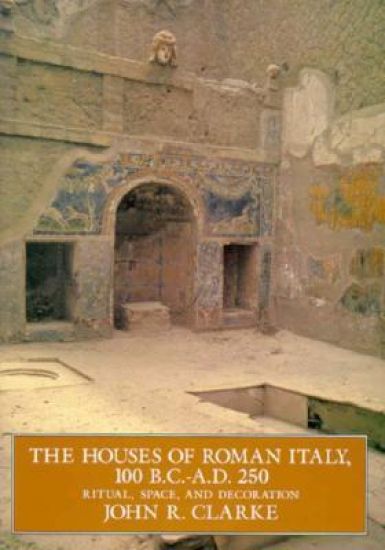
In this richly illustrated book, art historian John R. Clarke helps us see the ancient Roman house 'with Roman eyes'. Clarke presents a range of houses, from tenements to villas, and shows us how enduring patterns of Roman wall decoration tellingly bear the cultural, religious, and social imprints of the people who lived with them. In case studies of seventeen excavated houses, Clarke guides us through four centuries of Roman wall painting, mosaic, and stucco decoration, from the period of the 'Four Styles' (100 B.C. to A.D. 79) to the mid- third century. The First Style Samnite House shows its debt to public architecture in its clear integration of public and private spaces. The Villa of Oplontis asserts the extravagant social and cultural climate of the Second Style. Gem-like Third-Style rooms from the House of Lucretius Fronto reflect the refinement and elegance of Augustan tastes. The Vettii brothers' social climbing helps explain the overburdened Fourth-Style decoration of their famous house. And evidence of remodelling leads Clarke to conclude that the House of Jupiter and Ganymede became a gay hotel in the second century. In his emphasis on social and spiritual dimensions, Clarke offers a contribution to Roman art and architectural history that is both original and accessible to the general reader. The book's superb photographs not only support the author's findings but help to preserve an ancient legacy that is fast succumbing to modern deterioration resulting from pollution and vandalism.
Looking at Lovemaking

Looking at Lovemaking

John R. Clarke

University of California Press
2001
pokkari
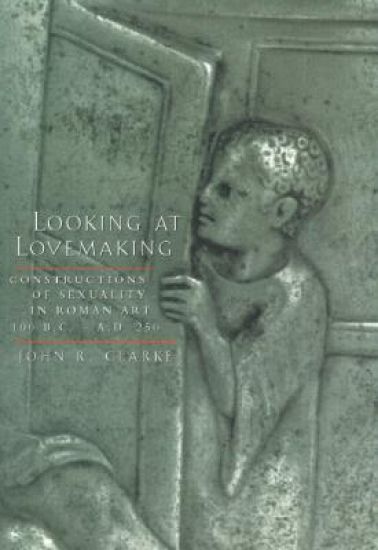
What did sex mean to the ancient Romans? In this lavishly illustrated study, John R. Clarke investigates a rich assortment of Roman erotic art to answer this question--and along the way, he reveals a society quite different from our own. Clarke reevaluates our understanding of Roman art and society in a study informed by recent gender and cultural studies, and focusing for the first time on attitudes toward the erotic among both the Roman non-elite and women. This splendid volume is the first study of erotic art and sexuality to set these works--many newly discovered and previously unpublished--in their ancient context and the first to define the differences between modern and ancient concepts of sexuality using clear visual evidence. Roman artists pictured a great range of human sexual activities--far beyond those mentioned in classical literature--including sex between men and women, men and men, women and women, men and boys, threesomes, foursomes, and more. Roman citizens paid artists to decorate expensive objects, such as silver and cameo glass, with scenes of lovemaking. Erotic works were created for and sold to a broad range of consumers, from the elite to the very poor, during a period spanning the first century B.C. through the mid-third century of our era. This erotic art was not hidden away, but was displayed proudly in homes as signs of wealth and luxury. In public spaces, artists often depicted outrageous sexual acrobatics to make people laugh. Looking at Lovemaking depicts a sophisticated, pre-Christian society that placed a high value on sexual pleasure and the art that represented it. Clarke shows how this culture evolved within religious, social, and legal frameworks that were vastly different from our own and contributes an original and controversial chapter to the history of human sexuality.
The Selling of Free Trade

The Selling of Free Trade

John R. MacArthur

University of California Press
2001
pokkari
"The Selling of 'Free Trade'" shows how Washington works to accomplish political or economic goals, even when confronted with widespread popular opposition. John R. MacArthur chronicles the brutal and expensive campaign in 1993 that led to passage of the poorly understood, highly controversial law creating the North American Free Trade Agreement.
Seeing through Zen

Seeing through Zen

John R. McRae

University of California Press
2004
pokkari
The tradition of Chan Buddhism - more popularly known as Zen - has been romanticized throughout its history. In this book, John R. McRae shows how modern critical techniques, supported by recent manuscript discoveries, make possible a more skeptical, accurate, and - ultimately - productive assessment of Chan lineages, teaching, fundraising practices, and social organization. Synthesizing twenty years of scholarship, "Seeing Through Zen" offers new, accessible analytic models for the interpretation of Chan spiritual practices and religious history. Writing in a lucid and engaging style, McRae traces the emergence of this Chinese spiritual tradition and its early figureheads, Bodhidharma and the 'sixth patriarch' Huineng, through the development of Zen dialogue and koans. In addition to constructing a central narrative for the doctrinal and social evolution of the school, "Seeing Through Zen" examines the religious dynamics behind Chan's use of iconoclastic stories and myths of patriarchal succession. McRae argues that Chinese Chan is fundamentally genealogical, both in its self-understanding as a school of Buddhism and in the very design of its practices of spiritual cultivation. Furthermore, by forgoing the standard idealization of Zen spontaneity, we can gain new insight into the religious vitality of the school as it came to dominate the Chinese religious scene, providing a model for all of East Asia - and the modern world. Ultimately, this book aims to change how we think about Chinese Chan by providing new ways of looking at the tradition.
Second Front

Second Front

John R. MacArthur; Ben H. (FRW) Bagdikian

University of California Press
2004
pokkari
Now updated with a new preface that examines the current conflict in Iraq, this brilliant work of investigative reporting reveals the government's assault on the constitutional freedoms of the American media during Operation Desert Storm. John R. MacArthur's engaging and provocative account is as essential and alarming today as when the first paperback edition was published ten years ago.
Art in the Lives of Ordinary Romans

Art in the Lives of Ordinary Romans

John R. Clarke

University of California Press
2006
pokkari
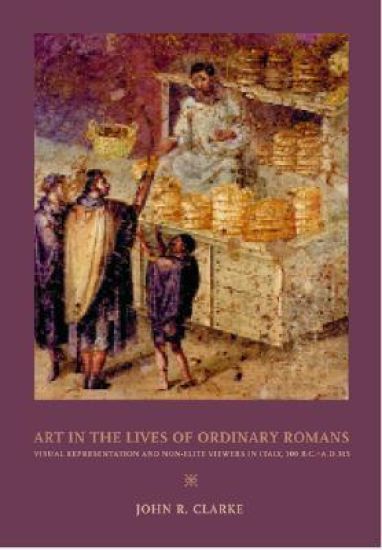
This splendidly illustrated book brings to life the ancient Romans whom modern scholarship has largely ignored: slaves, ex-slaves, foreigners, and the freeborn working poor. Though they had no access to the upper echelons of society, ordinary Romans enlivened their world with all manner of artworks. Discussing a wide range of art in the late republic and early empire--from familiar monuments to the obscure Caupona of Salvius and little-studied tomb reliefs--John R. Clarke provides a tantalizing glimpse into the lives of ordinary Roman people. Writing for a wide audience, he illuminates the dynamics of a discerning and sophisticated population, overturning much accepted wisdom about them, and opening our eyes to their astounding cultural diversity. Clarke begins by asking: How did emperors use monumental displays to communicate their policies to ordinary people? His innovative readings demonstrate how the Ara Pacis, the columns of Trajan and of Marcus Aurelius, and the Arch of Constantine announced each dynasty's program for handling the lower classes. Clarke then considers art commissioned by the non-elites themselves--the paintings, mosaics, and reliefs that decorated their homes, shops, taverns, and tombstones. In a series of paintings from taverns and houses, for instance, he uncovers wickedly funny combinations of text and image used by ordinary Romans to poke fun at elite pretensions in art, philosophy, and poetry. In addition to providing perceptive readings of many works of Roman art, this original and entertaining book demonstrates why historians must recognize, rather than erase, complexity and contradiction and asks new questions about class, culture, and social regulation that are highly relevant in today's global culture.
Urban Fortunes

Urban Fortunes

John R. Logan; Harvey Molotch

University of California Press
2007
pokkari
This sociological classic is updated with a new preface by the authors looking at developments in the study of urban planning during the twenty-year life of this influential work.
Stealth Democracy

Stealth Democracy

John R. Hibbing; Elizabeth Theiss-Morse

Cambridge University Press
2002
pokkari
Americans often complain about the operation of their government, but scholars have never developed a complete picture of people’s preferred type of government. In this provocative and timely book, Hibbing and Theiss-Morse, employing an original national survey and focus groups, report the governmental procedures Americans desire. Contrary to the prevailing view that people want greater involvement in politics, most citizens do not care about most policies and therefore are content to turn over decision-making authority to someone else. People’s wish for the political system is that decision makers be empathetic and, especially, non-self-interested, not that they be responsive and accountable to the people’s largely nonexistent policy preferences or, even worse, that the people be obligated to participate directly in decision making. Hibbing and Theiss-Morse conclude by cautioning communitarians, direct democrats, social capitalists, deliberation theorists, and all those who think that greater citizen involvement is the solution to society’s problems.
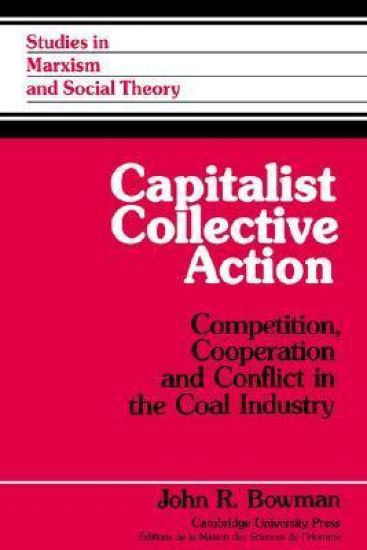
Capitalist Collective Action

Capitalist Collective Action

John R. Bowman

Cambridge University Press
2006
pokkari
This 1989 volume presents a theory of capitalist collective action and a case study of the pre-World War II American coal industry to which the theory is applied. The author examines the irony of capitalist firms that do not want to compete with each other, but often cannot avoid doing so. He then explains under what conditions businesses would be able to organize their competition and identifies the economic and political factors that facilitate or inhibit this organization. The case study not only illustrates the theory, but demonstrates how the competitive relations of capitalist firms are critically important determinants of their political behavior. The author argues that the traditional Marxist concern with conflict between workers and capitalists should be supplemented with a concern for the competitive conflicts among capitalists.
Innovation and Knowledge Creation in an Open Economy

Innovation and Knowledge Creation in an Open Economy

John R. Baldwin; Petr Hanel

Cambridge University Press
2007
pokkari
This study of innovation - its intensity, the sources used for knowledge creation, and its impacts - is based on a comprehensive survey of innovation of Canadian manufacturing firms. Attention is paid to the different actors in the system, who both compete with and complement one another. The study investigates how innovation regimes differ across size of firm and across industries. Owing to the high degree of foreign investment in Canada, special attention is paid to the performance of foreign-owned firms. The innovation regime of Canadian innovators is compared with results of studies of other industrialized countries. The picture of a typical innovator is a firm that combines internal resources and external contacts to develop a set of complementary strategies. The study finds that innovating firms depend not only on R&D, but also on ideas and technology from various other sources, both internal and external to the firm.