Kirjojen hintavertailu. Mukana 12 290 406 kirjaa ja 12 kauppaa.

Kirjahaku

Etsi kirjoja tekijän nimen, kirjan nimen tai ISBN:n perusteella.

1000 tulosta hakusanalla John Stuart

Leitbilder Der Gerechtigkeit in Den Marktwirtschaftlichen Konzeptionen Von Adam Smith, John Stuart Mill Und Alfred Mueller-Armack
Ethik, Okonomie und Politik bilden in der antiken Philosophie des Aristoteles eine integrative gedankliche Einheit. Diesem Denkmodell bleibt auch die klassische Nationalokonomie des 18. und 19. Jahrhunderts verbunden bis zur Marginalistischen Revolution. In ihr erfahrt die Wirtschaftstheorie eine ethische Neutralisierung, die seit Mitte des 20. Jahrhunderts hinterfragt wird. Die zeitgenossische Okonomie offnet sich erneut der aristotelischen Ordnungsidee und einer neuen Wirtschaftsethik. Als Beitrag zu dieser wirtschaftsethischen Diskussion stellt die Dissertation mit dem Gegenstand und Begriff der Gerechtigkeit ein Wertprinzip von Ethik und Okonomie in den Mittelpunkt und dokumentiert seinen Stellenwert in der 200-jahrigen Theoriegeschichte liberaler, marktwirtschaftlicher Volkswirtschaftslehre. Untersucht werden die Schriften dreier Autoren, deren Lebenswerk in aristotelischer Tradition steht und die grundlegende Beitrage zum Verstandnis liberaler Nationalokonomie und sozio-okonomischer Gerechtigkeit geleistet haben: Smith, Mill und Muller-Armack."
The Laws of the Phenomena of Society. How Would Weber and Durkheim Have Responded to John Stuart Mill's Famous Quote?
Essay aus dem Jahr 2012 im Fachbereich P dagogik - Wissenschaft, Theorie, Anthropologie, Note: 66, University of Cambridge, Sprache: Deutsch, Abstract: 'The Laws of the phenomena of society are, and can be, nothing but the laws of the actions and passions of human beings . . . Men are not, when brought together, converted into another kind of substance' (John Stuart Mill). Compare and contrast how Weber and Durkheim might have responded to this statement. What John Stuart Mill means seems straightforward: society functions as a unidirectional interplay of individuals. The rules, that govern those individuals in isolation also dominate in situations of collective character. Mill expresses a deep belief in the overarching importance of the individual in comparison to collectives that in turn do not change the actor's behaviour. When we place Mill in his liberal and utilitarian context, this opinion does not surprise; for him, self-interest seemed to rule both the individual and society. To put it crudely: individual > society. Contrasting the 'laws of the phenomena of society' with 'the laws of the actions and passions of human beings', the main difference lies in the society-individual dichotomy, i.e. the level of analysis. The former refers to situations in which more than one actor participates, such as religion, economy or administration. The latter alludes to the personal behaviour, feelings and ideas of a human being, almost to psychology. Without questioning this dichotomy in its foundation, both Weber and Durkheim, differ widely from the view that both spheres of law are approximately congruent. For both scholars, society has a life on its own, rules on its own that are at least partly independent from the individual. Durkheim much more than Weber even ascribes an influence to society that is able to dominate the individual behaviour. For Weber, the overarching force of capitalist society is a particular condition in modern society that he reveals and criti
An Inverness Merchant Of The Olden Time [j. Stuart]

An Inverness Merchant Of The Olden Time [j. Stuart]

William MacKay; John Stuart

Sagwan Press
2015
sidottu
This work has been selected by scholars as being culturally important, and is part of the knowledge base of civilization as we know it. This work was reproduced from the original artifact, and remains as true to the original work as possible. Therefore, you will see the original copyright references, library stamps (as most of these works have been housed in our most important libraries around the world), and other notations in the work.This work is in the public domain in the United States of America, and possibly other nations. Within the United States, you may freely copy and distribute this work, as no entity (individual or corporate) has a copyright on the body of the work.As a reproduction of a historical artifact, this work may contain missing or blurred pages, poor pictures, errant marks, etc. Scholars believe, and we concur, that this work is important enough to be preserved, reproduced, and made generally available to the public. We appreciate your support of the preservation process, and thank you for being an important part of keeping this knowledge alive and relevant.
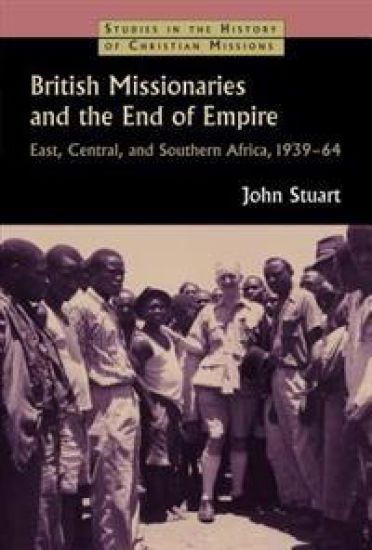
British Missionaries and the End of Empire

British Missionaries and the End of Empire

John Stuart

William B Eerdmans Publishing Co
2011
nidottu
There are many histories of overseas mission and many histories of the last days of Great Britain's empire in Africa, but there has been no book-length study on the relationship between them -- until now. In British Missionaries and the End of Empire, historian John Stuart thoroughly and critically examines British Protestant missionary experiences during the tumultuous years between 1939 and 1964 in east, central, and southern Africa. Focusing on Botswana, Zambia, Malawi, and Kenya (with an eye for South African influence on mission affairs), Stuart portrays the uneven and evolving relationship between Protestant missionaries, the British empire, and African nationalists. He shows how missionaries sometimes supported empire, sometimes drew comfort from it, sometimes criticized it, yet finally learned to live with its formal demise, continuing their work in the newly formed African independent states even after the end of empire.