Kirjojen hintavertailu. Mukana 12 459 402 kirjaa ja 12 kauppaa.

Kirjahaku

Etsi kirjoja tekijän nimen, kirjan nimen tai ISBN:n perusteella.

1000 tulosta hakusanalla Luca Rossini

Risk and Presidential Decision-making
This book aims at gauging whether the nature of US foreign policy decision-making has changed after the Cold War as radically as a large body of literature seems to suggest, and develops a new framework to interpret presidential decision-making in foreign policy. It locates the study of risk in US foreign policy in a wider intellectual landscape that draws on contemporary debates in historiography, international relations and Presidential studies.Based on developments in the health and environment literature, the book identifies the President as the ultimate risk-manager, demonstrating how a President is called to perform a delicate balancing act between risks on the domestic/political side and risks on the strategic/international side. Every decision represents a ‘risk vs. risk trade-off,’ in which the management of one ‘target risk’ leads to the development ‘countervailing risks.’ The book applies this framework to the study three major crises in US foreign policy: the Cuban Missile Crisis, the seizure of the US Embassy in Tehran in 1979, and the massacre at Srebrenica in 1995. Each case-study results from substantial archival research and over twenty interviews with policymakers and academics, including former President Jimmy Carter and former Senator Bob Dole.This book is ideal for postgraduate researchers and academics in US foreign policy, foreign policy decision-making and the US Presidency as well as Departments and Institutes dealing with the study of risk in the social sciences. The case studies will also be of great use to undergraduate students.
European Culture Wars and the Italian Case

European Culture Wars and the Italian Case

Luca Ozzano; Alberta Giorgi

Routledge
2020
nidottu
This book aims to understand the European political debate about contentious issues, framed in terms of religious values by religious and/or secular actors in 21st century. It specifically focuses on the Italian case, which, due to its peculiar history and contemporary political landscape, is a paradigmatic case for the study of the relationships between religion and politics.In recent years, a number of controversies related to religious issues have characterised the European public debate at both the EU and the national level. The ‘affaire du foulard’ in France, the referendum on abortion in Portugal, the recognition of same-sex marriages in many Western European States, the debate over bioethics and the regulation of euthanasia are only a few examples of contentious issues involving religion. This book aims to shed light on the interrelation between these different debates, as well as their broader meaning, through the analysis of the paradigmatic case of Italy. Italy summarizes and sometimes exasperates wider European trends, both because of the peculiar role traditionally played by the Vatican in Italian politics and for the rise, since the 1990s, of new political entrepreneurs eager to exploit ethical and civilizational issues.This work will be of great interest to scholars and students of a number of fields within the disciplines of political science, sociology and law, and will be useful for courses on religion and politics, political parties, social movements and civil society.
Kant and the Problem of Self-Knowledge
This book addresses the problem of self-knowledge in Kant’s philosophy. As Kant writes in his major works of the critical period, it is due to the simple and empty representation ‘I think’ that the subject’s capacity for self-consciousness enables the subject to represent its own mental dimension. This book articulates Kant’s theory of self-knowledge on the basis of the following three philosophical problems: 1) a semantic problem regarding the type of reference of the representation ‘I’; 2) an epistemic problem regarding the type of knowledge relative to the thinking subject produced by the representation ‘I think’; and 3) a strictly metaphysical problem regarding the features assigned to the thinking subject’s nature. The author connects the relevant scholarly literature on Kant with contemporary debates on the huge philosophical field of self-knowledge. He develops a formal reading according to which the unity of self-consciousness does not presuppose the identity of a real subject, but a formal identity based on the representation ‘I think’.
An Economic Theory of Managerial Firms
The separation between ownership and control has become common practice over the last century, in most medium and large firms across the world. Throughout the twentieth century, the theory of the firm and the theory of industrial organization developed parallel and complementary views on managerial firms. This book offers a comprehensive exposition of this debate.In its survey of strategic delegation in oligopoly games, An Economic Theory of Managerial Firms is able to offer a reinterpretation of a range of standard results in the light of the fact that the control of firms is generally not in the hand of its owners. The theoretical models are supported by a wealth of real-world examples, in order to provide a study of strategic delegation that is far more in-depth than has previously been found in the literature on industrial organization. In this volume, analysis is extended in several directions to cover applications concerning the role of: managerial firms in mixed market; collusion and mergers; divisionalization and vertical relations; technical progress; product differentiation; international trade; environmental issues; and the intertemporal growth of firms.This book is of great interest to those who study industrial economics, organizational studies and industrial studies.
The Algorithmic Unconscious

The Algorithmic Unconscious

Luca Possati

Routledge
2021
sidottu
This book applies the concepts and methods of psychoanalysis to the study of artificial intelligence (AI) and human–AI interaction. It develops a new, more fruitful approach for applying psychoanalysis to AI and machine behavior. It appeals to a broad range of scholars: philosophers working on psychoanalysis, technology, AI ethics, and cognitive sciences, psychoanalysts, psychologists, and computer scientists. The book is divided into four parts. The first part (Chapter 1) analyzes the concept of "machine behavior." The second part (Chapter 2) develops a reinterpretation of some fundamental Freudian and Lacanian concepts through Bruno Latour’s actor-network theory. The third part (Chapters 3 and 4) focuses on the nature and structure of the algorithmic unconscious. The author claims that the unconscious roots of AI lie in a form of projective identification, i.e., an emotional and imaginative exchange between humans and machines. In the fourth part of the book (Chapter 5), the author advances the thesis that neuropsychoanalysis and the affective neurosciences can provide a new paradigm for research on artificial general intelligence. The Algorithmic Unconscious explores a completely new approach to AI, which can also be defined as a form of "therapy." Analyzing the projective identification processes that take place in groups of professional programmers and designers, as well as the "hidden" features of AI (errors, noise information, biases, etc.), represents an important tool to enable a healthy and positive relationship between humans and AI. Psychoanalysis is used as a critical space for reflection, innovation, and progress.
The Algorithmic Unconscious

The Algorithmic Unconscious

Luca Possati

TAYLOR FRANCIS LTD
2022
nidottu
This book applies the concepts and methods of psychoanalysis to the study of artificial intelligence (AI) and human–AI interaction. It develops a new, more fruitful approach for applying psychoanalysis to AI and machine behavior. It appeals to a broad range of scholars: philosophers working on psychoanalysis, technology, AI ethics, and cognitive sciences, psychoanalysts, psychologists, and computer scientists. The book is divided into four parts. The first part (Chapter 1) analyzes the concept of "machine behavior." The second part (Chapter 2) develops a reinterpretation of some fundamental Freudian and Lacanian concepts through Bruno Latour’s actor-network theory. The third part (Chapters 3 and 4) focuses on the nature and structure of the algorithmic unconscious. The author claims that the unconscious roots of AI lie in a form of projective identification, i.e., an emotional and imaginative exchange between humans and machines. In the fourth part of the book (Chapter 5), the author advances the thesis that neuropsychoanalysis and the affective neurosciences can provide a new paradigm for research on artificial general intelligence. The Algorithmic Unconscious explores a completely new approach to AI, which can also be defined as a form of "therapy." Analyzing the projective identification processes that take place in groups of professional programmers and designers, as well as the "hidden" features of AI (errors, noise information, biases, etc.), represents an important tool to enable a healthy and positive relationship between humans and AI. Psychoanalysis is used as a critical space for reflection, innovation, and progress.
Cyprus between Late Antiquity and the Early Middle Ages (ca. 600?800)
Research on early medieval Cyprus has focused on the late antique "golden age" (late fourth/early fifth to seventh century) and the so-called Byzantine "Reconquista" (post-AD 965) while overlooking the intervening period. This phase was characterized, supposedly, by the division of the political sovereignty between the Umayyads and the Byzantines, bringing about the social and demographic dislocation of the population of the island. This book proposes a different story of continuities and slow transformations in the fate of Cyprus between the late sixth and the early ninth centuries.Analysis of new archaeological evidence shows signs of a continuing link to Constantinople. Moreover, together with a reassessment of the literary evidence, archaeology and material culture help us to reappraise the impact of Arab naval raids and contextualize the confrontational episodes throughout the ebb and flow of Eastern Mediterranean history: the political influence of the Caliphate looked stronger in the second half of the seventh century, the administrative and ecclesiastical influence of the Byzantine empire was held sway from the beginning of the eighth to the twelfth century. Whereas the island retained sound commercial ties with the Umayyad Levant in the seventh and eighth centuries, at the same time politically and economically it remained part of the Byzantine sphere. This belies the idea of Cyprus as an independent province only loosely tied to Constantinople and allows us to draw a different picture of the cultural identities, political practices and hierarchy of wealth and power in Cyprus during the passage from Late Antiquity to the early Middle Ages.
When Democracies Collapse

When Democracies Collapse

Luca Tomini

Routledge
2019
nidottu
While the process of democratization is nowadays an established scholarship, the reverse process of de-democratization has generated less attention even when the regression or even breakdown of democracy occurred on a regular basis over past decades.This book investigates both the different combination of explanatory factors triggering the transition from democratic rule as well as the role of the actors’ involved in the process. It aims to integrate different levels of analysis and explanatory factors through a comparative analysis of the phenomenon since the beginning of the third wave of democratization. As such, it addresses the existing divide between the approaches focused on the conditions and those focused on the processes of change, using a mixed-method research design.This text will be of key interest to scholars and students of comparative politics, democracy, democratization and de-democratization, political theory, and comparative political institutions.
Turkmenistan’s Foreign Policy

Turkmenistan’s Foreign Policy

Luca Anceschi

Routledge
2008
sidottu
Turkmenistan, an independent nation since 1991, is a strategically important Central Asian state. This book covers the most significant period of the establishment of the Turkmen political regime. At the core of this book is the Doctrine of Positive Neutrality, which, from 1995 onwards, constituted the theoretical backbone for the foreign policy of post-Soviet Turkmenistan. The author analyses the reason and aim of the concept, its significance for and impact on the country’s domestic and foreign relations, its practical implementation and its transformation into a tool of strengthening of absolute personal authority. Furthermore, he establishes whether Positive Neutrality has to be seen as a ‘domestic-oriented’ foreign policy, which has been used by the Turkmen regime to reinforce its internal position. . This is the first book-length and thorough analysis of Turkmenistan’s foreign policy. It furthers our understanding of Turkmenistan, and provides an informed background for the study of its foreign policy. It fills a void in the current literature, and it will constitute an essential reference for most scholars and researcher focusing on contemporary Central Asia, Russian foreign policy, Foreign Policy, International Relations and Comparative Politics.
Innovating for Sustainability

Innovating for Sustainability

Luca Berchicci

Routledge
2008
sidottu
One of the challenges met by green entrepreneurs and product developers who have tried to develop more sustainable products is that efforts to have better products in environmental terms do not always translate into effective business cases. The purpose of this book is a better understanding of the implications of environmental issues in new product development. Through an empirical study in the human powered vehicle sector, Luca Berchicci examines how and to what extent the environmental ambition of product developers and managers influences the way new products and services are developed. The understanding of this phenomenon is particularly important since managers are encouraged and/or motivated to undertake environmental new product development projects. From the descriptions and analyses of the two cases study Luca Berchicci suggests that a high level of environmental ambition increases the complexity of the product innovation process. Moreover, a high level of environmental ambition may hamper a product innovation process because it may lead the developers away from the market that their product is to serve. Accordingly, this book attempts to explain and predict how environmental ambition influences new product development processes. This claim provides a theoretical contribution to existing research in both product innovation and green product innovation. Moreover, this book provides an original and deep insight on the diverse facets of greening.
Oligopoly, the Environment and Natural Resources
Industrial production and consumption patterns rely heavily on the intensive use of both renewable and non-renewable resources and the consequences for the environment can be serious. Following a long period of time where the profit incentives of firms have prevailed over preservation of the environment and the world’s natural resources, a new consensus has emerged concerning the need to regulate firm behaviour, aimed at ensuring the sustainability of the economic system in the long run.This book offers an exhaustive overview of current economic debate about these topics, taking modern oligopoly theory as a benchmark. The first part of the book covers static models dealing with incentives for green research and development, Pigovian taxation, cartels, environmental quality and international trade, as well as the role of corporate social responsibility, public firms and consumer environmental awareness as endogenous regulatory instruments. Then, the author moves on to examine the role of time while drawing from optimal control and differential game theory. This opens the way to the discussion of fair discount rates to ensure the welfare of future generations, as well as the long run sustainability of production and consumption patterns.
Innovating for Sustainability

Innovating for Sustainability

Luca Berchicci

Routledge
2012
nidottu
One of the challenges met by green entrepreneurs and product developers who have tried to develop more sustainable products is that efforts to have better products in environmental terms do not always translate into effective business cases. The purpose of this book is a better understanding of the implications of environmental issues in new product development. Through an empirical study in the human powered vehicle sector, Luca Berchicci examines how and to what extent the environmental ambition of product developers and managers influences the way new products and services are developed. The understanding of this phenomenon is particularly important since managers are encouraged and/or motivated to undertake environmental new product development projects. From the descriptions and analyses of the two cases study Luca Berchicci suggests that a high level of environmental ambition increases the complexity of the product innovation process. Moreover, a high level of environmental ambition may hamper a product innovation process because it may lead the developers away from the market that their product is to serve. Accordingly, this book attempts to explain and predict how environmental ambition influences new product development processes. This claim provides a theoretical contribution to existing research in both product innovation and green product innovation. Moreover, this book provides an original and deep insight on the diverse facets of greening.
Game Theory in the Social Sciences

Game Theory in the Social Sciences

Luca Lambertini

Routledge
2011
sidottu
Individuals, firms, governments and nations behave strategically, for good and bad. Over the last few decades, game theory has been constructed and progressively refined to become the major tool used by social scientists to understand, predict and regulate strategic interaction among agents who often have conflicting interests. In the surprisingly anodyne jargon of the theory, they ‘play games’. This book offers an introduction to the basic tools of game theory and an overview of a number of applications to real-world cases, covering the areas of economics, politics and international relations. Each chapter is accompanied by some suggestions about further reading.
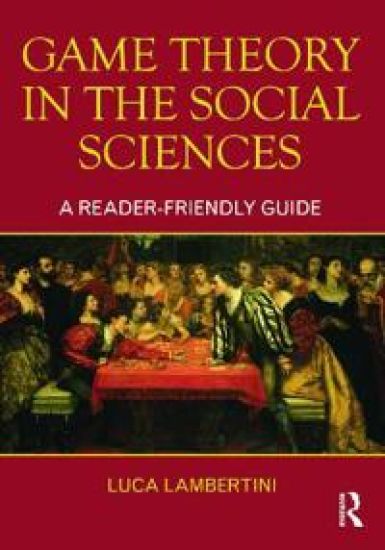
Game Theory in the Social Sciences

Game Theory in the Social Sciences

Luca Lambertini

Routledge
2011
nidottu
Individuals, firms, governments and nations behave strategically, for good and bad. Over the last few decades, game theory has been constructed and progressively refined to become the major tool used by social scientists to understand, predict and regulate strategic interaction among agents who often have conflicting interests. In the surprisingly anodyne jargon of the theory, they ‘play games’. This book offers an introduction to the basic tools of game theory and an overview of a number of applications to real-world cases, covering the areas of economics, politics and international relations. Each chapter is accompanied by some suggestions about further reading.
Europe's Encounter with Islam

Europe's Encounter with Islam

Luca Mavelli

Routledge
2012
sidottu
In the last few years, the Muslim presence in Europe has been increasingly perceived as ‘problematic’. Events such as the French ban on headscarves in public schools, the publication of the so-called ‘Danish cartoons’, and the speech of Pope Benedict XVI at the University of Regensburg have hit the front pages of newspapers the world over, and prompted a number of scholarly debates on Muslims’ capacity to comply with the seemingly neutral and pluralistic rules of European secularity.Luca Mavelli argues that this perspective has prevented an in-depth reflection on the limits of Europe’s secular tradition and its role in Europe’s conflictual encounter with Islam. Through an original reading of Michel Foucault’s spiritual notion of knowledge and an engagement with key thinkers, from Thomas Aquinas to Jurgën Habermas, Mavelli articulates a contending genealogy of European secularity. While not denying the latter’s achievements in terms of pluralism and autonomy, he suggests that Europe’s secular tradition has also contributed to forms of isolation, which translate into Europe’s incapacity to perceive its encounter with Islam as an opportunity rather than a threat.Drawing on this theoretical perspective, Mavelli offers a contending account of some of the most important recent controversies surrounding Islam in Europe and investigates the ‘postsecular’ as a normative model to engage with the tensions at the heart of European secularity. Finally, he advances the possibility of a Europe willing to reconsider its established secular narratives which may identify in the encounter with Islam an opportunity to flourish and cultivate its democratic qualities and postnational commitments.This work will be of great interest to students and scholars of religion and international relations, social and political theory, and Islam in Europe.
Europe's Encounter with Islam

Europe's Encounter with Islam

Luca Mavelli

Routledge
2012
nidottu
In the last few years, the Muslim presence in Europe has been increasingly perceived as ‘problematic’. Events such as the French ban on headscarves in public schools, the publication of the so-called ‘Danish cartoons’, and the speech of Pope Benedict XVI at the University of Regensburg have hit the front pages of newspapers the world over, and prompted a number of scholarly debates on Muslims’ capacity to comply with the seemingly neutral and pluralistic rules of European secularity.Luca Mavelli argues that this perspective has prevented an in-depth reflection on the limits of Europe’s secular tradition and its role in Europe’s conflictual encounter with Islam. Through an original reading of Michel Foucault’s spiritual notion of knowledge and an engagement with key thinkers, from Thomas Aquinas to Jurgën Habermas, Mavelli articulates a contending genealogy of European secularity. While not denying the latter’s achievements in terms of pluralism and autonomy, he suggests that Europe’s secular tradition has also contributed to forms of isolation, which translate into Europe’s incapacity to perceive its encounter with Islam as an opportunity rather than a threat.Drawing on this theoretical perspective, Mavelli offers a contending account of some of the most important recent controversies surrounding Islam in Europe and investigates the ‘postsecular’ as a normative model to engage with the tensions at the heart of European secularity. Finally, he advances the possibility of a Europe willing to reconsider its established secular narratives which may identify in the encounter with Islam an opportunity to flourish and cultivate its democratic qualities and postnational commitments.This work will be of great interest to students and scholars of religion and international relations, social and political theory, and Islam in Europe.
Analysing Kazakhstan's Foreign Policy
This book investigates the roles that ideas and constructs associated with Eurasia have played in the making of Kazakhstan’s foreign policy during the Nazarbaev era. This book delves into the specific Eurasia-centric narratives through which the regime, headed by Nursultan Nazarbaev, imagined the role of post-Soviet Kazakhstan in the wider Eurasian geopolitical space. Based on substantive fieldwork and sustained engagement with primary sources, the book unveils the power implications of Kazakhstani neo-Eurasianism, arguing that the strengthening of the regime’s domestic power ranked highly in the list of objectives pursued by Kazakhstani foreign policy between the collapse of the Soviet Union and Nazarbaev’s apparent withdrawal from the Kazakhstani political scene (19 March 2019). This book, ultimately, is a study of inter-state integration, which makes use of a rigorous methodological approach to assess different incarnations of post-Soviet multilateralism, from the Commonwealth of Independent States to the more recent, and highly controversial, Eurasian Economic Union.This book offers a ground-breaking analysis of Kazakhstani foreign policy in the Nazarbaev era. It will be of interest to students and scholars of Central Asian Politics, International Relations and Security Studies.
The European Union and Direct Taxation
Within the European Union, direct taxation is an area which often provokes controversy due to tensions between the tax sovereignty of the individual Member States and the desire for an integrated internal market. This book offers a critical review of the legislative and case-law developments in this area at the EU level, and reviews the European Commission’s proposed solutions in light of their concerns regarding the proper functioning of the EU’s internal market.Luca Cerioni set out a series of benchmarks determined from the objectives expressed by the European Commission, including: the elimination of double taxation and double non-taxation; the simplification of cross-border tax compliance; the reduction of abusive forum-shopping practices and general aggressive tax planning strategies; legal certainty for all businesses and individuals carrying on activities and receiving income in more than one EU Member State. Cerioni uses these benchmarks to ask which Directives and/or rulings have left legal uncertainty, and which have ended up creating or increasing the scope for aggressive tax planning. The book puts forward a comprehensive solution for a new optimal regime relating to tax residence, which would contribute to the EU project to the mutual benefit of Member States and taxpayers.As a thorough and critical discussion of EU tax rules in force, and of the European Court’s case law in direct taxation, this book will be of great use to academic researchers and students of EU law, tax practitioners, and policy-makers at the EU and national level.
Cities on Rails

Cities on Rails

Luca Bertolini; Tejo Spit

Spon Press
1998
nidottu
The development of railway stations and their surroundings is an emerging feature in current urban projects. Based on a series of the most inspiring contemporary European examples of station redevelopment, this book will help planners and urban designers understand the specific and complex nature of station locations. Based on their extensive research, the authors, pioneers of studies in the field in the last few years, harness and expand the body of knowledge and present guiding principles and conditions for successful implementation of such planning projects.
Smart City Code

Smart City Code

Luca Mora; Paolo Gerli; Dominik Beckers; Sara Thabit; Francesco Tonnarelli

Elsevier - Health Sciences Division
2025
nidottu
Smart City Code: Governance Handbook for Digital Transformation Managers in the Public Sector explores how to govern the planning, implementation, and maintenance operations in smart city projects and transitions, and the urban digitalization processes that may potentially trigger. It provides readers with the evidence-based knowledge they need to approach the complexity of smart city governance, responding to the United Nations’ call for more advanced strategic and technical support on urban digital transformations to national, regional, and local governments. The book uses a comprehensive framework that details what configuration of multi-level components should be considered in the governance of smart city transitions.