Kirjojen hintavertailu. Mukana 12 016 292 kirjaa ja 12 kauppaa.

Kirjahaku

Etsi kirjoja tekijän nimen, kirjan nimen tai ISBN:n perusteella.

1000 tulosta hakusanalla Muhammad Anwar-Ul-Haq

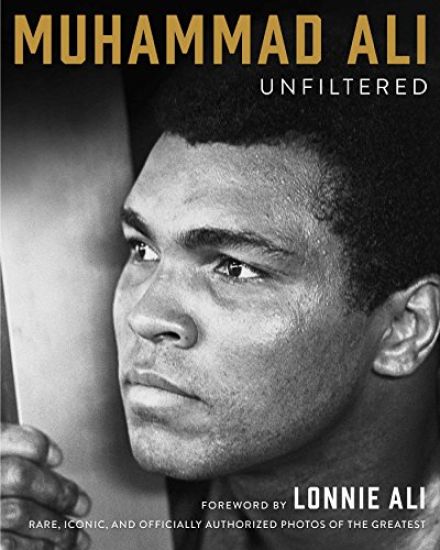
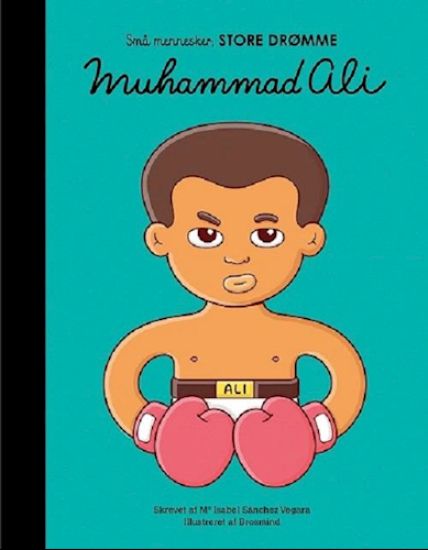
Muhammad Ali

Muhammad Ali

Maria Isabel Sanchez Vegara

-
2019
sidottu
I denne bogserie kan du lære de mest fantastiske mennesker at kende – fra kunstnere og musikere til designere og videnskabsfolk. Alle begyndte de som et barn med en drøm og endte med at opnå det mest utrolige. Her er historien om Muhammad Ali, den berømte bokser. Da han var en lille dreng, fik Muhammad Ali stjålet sin cykel. Han ville finde tyven, men en politibetjent gav ham det råd at lære at bokse først. Ali trænede hårdt og udviklede en speciel bokseteknik, der byggede på elegance og hurtighed. Hans kvikke hjerne og frække replikker var med til at give ham den største boksetitel af dem alle: verdensmester i sværvægt. Efter den spændende fortælling om Ali er der en sektion med fakta og fotos.
Muhammad + Khadija
”Men man kan stadig blive gift med hinanden, hvis én er rig, og den anden ikke er det,” påpeger Osama.”Det kan man sagtens. Du har helt ret, min skat. Men hvorfor valgte Khadija, at blive gift med Muhammad, sallallahu 'alayhi wa sallam, selvom han var fattig?” ”Øhh, fordi han var troværdig, han løj ikke og alt mulig andet,” svarer Osama og ruller meget med øjnene.Bogen handler om en af de smukkeste kærlighedshistorier, der har fundet sted. Profeten Muhammad, sallallahu 'alayhi wa sallam, og Khadija Bintu Khuwaylids forhold er fyldt med guldkorn til, hvordan man kan få et kærligt og stabilt familieliv, men hvordan taler man om sådan et emne på en måde, så det bliver relevant for børn?I serien ”Abulaban Brødrene” følger vi de tre drenge, Adam (10 år), Osama (8 år) og Hicham (5 år), hvis forældre ofte gerne vil forklare dem ting om islam, men hvor samtalen ikke altid går som forventet.Serien er inspireret af forfatterens egne samtaler med sine børn og et ønske om at hjælpe voksne med at formidle islam til børn på en sjov, let og forståelig måde.
Muhammad the Greatest

Muhammad the Greatest

Ahmed Deedat

Ahmed Deedat
2023
pokkari
About ten years ago, a distant cousin of mine - Mr.Mohamed Mehtar Farooki gave me a typedquotation by the French historian, Lamartine. Thequotation A detailed exposition of the quotationwill be found on page 38] purported to prove thatMuhammad (pbuh), the Prophet of Islam, was thegreatest man that ever lived. Mr. Mehtar was in thehabit of passing information on to me, believingthat I might put the same to some good use at theproper time and place. Before this he hadpresented me with "The Call of the Minaret," anexpensive book written by (Bishop KennethCragg). By analysing this book I discovered themasterful deceit of the Christian Orientalists.Lamartine's tribute to our prophet inspired me and2I had a great desire to share his thoughts about ourNabi with my Muslim brethren. The opportunityto do so was not long in coming.I received a phone call from the Muslimcommunity in Dannhauser, a small town inNorthern Natal, who were organising a birthdaycelebration of the Holy Prophet. They invited meto give a lecture on that auspicious occasion. So Ideemed it an honour and a privilege, I readilyagreed. When they inquired, in view of theiradvertising needs, as to the subject of my lecture, Isuggested on the inspiration from Lamartine, "Muhammad (pbuh) the Greatest."
Muhammad The Messenger of God

Muhammad The Messenger of God

Dr Abdurrahman Al-Sheha

Dr.Abdurrahman al-Sheha
2022
pokkari
Never has a man set for himself, voluntarily or involuntarily, a more sublime aim, since this aim was superhuman; to sub-vert superstitions which had been imposed between man andhis Creator, to render God unto man and man unto God; torestore the rational and sacred idea of divinity amidst thechaos of the material and disfigured gods of idolatry, then ex-isting. Never has a man undertaken a work so far beyondhuman power with so feeble means, for he (Muhammad) hadin the conception as well as in the execution of such a greatdesign, no other instrument than himself and no other aid ex-cept a handful of men living in a corner of the desert. Finally, never has a man accomplished such a huge and lasting revo-lution in the world, because in less than two centuries after itsappearance, Islam, in faith and in arms, reigned over thewhole of Arabia, and conquered, in God's name, PersiaKhorasan, Transoxania, Western India, Syria, Egypt, Abyssin-ia, all the known continent of Northern Africa, numerous is-lands of the Mediterranean Sea, Spain, and part of Gaul. "Ifgreatness of purpose, smallness of means, and astonishing re-sults are the three criteria of a human genius, who could darecompare any great man in history with Muhammad? Themost famous men created arms, laws, and empires only. Theyfounded, if anything at all, no more than material powers.
The Life of Muhammad [Pbuh]

The Life of Muhammad [Pbuh]

Muhammad Husayn Haykal

Qadeem Press
2023
pokkari
In his meticulously researched and eloquently written biography, The Life of Muhammad (saw), Muhammad Husayn Haykal paints a vivid and comprehensive portrait of the Prophet Muhammad (saw), the founder of Islam. Drawing upon a wealth of historical sources and incorporating insights from both traditional Islamic scholarship and modern research, Haykal presents a balanced and engaging account of Muhammad's life and teachings.Haykal begins by tracing Muhammad's lineage and upbringing in pre-Islamic Arabia, a society characterized by tribalism, idolatry, and social injustice. He meticulously details Muhammad's (saw) early life, highlighting his integrity, trustworthiness, and compassion, qualities that earned him the moniker "Al-Ameen" (The Trustworthy) among his people.The book then delves into Muhammad's (saw) prophethood. Haykal vividly describes the pivotal moments in Muhammad's (saw) life, including the revelation of the first verses of the Quran at the Cave of Hira and his subsequent struggle to spread the message of Islam amidst widespread scepticism and opposition.Haykal's account of Muhammad's life is not merely a chronological narrative; it is a profound exploration of his character, his leadership, and his impact on the world. He sheds light on Muhammad's unwavering faith, his strategic brilliance, and his unwavering commitment to justice and equality.Haykal also addresses common misconceptions and criticisms of Islam, providing a nuanced and well-informed perspective on the religion's origins, its core beliefs, and its historical trajectory. He emphasizes the message of peace, tolerance, and social responsibility that lies at the heart of Islam, a message that remains as relevant today as it was in the time of the Prophet Muhammad.The Life of Muhammad (saw) is not just a biography; it is a testament to the enduring power of faith, the transformative impact of leadership, and the profound influence of a single individual on the course of human history. Haykal's work offers a valuable contribution to our understanding of Islam and the Prophet Muhammad (saw), providing readers with a deeper appreciation of the Prophet Muhammad's life, legacy, and enduring significance.
Mashhoor Shayaron kee Pratinidhi Shayari Muhammad Iqbal

Mashhoor Shayaron kee Pratinidhi Shayari Muhammad Iqbal

Muhammad Iqbal

Prabhakar Prakashan Private Limited
2022
pokkari
आता है याद मुझको गुजरा हुआ ज़माना वो बाग की बहारें वो सब का चहचहाना आजादियाँ कहाँ वो अब अपने घोंसले की अपनी खुशी से आना अपनी खुशी से जाना इकबाल युग निर्माता शायर थे। उनकी शायरी एक विचार के खास निज़ाम से रोशनी ग्रहण करती है। इक़बाल आदमी की महानता के अलमबरदार थे और वो किसी बख्शी हुई जन्नत की बजाय अपने खून-ए-जिगर से स्वयं अपनी जन्नत बनाने की प्रक्रिया को अधिक संभावित और अधिक जीवनदायिनी समझते थे। इसके लिए उसका उपाय तजवीज करते हुए उन्होंने कहा था, "पूरब के राष्ट्रों को ये महसूस कर लेना चाहिए कि ज़िन्दगी अपनी हवेली में किसी तरह का इन्किलाब नहीं पैदा कर सकती जब तक उसकी अंदरूनी गहराईयों में इन्किलाब न पैदा हो और कोई नई दुनिया एक बाहरी अस्तित्व नहीं हासिल कर सकती जब तक उसका वजूद इंसानों के ज़मीर में रूपायित न हो।"" इकबाल की शायरी मूल रूप से सक्रियता व कर्म और निरंतर संघर्ष को बयाँ करती है। यहाँ तक कि उनके यहाँ कभी-कभी ये संघर्ष उद्देश्य प्राप्ति के माध्यम की बजाय खुद मकसद बनती नज़र आती है। - इसी किताब से
Muhammad Light and Peace for Humanity

Muhammad Light and Peace for Humanity

Hussein Ghubash

ISLAMIC BOOK TRUST
2019
pokkari
There are many biographies of the Prophet Muhammad (saw) in almost every language of the world, so why write a new one? What can be added to what has already been written? Every age has its own unique language, terminology and readership, and this age is no exception. The language people use and understand has changed, and the majority are no longer equipped to fully understand the classical, historical, narrative-based language used in most works of Sīra. This acts as a barrier to accessing the Muhammadan lessons and spiritual awakenings. This biography is therefore written in as contemporary a style as possible, without being overly simplistic, in order to bring to life these divine lessons and lights.This factor alone-although there are many others-justifies producing a contemporary Sīra that extracts the material from the historical sources and paints in modern terms a true and accurate picture of the life of our noble Prophet that sheds new light on the course of events. In doing so, it aims to be as concise as possible while leaving the divine Muhammadan core intact.Through the Prophet's life and words, the Qur'ān is brought into the world of form, and when sincere Muslims study that life in all its glorious details, relive its events, and return to the source of the pure spring of Islam, their faith is strengthened and purified.Dr. Hussein Ghubash is the author of several books and the U.A.E ambassador to UNESCO. He holds a Ph.D. in political science.
Muhammad Never Ever Was A Prophet: Part Three: Muhammad Is The God - Partner Of Allah
This is book # 3 in the series "Muhammad Never Ever Was A Prophet". Analyzing Sura 4 Al-Nisa. A valuable tool that exposes the untruth of the Quran via biblical scriptures that the Quran claims to stand on. As in Book One and Two, so here in Book Three, this is exhaustive but nonetheless an ordinary analysis of the Quran. Can it verify its own authority and its own authenticity? A simple internal cross examination via cross referencing. If Allah is indeed the true God of this entire universe and the Quran is indeed its final revelation, then all verses must find harmony without regard to chronological order. No contradictions. All must, at least, acquiescence. An example follows: Muhammad is the God -parnter of Allah. Sura 3 (1) A. L. M. (2) There is no God but God, the living, the self-subsisting But also In Sura 3 (31) Say, if ye love God, follow me: then God shall love you, and forgive you your sins; for God is gracious and merciful. (32) Say, Obey God, and his apostle; but if ye go back, verily God loveth not the unbelievers. Sura 4 (46) Surely God will not pardon the giving him an equal, but will pardon any other sin except that to whom he pleaseth; and whoso giveth a companion unto God hath devised a great wickedness. And yet again in Sura 4 (79) Whoever obeyeth the apostle, obeyeth God; and whoever turneth back, we have not sent thee to be a keeper over them.
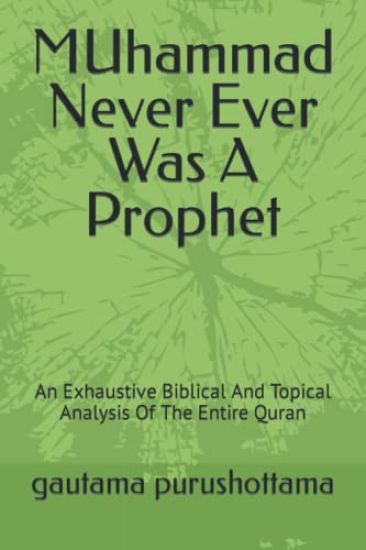
MUhammad Never Ever Was A Prophet: An Exhaustive Biblical And Topical Analysis Of The Entire Quran
This is a textbook face value exegesis of the first 2 Surahs of Al-quran. It seeks to initiate a mature reconsideration of Al-quran by those who hold it to be the final revelation of Allah. To promote that clear objective, Al-quran is analyzed without regard to time sequence-(An exegetical study mindful of the chronological order of events is neither necessary nor appropriate. This is proved by the helter-skelter subject arrangement of Al-quran)-or geographical location of Allah's revelation to Muhammad via Gabriel. The Quran claims that there is no doubt about it. It insists that it confirms the previously given biblical scriptures. And is supposed to be an exposition of them. Therefore the Quran declares itself to be a continuation of the biblical scriptures. This bold statement shall be tested here. Surah14:4 mentions that Allah sent to every people a message in their own language . Nor is familiarity of the Arabic language necessary. For surely Allah has also brought about the English translation, for Al-quran says in: Surah 14 (4) 'We have sent no apostle but with the language of his people, that he might declare their duty plainly unto them; for God causeth to err whom he pleaseth, and directeth whom he pleaseth; and he is the mighty, the wise'. Now consider diligently the verses quoted below: Surah 30(21) And of his signs are also the creation of the heavens and the earth, and the variety of your languages, and of your complexions: verily herein are signs unto men of understanding. Surah 41(41) Verily they who believe not in the admonition of the Qur n, after it hath come unto them, shall one day be discovered. It is certainly a book of infinite value: (42) vanity shall not approach it, either from before it, or from behind it: it is a revelation from a wise God, whose praise is justly to be celebrated. Surah 12(1) A. L. R. (2) These are the signs of the perspicuous book, which we have sent down in the Arabic tongue, that, peradventure, ye might understand. (3) We relate unto thee a most excellent history, by revealing unto thee this Qur n, whereas thou wast before one of the negligent. Surah 33(40) Muhammad is not the father of any man among you; but the Apostle of God and the seal of the prophets: and God knoweth all things. And a major noticeable curiosity is revealed Every apostle, sent before Muhammad, spoke the language of his hearers. Muhammad spoke in the Arabic language to the Arabs and was the last of the prophets. Therefore it follows that no other prophet will be sent to any other race; and that any people whose language came up after Muhammad is excempt from islamic evengelism. One such language is English. Thus any person whose mother tongue is English, regardless of birthplace, is free from islamic propaganda. Should Al-quran be translated into the English language? Allah's revelation requires its followers to answer 'No'. Another is Gurmukhi in which the sacred book of the Sikhs are written. Sikhism, the 5th largest major religion. About 20-30 million followers are exempt. In fact, anyone whose mother tongue is not Arabic is exemp Note: A second edition, titled THE ARABIC QURAN'S BEGINNINGS, is due to be published in 2026.
Muhammad Never Ever Was A Prophet

Muhammad Never Ever Was A Prophet

Sudhendra Pratap; Gautama Purushottama

Independently Published
2019
pokkari
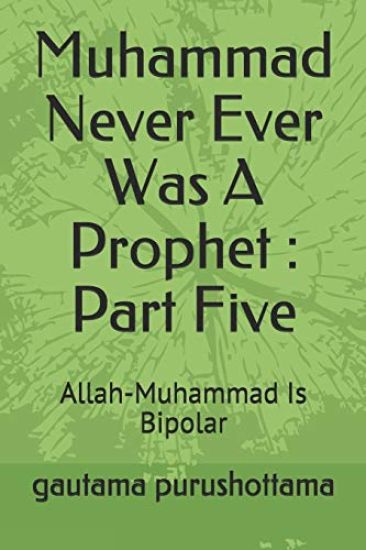
Muhammad had a distorted time perception. He spoke for his own benefits i.e. he never was a prophet uttering inspired and divine scriptures. He represented himself. Which means that Muhammad is Allah. Allah-Muhammad was bipolar and had nil authority over mankind except by installation of fear. This book analyses Sura 6 and, as the previous four books, seeks to initiate a reconsideration of the Quran by those who hold it to be the final revelation of Allah. To that end, complete chapters or large portions of the biblical books are quoted. Lord of all things? Sura 6 164 Say: Shall I seek another than Allah for Lord, when He is Lord of all things? Each soul earneth only on its own account, nor doth any laden bear another's load. Then unto your Lord is your return and He will tell you that wherein ye differed. Commentary by Maulana Muhammad Ali Quote 164 "Nor does a bearer of burden bear another's burden" are the words in which the Christian doctrine of atonement is rejected by the Holy Qur' n. Elsewhere we have: "That no bearer of burden bears another's burden, and that man can have nothing but what he strives for" (53:38, 39). Every man that is born is called a bearer of burden, not because he is a sinner, but because he starts life with certain responsibilities of his own. It is groundless to assert that Jesus Christ entered into life without any responsibilities of his own. The study of his life shows him as feeling his own responsibilities and as caring for them. Unquote Sura 53:38 That no bearer of burden bears another's burden. 39 And that man can have nothing but what he strives for. Analysis. Bipolarity Each and every human labours without help from another human for approval from Allah. The Quran declares that Allah is the Lord of all things, but mankind, while being held accountable to Allah, is unassisted by the Cherisher of all things. The reason being that Allah selects which human gets help. Obviously Allah is misnamed or Allah suffers from bipolarity. Further proof to the matter, Maulana Muhammad Ali declares that this particular verse rejects the Christian doctrine of atonement, meaning that mankind is not saved by Christ Jesus. This interpretation therefore, also dethrones Allah as being the Lord and Cherisher of all things. Any islamic doctrine of atonement by Allah is void. Thus Allah is not Lord of all, hence not Lord at all.
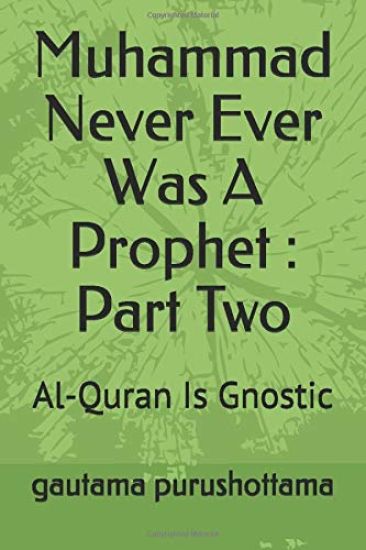
Muhammad Never Ever Was A Prophet: Part Two: Al-Quran Is Gnostic

Muhammad Never Ever Was A Prophet: Part Two: Al-Quran Is Gnostic

Gautama Purushottama

Independently Published
2018
nidottu
This book, analyzing Surah 3, is Part Two of the series "Muhammad Never Ever Was A Prophet". An invaluable resource tool for Muslim outreach. Sura 3(7) He it is Who has revealed the Book to you; some of its verses are decisive, they are the basis of the Book, and others are allegorical. Then as for those in whose hearts there is perversity, they follow the part of it which is allegorical, seeking to mislead, and seeking to give it (their own) interpretation.And none knows its interpretation except Allah, and those firmly rooted in knowledge. They say: We believe in it, it is all from our Lord. And none do mind except those having understanding. (Maulvi Muhammad Ali) Exegesis These alleged allegorical verses are neither defined nor described in Surah 3 nor anywhere else in the Quran. Not one quranic verse is identified clearly and definitely as allegorical. They remain allegations. Is it not foolishness on the part of Allah to reveal an allegorical verse to mankind that only it can know the location of or understand? The immutable surah verses, including Surah 3(1)-(6) that declare the Quran- from God, composed by God, confirming the previous scripture, an explanation of the scripture, without doubts, from the lord of all creatures, a revelation, a light, directing into the right way, the way of God glorious and written in a table kept in Heaven sent down by the living, subsisting God, confirming that which was revealed before it (law, gospel, distinction between good and evil)- does not acquiesce with Sura 3(7) which declares that there are in Al-quran: some verses clear to be understood are the foundation, others are parabolical, perverse hearts, out of love of schism and a desire of interpretation, will follow the parabolical, yet only God knows the interpretation.