Kirjojen hintavertailu. Mukana 12 016 292 kirjaa ja 12 kauppaa.

Kirjahaku

Etsi kirjoja tekijän nimen, kirjan nimen tai ISBN:n perusteella.

1000 tulosta hakusanalla Norbert Wolf

Optimal Sequentially Planned Decision Procedures

Optimal Sequentially Planned Decision Procedures

Norbert Schmitz

Springer-Verlag New York Inc.
1992
nidottu
Learning from experience, making decisions on the basis of the available information, and proceeding step by step to a desired goal are fundamental behavioural qualities of human beings. Nevertheless, it was not until the early 1940's that such a statistical theory - namely Sequential Analysis - was created, which allows us to investigate this kind of behaviour in a precise manner. A. Wald's famous sequential probability ratio test (SPRT; see example (1.8» turned out to have an enormous influence on the development of this theory. On the one hand, Wald's fundamental monograph "Sequential Analysis" ([Wa]*) is essentially centered around this test. On the other hand, important properties of the SPRT - e.g. Bayes­ optimality, minimax-properties, "uniform" optimality with respect to expected sample sizes - gave rise to the development of a general statistical decision theory. As a conse­ quence, the SPRT's played a dominating role in the further development of sequential analysis and, more generally, in theoretical statistics.

How to Build an Igloo

How to Build an Igloo

Norbert E. Yankielun

WW Norton Co
2007
nidottu
How can you determine if the fresh snow that’s fallen outside your front door is as good for making a slab shelter as a snowman? What is a slab shelter, anyway? For that matter, what are drift caves, spruce traps, snow block walls, and bivy bag shelters, and how would you go about building them, whether for winter fun or protection from the weather? In this instructive, whimsical, illustrated manual, Norbert E. Yankielun, a seasoned cold-regions explorer and researcher, takes readers step-by-step through the process of constructing and inhabiting a range of useful snow structures—from the most basic to the more complex. Whether you’re a veteran backcountry skier or a backyard builder, this is one book you won’t want to be without.
Modern Foreign Languages

Modern Foreign Languages

Norbert Pachler; Michael Evans; Shirley Lawes

Routledge
2007
nidottu
Covering the training standards for NQTs and the Induction Standards and also fully exploring issues to do with subject knowledge in learning to teach, this is the essential guide for teachers of foreign languages. Acknowledging that an essential element of a secondary teacher's identity is tied up with their subject taught, the book is divided into three sections: framing the subject teaching the subject modern languages within the professional community.This book aims to provide stimulating assistance to subject specialists by helping them find ways of thinking about their specialism, how to teach with it, and how to enagage with what pupils learn through it. Written with teachers of modern foreign languages in the years of their early professional development in mind, this book is also suitable for those on PGCE courses, those in their induction year, and those in years two and three of their teaching career.
Modern Foreign Languages

Modern Foreign Languages

Norbert Pachler; Michael Evans; Shirley Lawes

Routledge
2007
sidottu
Covering the training standards for NQTs and the Induction Standards and also fully exploring issues to do with subject knowledge in learning to teach, this is the essential guide for teachers of foreign languages. Acknowledging that an essential element of a secondary teacher's identity is tied up with their subject taught, the book is divided into three sections: framing the subject teaching the subject modern languages within the professional community.This book aims to provide stimulating assistance to subject specialists by helping them find ways of thinking about their specialism, how to teach with it, and how to enagage with what pupils learn through it. Written with teachers of modern foreign languages in the years of their early professional development in mind, this book is also suitable for those on PGCE courses, those in their induction year, and those in years two and three of their teaching career.
Postcolonial Memoir in the Middle East
This book reconsiders the notion of liminality in postcolonial critical discourse today. By visiting Mashriqi writers of memoir, Bugeja offers a unique intervention in the understanding of 'in-between' and ‘threshold’ states in present-day postcolonialist thought. His analysis situates liminal space as a fraught form of consciousness that mediates between conditions of historical contingency and the memorializing present. Within the present Mashriqi memoir form, liminal spaces may be read as articulations of 'representational spaces' — narrative spaces that, based as they are within the histories of local communities, are nonetheless redolent with memorial and imaginary elements. Liminal consciousness today, Bugeja argues, is a direct consequence of the impact of volatile present-day memories on the re-conception of the open wounds of history. Incisive readings of life-writings by Mourid Barghouti, Amin Maalouf, Orhan Pamuk, Amos Oz, and Wadad Makdisi Cortas demonstrate the double-edged representational chasm that opens up when present acts of memorializing are brought to bear upon the elusive histories of the early-twentieth-century Mashriq. Sifting through the wide-ranging theoretical literature on liminality and challenging received views of the concept, this book proposes a nuanced, materialist, and original rethinking of the liminal as a more vigilant outlook onto the political, literary and historical predicaments of the contemporary Middle East.
Learning to Teach Foreign Languages in the Secondary School

Learning to Teach Foreign Languages in the Secondary School

Norbert Pachler; Michael Evans; Ana Redondo; Linda Fisher

Routledge
2013
sidottu
Praise for previous editions:- ‘A wealth of theory, research, practical advice, case studies and tasks in one volume…Indispensable for both HEI tutors and mentors, and an important book to recommend to all MFL students.' – Language Learning Journal‘Presenting clear, straightforward, factual information on all current issues facing MFL student teachers ... An excellent reference guide during the first years of teaching.' – Mentoring and TutoringLearning to Teach Foreign Languages in the Secondary School has established itself as the leading textbook for student teachers of foreign languages in the UK and internationally. The practical focus is underpinned by a theoretical perspective and backed up by the latest research, encouraging you to develop a personal approach to foreign language teaching. This new, fourth edition, has been comprehensively updated to take account of recent policy and curriculum changes, and now covers a range of relevant statutory frameworks. Fully revised chapters cover the key knowledge and skills essential for becoming a foreign language teacher: What can we learn from research into language teaching and learning? Teaching methods and learning strategies Creating a meaningful learning environment Transition from Primary to Secondary The role of digital technologies Teaching in the target language Receptive skills and productive skills Teaching and learning grammar Planning and reflecting on classroom practice Pupil differences and differentiation Assessment for and of learning It includes many examples of how to analyse practice to ensure pupil learning is maximised, together with activities and tasks to support you as you analyse your own learning and performance. Learning to Teach Foreign Languages in the Secondary School provides practical help and support for many of the situations and potential challenges you are faced with in school. It is an essential purchase for every aspiring secondary foreign languages school teacher.
Learning to Teach Foreign Languages in the Secondary School

Learning to Teach Foreign Languages in the Secondary School

Norbert Pachler; Michael Evans; Ana Redondo; Linda Fisher

Routledge
2013
nidottu
Praise for previous editions:- ‘A wealth of theory, research, practical advice, case studies and tasks in one volume…Indispensable for both HEI tutors and mentors, and an important book to recommend to all MFL students.' – Language Learning Journal‘Presenting clear, straightforward, factual information on all current issues facing MFL student teachers ... An excellent reference guide during the first years of teaching.' – Mentoring and TutoringLearning to Teach Foreign Languages in the Secondary School has established itself as the leading textbook for student teachers of foreign languages in the UK and internationally. The practical focus is underpinned by a theoretical perspective and backed up by the latest research, encouraging you to develop a personal approach to foreign language teaching. This new, fourth edition, has been comprehensively updated to take account of recent policy and curriculum changes, and now covers a range of relevant statutory frameworks. Fully revised chapters cover the key knowledge and skills essential for becoming a foreign language teacher: What can we learn from research into language teaching and learning? Teaching methods and learning strategies Creating a meaningful learning environment Transition from Primary to Secondary The role of digital technologies Teaching in the target language Receptive skills and productive skills Teaching and learning grammar Planning and reflecting on classroom practice Pupil differences and differentiation Assessment for and of learning It includes many examples of how to analyse practice to ensure pupil learning is maximised, together with activities and tasks to support you as you analyse your own learning and performance. Learning to Teach Foreign Languages in the Secondary School provides practical help and support for many of the situations and potential challenges you are faced with in school. It is an essential purchase for every aspiring secondary foreign languages school teacher.
Technology and Work in German Industry

Technology and Work in German Industry

Norbert Altmann; Christoph Kohler; Pamela Meil

Routledge
2017
sidottu
German industry in particular is a central focus for studying technical and organizational changes in industry due to its pivotal position in international markets, its technological sophistication and its well-established training systems. Originally published in 1992, this study brings together contributions which contain both theoretical approaches and extensive empirical studies, on the manufacturing industry in Germany, including comparisons to other european countries. It looks at the developments of new technology, identifying trends in rationalization and the influences they have on organizational behaviour. As it discusses the relationships between technology and the work-force it includes discussion on flexible specialization, labour processes, union relations, small and large firms and training processes.
Technology and Work in German Industry

Technology and Work in German Industry

Norbert Altmann; Christoph Kohler; Pamela Meil

Routledge
2018
nidottu
German industry in particular is a central focus for studying technical and organizational changes in industry due to its pivotal position in international markets, its technological sophistication and its well-established training systems. Originally published in 1992, this study brings together contributions which contain both theoretical approaches and extensive empirical studies, on the manufacturing industry in Germany, including comparisons to other european countries. It looks at the developments of new technology, identifying trends in rationalization and the influences they have on organizational behaviour. As it discusses the relationships between technology and the work-force it includes discussion on flexible specialization, labour processes, union relations, small and large firms and training processes.
Wealth Management in the New Economy

Wealth Management in the New Economy

Norbert M. Mindel; Sarah E. Sleight

John Wiley Sons Inc
2010
sidottu
A practical guide to managing wealth in modern times Wealth Management in the New Economy addresses a wide array of wealth management topics and established financial theories. Author Norbert Mindel has successfully advised his clients for more than three decades in the business. Now, with this new book, he shares the wisdom he has acquired and offers valuable insights into successful wealth management in an economy that has changed dramatically over the past year. Along the way, Mindel explores the essential aspects of this discipline, including the keys to wealth creation, properly managing risk, asset protection, planning for a prosperous retirement, and many other issues that you need to understand in order to survive and flourish in today's economy. While market forces are far too complex to be fully predicted or exploited, it is still possible to protect and grow your-or your client's-wealth. Wealth Management in the New Economy will show you how to achieve this important goal. Reveals how you can reduce market risk by using proven theories of portfolio managementWritten by accomplished financial advisor, attorney, and CPA Norbert MindelLays out strategies wealth managers and investors both can use to protect and grow wealth in the new economy For practical financial guidance you can count on, look no further than Wealth Management in the New Economy.
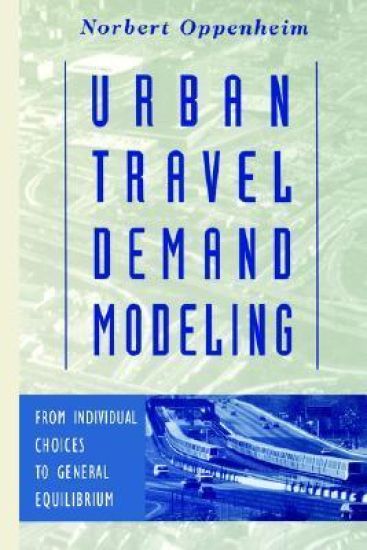
Urban Travel Demand Modeling

Urban Travel Demand Modeling

Norbert Oppenheim

John Wiley Sons Inc
1995
nidottu
A state-of-the-art approach to urban travel demand modeling Currently used travel forecasting methodology was developed almost three decades ago, primarily to assess the impacts of large-scale capital improvement projects, and was not designed to deal with contemporary urban transportation problems. To be effective today, travel demand models must explicitly represent traveler behavior, must be policy-sensitive, and must be operationally reliable. Urban Travel Demand Modeling: From Individual Choices to General Equilibrium presents an integrated system of models which overhaul the four traditional phases of travel generation, modal split, trip distribution, and network assignment. This book shows, for the first time, how generalized network equilibrium may be rigorously forecast from the optimal travel choices of "trip consumers" without the need to resort to heuristic procedures such as feedbacks. In addition, models for optimal transportation supply decisions are integrated with the demand models. Transit travel and goods movements are specifically addressed. To make this book as self-contained as possible, the author provides review material on the mathematics required and the basic concepts of discrete choice modeling. Numerical examples throughout the book demonstrate the calibration and use of the models in a variety of situations, including uncongested and congested networks. Review problems are systematically provided, many with solutions. Illustrative add-on software for model implementation on several popular platforms is also available separately. Urban Travel Demand Modeling may be used at the senior and graduate levels in civil engineering, economics, operations research, urban and regional planning, and geography courses. Transportation professionals in the private and public sectors, academics and researchers, will also find this methodology a rich, versatile, and efficient tool with which to address major urban transportation issues, including demand management, road and parking pricing, environmental impacts, changing socioeconomic and activity patterns, and urban development.
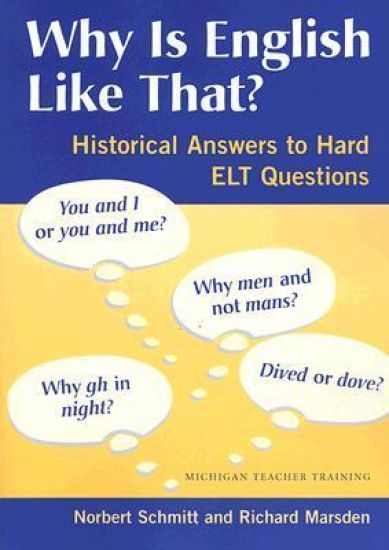
Why Is English Like That?

Why Is English Like That?

Norbert Schmitt; Richard Marsden

The University of Michigan Press
2006
nidottu
Why is "night" spelled with "gh"? Why can't sentences end with prepositions? Why does English have so many words that express the same ideas? Questions like these can be difficult for teachers to answer when they do not know the historical background of the English language. Why Is English Like That? gives teachers a brief and accessible history of the English without assuming any prior knowledge of the subject. The book outlines the historical events that shaped English; describes how its grammar, vocabulary, spelling, and pronunciation developed over time; and highlights the "quirks" and "exceptions" in English that can be explained on a historical basis. By understanding how the English of today evolved from the English of past times, both teachers and students will be more comfortable with the many conventions of the English language.Why Is English Like That? also contains reproducible grammar and vocabulary exercises that will help teachers incorporate some of this historical knowledge into classroom activities. This book was written with English language teachers in mind, and the exercises are designed for ESL/EFL students, but it may also be used by teachers in training (L1 and L2).
Legal Anthropology

Legal Anthropology

Norbert Rouland

Continuum International Publishing Group Ltd.
2000
sidottu
This account of the anthropology of law is remarkable in its command of the Anglo-American and Continental literatures in this field; and it is timely in addressing contemporary issues. Two central projects are carried through in succesive parts of the book. In the first, the author outlines the history of the "anthropology of law", drawing on the intellectual context of legal development. In the second, Professor Rouland examines the legal ideas, institutions and processes of small-scale non-Western societies, moving finally towards an anthropology of modern law. The author has published widely within the field of legal anthropology.
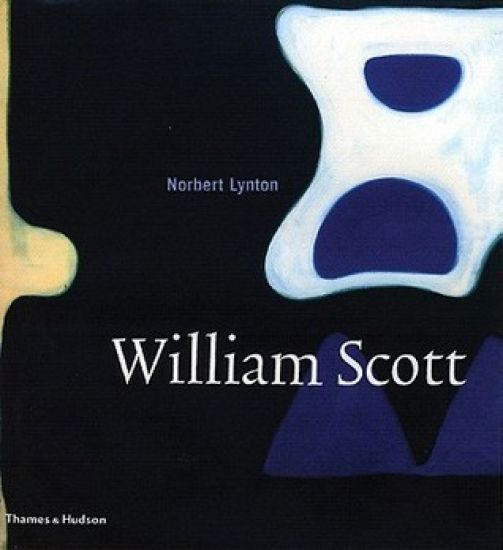
William Scott

William Scott

Norbert Lynton

Thames Hudson Ltd
2007
nidottu
William Scott, born in 1913, first came to the public’s attention when he participated in the Arts Council’s exhibition at the 1951 Festival of Britain. His work ranges from abstract paintings to ever-richer still lifes with multiple levels of paint, and multiple levels of meaning. This sumptuous volume, the definitive book on Scott and his art, includes work from all periods, most of which is reproduced in full colour.
Judaism and the Doctrine of Creation

Judaism and the Doctrine of Creation

Norbert M. Samuelson

Cambridge University Press
2007
pokkari
The topic of this book is 'creation'. It breaks down into discussions of two distinct, but interrelated, questions: what does the universe look like, and what is its origin? The opinions about creation considered by Norbert Samuelson come from the Hebrew scriptures, Greek philosophy, Jewish philosophy and contemporary physics. His perspective is Jewish, liberal and philosophical. It is 'Jewish' because the foundation of the discussion is biblical texts interpreted in the light of traditional rabbinic texts. It is 'philosophical' because the subject matter is important in both past and present philosophical texts, and to Jewish philosophy in particular. Finally, it is 'liberal' because the authorities consulted include heterodox as well as orthodox Jewish sources. The ensuing discussion leads to original conclusions about a diversity of topics, including the limits of human reason and religious faith, and the relevance of scientific models to religious doctrine.
A Theory of Syntax

A Theory of Syntax

Norbert Hornstein

Cambridge University Press
2008
sidottu
Human language seems to have arisen roughly within the last 50-100,000 years. In evolutionary terms, this is the mere blink of an eye. If this is correct, then much of what we consider distinctive to language must in fact involve operations available in pre-linguistic cognitive domains. In this book Norbert Hornstein, one of the most influential linguists working on syntax, discusses a topical set of issues in syntactic theory, including a number of original proposals at the cutting edge of research in this area. He provides a theory of the basic grammatical operations and suggests that there is only one that is distinctive to language. If this theory is correct then this narrows the evolutionary gap between verbal and non-verbal primates, thus facilitating the rapid evolutionary emergence of our linguistic capacity.
Judaism and the Doctrine of Creation

Judaism and the Doctrine of Creation

Norbert M. Samuelson

Cambridge University Press
1994
sidottu
The topic of this book is ‘creation’. It breaks down into discussions of two distinct, but interrelated, questions: what does the universe look like, and what is its origin? The opinions about creation considered by Norbert Samuelson come from the Hebrew scriptures, Greek philosophy, Jewish philosophy, and contemporary physics. His perspective is Jewish, liberal, and philosophical. It is ‘Jewish’ because the foundation of the discussion is biblical texts interpreted in the light of traditional rabbinic texts. It is ‘philosophical’ because the subject matter is important in both past and present philosophical texts, and to Jewish philosophy in particular. Finally, it is ‘liberal’ because the authorities consulted include heterodox as well as orthodox Jewish sources. The ensuing discussion leads to original conclusions about a diversity of topics, including the limits of human reason and religious faith, and the relevance of scientific models to religious doctrine.
Hindu Kingship and Polity in Precolonial India

Hindu Kingship and Polity in Precolonial India

Norbert Peabody

Cambridge University Press
2002
sidottu
Through the analysis of eighteenth- and early nineteenth-century texts on the Hindu Kingdom of Kota in Rajasthan, in this 2003 book Norbert Peabody explores the ways in which historical consciousness, or memory, is culturally constructed and how this consciousness informs social experience. By building on the premise that no society receives the past in a transparent, universal and objective way, he unravels how the past in Kota has been fashioned. His analysis demonstrates how different styles of historical interpretation sustain different regimes, and how specific varieties of social and political activity are founded upon these different perceptions of the past. In this way, he suggests that different societies not only establish different co-ordinates of value in their constructions of the past, but also that the very processes of social and political transformation differ from society to society. This is a fascinating and challenging book which promises to become a classic in the field.
Understanding Minimalism

Understanding Minimalism

Norbert Hornstein; Jairo Nunes; Kleanthes K. Grohmann

Cambridge University Press
2005
pokkari
Understanding Minimalism, first published in 2005, is an introduction to the Minimalist Program - the model of syntactic theory within generative linguistics. Accessibly written, it presents the basic principles and techniques of the minimalist program, looking firstly at analyses within Government and Binding Theory (the Minimalist Program's predecessor), and gradually introducing minimalist alternatives. Minimalist models of grammar are presented in a step-by-step fashion, and the ways in which they contrast with GB analyses are clearly explained. Spanning a decade of minimalist thinking, this textbook will enable students to develop a feel for the sorts of questions and problems that minimalism invites, and to master the techniques of minimalist analysis. Over 100 exercises are provided, encouraging them to put these skills into practice. Understanding Minimalism will be an invaluable text for intermediate and advanced students of syntactic theory, and will set a solid foundation for further study and research within Chomsky's minimalist framework.