Kirjojen hintavertailu. Mukana 11 213 693 kirjaa ja 12 kauppaa.

Kirjahaku

Etsi kirjoja tekijän nimen, kirjan nimen tai ISBN:n perusteella.

1000 tulosta hakusanalla Thomas Witherow

Thomas Wyatt

Thomas Wyatt

Routledge
1995
sidottu
The Critical Heritage gathers together a large body of critical sources on major figures in literature. Each volume presents contemporary responses to a writer's work, enabling students and researchers to read for themselves, for example, comments on early performances of Shakespeare's plays, or reactions to the first publication of Jane Austen's novels. The carefully selected sources range from landmark essays in the history of criticism to journalism and contemporary opinion, and little published documentary material such as letters and diaries. Significant pieces of criticism from later periods are also included, in order to demonstrate the fluctuations in an author's reputation. Each volume contains an introduction to the writer's published works, a selected bibliography, and an index of works, authors and subjects. The Collected Critical Heritage set will be available as a set of 68 volumes and the series will also be available in mini sets selected by period (in slipcase boxes) and as individual volumes.
Thomas Hardy

Thomas Hardy

Routledge
1995
sidottu
The Critical Heritage gathers together a large body of critical sources on major figures in literature. Each volume presents contemporary responses to a writer's work, enabling students and researchers to read for themselves, for example, comments on early performances of Shakespeare's plays, or reactions to the first publication of Jane Austen's novels. The carefully selected sources range from landmark essays in the history of criticism to journalism and contemporary opinion, and little published documentary material such as letters and diaries. Significant pieces of criticism from later periods are also included, in order to demonstrate the fluctuations in an author's reputation. Each volume contains an introduction to the writer's published works, a selected bibliography, and an index of works, authors and subjects. The Collected Critical Heritage set will be available as a set of 68 volumes and the series will also be available in mini sets selected by period (in slipcase boxes) and as individual volumes.
Thomas Carlyle
The Critical Heritage gathers together a large body of critical sources on major figures in liteature. Each volume presents contemporary responses on a writer's work, enabling student and researcher to read the material themselves.
Thomas Robert Malthus
Malthus' Essay on the Principles of Population was one of the most controversial books ever published. Going through six editions in the author's lifetime, it cast a long shadow down the nineteenth century, with nearly all of the century's leading thinkers - from Hazlitt and Ricardo to Marx and Darwin - feeling compelled to comment on it.
Thomas Paine: Life and Works
Thomas Paine was a hugely influential revolutionary pamphleteer, whose writings were instrumental in bringing about some of the greatest political changes the world has seen. Paine's enduring importance lies not so much in the depth of his political philosophy as in his great abilities as a communicator of political ideas. Conway's Writings was the first complete critical collection of Paine's works, and his Life was the first account to show Paine in a positive light.
Thomas Hardy: Family History
This third collection in the Family History Series (Jane Austen and the Brontes have already been published), is a five-volume set which looks at the cultural and biographical background to Thomas Hardy, embracing rare and out-of-print books, pamphlets and journal articles.Together these original sources include important writings and interviews on Hardy by family and friends, covering his life and relationships, his intellectual and musical background, his family background and their homes and haunts. It provides an invaluable amount of hard to find material for any serious Hardy scholarship.
Thomas Hardy

Thomas Hardy

Geoffrey Harvey

Routledge
2003
sidottu
Thomas Hardy was the foremost novelist of his time, as well as an established poet. Author of Jude the Obscure and Far from the Madding Crowd, Hardy reflected in his works the dynamics of social, intellectual and aesthetic change in nineteenth-century England.This guide provides students with a lucid introduction to Hardy's life and works and the basis for a sound comprehension of his work, including:the major aspects of Hardy's life in the context of contemporary culturea detailed commentary on Hardy's most important work and a critical map of Hardy's complete writingan outline of the vast body of criticism that has built up around Hardy's work with examples of recent critical debate.Exposition and guide, this volume enables readers to form their own readings of one of the most important writers of the nineteenth century.
Thomas Hardy

Thomas Hardy

Geoffrey Harvey

Routledge
2003
nidottu
Thomas Hardy was the foremost novelist of his time, as well as an established poet. Author of Jude the Obscure and Far from the Madding Crowd, Hardy reflected in his works the dynamics of social, intellectual and aesthetic change in nineteenth-century England.This guide provides students with a lucid introduction to Hardy's life and works and the basis for a sound comprehension of his work, including:the major aspects of Hardy's life in the context of contemporary culturea detailed commentary on Hardy's most important work and a critical map of Hardy's complete writingan outline of the vast body of criticism that has built up around Hardy's work with examples of recent critical debate.Exposition and guide, this volume enables readers to form their own readings of one of the most important writers of the nineteenth century.
Thomas Hardy's Tess of the d'Urbervilles
This sourcebook offers an introduction to Thomas Hardy's crucial novel, offering:a contextual overview, a chronology and reprinted contemporary documents, including a selection of Hardy's poemsan overview of the book's early reception and recent critical fortunes, as well as a wide range of reprinted extracts from critical workskey passages from the novel, reprinted with editorial comment and cross-referenced within the volume to contextual and critical documentssuggestions for further reading and a list of relevant web resources.For students on a wide range of courses, this sourcebook offers the essential stepping-stone from a basic reading knowledge to an advanced understanding of Hardy's best-known novel.
Thomas Hardy's Tess of the d'Urbervilles
This sourcebook offers an introduction to Thomas Hardy's crucial novel, offering:a contextual overview, a chronology and reprinted contemporary documents, including a selection of Hardy's poemsan overview of the book's early reception and recent critical fortunes, as well as a wide range of reprinted extracts from critical workskey passages from the novel, reprinted with editorial comment and cross-referenced within the volume to contextual and critical documentssuggestions for further reading and a list of relevant web resources.For students on a wide range of courses, this sourcebook offers the essential stepping-stone from a basic reading knowledge to an advanced understanding of Hardy's best-known novel.
Thomas Reid and Scepticism

Thomas Reid and Scepticism

Philip De Bary; Philip de Bary

Routledge
2001
sidottu
This book bears witness to the current reawakening of interest in Reid's philosophy. It first examines Reid's negative attack on the Way of Ideas, and finds him to be a devastating critic of his predecessors. Turning to the positive part of Reid's programme, the author then develops a fresh interpretation of Reid as an anticipator of present-day 'reliabilism'. Throughout the book, Reid is presented as a powerful thinker with much to say to philosophers in the twenty-first century. The book will be of interest not only to Reid scholars and historians of philosophy, but also to specialists and students in contemporary epistemology.
Thomas De Quincey
The ongoing critical fascination with Thomas De Quincey and the burgeoning recognition of the centrality of his writings to the Romantic age and beyond necessitates a critical examination of De Quincey. In this spirit, ten of the top De Quincey scholars in the world have come together in this volume to engage directly with the immense amount of new information to be published on De Quincey in the past two decades. The book features wide-ranging and incisive assessments of De Quincey as essayist, addict, economist, subversive, biographer, autobiographer, aesthete, innovator, hedonist, and much else.
Thomas Reid and Scepticism

Thomas Reid and Scepticism

Philip De Bary; Philip de Bary

Routledge
2006
nidottu
This book bears witness to the current reawakening of interest in Reid's philosophy. It first examines Reid's negative attack on the Way of Ideas, and finds him to be a devastating critic of his predecessors. Turning to the positive part of Reid's programme, the author then develops a fresh interpretation of Reid as an anticipator of present-day 'reliabilism'. Throughout the book, Reid is presented as a powerful thinker with much to say to philosophers in the twenty-first century. The book will be of interest not only to Reid scholars and historians of philosophy, but also to specialists and students in contemporary epistemology.
Thomas Hobbes and Carl Schmitt
Thomas Hobbes, the English 17th century philosopher, and Carl Schmitt, Hitler’s ‘crown jurist’, a political thinker and author of an enigmatic book on Hobbes, are increasingly relevant today for two reasons. First, they address the problem of political order, so important when we witness failed states, the privatisation of war, and the rise of political violence that does not derive from the state. Secondly, they are both crucial sources for the use of mythology in politics; moreover, they address the key issue of our time, namely, the relation between politics and religion. This collection of important new essays addresses Hobbes and Schmitt as political thinkers, their importance for present-day politics and society, their conceptions of myth and politics, and Schmitt’s use of Hobbes in (and some say against) the Third Reich. When myth, violence and revelation re-emerge as political forces, it is important to understand Hobbes’s and Schmitt’s answers to the problems of their time – and to those of ours.This book was based on a special issue of the Critical Review of International Social and Political Philosophy.
Thomas Cranmer

Thomas Cranmer

Susan Wabuda

Routledge
2017
sidottu
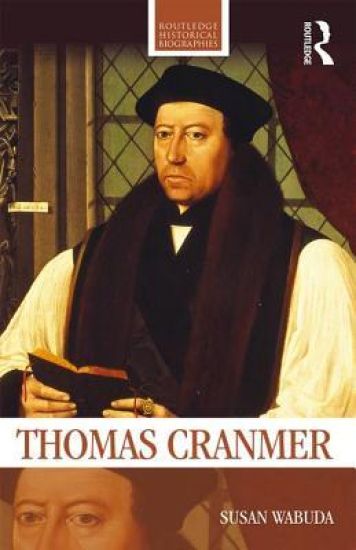
Thomas Cranmer’s place in English history is firmly established, yet the complexities of his character have remained obscure and he continues to be one of the most problematic figures of the Tudor period. Susan Wabuda’s biography sheds fresh light not only on the private Cranmer, but also on the qualities that enabled him to master a shifting political landscape and to build a new English Church. Athletic by nature, Cranmer enjoyed hunting and he was a keen collector of books. He was blessed with several lifelong friendships and twice risked his career by marrying the women he loved. A skilled debater and a deft politician, Cranmer sought to balance his long-term plans for the Church against the immediate demands of survival at court. Obedient at all times, yet never entirely trustworthy, he had to reconcile the will of his God with the will of the monarch he served. For too long, Cranmer’s legacy has overshadowed the life of the man himself, but this new biography enriches and extends our understanding of both. Accessible and informative, it will be essential reading for students and scholars of the English Reformation and the Tudor age.
Thomas Cranmer

Thomas Cranmer

Susan Wabuda

Routledge
2017
nidottu
Thomas Cranmer’s place in English history is firmly established, yet the complexities of his character have remained obscure and he continues to be one of the most problematic figures of the Tudor period. Susan Wabuda’s biography sheds fresh light not only on the private Cranmer, but also on the qualities that enabled him to master a shifting political landscape and to build a new English Church. Athletic by nature, Cranmer enjoyed hunting and he was a keen collector of books. He was blessed with several lifelong friendships and twice risked his career by marrying the women he loved. A skilled debater and a deft politician, Cranmer sought to balance his long-term plans for the Church against the immediate demands of survival at court. Obedient at all times, yet never entirely trustworthy, he had to reconcile the will of his God with the will of the monarch he served. For too long, Cranmer’s legacy has overshadowed the life of the man himself, but this new biography enriches and extends our understanding of both. Accessible and informative, it will be essential reading for students and scholars of the English Reformation and the Tudor age.
Thomas Tooke and the Monetary Thought of Classical Economics
This study provides a comprehensive account and reconsideration of the contribution to political economy of Thomas Tooke (1774-1858). It clarifies Tooke’s monetary thought and its legacy to modern economics. The study shows Tooke possessed a rich and extensive political economy, covering many aspects of economic activity relevant to key policy issues. Tooke’s political economy is shown to be a unified and coherent body of intellectual thought in the classical tradition which, like most of his nineteenth-century contemporaries, was much influenced by Adam Smith’s economics. More particularly, Tooke’s monetary thought, especially his novel banking school theory, is shown to be theoretically coherent from the standpoint of nineteenth-century classical economics. It is also shown that besides contributing toward a better understanding of the behaviour of monetary systems in general, key elements of Tooke’s banking school theory make an important contribution to explaining distribution, growth and price inflation in modern economics.
Thomas Hobbes and Carl Schmitt
Thomas Hobbes, the English 17th century philosopher, and Carl Schmitt, Hitler’s ‘crown jurist’, a political thinker and author of an enigmatic book on Hobbes, are increasingly relevant today for two reasons. First, they address the problem of political order, so important when we witness failed states, the privatisation of war, and the rise of political violence that does not derive from the state. Secondly, they are both crucial sources for the use of mythology in politics; moreover, they address the key issue of our time, namely, the relation between politics and religion. This collection of important new essays addresses Hobbes and Schmitt as political thinkers, their importance for present-day politics and society, their conceptions of myth and politics, and Schmitt’s use of Hobbes in (and some say against) the Third Reich. When myth, violence and revelation re-emerge as political forces, it is important to understand Hobbes’s and Schmitt’s answers to the problems of their time – and to those of ours.This book was based on a special issue of the Critical Review of International Social and Political Philosophy.
Thomas Hardy (Routledge Revivals)
First published in 1977, this concise and insightful study of the life and works of Thomas Hardy provides a thorough examination of Hardy's literary output. Alongside a brief biography of Hardy's life, Professor Page's study also spotlights his major and minor novels, his short stories, his non-fiction prose and his verse.
Thomas Hardy (Routledge Revivals)
First published in 1977, this concise and insightful study of the life and works of Thomas Hardy provides a thorough examination of Hardy's literary output. Alongside a brief biography of Hardy's life, Professor Page's study also spotlights his major and minor novels, his short stories, his non-fiction prose and his verse.