Kirjojen hintavertailu. Mukana 11 627 373 kirjaa ja 12 kauppaa.

Kirjahaku

Etsi kirjoja tekijän nimen, kirjan nimen tai ISBN:n perusteella.

1000 tulosta hakusanalla "Blair"

Blair's War

Blair's War

David Coates; Joel Krieger

Polity Press
2004
nidottu
Tony Blair and George Bush may have won the war in Iraq, but they are losing the peace at home. How did Blair come to support the US-led invasion of Iraq? Why did he risk taking Britain into a conflict which so imperilled his premiership? Was he justified in doing so? These are just some of the questions which David Coates and Joel Krieger seek to answer in Blair’s War – the most authoritative and complete record of the conflict to date. Written by two of the most experienced and perceptive observers of British politics and New Labour, the book explains how his stalwart commitment to stand ‘shoulder to shoulder’ with America after 9/11 trapped Blair in a tragic logic that took the UK to war in Iraq. It reveals how Blair was bushwhacked into exaggerating the Iraqi threat, seduced away from New Labour’s ethical foreign policy, and drawn into Bush’s imperial campaign. Blair’s War blows a hole through each of the justifications for war and offers a detailed, original and compelling set of proposals to return the UK to an ethical foreign policy. With an exquisite sense of the unfolding drama and an eye for detail, the authors develop the arguments for and against the war and, with unerring fairness, test each argument against the record of what was known, what was suspected, and what was misrepresented. The book provides a unique perspective on this latest unsettling turn in the ‘special relationship’, and is essential reading for voters on both sides of the Atlantic, who must soon determine the political fates of both the President and Prime Minister.
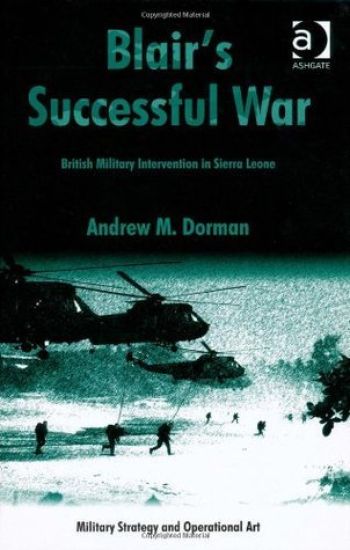
Blair's Successful War

Blair's Successful War

Andrew M. Dorman

Ashgate Publishing Limited
2009
sidottu
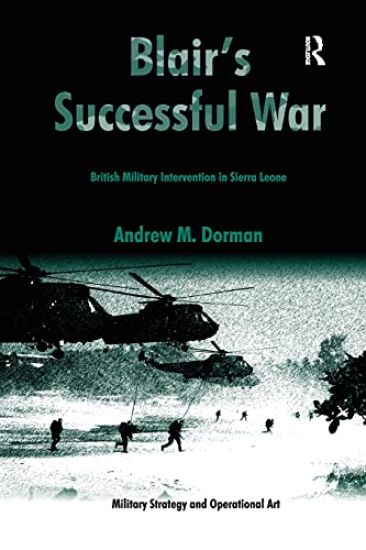
Andrew Dorman introduces Sierra Leone as Blair's second great military adventure after Kosovo and the first he undertook on his own. It is tied to Blair's 1999 Chicago speech on the 'Doctrine of the International Community', his move towards humanitarianism and the impact of the Kosovo experience. The book links this move with the rise of cosmopolitan militaries and the increasing involvement of Western forces in humanitarian operations and their impact on the international system. Furthermore, it places it within the context of defence transformation and the emerging Western expeditionary capabilities, in particular the European Union's new battle group concept and developments in concepts such as Network Centric Warfare and Networked Enabled Capability. Examining the whole campaign and considering the impact on the Blair Government, this book will prove to be a key reader on the topic.
Blair's Successful War

Blair's Successful War

Andrew Dorman

Routledge
2018
nidottu
Andrew Dorman introduces Sierra Leone as Blair's second great military adventure after Kosovo and the first he undertook on his own. It is tied to Blair's 1999 Chicago speech on the 'Doctrine of the International Community', his move towards humanitarianism and the impact of the Kosovo experience. The book links this move with the rise of cosmopolitan militaries and the increasing involvement of Western forces in humanitarian operations and their impact on the international system. Furthermore, it places it within the context of defence transformation and the emerging Western expeditionary capabilities, in particular the European Union's new battle group concept and developments in concepts such as Network Centric Warfare and Networked Enabled Capability. Examining the whole campaign and considering the impact on the Blair Government, this book will prove to be a key reader on the topic.
Blair's Educational Legacy?
The United Kingdom General Election on 1st May 1997 gave a landslide victory to a re-vitalised Labour Party. Tony Blair became Prime Minister with a huge Commons majority of 179 over all other parties. Such a majority meant that extensive changes of policy could be implemented with little effective opposition. During the election campaign Tony Blair had repeatedly claimed that the top three priorities of a New Labour government would be 'education, education, education' , and on page two of the Labour Party's election manifesto a smiling Blair is seen with Nelson Mandela - the unacknowledged originator of the oratorical education triplet. Following a third Election victory in 2005 and after over ten years as Prime Minister, Blair finally stepped down to Gordon Brown in mid-2007, but only after a promotional ‘final tour’ that lasted several months. Towards the end, Blair devoted considerable efforts to try to ensure that his legacy would be positive and that he would be remembered for more than his role in the Iraq war. But what is his legacy in the field of education? This book brings together the assessments of key educational researchers who have been centrally involved with both the critique and implementation of various policy developments. It is now time to make a solid academic evaluation of his influence on education. This book is timely, and relates directly to the central policy themes of the last decade. It considers the relationships between theory and practice and examines the nature of policy and politics. Each contribution will review empirical data and policy changes relating to Blair’s period as Prime Minister and will make an assessment of the enduring effects of changes in policy. Each will assess the long-term and lasting effects as well as the shorter-term responses. This book was published as a special issue of the Oxford Review of Education.
Blair’s Educational Legacy

Blair’s Educational Legacy

A. Green

Palgrave Macmillan
2011
nidottu
Providing an overview and Marxist assessment of Tony Blair and New Labour's UK education policies, structures, and processes, the contributors in this exciting new collection discuss specific aspects of education policy and practices.