Kirjojen hintavertailu. Mukana 11 717 486 kirjaa ja 12 kauppaa.

Kirjahaku

Etsi kirjoja tekijän nimen, kirjan nimen tai ISBN:n perusteella.

55 tulosta hakusanalla "Human-Robot Interaction"

Computational Human-Robot Interaction

Computational Human-Robot Interaction

Andrea Thomaz; Guy Hoffman; Maya Cakmak

now publishers Inc
2016
nidottu
The field of Human-Robot Interaction (HRI) is expanding and maturing and HRI is a research topic which is increasingly solicited and included in the broader robotics community.Computational Human-Robot Interaction provides the reader with a systematic overview of the field of Human-Robot Interaction over the past decade, with a focus on the computational frameworks, algorithms, techniques, and models currently used to enable robots to interact with humans.Within the field of robotics, HRI poses distinct computational challenges, in each of the traditional core research areas: perception, manipulation, planning, task execution, navigation, and learning.The book addresses these challenges by surveying twelve publication venues and including work that tackles computational HRI challenges, categorized along eight topics:(1) Perceiving humans and their activities.(2) Generating and understanding verbal expression.(3) Generating and understanding non-verbal behaviors.(4) Modeling, expressing, and understanding emotional states.(5) Recognizing and conveying intentional action.(6) Ccollaborating with humans.(7) Navigating with and around humans.(8) Learning from humans in a social manner.For each topic, promising future research areas are identified. This is an ideal reference for any researcher who wants to understand the research that has been done so far in the area, and potentially get involved with their own avenue of research.
Basic Human-robot Interaction

Basic Human-robot Interaction

David O Johnson

WORLD SCIENTIFIC PUBLISHING CO PTE LTD
2024
sidottu
The book's content is designed to provide practical guidance and insights for conducting experiments in Human-Robot Interaction (HRI) and publishing the results in scientific journals. It includes a detailed explanation of how to conduct HRI experiments and what to do and what not to do to get an article accepted for publication. It is tailored to those seeking to deepen their understanding of HRI methodologies, statistical measurements, and research design. The case studies and examples featured in the book focus on interactions between social robots and specific demographics such as children and older adults, making it relevant for individuals working in healthcare, education, and related domains.Also covered are common statistical measurements used in HRI research and quantitative, qualitative, and meta-analyses. The concepts are illustrated with several international case studies of interactions between social robots and children and older adults and robot learning instead of programming. The final chapter explores current trends in HRI and provides insights into what to look for in the coming years. It includes an extensive reference section to help HRI researchers in all these areas.This book will appeal to an international audience of advanced students, researchers, industry, and others who are actively engaged or interested in the field of HRI.
Revitalizing Human-Robot Interaction

Revitalizing Human-Robot Interaction

Huiying Zhou; Geng Yang; Baicun Wang; Na Dong

Springer Nature Switzerland AG
2025
sidottu
This book characterizes key technologies and applications of human-robot interaction in smart manufacturing and provide references for facilitating paradigm shift and the sustainable development of human-machine interaction. It includes mainly four aspects: human motion perception and reconstruction, analysis of human motion, intuitive human-robot teleoperation based on IMU-based motion perception, and enhanced human-robot collaboration through motion estimation. Human-robot interaction has great potential for development based on key technologies for digitization, networking, and intelligentization. It is crucial to utilize the advantages of human to improve the human-robot system’s capabilities. The book features detailed illustrations, informative tables, and research algorithms designed to facilitate understanding of complex concepts. These elements not only enhance the reading experience but also serve as valuable references for applied research and real-world implementation. The book will be useful for advanced students, researchers, engineers, developers, and entrepreneurs interested in human-robot interaction research and technologies.
Trust in Human-Robot Interaction
Trust in Human-Robot Interaction addresses the gamut of factors that influence trust of robotic systems. The book presents the theory, fundamentals, techniques and diverse applications of the behavioral, cognitive and neural mechanisms of trust in human-robot interaction, covering topics like individual differences, transparency, communication, physical design, privacy and ethics.
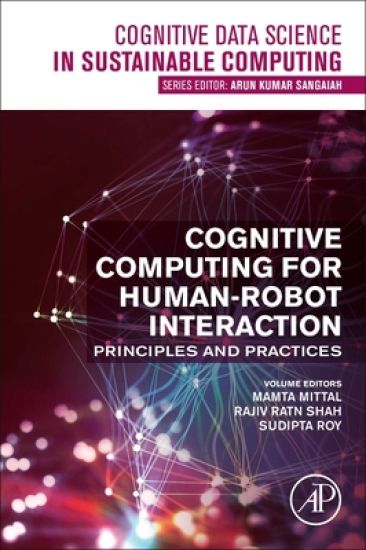
Cognitive Computing for Human-Robot Interaction
Cognitive Computing for Human-Robot Interaction: Principles and Practices explores the efforts that should ultimately enable society to take advantage of the often-heralded potential of robots to provide economical and sustainable computing applications. This book discusses each of these applications, presents working implementations, and combines coherent and original deliberative architecture for human–robot interactions (HRI). Supported by experimental results, it shows how explicit knowledge management promises to be instrumental in building richer and more natural HRI, by pushing for pervasive, human-level semantics within the robot's deliberative system for sustainable computing applications. This book will be of special interest to academics, postgraduate students, and researchers working in the area of artificial intelligence and machine learning. Key features: Introduces several new contributions to the representation and management of humans in autonomous robotic systems; Explores the potential of cognitive computing, robots, and HRI to generate a deeper understanding and to provide a better contribution from robots to society; Engages with the potential repercussions of cognitive computing and HRI in the real world.
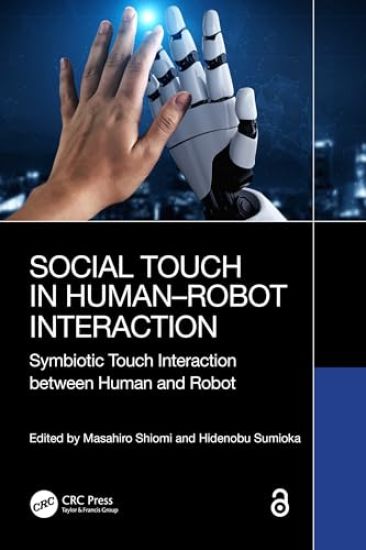
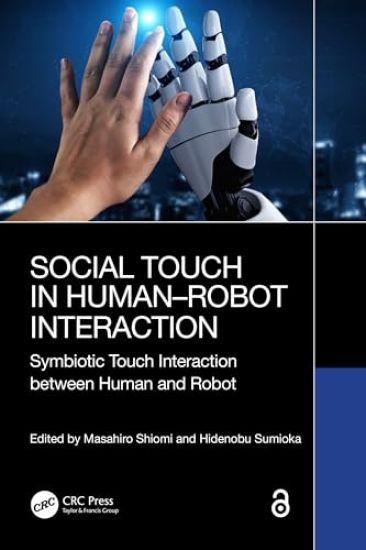
Social Touch in Human–Robot Interaction
In this book for researchers and students, editors Shiomi and Sumioka bring together contributions from researchers working on the CREST project at ATR Deep Interaction Laboratories, a world leader in social robotics, to comprehensively describe robot touch systems from hardware to applications. Appropriate touch from robots to humans is essential for social robots, but achieving this requires various solutions at every stage of the touch process. Through this book, readers will gain an understanding of the needs, essential systems and communication cues, behaviour designs, and real-world issues for social touch applications. This book compiles and updates technical and empirical research that was previously scattered throughout the literature into a single volume. Through individually authored chapters addressing various elements of ATR’s CREST project, this book tackles key areas where understanding is needed to realize acceptable touch interaction, including pre-touch interaction, interaction design for touching and being touched, behaviour changes caused by touch interaction, and applications of social touch interaction. It introduces a touch sensor and robots developed by the authors, including several touch-related behaviours and design policies. This approach will enable readers to easily apply this knowledge to their own social robotics programs. This book is invaluable for anyone who wishes to understand and develop social robots that physically interact with people. It is most beneficial for researchers and upper undergraduate and graduate students in the fields of human–robot/agent/computer interaction and social touch interaction and those in the broader fields of engineering, computer science, and cognitive science.
Social Touch in Human–Robot Interaction
In this book for researchers and students, editors Shiomi and Sumioka bring together contributions from researchers working on the CREST project at ATR Deep Interaction Laboratories, a world leader in social robotics, to comprehensively describe robot touch systems from hardware to applications.Appropriate touch from robots to humans is essential for social robots, but achieving this requires various solutions at every stage of the touch process. Through this book, readers will gain an understanding of the needs, essential systems and communication cues, behaviour designs, and real-world issues for social touch applications. This book compiles and updates technical and empirical research that was previously scattered throughout the literature into a single volume. Through individually authored chapters addressing various elements of ATR’s CREST project, this book tackles key areas where understanding is needed to realize acceptable touch interaction, including pre-touch interaction, interaction design for touching and being touched, behaviour changes caused by touch interaction, and applications of social touch interaction. It introduces a touch sensor and robots developed by the authors, including several touch-related behaviours and design policies. This approach will enable readers to easily apply this knowledge to their own social robotics programs. This book is invaluable for anyone who wishes to understand and develop social robots that physically interact with people.It is most beneficial for researchers and upper undergraduate and graduate students in the fields of human–robot/agent/computer interaction and social touch interaction and those in the broader fields of engineering, computer science, and cognitive science.
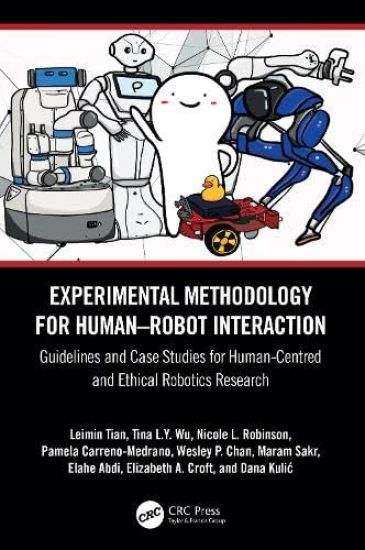
Experimental Methodology for Human–Robot Interaction

Experimental Methodology for Human–Robot Interaction

Leimin Tian; Tina L.Y. Wu; Nicole L. Robinson; Pamela Carreno-Medrano; Wesley P. Chan; Maram Sakr; Elahe Abdi; Elizabeth A. Croft; Dana Kulic

TAYLOR FRANCIS LTD
2025
sidottu
Leading figures in Australian robotics research provide an overview and guidance for human–robot interaction (HRI) experimental design and evaluation methodologies that consider the ethical implications of the research and its applications from a human-centred and contextual perspective. The authors explain introductory and advanced topics in HRI with a focus on human-centred evaluation and ethical practices. They also provide an online interactive checklist tool for novice HRI researchers and students to deploy when designing their own studies.The book is structured into three parts. In Part I, the authors first review fundamental methodologies and provide an interactive checklist tool of the HRI experimental study life cycle to guide beginners to the field. Part II introduces an expanded set of approaches to support researchers and practitioners to create high-quality study designs that draw on practices from human-computer interaction, human-centred artificial intelligence, psychology and social science, and advance ethical HRI research. Finally, in Part III, the authors discuss a selection of HRI studies as examples of how the introduced methodologies are adopted, which will support the readers to further understand the fundamental and advanced methodologies described in Parts I and II. The diverse collection of case studies enables readers to grasp the state of the art and apply what they have learned in their own practices.This book is a vital resource for both students new to the field and experienced researchers and practitioners. The book’s practical focus and clear elucidation of relevant case studies, from its introduction to the HRI experimental study life cycle through to advanced methods emerging in the field, ensures that this will greatly benefit progress in the field with human-centred and ethical experimental methodology.
Culture and Human-Robot Interaction in Militarized Spaces
Explosive Ordnance Disposal (EOD) personnel are some of the most highly trained people in the military, with a job description that spans defusing unexploded ordnance to protecting VIP’s and state dignitaries. EOD are also one of the first military groups to work with robots every day. These robots have become an increasingly important tool in EOD work, enabling people to work at safer distances in many dangerous situations. Based on exploratory research investigating interactions between EOD personnel and the robots they use, this study richly describes the nuances of these reciprocal influences, especially those related to operator emotion associated with the robots. In particular, this book examines the activities, processes and contexts that influence or constrain everyday EOD human-robot interactions, what human factors are shaping the (robotic) technology and how people and culture are being changed by using it. The findings from this research have implications for future personnel training, and the refinement of robot design considerations for many fields that rely on critical small group communication and decision-making skills.
Culture and Human-Robot Interaction in Militarized Spaces
Explosive Ordnance Disposal (EOD) personnel are some of the most highly trained people in the military, with a job description that spans defusing unexploded ordnance to protecting VIP’s and state dignitaries. EOD are also one of the first military groups to work with robots every day. These robots have become an increasingly important tool in EOD work, enabling people to work at safer distances in many dangerous situations. Based on exploratory research investigating interactions between EOD personnel and the robots they use, this study richly describes the nuances of these reciprocal influences, especially those related to operator emotion associated with the robots. In particular, this book examines the activities, processes and contexts that influence or constrain everyday EOD human-robot interactions, what human factors are shaping the (robotic) technology and how people and culture are being changed by using it. The findings from this research have implications for future personnel training, and the refinement of robot design considerations for many fields that rely on critical small group communication and decision-making skills.
Learn AI and Human-Robot Interaction from Asimov's I, Robot Stories: Robotics Through Science Fiction vol. 2
Learn about artificial intelligence and human-robot interaction by reading nine famous short stories, each accompanied by an explanation of the real science at the level of a TED talk.Artificial intelligence for robots may be the most transformative technology of the future digital revolution. But AI isn't just about the algorithms on the inside of the robot, it is also about how those algorithms will impact how we humans will work with robots. This critical field of study is called human-robot interaction: how we give commands to robots either explicitly or implicitly, how well they will be able to follow our directions and intent, and whether artificial intelligence will really lead to a robot uprising.Learn AI and Human-Robot Interaction from Asimov's I, Robot Stories provides an introduction to human-robot interaction for the layperson, from advanced high school students to managers to fans of Bill Nye and Neil deGrasse Tyson to students and teachers looking for a supplemental textbook for formal courses in artificial intelligence and robotics. It is a companion to Isaac Asimov's I, Robot collection of his most famous and entertaining stories in the world about robots, including the one that introduced the Three Laws of Robotics. Each of the stories unintentionally illustrates one or more core concepts in human-robot interaction: how verbal and non-verbal communication works; the flaws in the Three Laws of Robotics; the Uncanny Valley; transparency and visibility; trust; how robots reason; the types of user interfaces; and if a robot can have full moral agency. In this companion book, each I, Robot story is accompanied by description of how the science behind the core concept works at the level of a TED talk. In the last chapter, the book pulls together the principles illustrated in the different stories into a comprehensive overview of the field of human-robot interaction, highlighting the challenges, and opportunities, of building artificially intelligent systems and the ethical implications. The book also provides study questions that can be used for self-study, home schooling, or in a classroom. Prof. Robin R. Murphy is one of the founders of the field of human-robot interaction, an award winning textbook author, a TED talk speaker, and has been declared one of the 30 Most Innovative Women Professors Alive Today by The Best Master's Degrees and one of the most influential women in technology. Her interest in human-robot interaction resulted from her field work in using robots for disaster response. As she participated in disasters such as the 9/11 World Trade Center, Hurricane Harvey, and the Fukushima Daiichi nuclear accident, she documented that the robots physically worked but there was an unusually high rate of human error, frustration, and fatigue. Murphy frequently appears on CNN, NBC, NPR, Popular Science, NY Times, and the popular press. As an Innovative Teaching Faculty Fellow at Texas A&M, she pursues more engaging forms of education, particularly the use of science fiction to enable students to better visualize the abstract concepts in artificial intelligence, how the algorithms actually work, what would be the impact on systems design, and explore the ethics of artificial intelligence. This resulted in her Robotics Through Science Fiction blog, her book 2018 book Robotics Through Science Fiction: Artificial Intelligence Explained Through Six Classic Robot Short Stories, and her ongoing column on science fiction and science fact for Science Robotics, one of the top scientific journals.
Discovering the Frontiers of Human-Robot Interaction

Discovering the Frontiers of Human-Robot Interaction

Springer International Publishing AG
2024
sidottu
The field of Human-Robot Interaction (HRI) is rapidly evolving, blurring the lines between human and machine capabilities. Recent advances in computer science, computer vision, artificial intelligence, robotics, brain-computer interfaces, neural engineering, and cognitive science have profoundly transformed HRI. As we stand on the threshold of a new era characterized by increasingly sophisticated human-machine interactions, it becomes imperative to explore the emerging frontiers of this dynamic field. Robots are now entering homes, workplaces, and even battlefields, necessitating a deeper understanding of effective, safe, and ethical human-robot interaction. This book delves into cutting-edge research shaping the future of HRI, representing a collective effort to navigate uncharted territories. Through diverse chapters authored by leading experts, it offers a comprehensive exploration of the latest developments, challenges, and opportunities in HRI. By examining technical, engineering, and methodological challenges, this volume brings together perspectives from researchers, engineers, and designers to provide a comprehensive view of this dynamic field. Aiming to showcase groundbreaking research and spark interdisciplinary dialogue and collaboration, this book is a valuable resource for researchers, engineers, students, and anyone interested in the future of human-robot collaboration. Whether you are a seasoned roboticist, a curious student, or simply interested in future technology, this book offers insights and knowledge to navigate the complex world of human-robot interaction. Join us on this journey of discovery as we navigate the emerging frontiers of human-robot interaction together.
Smart Maintenance for Human–Robot Interaction

Smart Maintenance for Human–Robot Interaction

Bo Xing; Tshilidzi Marwala

Springer International Publishing AG
2017
sidottu
This self-contained book, written by active researchers, presents up-to-date information on smart maintenance strategies for human–robot interaction (HRI) and the associated applications of novel search algorithms in a single volume, eliminating the need to consult scattered resources. Unlike other books, it addresses maintaining a smart HRI from three dimensions, namely, hardware, cyberware, and hybrid-asset management, covering problems encountered in each through a wide variety of representative examples and elaborated illustrations. Further, the diverse mathematical models and intelligent systems constructions make the book highly practical. It enables readers interested in maintenance, robotics, and intelligent systems but perplexed by myriads of interrelated issues to grasp basic methodologies. At the same time, the referenced literature can be used as a roadmap for conducting deeper researches.
Smart Maintenance for Human–Robot Interaction

Smart Maintenance for Human–Robot Interaction

Bo Xing; Tshilidzi Marwala

Springer International Publishing AG
2018
nidottu
This self-contained book, written by active researchers, presents up-to-date information on smart maintenance strategies for human–robot interaction (HRI) and the associated applications of novel search algorithms in a single volume, eliminating the need to consult scattered resources. Unlike other books, it addresses maintaining a smart HRI from three dimensions, namely, hardware, cyberware, and hybrid-asset management, covering problems encountered in each through a wide variety of representative examples and elaborated illustrations. Further, the diverse mathematical models and intelligent systems constructions make the book highly practical. It enables readers interested in maintenance, robotics, and intelligent systems but perplexed by myriads of interrelated issues to grasp basic methodologies. At the same time, the referenced literature can be used as a roadmap for conducting deeper researches.
Emotional Design in Human-Robot Interaction

Emotional Design in Human-Robot Interaction

Springer International Publishing AG
2019
sidottu
While social robots participation increases in everyday human life, their presence in diverse contexts and situations is expected. At the same point, users tend to become more demanding regarding their roles, abilities, behaviour and appearance. Thus, designers and developers are confronted with the need to design more sophisticated robots that can produce such a positive reaction from users so as to become well accepted in various cases of use. Like this, Human-Robot Interaction has become a developing area. Emotions are an important part in human life, since they mediate the interaction with other humans, entities and/or products. In recent years, there has been an increase in the importance of emotions applied to the design field, giving rise to the so-called Emotional Design area. In the case of Human-Robot Interaction, the emotional design can help to elicit (e.g., pleasurable) or prevent (e.g., unpleasant) emotional/affective reactions/responses. This book gives a practical introduction to emotional design in human-robot interaction and supports designers with knowledge and research tools to help them take design decisions based on a User-Centred Design approach. It should also be useful to people interested in design processes, even if not directly related to the design of social robots but, instead, to other technology-based artefacts. The text is meant as a reference source with practical guidelines and advice for design issues.
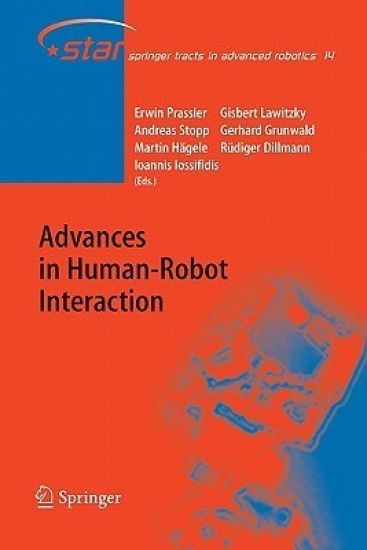
Advances in Human-Robot Interaction

Advances in Human-Robot Interaction

Springer-Verlag Berlin and Heidelberg GmbH Co. K
2004
sidottu
"Advances in Human-Robot Interaction" provides a unique collection of recent research in human-robot interaction. It covers the basic important research areas ranging from multi-modal interfaces, interpretation, interaction, learning, or motion coordination to topics such as physical interaction, systems, and architectures. The book addresses key issues of human-robot interaction concerned with perception, modelling, control, planning and cognition, covering a wide spectrum of applications. This includes interaction and communication with robots in manufacturing environments and the collaboration and co-existence with assistive robots in domestic environments. Among the presented examples are a robotic bartender, a new programming paradigm for a cleaning robot, or an approach to interactive teaching of a robot assistant in manufacturing environment. This carefully edited book reports on contributions from leading German academic institutions and industrial companies brought together within MORPHA, a 4 year project on interaction and communication between humans and anthropomorphic robot assistants.
Advances in Human-Robot Interaction

Advances in Human-Robot Interaction

Springer-Verlag Berlin and Heidelberg GmbH Co. K
2010
nidottu
"Advances in Human-Robot Interaction" provides a unique collection of recent research in human-robot interaction. It covers the basic important research areas ranging from multi-modal interfaces, interpretation, interaction, learning, or motion coordination to topics such as physical interaction, systems, and architectures. The book addresses key issues of human-robot interaction concerned with perception, modelling, control, planning and cognition, covering a wide spectrum of applications. This includes interaction and communication with robots in manufacturing environments and the collaboration and co-existence with assistive robots in domestic environments. Among the presented examples are a robotic bartender, a new programming paradigm for a cleaning robot, or an approach to interactive teaching of a robot assistant in manufacturing environment. This carefully edited book reports on contributions from leading German academic institutions and industrial companies brought together within MORPHA, a 4 year project on interaction and communication between humans and anthropomorphic robot assistants.
Mixed Reality and Human-Robot Interaction
MR technologies play an increasing role in different aspects of human-robot interactions. The visual combination of digital contents with real working spaces creates a simulated environment that is set out to enhance these aspects. This book presents and discusses fundamental scientific issues, technical implementations, lab testing, and industrial applications and case studies of Mixed Reality in Human-Robot Interaction. It is a reference book that not only acts as meta-book in the field that defines and frames Mixed Reality use in Human-Robot Interaction, but also addresses up-coming trends and emerging directions of the field.This volume offers a comprehensive reference volume to the state-of-the-art in the area of MR in Human-Robot Interaction, an excellent mix of contributions from leading researcher/experts in multiple disciplines from academia and industry. All authors are experts and/or top researchers in their respective areas and each of the chapters has been rigorously reviewed for intellectual contents by the editorial team to ensure a high quality. This book provides up-to-date insight into the current research topics in this field as well as the latest technological advancements and the best working examples.