Kirjojen hintavertailu. Mukana 11 342 296 kirjaa ja 12 kauppaa.

Kirjahaku

Etsi kirjoja tekijän nimen, kirjan nimen tai ISBN:n perusteella.

1000 tulosta hakusanalla "Madison"

Madison's Nightmare

Madison's Nightmare

Peter M. Shane

University of Chicago Press
2016
nidottu
The George W. Bush administration’s ambitious—even breathtaking—claims of unilateral executive authority raised deep concerns among constitutional scholars, civil libertarians, and ordinary citizens alike. But Bush’s attempts to assert his power are only the culmination of a near-thirty-year assault on the basic checks and balances of the U.S. government—a battle waged by presidents of both parties, and one that, as Peter M. Shane warns in Madison’s Nightmare, threatens to utterly subvert the founders’ vision of representative government.Tracing this tendency back to the first Reagan administration, Shane shows how this era of "aggressive presidentialism" has seen presidents exerting ever more control over nearly every arena of policy, from military affairs and national security to domestic programs. Driven by political ambition and a growing culture of entitlement in the executive branch—and abetted by a complaisant Congress, riven by partisanship—this presidential aggrandizement has too often undermined wise policy making and led to shallow, ideological, and sometimes outright lawless decisions. The solution, Shane argues, will require a multipronged program of reform, including both specific changes in government practice and broader institutional changes aimed at supporting a renewed culture of government accountability.From the war on science to the mismanaged war on terror, Madison’s Nightmare outlines the disastrous consequences of the unchecked executive—and issues a stern wake-up call to all who care about the fate of our long democratic experiment.
Madison's Nightmare

Madison's Nightmare

Peter M. Shane

University of Chicago Press
2009
sidottu
In recent years, the Bush administration's ambitious - even breathtaking - claims of unilateral executive authority have properly raised concerns among constitutional scholars, civil libertarians, and ordinary citizens alike. But Bush's attempts to assert his power are only the latest development in a near-thirty-year assault on the basic checks and balances of the U.S. government - a battle waged by presidents of both parties, and one that, as Peter M. Shane warns in "Madison's Nightmare", threatens to utterly subvert the founders' vision of representative government. Tracing this tendency back to the first Reagan administration, Shane shows how this era of 'aggressive presidentialism' has seen presidents exerting ever more control over nearly every arena of policy, from military affairs and national security to domestic programs. Driven by political ambition and a growing culture of entitlement in the executive branch - and abetted by a complaisant Congress, riven by partisanship - this presidential aggrandizement has too often undermined wise policy making and led to shallow, ideological, and sometimes outright lawless decisions. The solution, Shane argues, will require a multipronged program of reform, including both specific changes in government practice and broader institutional changes aimed at supporting a renewed culture of government accountability. From the war on science to the mismanaged war on terror, "Madison's Nightmare" outlines the disastrous consequences of the unchecked executive - and issues a stern wake-up call to all who care about the fate of our long democratic experiment.

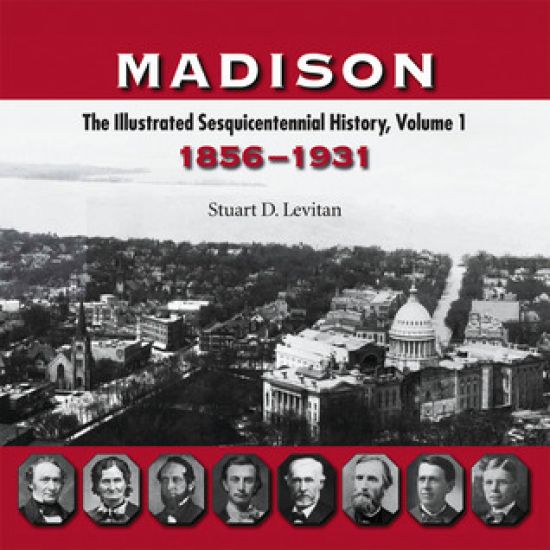
Madison v. 1; 1856-1931

Madison v. 1; 1856-1931

Stuart D. Levitan

University of Wisconsin Press
2006
nidottu
This engaging illustrated history, full of photographs, maps, and bird's-eye views, captures Madison's early history from its first days as a city to the Great Depression. Biographical vignettes tell the stories of early movers and shakers in the city. The volume includes many archival images of Madison that have never been published or have not been seen for a century or more. ""Every page and every illustration selection bears the stamp of Levitan's passionate and opinionated affection for his adopted hometown. Using a multitude of published and unpublished sources and the magnificent collections of photographs and illustrations available for Madison research, Levitan informs, entertains, engages, surprises, and, in some instances, will outrage. Historically informed Madison readers will have 'I never knew that' moments, and newcomers to the Madison area will be astounded to see the transformations wrought since Madison struggled into being in 1837 as a hamlet/capital. Madison historians who now refer offhandedly to Parks, Thwaites, and Mollenhoff have a new name to add to their list: Levitan."" - Jack Holzhueter, historical consultant and retired editor, ""Wisconsin Magazine of History.
Madison Chefs

Madison Chefs

Lindsay Christians; Chris Hynes

UNIVERSITY OF WISCONSIN PRESS
2021
sidottu
Why do Salvatore’s tomato pies have the sauce on the top? Where did chef Tami Lax learn to identify mushrooms in the woods? How did Morris develop its signature ramen? Farm-to-table is a clichÉ, but its roots among the farmers and chefs of south-central Wisconsin are deep, vibrant, and resilient. From brats and burgers to bibimbap, Madison’s food scene looks substantially different than it did just a decade ago. Though the city has always been ahead of the locavore movement, a restaurant boom in the 2010s radically changed the dining landscape. Even when individual eateries close or chefs move on, their ideas, connections, and creativity have lasting power. Much larger cities have been unable to match the culinary variety, innovation, and depth of talent found in Wisconsin’s state capital. Lindsay Christians’s in-depth look at nine creative, intense, and dedicated chefs captures the reason why Madison’s food culture remains a gem in America’s Upper Midwest. This beautifully illustrated book will leave you salivating—or making reservations.
Madison Park

Madison Park

Eric L. Motley; Walter Isaacson

ZONDERVAN
2022
nidottu
Welcome to Madison Park, a small community in Alabama founded by freed slaves in 1880. And meet Eric Motley, a native son who came of age in this remarkable place where constant lessons in self-determination, hope, and unceasing belief in the American dream taught him everything he needed for his journey to the Oval Office as a special assistant to President George W. Bush.Eric grew up among people whose belief was to "give" and never turn away from your neighbor's need. There was Aunt Shine, the goodly matriarch who cared so much about young Motley's schooling that she would stand up in a crowded church and announce Eric's progress or his shortcomings. There was Old Man Salery, who secretly siphoned gasoline from his beat-up car into the Motleys' tank at night. There were Motley's grandparents, who bought books for Eric they couldn't afford, spending the last of their seed money. And there was Reverend Brinkley, a man of enormous faith and simple living. It was said that whenever the Reverend came your way, light abounded. Life in Madison Park wasn't always easy or fair, and Motley reveals personal and heartbreaking stories of racial injustice and segregation. But Eric shows how the community taught him everything he needed to know about love and faith.This charming, engaging, and deeply inspiring memoir will help you remember that we can create a world of shared values based on love and hope. It is a story that reveals the amazing power of faith in God and each other. If you're in search of hope during troubled times, look no further than Madison Park.
Madison Times

Madison Times

Douglas F Ingram

Douglas F. Ingram, Jr.
2022
pokkari
With the approach of her fortieth birthday, Chloe Murphy finds herself restless. She has a happy, stable marriage, and loves running the Madison Inn in Savannah with her husband, Royce, but she craves excitement and a break from the daily routine into which they have fallen. Guided by newfound friends, Chloe and Royce set out to explore their unrealized sexual fantasies.As they begin building an enticing profile they hope will attract potential playmates on a popular swingers' website, they uncover Chloe's exhibitionist streak, as well as Royce's creative talent for erotic photography. Their blog displaying the results of their exciting new shared hobby quickly becomes popular... but not all of their admirers are like-minded players in the Lifestyle.When a fan of Chloe's online persona stumbles onto her true identity, he becomes obsessed with her. How far will he go, and will Royce and Chloe escape his twisted plan?
Madison: God's Fingerprint 1.618

Madison: God's Fingerprint 1.618

A. V. Smith

R. R. Bowker
2019
nidottu
***2019 AUTHOR ACADEMY AWARD WINNER for BEST ROMANCE***While in College, Madison befriends a second-generation Colombian who gets bullied until she steps in. Madison receives more than a simple warm welcome when her friend takes her to visit Colombia for his family's gratitude. Unbeknownst to Madison, a familial bond is illuminated that changes her future. Love dares to awaken Madison's soul; however, with the darkness that surrounded her teenage years, she has constructed walls of protection. As passionate, erotic themes and emotional conflict shift her vision of the world, she is forced to face the event that paralyzed her father and sent her parents to prison. The murder of a family of three combined with a harassing phone call at work puts Madison on a collision course with the man who had her friend's father assassinated, and who tainted the narcotics found in her father's possession the night her life was forever changed.Madison is a woman with a tumultuous past struggling to escape her demons all the while blindsided by love at a poetry event. Longing to feel normal, Madison attempts to balance her desire for justice with her need for swift, deadly punishment. With the help of her grandmother and sister-friends, she discovers who she really is as well as the courage to let love in.
Madison’s Hand

Madison’s Hand

Mary Sarah Bilder

Harvard University Press
2017
nidottu
Winner of the Bancroft PrizeWinner of the James Bradford Best Biography Prize, Society for Historians of the Early American RepublicFinalist, Literary Award for Nonfiction, Library of VirginiaFinalist, George Washington PrizeJames Madison’s Notes on the 1787 Constitutional Convention have acquired nearly unquestioned authority as the description of the U.S. Constitution’s creation. No document provides a more complete record of the deliberations in Philadelphia or depicts the Convention’s charismatic figures, crushing disappointments, and miraculous triumphs with such narrative force. But how reliable is this account?“[A] superb study of the Constitutional Convention as selectively reflected in Madison’s voluminous notes on it…Scholars have been aware that Madison made revisions in the Notes but have not intensively explored them. Bilder has looked closely indeed at the Notes and at his revisions, and the result is this lucid, subtle book. It will be impossible to view Madison’s role at the convention and read his Notes in the same uncomplicated way again…An accessible and brilliant rethinking of a crucial moment in American history.”—Robert K. Landers, Wall Street Journal
Madison's Advice to My Country

Madison's Advice to My Country

Adrienne Koch

Princeton University Press
2015
pokkari
Miss Koch probes the essential meaning of Madison's political philosophy to locate his distinctive angle of vision. She considers three controlling themes in his political thought--liberty, justice, and union--and presents a profile of his mind and heart. The material in the book was originally presented as the Whig-Clio Bicentennial Lectures at Princeton University. Originally published in 1966. The Princeton Legacy Library uses the latest print-on-demand technology to again make available previously out-of-print books from the distinguished backlist of Princeton University Press. These editions preserve the original texts of these important books while presenting them in durable paperback and hardcover editions. The goal of the Princeton Legacy Library is to vastly increase access to the rich scholarly heritage found in the thousands of books published by Princeton University Press since its founding in 1905.
Madison's Advice to My Country

Madison's Advice to My Country

Adrienne Koch

Princeton University Press
2016
sidottu
Miss Koch probes the essential meaning of Madison's political philosophy to locate his distinctive angle of vision. She considers three controlling themes in his political thought--liberty, justice, and union--and presents a profile of his mind and heart. The material in the book was originally presented as the Whig-Clio Bicentennial Lectures at Princeton University. Originally published in 1966. The Princeton Legacy Library uses the latest print-on-demand technology to again make available previously out-of-print books from the distinguished backlist of Princeton University Press. These editions preserve the original texts of these important books while presenting them in durable paperback and hardcover editions. The goal of the Princeton Legacy Library is to vastly increase access to the rich scholarly heritage found in the thousands of books published by Princeton University Press since its founding in 1905.
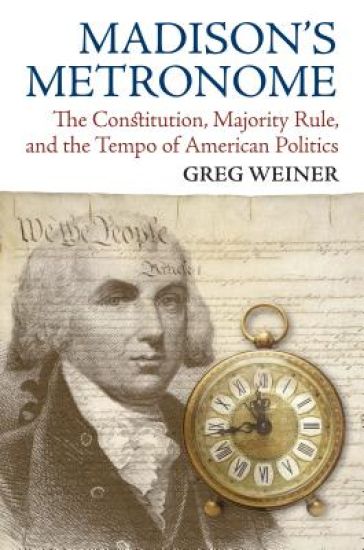
Madison's Metronome

Madison's Metronome

Greg Weiner

University Press of Kansas
2019
nidottu
In the wake of national crises and sharp shifts in the electorate, new members of Congress march off to Washington full of intense idealism and the desire for instant change—but often lacking in any sense of proportion or patience. This drive for instant political gratification concerned one of the key Founders, James Madison, who accepted the inevitability of majority rule but worried that an inflamed majority might not rule reasonably.Greg Weiner challenges longstanding suppositions that Madison harbored misgivings about majority rule, arguing instead that he viewed constitutional institutions as delaying mechanisms to postpone decisions until after public passions had cooled and reason took hold. In effect, Madison believed that one of the Constitution's primary functions is to act as a metronome, regulating the tempo of American politics.Weiner calls this implicit doctrine "temporal republicanism" to emphasize both its compatibility with and its contrast to other interpretations of the Founders' thought. Like civic republicanism, the "temporal" variety embodies a Set of values—public-spiritedness, respect for the rights of others-broader than the technical device of majority rule. Exploring this fundamental idea of time-seasoned majority rule across the entire range of Madison's long career, Weiner shows that it did not substantially change over the course of his life. He presents Madison's understanding of internal constitutional checks and his famous "extended republic" argument as different and complementary mechanisms for improving majority rule by slowing it down, not blocking it. And he reveals that the changes we see in Madison's views of majority rule arise largely from his evolving beliefs about who, exactly, was behaving impulsively—whether abusive majorities in the 1780s, the Adams regime in the 1790s, the nullifiers in the 1820s. Yet there is no evidence that Madison's underlying beliefs about either majority rule or the distorting and transient nature of passions ever swayed.If patience was a fact of life in Madison's day—a time when communication and travel were slow—it surely is much harder to cultivate in the age of the Internet, 24-hour news, and politics based on instant gratification. While many of today's politicians seem to wed supreme impatience with an avowed devotion to original constitutional principles, Madison's Metronome suggests that one of our nation's great luminaries would likely view that marriage with caution.
Madison v. Marshall

Madison v. Marshall

Guy Padula

Lexington Books
2001
sidottu
Popular Sovereignty or Natural Law? At a time of constitutional crisis in the American body politic, Guy Padula's timely and stimulating new work explores whether the answers to today's heated political debate can be found by scrutinizing the past. In Madison v. Marshall Padula turns the spotlight on the interpretive intent of America's Founding Fathers to discover if the consent of the people or the rule of justice triumphs. Comparing the constitutional theories of the Founding generation's two preeminent constitutional authorities, Padula shatters the Originalist myth that Madison and Marshall shared a compatible constitutional jurisprudence. He concludes that the meaning of the Constitution has been contested from the outset. This is essential reading for legal scholars, political scientists and historians seeking to learn more about the fundamental nature of U.S. law and how it should be interpreted.
Madison v. Marshall

Madison v. Marshall

Guy Padula

Lexington Books
2002
nidottu
Popular Sovereignty or Natural Law? At a time of constitutional crisis in the American body politic, Guy Padula's timely and stimulating new work explores whether the answers to today's heated political debate can be found by scrutinizing the past. In Madison v. Marshall Padula turns the spotlight on the interpretive intent of America's Founding Fathers to discover if the consent of the people or the rule of justice triumphs. Comparing the constitutional theories of the Founding generation's two preeminent constitutional authorities, Padula shatters the Originalist myth that Madison and Marshall shared a compatible constitutional jurisprudence. He concludes that the meaning of the Constitution has been contested from the outset. This is essential reading for legal scholars, political scientists and historians seeking to learn more about the fundamental nature of U.S. law and how it should be interpreted.