Kirjojen hintavertailu. Mukana 11 357 983 kirjaa ja 12 kauppaa.

Kirjahaku

Etsi kirjoja tekijän nimen, kirjan nimen tai ISBN:n perusteella.

991 tulosta hakusanalla "Meta"

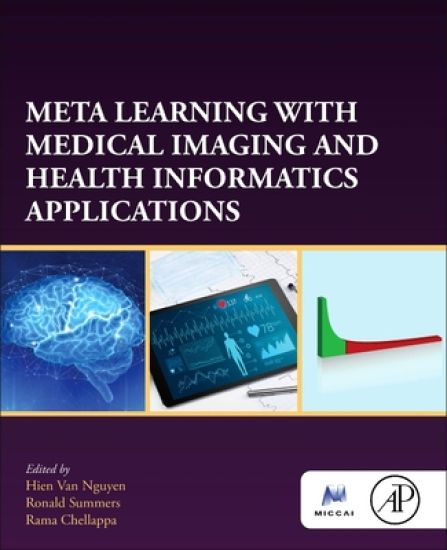
Meta Learning With Medical Imaging and Health Informatics Applications
Meta-Learning, or learning to learn, has become increasingly popular in recent years. Instead of building AI systems from scratch for each machine learning task, Meta-Learning constructs computational mechanisms to systematically and efficiently adapt to new tasks. The meta-learning paradigm has great potential to address deep neural networks’ fundamental challenges such as intensive data requirement, computationally expensive training, and limited capacity for transfer among tasks. This book provides a concise summary of Meta-Learning theories and their diverse applications in medical imaging and health informatics. It covers the unifying theory of meta-learning and its popular variants such as model-agnostic learning, memory augmentation, prototypical networks, and learning to optimize. The book brings together thought leaders from both machine learning and health informatics fields to discuss the current state of Meta-Learning, its relevance to medical imaging and health informatics, and future directions.
Meta-Formation

Meta-Formation

Rachel David

Lulu.com
2019
pokkari
Catalogue of contemporary artistic Ironwork accompanying the 2019 exhibition Meta-Formation: Experiments and Rituals. Curated, compiled and edited by Rachel David. Contributors and artists include Andy Cooperman, Sarah Darro, Hoss Haley, Daniel Miller, Jeffrey Funk, Monica Coyne, and Patrick Quinn. 30 North American and International artists represented.
Meta-Regulation in Practice

Meta-Regulation in Practice

F.C. Simon

Routledge
2019
nidottu
Meta-regulation presents itself as a progressive policy approach that can manage complexity and conflicting objectives better than traditional command and control regulation. It does this by ‘harnessing’ markets and enlisting a broad range of stakeholders to reach a more inclusive view of the public interest that a self-regulating business can then respond to.Based on a seventeen year study of the Australian energy industry, and via the lens of Niklas Luhmann’s systems theory, Meta-Regulation in Practice argues that normative meta-regulatory theory relies on questionable assumptions of stakeholder morality and rationality. Meta-regulation in practice appears to be most challenged in a complex and contested environment; the very environment it is supposed to serve best. Contending that scholarship must prioritise an understanding of communicative possibilities in practice, this book will be of interest to undergraduate and postgraduate students, as well as postdoctoral researchers interested in subjects such as business regulation, systems theory and corporate social responsibility.Please visit meta-regulation.com for more insightful information on meta-regulation and Meta-Regulation in Practice.
Meta-analysis of Binary Data Using Profile Likelihood

Meta-analysis of Binary Data Using Profile Likelihood

Dankmar Bohning; Sasivimol Rattanasiri; Ronny Kuhnert

CRC Press
2019
nidottu
Providing reliable information on an intervention effect, meta-analysis is a powerful statistical tool for analyzing and combining results from individual studies. Meta-Analysis of Binary Data Using Profile Likelihood focuses on the analysis and modeling of a meta-analysis with individually pooled data (MAIPD). It presents a unifying approach to modeling a treatment effect in a meta-analysis of clinical trials with binary outcomes.After illustrating the meta-analytic situation of an MAIPD with several examples, the authors introduce the profile likelihood model and extend it to cope with unobserved heterogeneity. They describe elements of log-linear modeling, ways for finding the profile maximum likelihood estimator, and alternative approaches to the profile likelihood method. The authors also discuss how to model covariate information and unobserved heterogeneity simultaneously and use the profile likelihood method to estimate odds ratios. The final chapters look at quantifying heterogeneity in an MAIPD and show how meta-analysis can be applied to the surveillance of scrapie. Containing new developments not available in the current literature, along with easy-to-follow inferences and algorithms, this book enables clinicians to efficiently analyze MAIPDs.
Meta-Analysis in Medicine and Health Policy
This remarkable text raises the analysis of data in health sciences and policy to new heights of refinement and applicability by introducing cutting-edge meta-analysis strategies while reviewing more commonly used techniques. Each chapter builds on sound principles, develops methodologies to solve statistical problems, and presents concrete applications used by experienced medical practitioners and health policymakers. Written by more than 30 celebrated international experts, Meta-Analysis in Medicine and Health Policy employs copious examples and pictorial presentations to teach and reinforce biostatistical techniques more effectively and poses numerous open questions of medical and health policy research.
Meta-Ethnographic Synthesis in Education
Calls for “deparochialization of educational research” (Lingard 2006) have directed educational ethnography from the conventional research designs and from the study of single sites and local situations to the study of “the circulation of cultural meanings, objects and identities in diffuse time-spaces” (Marcus 1995: 96). In response to this call and following the already established tradition of use of meta-ethnography in health studies this volume explores the potentials of this method (Noblit & Hare, 1988) to unpick the interconnectedness of different educational sites which have been and are being studied ethnographically. Besides, metaethnographic analyses may also offer a credible response to the lessening of opportunities for original educational ethnographic research at times of limited resources.The volume examines the forms of translocal and transtemporal ethnographic synthesis currently in use by educational ethnographers as well as the challenges and the possibilities that the method offers. It also addresses and attempts to respond to the question if meta-ethnography might be a means to sharpen ethnographers’ sensitivity for each other’s work and achievements in the past.This book was originally published as a special issue of Ethnography and Education.
Meta-Reality

Meta-Reality

Roy Bhaskar

Routledge
2026
sidottu
Meta-Reality emerged from the use of critical realist philosophy to address the fundamental philosophical questions; The nature of the self, The limits of thought, The possibility of personal freedom, The role of religion and spirituality in our lives.In this comprehensive introductory text, the originator of meta-Reality Roy Bhaskar talks the reader through the step by step emergence of his philosophy of meta-Reality, from his earlier philosophy of critical realism. The definition of this theory, and its potential to shed new light on issues is then explored in the book’s next eight chapters: Identity and the Self Transcendental Identification, Self-Realization and Freedom The Axial Revolution and Modernity Comparative Religion and Spirituality Unfolding the Enfolded: Creativity, Learning and Education Unconditional Love, Peace and Conflict Resolution ‘Unthinking’ and the Limits of Thought, Spontaneous Right Action and Re-enchanting Reality Conclusion and Summary: Being BeingThroughout this book, the examination of classical philosophical problems helps the reader to fully understand the author’s philosophy of meta-Reality, while at the same time exposing the reader to its implications for philosophical inquiry and the wider world. Frequent references are made to the philosophies that it is in conflict with (Descartes, Hobbes and Hume), and their differences are subjected to close scrutiny, helping to situate this new approach in the field. Here Roy Bhaskar has produced an essential text for all students of modern philosophy with an interest in critical realism. The book’s comprehensive approach, depth of analysis, and exploration of a wide range of philosophical problems make it crucial and compelling reading for the postgraduate and undergraduate alike.
Meta-Reality

Meta-Reality

Roy Bhaskar

Routledge
2026
nidottu
Meta-Reality emerged from the use of critical realist philosophy to address the fundamental philosophical questions; The nature of the self, The limits of thought, The possibility of personal freedom, The role of religion and spirituality in our lives.In this comprehensive introductory text, the originator of meta-Reality Roy Bhaskar talks the reader through the step by step emergence of his philosophy of meta-Reality, from his earlier philosophy of critical realism. The definition of this theory, and its potential to shed new light on issues is then explored in the book’s next eight chapters: Identity and the Self Transcendental Identification, Self-Realization and Freedom The Axial Revolution and Modernity Comparative Religion and Spirituality Unfolding the Enfolded: Creativity, Learning and Education Unconditional Love, Peace and Conflict Resolution ‘Unthinking’ and the Limits of Thought, Spontaneous Right Action and Re-enchanting Reality Conclusion and Summary: Being BeingThroughout this book, the examination of classical philosophical problems helps the reader to fully understand the author’s philosophy of meta-Reality, while at the same time exposing the reader to its implications for philosophical inquiry and the wider world. Frequent references are made to the philosophies that it is in conflict with (Descartes, Hobbes and Hume), and their differences are subjected to close scrutiny, helping to situate this new approach in the field. Here Roy Bhaskar has produced an essential text for all students of modern philosophy with an interest in critical realism. The book’s comprehensive approach, depth of analysis, and exploration of a wide range of philosophical problems make it crucial and compelling reading for the postgraduate and undergraduate alike.
Meta-Regression Analysis in Economics and Business

Meta-Regression Analysis in Economics and Business

T.D. Stanley; Hristos Doucouliagos

Routledge
2012
sidottu
The purpose of this book is to introduce novice researchers to the tools of meta-analysis and meta-regression analysis and to summarize the state of the art for existing practitioners. Meta-regression analysis addresses the rising "Tower of Babel" that current economics and business research has become. Meta-analysis is the statistical analysis of previously published, or reported, research findings on a given hypothesis, empirical effect, phenomenon, or policy intervention. It is a systematic review of all the relevant scientific knowledge on a specific subject and is an essential part of the evidence-based practice movement in medicine, education and the social sciences. However, research in economics and business is often fundamentally different from what is found in the sciences and thereby requires different methods for its synthesis—meta-regression analysis. This book develops, summarizes, and applies these meta-analytic methods.
Meta Analysis

Meta Analysis

Elena Kulinskaya; Stephan Morgenthaler; Robert G. Staudte

John Wiley Sons Inc
2008
nidottu
Meta Analysis: A Guide to Calibrating and Combining Statistical Evidence acts as a source of basic methods for scientists wanting to combine evidence from different experiments. The authors aim to promote a deeper understanding of the notion of statistical evidence. The book is comprised of two parts – The Handbook, and The Theory. The Handbook is a guide for combining and interpreting experimental evidence to solve standard statistical problems. This section allows someone with a rudimentary knowledge in general statistics to apply the methods. The Theory provides the motivation, theory and results of simulation experiments to justify the methodology. This is a coherent introduction to the statistical concepts required to understand the authors’ thesis that evidence in a test statistic can often be calibrated when transformed to the right scale.
Meta-Analysis of Controlled Clinical Trials

Meta-Analysis of Controlled Clinical Trials

Anne Whitehead

John Wiley Sons Inc
2002
sidottu
Over the last twenty years there has been a dramatic upsurge in the application of meta-analysis to medical research. This has mainly been due to greater emphasis on evidence-based medicine and the need for reliable summaries of the vast and expanding volume of clinical research. At the same time there have been great strides in the development and refinement of the associated statistical methodology. This book describes the planning, conduct and reporting of a meta-analysis as applied to a series of randomized controlled clinical trials. *The various approaches are presented within a general unified framework. *Meta-analysis techniques are described in detail, from their theoretical development through to practical implementation. *Each topic discussed is supported by detailed worked examples. *A comparison of fixed and random effects approaches is included, as well as a discussion of Bayesian methods and cumulative meta-analysis. *Fully documented programs using standard statistical procedures in SAS are available on the Web. Ideally suited for practising statisticians and statistically-minded medical professionals, the book will also be of use to graduate students of medical statistics. The book is a self-contained and comprehensive account of the subject and an essential purchase for anyone involved in clinical trials.
Meta-translation Lao Zi's Dao De Jing (1-37)

Meta-translation Lao Zi's Dao De Jing (1-37)

Auke Jacominus Schade

Nemonik-Thinking.Org
2018
nidottu
The title of Lao Zi's ancient book Dao De Jing means literally-A Classic about the Way of Nature and the Way of People. Dao De Jing aims to maximize your success, which is to obtain what you seek and escape what you suffer. Success is maximized by aligning the Way of People with the Way of Nature (Schade, Stunning Revelations about Lao Zi's Dao De Jing, 2017). Despite the great efforts, previous translations of Dao De Jing do not present an adequate understanding of that mysterious manuscript. In order to take optimal advantage of the expertise accumulated in such earlier studies, this meta-translation is based on an English meta-analysis and a Chinese meta-analysis. The English meta-analysis is based on the following English translations- (Chan Wing-Tsit, 1988); (Cheng Gia-Fu and English, J, 1972); (Henricks, 1993); (Land, 1990); (Lau, 1985); (Lin, J. P., 1977); (Man-ho Kwok; Palmer, M.; & Ramsay, J., 1997); (Waley, 1968); and (Wing, 1986). The Chinese meta-analysis is based on the following Chinese versions of Dao De Jing- (Wang Bi, 226-249 AD); (He-Shang Gong, 179-157 BC); (Fu Yi, 555-639 AD); (Mawangdui-A, 200 BC); (Mawangdui-B, 200 BC); and (Guodian, 300 BC). This meta-translation of Dao (Chapters 1-37) is based on a special dictionary (Schade, Dictionary Lao Zi's Dao De Jing, 2018), while it is the foundation for (Schade, Lao Zi's Dao De Jing Demystified, 2017). Free PDF copies @ http: //nemonik-thinking.org/books.html
Meta-Religion

Meta-Religion

James W. Laine

University of California Press
2015
pokkari
Whereas many textbooks treat the subject of world religions in an apolitical way, as if each religion were a path for individuals seeking wisdom and not a discourse intimately connected with the exercise of power, James W. Laine treats religion and politics as halves of the same whole, tracing their relationship from the policies of Alexander the Great to the ideologies of modern Europe secularists, with stops in classical India, China, and the Islamic world. Meta-Religion is a groundbreaking text that brings power and politics to the fore of our understanding of world religions, placing religion at the center of world history. This synthetic approach is both transformative and enlightening as it presents a powerful model for thinking differently about what religion is and how it functions in the world. With images and maps to bring the narrative to life, Meta-Religion combines sophisticated scholarly critique with accessibility that students and scholar alike will appreciate.
Meta Work

Meta Work

Anastasia Wasko

Planet Dust Enterprises
2021
pokkari
Meta Work exemplifies the power of personal story to evoke catharsis in a healing journey. A cross between memoir, poetry, and narrative fiction, the new subgenre of autofiction is shown here to be an entry into an individual's inner world, allowing one the freedom to explore it without the strictures imposed by the aforementioned genres. Anastasia Wasko shows, by sharing her own journey as a person living in recovery with bipolar disorder, the power of this immersive tool to clarify, magnify, and ultimately transform one's own relationship with their internal challenge(s).
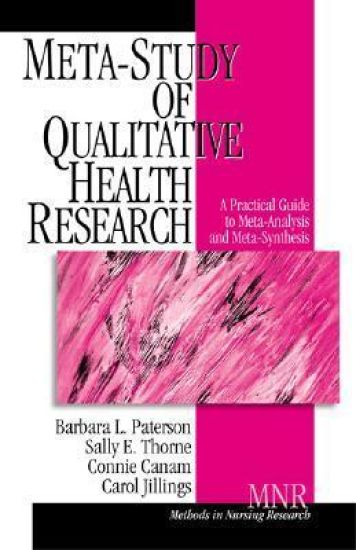
Meta-Study of Qualitative Health Research

Meta-Study of Qualitative Health Research

Barbara L. Paterson; Sally E. Thorne; Connie Canam; Carol Jillings

SAGE Publications Inc
2001
sidottu
"This book is a superior achievement from a group of masterful scholars. The book shows the theoretical, ethical, and political complexity of qualitative study, and yet offers an illuminating and useful guide to how it can be accomplished with distinction. I highly recommend it." —MARGARETE SANDELOWSKI, PhD, RN, FAAN Professor, School of Nursing University of North Carolina at Chapel Hill In this book, Volume 3 of the Methods in Nursing Research series, Barbara Paterson and colleagues provide step-by-step directions for how to proceed in conducting a meta-study, as well as recommendations for tools and standards relating to the application of their approach. Drawing from their experience with meta-study research projects on chronic illness, the authors articulate and theorize the meta-analysis and meta-synthesis of qualitatively derived knowledge.