Kirjojen hintavertailu. Mukana 11 627 220 kirjaa ja 12 kauppaa.

Kirjahaku

Etsi kirjoja tekijän nimen, kirjan nimen tai ISBN:n perusteella.

1000 tulosta hakusanalla "Polymers"

Polymers for Pharmaceutical and Biomedical Applications
Polymers for Pharmaceutical and Biomedical Applications: Fundamentals, Selection, and Preparation supports the successful selection, design, and development of polymers with the required properties and performance for a range of advanced pharmaceutical and biomedical applications. The book begins by introducing polymers for pharmaceutical and biomedical applications, examining classification, basic properties, structures, and grades. This is followed by in-depth chapters on synthesis and modification, characterization techniques, and dissolution and solubility of polymers for pharmaceutical applications. Key applications are highlighted, with chapters explaining the preparation of polymers for conventional dosage, modified drug delivery, conjugates, advanced drug and gene delivery, medical devices, pharmaceutical packaging, and more. Throughout the book, the aim is to provide accessible, step-by-step coverage supported by diagrams and case studies. This is a valuable resource for all those who are newly approaching the field of polymers and product development for pharmaceutical and biomedical applications. This includes researchers and advanced students across polymer science, pharmaceutical science, biomaterials, biomedicine, healthcare, and chemistry, and scientists and R&D professionals in an industrial setting.
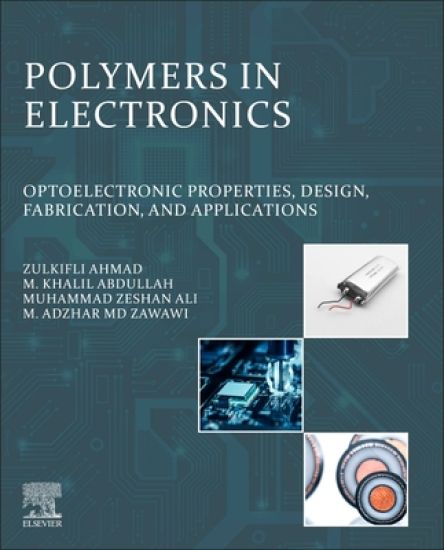
Polymers in Electronics

Polymers in Electronics

Zulkifli Ahmad; M. Khalil Abdullah; Muhammad Zeshan Ali; Mohamad Adzhar Md Zawawi

Elsevier - Health Sciences Division
2023
nidottu
Polymers in Electronics: Optoelectronic Properties, Design, Fabrication, and Applications brings together the fundamentals and latest advances in polymeric materials for electronic device applications, supporting researchers, scientists and advanced students, and approaching the topic from a range of disciplines. The book begins by introducing polymeric materials, their dielectric, optical, and thermal properties, and the essential principles and techniques for polymers as applied to electronics. This is followed by detailed coverage of the key steps in the preparation of polymeric materials for opto-electronic devices, including fabrication methods, materials design, rheology, encapsulation, and conductive polymer mechanisms. The final part of the book focuses on the latest developments in advanced devices, covering the areas of photovoltaics, transistors, light-emitting diodes, and stretchable electronics. In addition, it explains mechanisms, design, fabrication techniques, and end applications. This is a highly valuable resource for researchers, advanced students, engineers and R&D professionals from a range of disciplines.
Polymers for Dental and Orthopedic Applications
Recent advances not only in the creation of new polymers but also in their processing and production have ushered in huge strides in a variety of biomedical and clinical areas. Orthopedics and dentistry are two such areas that benefit immensely from developments in polymer science and technology. Polymers for Dental and Orthopedic Applications examines the most current topics in this expanding field with an emphasis on technological evolution and clinical impacts.Surveying major progress in polymer science and technology for dental, maxillofacial, and orthopedic applications, this book provides a unique illustration of the conceptual development of novel biomaterials and processes designed to meet targeted clinical needs. Two preeminent scientists lead a close-knit team of international experts with extensive experience in product development, bioengineering, education, and clinical applications. Ranging from polymeric materials for dental and maxillofacial application to joint repair and replacement, polymeric composites, and tissue engineering, the book also examines topics that are common to both dental and orthopedic fields, such as osseointegration and infection management. Explore the current status and future possibilities of polymeric biomaterials in Polymers for Dental and Orthopedic Applications. A unique blend of technical information and practical insight, this reference fosters the continued growth of a critically important field.
Polymers, Phosphors, and Voltaics for Radioisotope Microbatteries
Representing the collective effort of over 30 leading scientists in Russia and the United States, this is the first book written solely on the subject of nuclear batteries. It presents a rich historical discussion and original research on the conversion of nuclear materials into electrical power, which can then be harvested to make long-lasting, more energy efficient batteries. With this technology, power-matched supplies would last decades - even centuries - using safe, direct, long-life, stable, integrated electric power from the highest energy density source available. Polymers, Phosphors, and Voltaics for Radioisotope Microbatteries presents the state-of-the-art in interdisciplinary research in radiochemistry, tritium storage, semiconductor fabrication and characterization, nuclear battery fabrication and testing, integration into MEMS and other electronic devices, and much more. A key feature of this book is its discussion of construction materials for miniaturized radioisotope power supplies, since progress in nuclear battery technology depends on characterization of functionally radiation-stable components. Though substantial progress has been made to solve problems of using integrated radioisotope batteries for micro- and nanoelectronics, each author has provided an authoritative assessment and has indicated where development is needed. Research in this area has the potential to revolutionize the microelectronics industry by enabling MEMS and nanotechnology. Significant technological progress depends today on coordinated interdisciplinary research. Polymers, Phosphors, and Voltaics for Radioisotope Microbatteries contains diverse discussions of the problems of using radioactive material for microelectronic power needs and guides readers to future research in the area of long-life, high energy-density batteries.
Polymers for Controlled Drug Delivery

Polymers for Controlled Drug Delivery

Peter J. Tarcha

CRC Press
2019
nidottu
Polymers for Controlled Drug Delivery addresses the challenges of designing macromolecules that deliver therapeutic agents that function safely and in concert with living organisms. The book primarily discusses classes of polymers and polymeric vehicles, including particulates, such as latexes, coacervates, ion-exchange resins, and liposomes, as well as non-particulate vehicles such as enteric coatings, mediators, and bioadhesives. Other topics discussed include diffusion; biodegradation-controlled delivery; animal model studies for toxicity, metabolism, and elimination testing; and FDA requirements for clinical studies. Drug delivery researchers will find this book to be an invaluable reference tool.
Polymers in Drug Delivery
Together, the nano explosion and the genomic revolution are ushering in a new frontier in drug delivery. In recent years we’ve seen how polymers can play a crucial role in controlling the rate of drug release, enhancing solubility and uptake, and limiting degradation and toxicity. In the very near future, they may well be used to deliver gene therapy.While Polymers in Drug Delivery offers much new insight for the veteran specialist, this work has been compiled with the non-specialist in mind. It includes contributions from many of the world’s leading drug delivery specialists, yet avoids jargon and presents background information that initiates the next generation of scientists into the amazing work going on at the frontiers of this rapidly evolving science. Targeting specific issues at the forefront of drug delivery today, this engaging volume— · Outlines the issues that must be considered when selecting a polymer for fabricating a drug delivery agent or other medical devices · Explains the more commonly used methods by which polymers may be characterized prior to use · Profiles polymer matrices that have been used in the formulation of solid oral dosage forms, drug delivery scaffolds, and hydrogels · Examines the issues surrounding the encapsulation of biologics within microspheres · Explores the use of nanoparticulates, especially solid nanoparticles and nanocapsules prepared from largely-water-insoluble cyanoacrylate polymers · Discusses polymeric micelles and investigates the potential of soluble polymer prodrugs and polymer nanomedicines · Details the contribution made by polymers and dendrimers to the gene delivery effort, which may one day lead to effective treatments for largely incurable diseases Noting a dramatic paradigm shift that is bridging the gap between materials science and life science, the editor’s have compiled this volume to paint an interdisciplinary portrait of drug delivery that will challenge young scientists to turn their attention and effort towards this critical branch of biomedicine. Containing state-of-the-art information for drug delivery scientists, it is also a great choice for medical and pharmaceutical students and others seeking an in-depth introduction to the field.
Polymers in Concrete
Increasing attention is being given to the use of concrete-polymer composites as high performance and multi-functional materials in the construction industry, as well as in mechanical, electrical and chemical engineering. Particular interest is being given to these materials in Japan and other East Asian countries. This book forms the proceedings of the Second East Asia Symposium on Polymers in Concrete (II-EASPIC) held under the auspices of the Japan Charter of ICPIC (the International Congress on Polymers in Concrete). Papers are presented by international experts from thirteen different countries. Many aspects of the subject are discussed, including: new developments in the theory and practice of polymer composites; studies of their performance; appropriate manufacturing techniques and materials selection processes; their structural design; various types of concrete using polymers; methods of restoration and conservation using composites; overlays; adhesives and coating used in concrete works, special innovative developments and techniques for recycling.
Polymers in Energy Conversion and Storage
The research and development activities in energy conversion and storage are playing a significant role in our daily lives owing to the rising interest in clean energy technologies to alleviate the fossil-fuel crisis. Polymers are used in energy conversion and storage technology due to their low-cost, softness, ductility and flexibility compared to carbon and inorganic materials. Polymers in Energy Conversion and Storage provides in-depth literature on the applicability of polymers in energy conversion and storage, history and progress, fabrication techniques, and potential applications.Highly accomplished experts review current and potential applications including hydrogen production, solar cells, photovoltaics, water splitting, fuel cells, supercapacitors and batteries. Chapters address the history and progress, fabrication techniques, and many applications within a framework of basic studies, novel research, and energy applications.Additional Features Include:Explores all types of energy applications based on polymers and its compositesProvides an introduction and essential concepts tailored for the industrial and research communityDetails historical developments in the use of polymers in energy applicationsDiscusses the advantages of polymers as electrolytes in batteries and fuel cellsThis book is an invaluable guide for students, professors, scientists and R&D industrial experts working in the field.
Polymers in Energy Conversion and Storage
The research and development activities in energy conversion and storage are playing a significant role in our daily lives owing to the rising interest in clean energy technologies to alleviate the fossil-fuel crisis. Polymers are used in energy conversion and storage technology due to their low-cost, softness, ductility and flexibility compared to carbon and inorganic materials. Polymers in Energy Conversion and Storage provides in-depth literature on the applicability of polymers in energy conversion and storage, history and progress, fabrication techniques, and potential applications.Highly accomplished experts review current and potential applications including hydrogen production, solar cells, photovoltaics, water splitting, fuel cells, supercapacitors and batteries. Chapters address the history and progress, fabrication techniques, and many applications within a framework of basic studies, novel research, and energy applications.Additional Features Include:Explores all types of energy applications based on polymers and its compositesProvides an introduction and essential concepts tailored for the industrial and research communityDetails historical developments in the use of polymers in energy applicationsDiscusses the advantages of polymers as electrolytes in batteries and fuel cellsThis book is an invaluable guide for students, professors, scientists and R&D industrial experts working in the field.
Polymers at Interfaces

Polymers at Interfaces

G.J. Fleer; M.A. Cohen Stuart; J.M.H.M. Scheutjens; T. Cosgrove; B. Vincent

Chapman and Hall
1993
sidottu
This book is concerned with the configuration of polymers at the interfacial zone between two other phases or immiscible components. In recent years, developments in technology combined with increased attention from specialists in a wide range of fields have resulted in a considerable increase in our understanding of the behavior of polymers at interfaces. Inevitably these advances have generated a wealth of literature and although there have been numerous reviews, a critical treatment with adequate descriptions of both theory and experiment, including detailed analysis of the two, has been missing. This text hopes to fill this gap, providing a timely and comprehensive account of the field as it stands today. This long needed work will be invaluable to experts as well as newcomers in the broad field of polymers, interfaces and colloids, both in industry and academia. Whilst industrial laboratories involved in this field will find it indispensable, it will be equally important to anyone with an interest in interfacial polymer or colloidal research.
Polymers in Concrete
Increasing attention is being given to the use of concrete-polymer composites as high performance and multi-functional materials in the construction industry, as well as in mechanical, electrical and chemical engineering. Particular interest is being given to these materials in Japan and other East Asian countries. This book forms the proceedings of the Second East Asia Symposium on Polymers in Concrete (II-EASPIC) held under the auspices of the Japan Charter of ICPIC (the International Congress on Polymers in Concrete). Papers are presented by international experts from thirteen different countries. Many aspects of the subject are discussed, including: new developments in the theory and practice of polymer composites; studies of their performance; appropriate manufacturing techniques and materials selection processes; their structural design; various types of concrete using polymers; methods of restoration and conservation using composites; overlays; adhesives and coating used in concrete works, special innovative developments and techniques for recycling.
Polymers for Oral Drug Delivery Technologies

Polymers for Oral Drug Delivery Technologies

Elsevier - Health Sciences Division
2024
nidottu
Polymers for Oral Drug Delivery Technologies covers the fundamentals of oral drug delivery and various aspects of polymer technology in oral drug delivery, from classification and synthesis, to applications and regulatory factors. It presents the oral delivery of therapeutics for treating a number of diseases, along with the challenges of oral drug administration to assure a predictive and reproducible pharmacokinetic profile of active pharmaceutical ingredients (API). Polymers play an important role to achieve the targeted release profile consistently of an API in vivo by various functionalities like drug protection from gastric juice, fast release and supersaturation or release within a targeted area of the GI tract.
Polymers and Two-Dimensional Nanocomposites

Polymers and Two-Dimensional Nanocomposites

Elsevier - Health Sciences Division
2024
nidottu
Polymers and Two-Dimensional Nanocomposites provides a detailed review of recent progress in this important research field. The chapters cover new developments in synthesis methods, fabrication techniques, sample preparation methods, surface modification, characterization, methods of enhancing the properties of these materials and industrial applications in energy, environmental, oil and gas, sensors, corrosion, biomedical and structural applications. The book provides a valuable reference resource for academic and industrial researchers, materials scientists and engineers working in the fields of polymer science and engineering, polymer composites and nanocomposites.
Polymers for Electricity and Electronics

Polymers for Electricity and Electronics

Jiri George Drobny

John Wiley Sons Inc
2012
sidottu
The comprehensive, practical book that explores the principles, properties, and applications of electrical polymers The electrical properties of polymers present almost limitless possibilities for industrial research and development, and this book provides an in-depth look at these remarkable molecules. In addition to traditional applications in insulating materials, wires, and cables, electrical polymers are increasingly being used in a range of emerging technologies. Presenting a comprehensive overview of how electrical polymers function and how they can be applied in the electronics, automotive, medical, and military fields, Polymers for Electricity and Electronics: Materials, Properties, and Applications presents intensive and accessible coverage with a focus on practical applications. Including examples of state-of-the-art scientific issues, the book evaluates new technologies—such as light emitting diodes, molecular electronics, liquid crystals, nanotechnology, optical fibers, and soft electronics—and explains the advantages of conductive polymers as well as their processibility and commercial uses. This book is an essential resource for anyone working with, or interested in, polymers and polymer science. In addition, appendices that detail the electrical properties of selected polymers as well as list additional ASTM and corresponding international testing standards and methods for testing electrical properties are also included.
Polymers in Regenerative Medicine

Polymers in Regenerative Medicine

Manuel Monleon Pradas; Maria J. Vicent

John Wiley Sons Inc
2015
sidottu
Biomedical applications of Polymers from Scaffolds to Nanostructures The ability of polymers to span wide ranges of mechanical properties and morph into desired shapes makes them useful for a variety of applications, including scaffolds, self-assembling materials, and nanomedicines. With an interdisciplinary list of subjects and contributors, this book overviews the biomedical applications of polymers and focuses on the aspect of regenerative medicine. Chapters also cover fundamentals, theories, and tools for scientists to apply polymers in the following ways: Matrix protein interactions with synthetic surfacesMethods and materials for cell scaffoldsComplex cell-materials microenvironments in bioreactorsPolymer therapeutics as nano-sized medicines for tissue repair Functionalized mesoporous materials for controlled delivery Nucleic acid delivery nanocarriers Concepts include macro and nano requirements for polymers as well as future perspectives, trends, and challenges in the field. From self-assembling peptides to self-curing systems, this book presents the full therapeutic potential of novel polymeric systems and topics that are in the leading edge of technology.
Polymers From the Inside Out

Polymers From the Inside Out

Alan E. Tonelli

John Wiley Sons Inc
2001
sidottu
An introduction to polymers and how they dominate our world Polymer science is concerned with the structure, synthesis, physical properties, and utility of polymers. Polymers are macromolecular building blocks used to construct natural and man-made materials. Polymers from the Inside Out: An Introduction to Macromolecules provides an all-encompassing introduction to polymers and how they affect the world. Offering a clear explanation of the unique properties exhibited by polymers, this book explores the detailed microstructures of polymers and their internal responses to stress and the environment. Polymers from the Inside Out appeals to a wide range of disciplines, including polymer, organic, materials, and physical chemistry, as well as textile science and engineering. Chapters include:*Physical properties unique to polymeric materials *Step-growth and chain-growth polymerizations *Microstructures of polymers *Conformational characteristics of polymers developed with the rotational isomeric states model *Solution and bulk properties of polymers *Biopolymers *Discussion questions appropriate for first- and second-semester polymer students at the end of every chapterPolymers from the Inside Out is designed to facilitate either a one-semester or two-semester course on polymers and is an essential resource for the practicing scientist.
Polymers: Fibers and Textiles, A Compendium
Features carefully selected reprints from the world-renowned Encyclopedia of Polymer Science and Engineering. Contains complete articles written by leading authorities from industry, universities, and research institutes and provides specialists in the fields of fibers, textiles, and nonwoven fabrics with a wealth of information at their fingertips. The full texts, tables, figures, and references from the original work are reproduced here unchanged. Introductory material concerning nomenclature, SI units and conversion factors, and related information is included. Further enhanced by alphabetical organization, extensive cross references and a complete index.
Polymers: An Encyclopedic Sourcebook of Engineering Properties
This convenient desk reference is one of a series of volumes containing carefully selected reprints from the world-renowned Encyclopedia of Polymer Science and Engineering. It brings together the original, complete articles related to engineering properties of polymers and composites, with full text, tables, figures, and reference materials. All articles are by industrial or academic experts in their fields, and the final work has been carefully reviewed by specialists. Arranged alphabetically, the articles cover nearly every aspect of polymeric engineering materials, providing detailed information on methods of manufacture, properties, and uses. Cross-referenced, with an extensive index.
Polymers at Surfaces and Interfaces

Polymers at Surfaces and Interfaces

Richard A. L. Jones; Randal W. Richards

Cambridge University Press
1999
pokkari
This text deals from a fundamental viewpoint with the behaviour of polymers at surfaces and interfaces. Topics covered include the nature and properties of the surface of a polymer melt, the structure of interfaces between different polymers and between polymers and non-polymers, the molecular basis of adhesion, and the properties of polymers at liquid surfaces. Emphasis is placed on the underlying physical principles. Statistical mechanics models of the behaviour of polymers near interfaces are introduced, with the emphasis on theory that is tractable and applicable to experimental situations. Advanced undergraduates, graduate students and research workers in physics, chemistry and materials science with an interest in polymers will find this book of value.
Polymers in Oil and Gas Industry

Polymers in Oil and Gas Industry

Central West Publishing
2018
pokkari
Applications of polymers in various aspects of oil and gas industry are targeted in the book. These applications include enhanced oil recovery, oil spill clean up, membranes, adsorbents and coatings, among others. The majority of the chapters review the current state of art of the polymer applications in these areas. In addition, ample fundamental insights have been provided to make the readers aware about the importance of polymers and polymer nanotechnologies prevalent in oil and gas industry as well as to tune their performance to achieve certain set of properties useful for their applications. In summary, the book serves as a ready reference to not only the new researchers, chemical, petroleum and mechanical engineers, and plastic technologies, but also practicing scientists in both industry and academia. The book also serves as a reference text for the post graduate university students in materials, polymer, chemical, petroleum and mechanical engineering disciplines. For more details, please go to https: //centralwestpublishing.com