Kirjojen hintavertailu. Mukana 11 244 527 kirjaa ja 12 kauppaa.

Kirjahaku

Etsi kirjoja tekijän nimen, kirjan nimen tai ISBN:n perusteella.

1000 tulosta hakusanalla Adam J Pollack

Pick Me Up

Pick Me Up

Adam J. Kurtz

Tarcher/Putnam,US
2016
pokkari
A quirky, creative companion that offers a pick-me-up on every page On the heels of his internationally successful first book, 1 Page at a Time, graphic designer and illustrator Adam J. Kurtz delivers another intimate and engaging journal for anyone who loves to explore ideas, record thoughts and feelings, and capture those fleeting but amazing moments of everyday life. Unlike a linear journal, this book can be opened up to any page, encouraging and engaging readers time and time again through continued use. Rather than simply complete tasks and turn pages, users are encouraged to leave their mark, and if they land on the same page days or weeks later, they can review, reflect, and revise their previous response. Feeling lonely? Pensive? Peeved? Questioning? This deceptively simple book offers perspective, hope, and a twist of existential metaphor - and is perfect to pick up again and again.
Things Are What You Make of Them

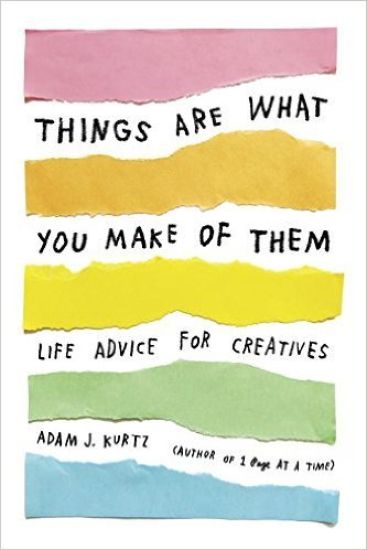
Things Are What You Make of Them

Adam J. Kurtz

Tarcher/Putnam,US
2017
nidottu
Insights and inspiration for anyone who makes art (or anything else) The Ultimate BuzzFeed Books Gift Guide - Official Selection From the creative mind and heart of designer Adam J. Kurtz comes this upbeat rallying cry for creators of all stripes. Expanding on a series of popular essays, this handwritten and heartfelt book shares wisdom and empathy from one working artist to others. Perforated tear-and-share pages make it easy to display themost crucial reminders or to pass a bit of advice on to someone who needs it. As wry and cheeky as it is empathic and empowering, this deceptively simple, vibrantly full-color book will be a touchstone for writers, artists, entrepreneurs, and anyone else who wants to be more creative--even when it would be easier to give up and act normal.
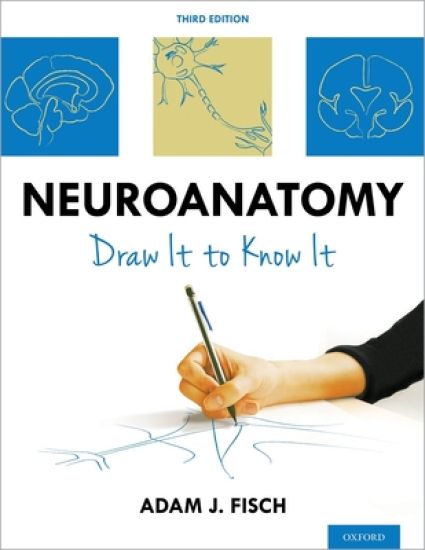
Neuroanatomy

Neuroanatomy

Adam J. Fisch

Oxford University Press Inc
2017
nidottu
Neuroanatomy: Draw It to Know It, Third Edition teaches neuroanatomy in a purely kinesthetic way. In using this book, the reader draws each neuroanatomical pathway and structure, and in the process, creates memorable and reproducible schematics for the various learning points in Neuroanatomy in a hands-on, enjoyable and highly effective manner. In addition to this unique method, Neuroanatomy: Draw It to Know It also provides a remarkable repository of reference materials, including numerous anatomic and radiographic brain images and illustrations from many other classic texts to enhance the learning experience. In the third edition of this now-classic text, the author completely reorganized the book based on user-feedback, taking a more intuitive and easy-to-use approach. For the first time, the illustrations are in full color. No other text in neuroanatomy engages the reader in as direct a manner as this book and none covers the advanced level of detail found while retaining the simplistic approach to the learning which has become the cornerstone of the text. Neuroanatomy: Draw It to Know It is singular in its ability to engage and instruct without overwhelming any level of neuroanatomy student.
Punishment for the Greater Good

Punishment for the Greater Good

Adam J. Kolber

OXFORD UNIVERSITY PRESS INC
2024
sidottu
Over ten million people are incarcerated throughout the world, even though punishment theorists have struggled for centuries to morally justify the practice. Theorists usually address criminal justice under abstract, idealized conditions that assume away real-world uncertainty. We don't have time, however, to wait for a perfect moral theory, and the history of philosophy suggests we will never find it.Punishment for the Greater Goodexamines the justification of punishment in the here and now, recognizing that we lack certainty about matters of both fact and value. Retributivists believe offenders deserve punishment because of their wrongdoing. They treat deserved punishment as intrinsically valuable. Adam Kolber argues that retributivism is too incomplete as a theory to address punishment at present and that the widely popular notion of proportional punishment at its core is both elusive and often undesirable. Rather than seeking retribution, we should reduce total societal suffering by deterring crime, incapacitating dangerous people, and hopefully rehabilitating them. Though this consequentialist approach has fallen out of favor in recent decades, Kolber argues that it is better suited to addressing punishment in the here and now than the approach commonly taken by retributivists. If consequentialism successfully justifies punishment, then contrary to some carceral abolitionists, at least some incarceration under some conditions is justified today. While we will rarely know how to punish for the greatest good, wecanseek to punish for the greater good.
Veiling Esther, Unveiling Her Story

Veiling Esther, Unveiling Her Story

Adam J. Silverstein

Oxford University Press
2018
sidottu
Veiling Esther, Unveiling Her Story: The Reception of a Biblical Book in Islamic Lands examines the ways in which the Biblical Book of Esther was read, understood, and used in Muslim lands, from ancient to modern times. It focuses on case studies covering works from various periods and regions of the Muslim world, including the Qur'an, pre-modern historical chronicles and literary works, the writings of a nineteenth-century Shia feminist, a twentieth-century Iranian encyclopaedia, and others. These case studies demonstrate that Muslim sources contain valuable materials on Esther, which shed light both on the Esther story itself and on the Muslim peoples and cultures that received it. Adam J. Silverstein argues that Muslim sources preserve important pre-Islamic materials on Esther that have not survived elsewhere, some of which offer answers to ancient questions about Esther, such as the meaning of Haman's epithet in the Greek versions of the story, the reason why Mordecai refused to prostrate before Haman, and the literary context of the 'plot of the eunuchs' to kill the Persian king. Throughout the book, Silverstein shows how each author's cultural and religious background influenced his or her understanding and retelling of the Esther story. In particular, he highlights that Persian Muslims (and Jews) were often forced to reconcile or choose between the conflicting historical narratives provided by their religious and cultural heritages respectively.
Islamic History

Islamic History

Adam J. Silverstein

Oxford University Press
2010
nidottu
Does history matter? This book argues not that history matters, but that Islamic history does. This Very Short Introduction introduces the story of Islamic history; the controversies surrounding its study; and the significance that it holds - for Muslims and for non-Muslims alike. Opening with a lucid overview of the rise and spread of Islam, from the seventh to twenty first century, the book charts the evolution of what was originally a small, localised community of believers into an international religion with over a billion adherents. Chapters are also dedicated to the peoples - Arabs, Persians, and Turks - who shaped Islamic history, and to three representative institutions - the mosque, jihad, and the caliphate - that highlight Islam's diversity over time. Finally, the roles that Islamic history has played in both religious and political contexts are analysed, while stressing the unique status that history enjoys amongst Muslims, especially compared to its lowly place in Western societies where history is often seen as little more than something that is not to be repeated. Some of the questions that will be answered are: · How did Islam arise from the obscurity of seventh century Arabia to the headlines of twenty first century media? · How do we know what we claim to know about Islam's rise and development? · Why does any of this matter, either to Muslims or to non-Muslims? ABOUT THE SERIES: The Very Short Introductions series from Oxford University Press contains hundreds of titles in almost every subject area. These pocket-sized books are the perfect way to get ahead in a new subject quickly. Our expert authors combine facts, analysis, perspective, new ideas, and enthusiasm to make interesting and challenging topics highly readable.
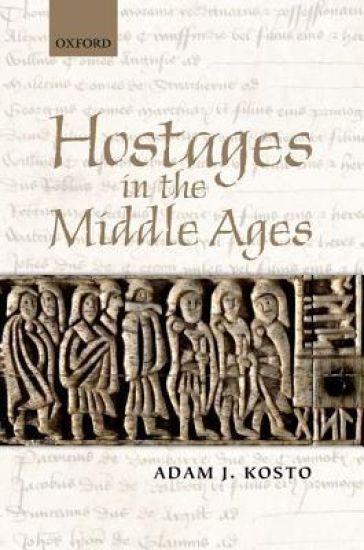
Hostages in the Middle Ages

Hostages in the Middle Ages

Adam J. Kosto

Oxford University Press
2012
sidottu
In medieval Europe hostages were given, not taken. They were a means of guarantee used to secure transactions ranging from treaties to wartime commitments to financial transactions. In principle, the force of the guarantee lay in the threat to the life of the hostage if the agreement were broken but, while violation of agreements was common, execution of hostages was a rarity. Medieval hostages are thus best understood not as simple pledges, but as a political institution characteristic of the medieval millennium, embedded in its changing historical contexts. In the Early Middle Ages, hostageship was principally seen in warfare and diplomacy, operating within structures of kinship and practices of alliance characteristic of elite political society. From the eleventh century, hostageship diversified, despite the spread of a legal and financial culture that would seem to have made it superfluous. Hostages in the Middle Ages traces the development of this institution from Late Antiquity through the period of the Hundred Years War, across Europe and the Mediterranean World. It explores the logic of agreements, the identity of hostages, and the conditions of their confinement, while shedding light on a wide range of subjects, from sieges and treaties, to captivity and ransom, to the Peace of God and the Crusades, to the rise of towns and representation, to political communication and shifting gender dynamics. The book closes by examining the reasons for the decline of hostageship in the Early Modern era, and the rise the modern variety of hostageship that was addressed by the Nuremberg tribunals and the United Nations in the twentieth century.
In Time of War

In Time of War

Adam J. Berinsky

University of Chicago Press
2009
sidottu
From World War II to the war in Iraq, periods of international conflict seem like unique moments in U.S. political history - but when it comes to public opinion, they are not. To make this groundbreaking revelation, "In Time of War" explodes conventional wisdom about American reactions to World War II, as well as the more recent conflicts in Korea, Vietnam, the Persian Gulf, Afghanistan, and Iraq. Adam J. Berinsky argues that public response to these crises has been shaped less by their defining characteristics - such as what they cost in lives and resources - than by the same political interests and group affiliations that influence our ideas about domestic issues. With the help of World War II - era survey data that had gone virtually untouched for the past sixty years, Berinsky begins by disproving the myth of 'the good war' that Americans all fell in line to support after the Japanese bombed Pearl Harbor. The attack, he reveals, did not significantly alter public opinion but merely punctuated interventionist sentiment that had already risen in response to the ways that political leaders at home had framed the fighting abroad. Weaving his findings into the first general theory of the factors that shape American war-time opinion, Berinsky also sheds new light on our reactions to other crises. He shows, for example, that our attitudes toward restricted civil liberties during Vietnam and after 9/11 stemmed from the same kinds of judgments we make during times of peace. With Iraq and Afghanistan now competing for attention with urgent issues within the United States, "In Time of War" offers a timely reminder of the full extent to which foreign and domestic politics profoundly influence - and ultimately illuminate - each other.
In Time of War

In Time of War

Adam J. Berinsky

University of Chicago Press
2009
nidottu
From World War II to the war in Iraq, periods of international conflict seem like unique moments in U.S. political history - but when it comes to public opinion, they are not. To make this ground breaking revelation, In "Time of War" explodes conventional wisdom about American reactions to World War II, as well as the more recent conflicts in Korea, Vietnam, the Persian Gulf, Afghanistan, and Iraq. Adam J. Berinsky argues that public response to these crises has been shaped less by their defining characteristics - such as what they cost in lives and resources - than by the same political interests and group affiliations that influence our ideas about domestic issues. With the help of World War II - era survey data that had gone virtually untouched for the past sixty years, Berinsky begins by disproving the myth of "the good war" that Americans all fell in line to support after the Japanese bombed Pearl Harbor. The attack, he reveals, did not significantly alter public opinion but merely punctuated interventionist sentiment that had already risen in response to the ways that political leaders at home had framed the fighting abroad. Weaving his findings into the first general theory of the factors that shape American wartime opinion, Berinsky also sheds new light on our reactions to other crises. He shows, for example, that our attitudes toward restricted civil liberties during Vietnam and after 9/11 stemmed from the same kinds of judgments we make during times of peace. With Iraq and Afghanistan now competing for attention with urgent issues within the United States, "In Time of War" offers a timely reminder of the full extent to which foreign and domestic politics profoundly influence - and ultimately illuminate - each other.
More Than a Feeling

More Than a Feeling

Adam J. Ramey; Jonathan D. Klingler; Gary E. Hollibaugh Jr.

University of Chicago Press
2017
sidottu
Whatever you think about the widening divide between Democrats and Republicans, ideological differences do not explain why politicians from the same parties, who share the same goals and policy preferences, often argue fiercely about how best to attain them. This perplexing misalignment suggests that we are missing an important piece of the puzzle. Political scientists have increasingly drawn on the relationship between voters' personalities and political orientation, but there has been little empirically grounded research looking at how legislators' personalities influence their performance on Capitol Hill. With More Than a Feeling, Adam J. Ramey, Jonathan D. Klingler, and Gary E. Hollibaugh, Jr. have developed an innovative framework incorporating what are known as the Big Five dimensions of personality openness to experience, conscientiousness, extraversion, agreeableness, and neuroticism to improve our understanding of political behavior among members of Congress. To determine how strongly individuals display these traits, the authors identified correlates across a wealth of data, including speeches, campaign contributions and expenditures, committee involvement, willingness to filibuster, and even Twitter feeds. They then show how we might expect to see the influence of these traits across all aspects of Congress members' political behavior from the type and quantity of legislation they sponsor and their style of communication to whether they decide to run again or seek a higher office. They also argue convincingly that the types of personalities that have come to dominate Capitol Hill in recent years may be contributing to a lot of the gridlock and frustration plaguing the American political system.
More Than a Feeling

More Than a Feeling

Adam J. Ramey; Jonathan D. Klingler; Gary E. Hollibaugh Jr.

University of Chicago Press
2017
nidottu
Whatever you think about the widening divide between Democrats and Republicans, ideological differences do not explain why politicians from the same parties, who share the same goals and policy preferences, often argue fiercely about how best to attain them. This perplexing misalignment suggests that we are missing an important piece of the puzzle. Political scientists have increasingly drawn on the relationship between voters' personalities and political orientation, but there has been little empirically grounded research looking at how legislators' personalities influence their performance on Capitol Hill. With More Than a Feeling, Adam J. Ramey, Jonathan D. Klingler, and Gary E. Hollibaugh, Jr. have developed an innovative framework incorporating what are known as the Big Five dimensions of personality openness to experience, conscientiousness, extraversion, agreeableness, and neuroticism to improve our understanding of political behavior among members of Congress. To determine how strongly individuals display these traits, the authors identified correlates across a wealth of data, including speeches, campaign contributions and expenditures, committee involvement, willingness to filibuster, and even Twitter feeds. They then show how we might expect to see the influence of these traits across all aspects of Congress members' political behavior from the type and quantity of legislation they sponsor and their style of communication to whether they decide to run again or seek a higher office. They also argue convincingly that the types of personalities that have come to dominate Capitol Hill in recent years may be contributing to a lot of the gridlock and frustration plaguing the American political system.
Weak Verb Morphology

Weak Verb Morphology

Adam J. Howell

ZONDERVAN
2025
nidottu
One of the obstacles to success in learning biblical Hebrew is understanding the various ways weak verbs inflect. Weak Verb Morphology by Adam J. Howell addresses the features and characteristics of the various weak verb patterns. With plenty of examples and thoughtful discussion, Howell's book helps to equip students to identify weak verbs and translate the biblical text with ease.Advancing Biblical Hebrew, edited by Miles V. Van Pelt, is an accessible book series intended for students wanting to press deeper in their Hebrew language acquisition. Each volume provides focused instruction in a specific linguistic category in order to better understand, translate, and interpret the Hebrew Bible. Individual volumes contain an introduction to the topic, a brief history of the topic, detailed descriptions of the topic with numerous examples, and suggested resources for further study.
Understanding and Applying Cryptography and Data Security
A How-to Guide for Implementing Algorithms and ProtocolsAddressing real-world implementation issues, Understanding and Applying Cryptography and Data Security emphasizes cryptographic algorithm and protocol implementation in hardware, software, and embedded systems. Derived from the author’s teaching notes and research publications, the text is designed for electrical engineering and computer science courses.Provides the Foundation for Constructing Cryptographic ProtocolsThe first several chapters present various types of symmetric-key cryptographic algorithms. These chapters examine basic substitution ciphers, cryptanalysis, the Data Encryption Standard (DES), and the Advanced Encryption Standard (AES). Subsequent chapters on public-key cryptographic algorithms cover the underlying mathematics behind the computation of inverses, the use of fast exponentiation techniques, tradeoffs between public- and symmetric-key algorithms, and the minimum key lengths necessary to maintain acceptable levels of security. The final chapters present the components needed for the creation of cryptographic protocols and investigate different security services and their impact on the construction of cryptographic protocols.Offers Implementation Comparisons By examining tradeoffs between code size, hardware logic resource requirements, memory usage, speed and throughput, power consumption, and more, this textbook provides students with a feel for what they may encounter in actual job situations.A solutions manual is available to qualified instructors with course adoptions.
Hans Mol and the Sociology of Religion
Hans Mol was born in the Netherlands during the 1920s. His imprisonment by the Gestapo during World War II began a long intellectual journey, exploring the role of religion in society. His work on the sociology of religion throughout the 20th and 21st Century is distinctive in its quest for both methodological and existential balancePart One of this book includes a brief outline of Mol’s most influential theory as originally explicated in Identity and the Sacred (1976). This is followed by a look at the initial reception of that theory in relation to the competing concepts of Mol’s contemporaries. Part Two is comprised of four previously-unpublished essays written by Mol during the 70s and 80s. Covering topics from evolution to evangelicalism, the papers display the sweeping ambition of this sociologist as well as the tone and contours of his intellectual articulation. In the Postscript this volume concludes with select transcripts of interviews conducted between Adam Powell and Hans Mol during the Spring of 2012. This volume of Mol’s work will be of keen interest to academics and students with an interest in the sociology of religion post-World War II and the development of contemporary Christian theology.
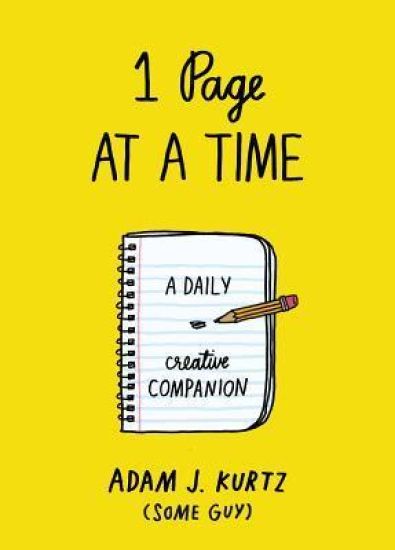
1 Page At A Time

1 Page At A Time

Adam J. Kurtz

Perigee Books,U.S.
2014
nidottu
Things are what you make of them Every day is a chance to create something new for yourself. Put down your phone and pick up a pencil. Give yourself some space. The Internet will still be there. Start with one page at a time, and you'll be surprised at just how much you can create. Each of the 365 prompts in 1 Page at a Time will encourage you to draw, write, list, reflect, and share. This book is your new best friend. Let's get started Now available in red, blue, and yellow
Making Agreements in Medieval Catalonia

Making Agreements in Medieval Catalonia

Adam J. Kosto

Cambridge University Press
2007
pokkari
This study examines the role of written agreements in eleventh- and twelfth-century Catalonia, and how they determined the social and political order. By tracing the fate of these agreements - or convenientiae - from their first appearance to the late twelfth century, it is possible to demonstrate the remarkable stability of the fluid structures which they engendered in what is generally thought of as 'feudal society'. The process of documentary change reveals the true nature and pace of the 'transformation of the year 1000'. Analysis of the convenientia as an instrument of power and its interaction with oral practices contributes to a deeper understanding of the role of the written word in medieval societies. Finally, a broad historiographical context establishes the significance of this study of Catalonia for a more general appreciation of the medieval Mediterranean world.
Physical Illness and Drugs of Abuse

Physical Illness and Drugs of Abuse

Adam J. Gordon

Cambridge University Press
2010
pokkari
The timely recognition of physical health problems in patients with severe mental disorders is emerging as an important priority in the medical health field. Although it is well known that persons with addictions to illicit substances often develop a variety of mental health and physical health conditions, the epidemiological associations between physical illness and addiction to illicit substances are poorly understood. This book comprehensively surveys recent literature to critically review the relationships between physical illness and drugs of abuse, describing the association between each of the principal classes of illicit drugs (cocaine, marijuana, opioids, and common hallucinogens and stimulants) and the major categories of physical illness. Clear summary tables accompany detailed discussions, providing the reader with a quick reference guide. Physical Illness and Drugs of Abuse will be essential reading for all health professionals, students, practising clinicians and policy makers with interests in mental health, public health and epidemiology.
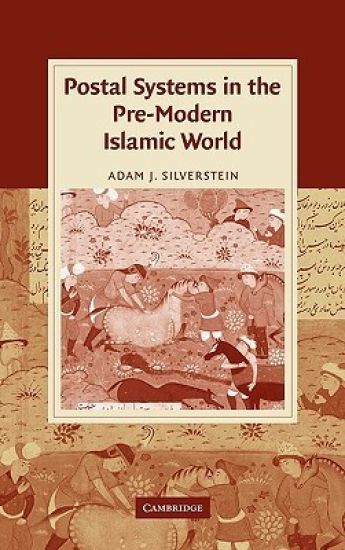
Postal Systems in the Pre-Modern Islamic World

Postal Systems in the Pre-Modern Islamic World

Adam J. Silverstein

Cambridge University Press
2010
pokkari
Adam Silverstein's book offers a fascinating account of the official methods of communication employed in the Near East from pre-Islamic times through the Mamluk period. Postal systems were set up by rulers in order to maintain control over vast tracts of land. These systems, invented centuries before steam-engines or cars, enabled the swift circulation of different commodities - from letters, people and horses to exotic fruits and ice. As the correspondence transported often included confidential reports from a ruler's provinces, such postal systems doubled as espionage-networks through which news reached the central authorities quickly enough to allow a timely reaction to events. The book sheds light not only on the role of communications technology in Islamic history, but also on how nomadic culture contributed to empire-building in the Near East. This is a long-awaited contribution to the history of pre-modern communications systems in the Near Eastern world.
Making Agreements in Medieval Catalonia

Making Agreements in Medieval Catalonia

Adam J. Kosto

Cambridge University Press
2001
sidottu
This study examines the role of written agreements in eleventh- and twelfth-century Catalonia, and how they determined the social and political order. By tracing the fate of these agreements - or convenientiae - from their first appearance to the late twelfth century, it is possible to demonstrate the remarkable stability of the fluid structures which they engendered in what is generally thought of as ‘feudal society’. The process of documentary change reveals the true nature and pace of the ‘transformation of the year 1000’. Analysis of the convenientia as an instrument of power and its interaction with oral practices contributes to a deeper understanding of the role of the written word in medieval societies. Finally, a broad historiographical context establishes the significance of this study of Catalonia for a more general appreciation of the medieval Mediterranean world.