Kirjojen hintavertailu. Mukana 11 244 527 kirjaa ja 12 kauppaa.

Kirjahaku

Etsi kirjoja tekijän nimen, kirjan nimen tai ISBN:n perusteella.

1000 tulosta hakusanalla Adolf Baumgartner

Adolf Hitler & the Third Reich

Adolf Hitler & the Third Reich

Zalampas

Bowling Green University Popular Press,US
1989
nidottu
The culmination of 30 years of writing about Philip Roth. This collection of essays, reviews, fulminations and daydreams, combines first impressions with conclusions that have been percolating for decades - the record of a restless reader coming to terms with a turbulent and mercurial writer.
Adolf Hitler

Adolf Hitler

Sherree O. Zalampas

Bowling Green University Popular Press,US
1990
nidottu
Zalampas applies the psychological model of Alfred Adler to Adolf Hitler through the examination of his views on architecture, art, and music. This study was made possible by the publication of Billy F. Price's volume of over seven hundred of Hitler's watercolors, oils, and sketches.
Adolf Busch

Adolf Busch

Tully Potter

TOCCATA PRESS
2024
sidottu
Monumental biography of one of the major musicians of the twentieth century. Revised edition: Adolf Busch (1891-1952) was an all-round musician and a moral beacon in troubled times. As first violin of the Busch String Quartet, founded in 1912, he was the greatest quartet-player of the last century and he led a famous conductorless orchestra, the Busch Chamber Players. He was also the busiest solo violinist of the inter-War years, regularly performing major concertos with such conductors as Nikisch, Toscanini, Weingartner, Walter, Furtwängler, Boult, Wood, Barbirolli and his elder brother Fritz. He was, moreover, an outstanding composer whose works enjoyed performances in Germany and further afield. Frequently he appeared as soloist and composer in the same concert. His courageous decision to boycott his native country from April 1933 - despite Hitler's efforts to persuade 'our German violinist' to return - drastically reduced his income and damaged his career as soloist and composer. In 1938, because of Mussolini's race laws, he imposed a similar boycott on Italy, where he was wildly popular. The following year he emigrated with his quartet colleagues to the United States, where he was not fully appreciated, although he had many successes with a new chamber orchestra and founded the Marlboro summer school. This biography, based on more than thirty years' research, examines Busch's exemplary behaviour in the context of a tumultuous era. Volume One traces his progress from childhood in Westphalia, through friendships with Fritz Steinbach, Donald Tovey and Max Reger, early triumphs in Berlin, London and Vienna, years of maturity and fulfilment, rejection of Hitler's Germany and close bonds with British musicians and concert-goers in the 1930s. It ends just before his move into American exile. Volume Two follows Busch through the Second World War, his return to give concerts in Europe in the late 1940s and his founding of the Marlboro summer school in Vermont shortly before his untimely death. A series of appendices consider Busch as violinist, violist and teacher, his taste and repertoire, his interpretations, his colleagues, his celebrated recordings and his compositions. This revised edition now features full colour covers and additional photographs added to the generous quantity presented in the first edition. Information from Scottish composer, Erik Chrisholm, which has come to light since the first edition gives a delightful picture of Busch and his colleagues in the early 1930s. The appendices and indexes have been thoroughly updated and the discography has been overhauled to reflect the large number of fresh reissues of Busch's recordings as well as new recordings of his compositions.
Adolf Loos A Private Portrait

Adolf Loos A Private Portrait

Claire Beck Loos

DoppelHouse Press
2011
sidottu
"A valuable fine-grained portrait...The English translation of her book is fluent and accurate, conveying well the tone of Claire Loos' original (which, in turn, to some extent mimics Loos' own writing style). Richly informative." --Christopher Long, West 86th: A Journal of Decorative Arts, Design History, and Material Culture "Claire Beck Loos, a gifted photographer and writer, ...reveals much about her ex-husband's mercurial persona in a series of conversationally-toned vignettes ...Claire died tragically at 38, at the Riga concentration camp; her memoir thus becomes a haunting tribute not only to Loos's talents, but to her own.." --Judy Pollan, Modernism Magazine "Her artist's way of encapsulating the essential about Loos in a mixture of camera-sharp observations is mitigated by an affectionate regard for the brilliant, but deeply flawed man that he was. The book is hugely perceptive and beautifully written." --Dr. Irena Murray, Former Director of the British Architectural Library at the Royal Institute of British Architects (RIBA), London "Claire [Beck Loos]'s book reveals a sharp eye for capturing personality, story and zeitgeist." --Stewart Oksenhorn, Arts Editor, Aspen Times "A highly personable and ultimately a sorrowful book about Loos in his declining years ...provides a host of important insights into the man, his intellectual circle, and most importantly his approach to the practice of architecture. The memoir is skillfully and lucidly framed by introductory essays and an Afterword." --Dr. Harry Mallgrave, Professor of Architecture, Illinois Institute of Technology, Chicago "[In] short tales of an afternoon or a conversation ...you get a very clear sense of who Loos was as a person, or at least how Claire remembers him: an eccentric who flits between intense joy and fury, generous to a fault, unafraid to disagree intensely with a client, full of quips and contradictory ways of seeing the world. It is indeed a personal portrait, and a surprising, quite wonderful little book." --Nicole Stock, Urbis architecture magazine, New Zealand "In razor-sharp anecdotes, some a paragraph, some several pages, Claire writes in the present tense. The result is altogether Loosian: timeless, with as little ornament, but as much empathy, as any protege could deliver. Here, theory in the flesh walks in." --Barbara Lamprecht, author of Neutra: Complete Works in a book review for the Society of Architectural Historians Adolf Loos--A Private Portrait is an unusual, literary biography featuring lively, often humorous, "snapshots" of Viennese-Czechoslovak architect Adolf Loos. An intimate collection of vignettes reveal Loos' personality, temperament and philosophy during the last years of his life (1929-1933) and the ways in which he helped shape Modern architecture. This translation, by Constance C. Pontasch and Nicholas Saunders, is the first English edition, the book having enjoyed several reprints in German. The author, Claire Beck Loos, was a photographer and Adolf Loos' last wife. She was born in 1904 in Czechoslovakia; her family were Jewish industrialists and important early clients of Loos, commissioning several apartments in Pilsen and works by the architect's friend Oskar Kokoschka. In addition to being a biography of her husband, Adolf Loos--A Private Portrait also serves as a self-portrait of Claire, a vibrant young artist who died a tragic and untimely death at Riga, a Nazi concentration camp, in 1942. The book includes supplemental texts by Claire's niece Janet Beck Wilson, biographical materials and previously unpublished artistic photographs by the author.
Adolf Hitler

Adolf Hitler

John Murray

John Murray Publishers
2021
pokkari
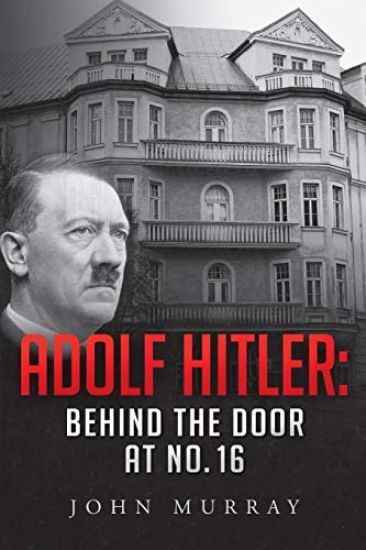
It's September 1931, and Adolf Hitler's live-in niece, Geli Raubal, lies dead on the floor of his Munich apartment at No. 16 Prinzregentenplatz. With Hitler's pistol by her side, it suits the Nazis to cover it up as a suicide.This historical event forms the centrepiece for John Murray's novel in which he introduces Geli's lover, Bernard Connolly, who was in theapartment the night before. Geli was alive when he left. Hitler is devastated by Geli's death and furious when he finds out that Connolly has broken into his safe. With the Nazis in pursuit Connolly manages to escape.Nearly ninety years later, John Scobie in Australia has the seemingly impossible task to nd out what was stolen from Hitler's safe. RetracingConnolly's steps through Austria, Scotland, and Germany, Scobie picks up a trail of clues which leads him to the priceless object. But it's what Scobie discovers about himself that is the real surprise.
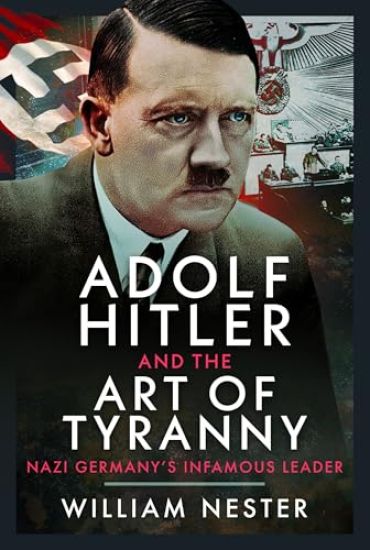
Adolf Hitler and the Art of Tyranny

Adolf Hitler and the Art of Tyranny

William Nester

PEN SWORD BOOKS LTD
2026
sidottu
Adolf Hitler may be history’s most notorious tyrant. Surely no one’s name is more often evoked to epitomize evil and the deliberate infliction of suffering on vulnerable individuals and groups? Through exceptional will and luck Hitler struggled up through the ranks of political power until he became Germany’s master. He then sought to dominate Europe. Determined to unite all German-speaking peoples in one nation, he embarked on a series of aggressions that culminated in a war that engulfed and devastated most of Europe and North Africa, and left tens of millions of people dead, maimed, or homeless. Along with his political opponents, he condemned Jews and other ‘inferior peoples’ as Germany’s enemies, and eventually had around six million of them arrested and systematically slaughtered. Adolf Hitler and the Art of Tyranny answers with depth and clarity three core questions. What made Hitler who he was; why did he do what he did; and what were the results? Many other questions radiate from these. For instance, how did Hitler get tyrannical power? Or why was the Third Reich destroyed after just a dozen years? Many more crucial questions and arrays of answers follow. Hitler, of course, did not act alone. He enthroned himself atop power pyramids that included the Nazi Party, government, military, secret police, industrial associations, religious institutions, and other social organizations. He commanded countless ‘willing executioners’ of his plans and orders. To a rational, knowledgeable person, Hitler’s mass appeal is puzzling. How could someone as histrionic, vulgar, shallow, bullying, and extreme as Hitler inspire such adoration and fanatical acts by millions of people?