Kirjojen hintavertailu. Mukana 11 244 527 kirjaa ja 12 kauppaa.

Kirjahaku

Etsi kirjoja tekijän nimen, kirjan nimen tai ISBN:n perusteella.

1000 tulosta hakusanalla Alan C Turley

Recovering Shakespeare's Theatrical Vocabulary

Recovering Shakespeare's Theatrical Vocabulary

Alan C. Dessen

Cambridge University Press
1995
sidottu
In this rigorous investigation of the staging of Shakespeare’s plays, Alan Dessen wrestles with three linked questions: (1) what did a playgoer at the original production actually see? (2) how can we tell today? and (3) so what? His emphasis is upon images and on-stage effects (e.g. the sick-chair, early entrances, tomb scenes) easily obscured or eclipsed today. Basing his analysis on the 600 English professional plays performed before 1642, Dessen identifies a vocabulary of the theatre shared by Shakespeare, his theatrical colleagues and his playgoers, in which stage directions do not admit of neat dictionary definitions but can be glossed in terms of options and potential meanings. To explore such terms, along with various costumes and properties (keys, trees, coffins, books), is to challenge unexamined assumptions that underlie how Shakespeare is read, edited and staged today.
A Dictionary of Stage Directions in English Drama 1580–1642

A Dictionary of Stage Directions in English Drama 1580–1642

Alan C. Dessen; Leslie Thomson

Cambridge University Press
1999
sidottu
This Dictionary, the first of its kind, defines and explains over 900 terms found in the stage directions of English professional plays from the 1580s to the early 1640s. The terms are drawn primarily from surviving printed and manuscript sources, and from the plays performed on the London stage, by both minor and major dramatists. The authors draw on a database of over 22,000 stage directions drawn from around 500 such plays. Each entry offers a definition, gives examples of how the term is used, cites additional instances, and gives cross-references to other relevant entries. Terms defined range from the obvious and common to the obscure and rare, including actions, places, objects, sounds and descriptions. The authors have also provided a user’s guide and an introduction which describes the scope and rationale of the volume. This will be an indispensable work of reference for scholars, historians, directors and actors.
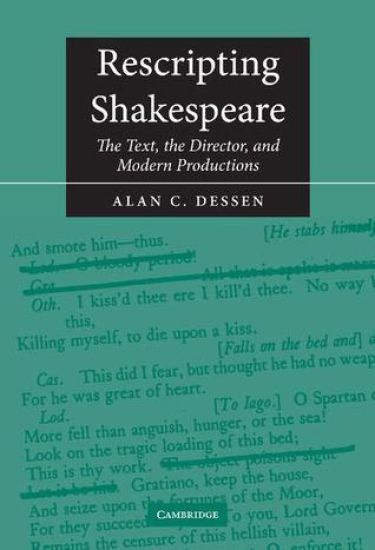
Rescripting Shakespeare

Rescripting Shakespeare

Alan C. Dessen

Cambridge University Press
2002
sidottu
Building on almost 300 productions from the last 25 years, this 2002 book focuses on the playtexts used when directors stage Shakespeare's plays: the words spoken, the scenes omitted or transposed, and the many other adjustments that must be made. Directors rescript to streamline the playscript and save running time, to eliminate obscurity, conserve on personnel, and occasionally cancel out passages that might not fit their 'concept'. They rewright when they make more extensive changes, moving closer to the role of playwrights, as when the three parts of Henry VI are compressed into two plays. Alan Dessen analyzes what such choices might exclude or preclude, and explains the exigencies faced by actors and directors in placing before today's audiences words targeted at players, playgoers, and playhouses that no longer exist. The results are of interest and importance as much to theatrical professionals as to theatre historians and students.
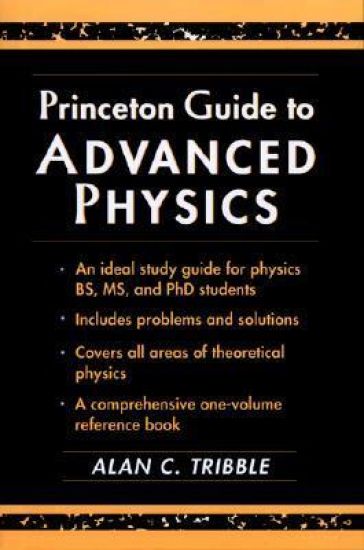
Princeton Guide to Advanced Physics

Princeton Guide to Advanced Physics

Alan C. Tribble

Princeton University Press
1996
pokkari
From classical mechanics to general relativity, the key principles in all areas of physics are surveyed in this one handy volume. Here Alan Tribble addresses the needs of students and practicing physicists alike. He starts with a review of mathematical methods and then summarizes the most widely used concepts in physics, detailing derivations and applications. With its mix of theory, application, and solved problems, Advanced Physics enables a student to grasp quickly the fundamentals of the field while providing physicists, engineers, and mathematicians with an ideal reference for locating critical formulas or reviewing mathematical details. One of Tribble's goals is to help students, particularly those preparing for comprehensive examinations, to develop and retain a broad base of knowledge and an in-depth understanding of the fundamental physical principles. Until now, reaching this goal has been a time-consuming and difficult task for the student, partly because so many texts have omitted key steps in crucial derivations or have assigned these derivations as exercises. By gathering widespread information into one highly accessible format, Advanced Physics will become an invaluable study aid, will serve readily as a text in a review course or as a supplemental text in higher-level courses, and will make for an indispensable reference for professionals throughout their careers.
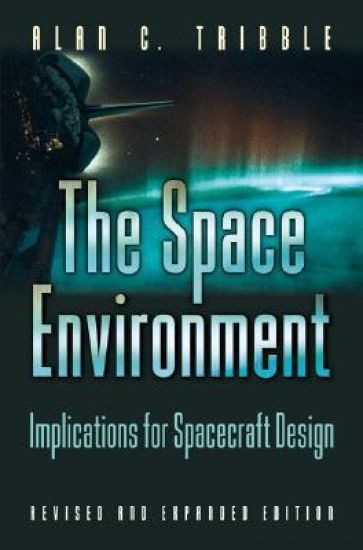
The Space Environment

The Space Environment

Alan C. Tribble

Princeton University Press
2003
pokkari
The breakup of the Space Shuttle Columbia as it reentered Earth's atmosphere on February 1, 2003, reminded the public--and NASA--of the grave risks posed to spacecraft by everything from insulating foam to space debris. Here, Alan Tribble presents a singular, up-to-date account of a wide range of less conspicuous but no less consequential environmental effects that can damage or cause poor performance of orbiting spacecraft. Conveying a wealth of insight into the nature of the space environment and how spacecraft interact with it, he covers design modifications aimed at eliminating or reducing such environmental effects as solar absorptance increases caused by self-contamination, materials erosion by atomic oxygen, electrical discharges due to spacecraft charging, degradation of electrical circuits by radiation, and bombardment by micrometeorites. This book is unique in that it bridges the gap between studies of the space environment as performed by space physicists and spacecraft design engineering as practiced by aerospace engineers.
Texas Ingenuity: Lone Star Inventions, Inventors & Innovators
Imagination is bigger in Texas, too. This collection of inspiring and often quirky stories highlights dozens of examples of innovation from Lone Star history. The Hamill brothers devised a better oil well to reach gushers at Spindletop. The first Neiman-Marcus store opened in Dallas in 1907, revolutionizing the retail fashion world. Astroturf emerged at the Astrodome in 1966. Fritos and corn dogs are just two ubiquitous snack foods claimed as Texan originals. Houston native, and civil rights activist, Congresswoman Barbara Jordan rose to national prominence as a voice of unity during the Watergate scandal. Author Alan C. Elliott details these and many more lessons in success in Texas Ingenuity.
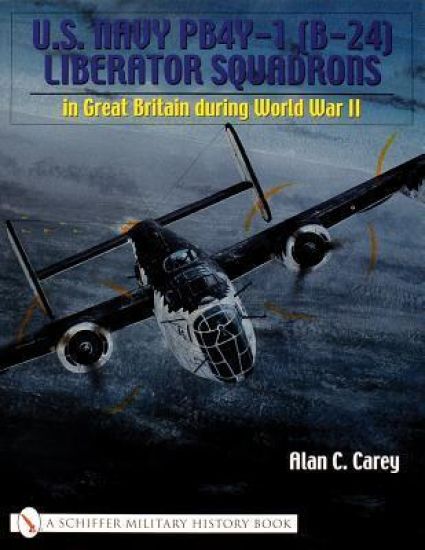
U.S. Navy PB4Y-1 (B-24) Liberator Squadrons

U.S. Navy PB4Y-1 (B-24) Liberator Squadrons

Alan C. Carey

Schiffer Publishing Ltd
2003
nidottu
Alan Carey’s new book, his fifth on USN and USMC bomber units of the Second World War, is the story of U.S. Navy Fleet Air Wing Seven (FAW-7) and the men who flew the Navy version of the Consolidated B-24 Liberator bomber out of Dunkeswell and Upottery, England during World War II. Navy PB4Y-1 Liberator squadrons were unlike their counterparts in the U.S. Army’s 8th Air Force, who battled their way through thick flak and swarms of German fighters while flying to and from targets in continental Europe. The job of U.S. Navy PB4Y-1 Liberator aircrews was to keep German U-boats from successfully operating in the Bay of Biscay and the English Channel by going out day after day, often in miserable weather conditions, on unrelenting search and destroy missions. During the war, FAW-7 Liberators were responsible for the sinking of five U-boats and damaging many more.
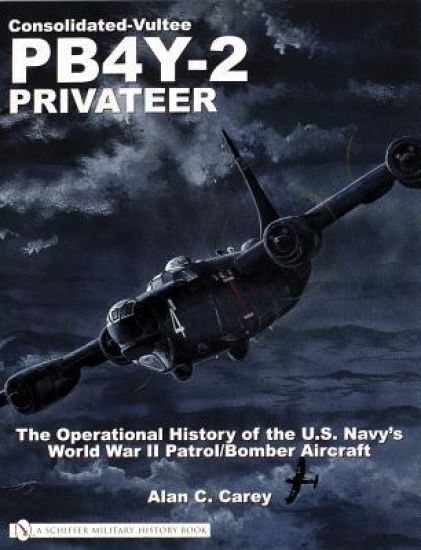
Consolidated-Vultee PB4Y-2 Privateer

Consolidated-Vultee PB4Y-2 Privateer

Alan C. Carey

Schiffer Publishing Ltd
2005
nidottu
Consolidated-Vultee Aircraft Corporation’s (Convair) attempt to make a few design changes to its famous B-24 Liberator for the U.S. Navy in 1942 eventually evolved into the PB4Y-2 Privateer, a 70,000-pound patrol bomber equipped with state-of-the-art electronics gear, armed with twelve .50-caliber machine guns, and the capability to deliver bombs, depth charges, and guided missiles. Beginning with the development and production of the aircraft, this book presents an in-depth examination of the patrol bomber’s entire operational history from 1942 to the present. Containing over 260 photographs and line art, the book covers the PB4Y-2’s service with the U.S. Navy, French Aéronavale, Republic of China Air Force, various countries of Latin America, and finally as a slurry bomber for aerial fire fighting companies.
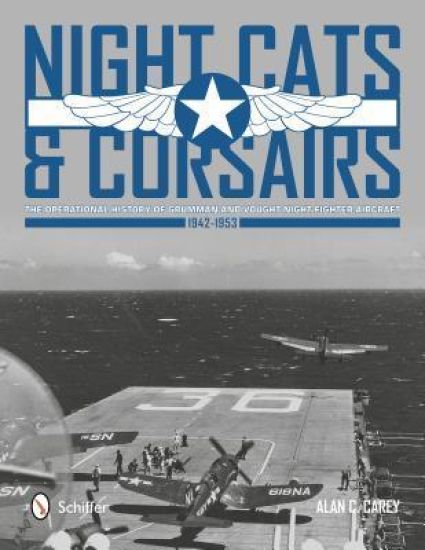
Night Cats and Corsairs

Night Cats and Corsairs

Alan C. Carey

Schiffer Publishing Ltd
2014
sidottu
The threat of enemy aircraft striking American naval forces at night with impunity during World War II led the Navy to seek fighter aircraft capable of stopping this threat. Trace the history of radar-equipped night fighter aircraft produced for the U.S. Navy and Marine Corps by the American aircraft companies Grumman and Vought before the arrival of jets with nocturnal capabilities. World War II squadrons operated night variants of the Vought F4U-2 Corsair and Grumman F6F-3/5N Hellcat while post-war night fighter units were equipped with the Grumman F7F-3N Tigercat and/or Vought F4U-5N/NL. Night Cats and Corsairs contains never before published color and black and white photographs covering the night variants of the F6F Hellcat, F7F Tigercat, F4U-2 and F4U-5N/NL Corsairs.
We Flew Alone 2nd Edition

We Flew Alone 2nd Edition

Alan C. Carey

Schiffer Publishing Ltd
2017
nidottu
This revised and expanded second edition covers USN and USMC squadrons that operated the Consolidated B-24 Liberator heavy bomber as the PB4Y-1 in the Pacific from early 1943 through September 1944 in the Central Pacific. Combat air crews consisted of eleven young men typically ages 18 to 26 led by a patrol plane commander in his early to mid-twenties. They flew alone on single-plane patrols often lasting ten or more hours. Alone on patrol there were no witnesses when an aircraft failed to return to base; they simply vanished, leaving little if any clues about their fate. Other aircrews sent to look for the missing would occasionally spot a deflated life raft floating or dye marker spreading across the water—evidence marking where a four-engine bomber and its crew had gone down.
Charter versus Federalism

Charter versus Federalism

Alan C. Cairns

McGill-Queen's University Press
1992
nidottu
Responding to the increasing diversity of the Canadian population -- and to an increasing sensitivity to historical diversities -- the 1982 Constitution Act amended the British North America Act and introduced the Charter of Rights and Freedoms, giving new powers to heterogeneous groups within the Canadian polity. These changes disturbed the equilibrium of an older, federalist Canada whose constitutional concerns were limited to the relative powers of federal and provincial governments and to French-English ethnic/linguistic questions. Cairns underlines the significance of international influences on the development of Canada's constitution, in particular the adoption of the Charter, and examines the constitution's role in shaping Canadians' civic identities and community conceptions. He argues that the constitution is a powerful mobilizing instrument that shapes the people subject to its authority. Canada is now populated by what Cairns calls "Charter Canadians," who see themselves as rights-bearers and tend to look to the federal government as the effective focus of political community. During the Meech Lake affair, the demands of Charter Canadians and politicized aboriginal peoples clashed with Quebec's constitutional aspirations as well as older elite accommodation politics. In addition to the Charter, the 1982 Constitution Act contained a new amending formula that contradicted the Charter's message that the rights of individuals precede those of governments. This formula gave a collective of federal and provincial governments a formal monopoly on constitutional change and encouraged the belief, refuted by the Meech Lake experience, that they could amend the constitution in terms of their own self-interest and announce the results as a fait accompli. The clash between the Charter and the amending formula is constitutionally destabilizing, Cairns argues, because these two parts of the same constitution are based on different understandings of the fundamental purpose of the constitution and for whose benefit it exists. The Meech Lake fiasco, having brought Canada to the brink of disaster, clearly indicates that Canada's future constitutional health depends not only on the reconciliation of Quebec with the rest of Canada but -- respectful of the Charter's message -- on a simultaneous constitutional rapprochement between citizens and governments in the process of constitutional reform.
Citizenship, Diversity, and Pluralism

Citizenship, Diversity, and Pluralism

Alan C. Cairns; John C. Courtney; Peter MacKinnon

McGill-Queen's University Press
2000
nidottu
In Citizenship, Diversity, and Pluralism leading scholars assess the transformation of these two dimensions of citizenship in increasingly diverse and plural modern societies, both in Canada and internationally. Subjects addressed include the changing ethnic demography of states, social citizenship, multiculturalism, feminist perspectives on citizenship, aboriginal nationalism, identity politics, and the internationalization of human rights. Contributors include Heribert Adam (Simon Fraser), Keith Banting (Queen's), Anthony Birch (emeritus, Victoria), John Borrows (UBC), Alan Cairns, Walker Connor (Trinity College), John Erik Fossum (LOS?Senteret, Norway), Virginia Leary (emeritus, SUNY), Denise Reaume (Toronto), Lynn Smith (justice, BC Supreme Court), Charles Taylor (emeritus, McGill), and Jeremy Webber (Sydney, Australia).