Kirjojen hintavertailu. Mukana 12 459 402 kirjaa ja 12 kauppaa.

Kirjahaku

Etsi kirjoja tekijän nimen, kirjan nimen tai ISBN:n perusteella.

1000 tulosta hakusanalla Alan Jeffrey

Hydraulic Modelling: An Introduction

Hydraulic Modelling: An Introduction

Pavel Novak; Vincent Guinot; Alan Jeffrey; Dominic E. Reeve

Spon Press
2010
nidottu
Modelling forms a vital part of all engineering design, yet many hydraulic engineers are not fully aware of the assumptions they make. These assumptions can have important consequences when choosing the best model to inform design decisions.Considering the advantages and limitations of both physical and mathematical methods, this book will help you identify the most appropriate form of analysis for the hydraulic engineering application in question. All models require the knowledge of their background, good data and careful interpretation and so this book also provides guidance on the range of accuracy to be expected of the model simulations and how they should be related to the prototype.Applications to models include: open channel systemsclosed conduit flowsstorm drainage systemsestuariescoastal and nearshore structureshydraulic structures.This an invaluable guide for students and professionals.
Jeffrey Alan Marks

Jeffrey Alan Marks

Marks Jeffrey Alan; Goin Suzanne

Rizzoli International Publications
2013
sidottu
The luxe homes designed by one of Bravo TV’s Million Dollar Decorators Jeffrey Alan Marks demonstrate his breezy, tailored look. Jeffrey Alan Marks Inc. (JAM) specializes in residential and commercial interior design and architecture. Inspired by his Southern California outdoor lifestyle, Marks’s trademark look is a synthesis of a fresh informality infused with sophisticated English and European accents. His joyous, comfortable spaces are known for their playful charm, vivid colors, and patterns. He contrasts natural materials, such as weathered driftwood, with sleek finishes. This book showcases a series of beautifully photographed residences revealing Marks’s skill at capturing each client’s personality, from a movie star’s London townhouse full of eccentric furnishings to a charming Nantucket cottage with nautical embellishments. A striking surfside vibe energizes his Santa Monica Canyon beach house, where he hung a rowboat from the whitewashed bedroom ceiling. Marks explains how he made each project’s room a sanctuary where all details are synchronized. Through collective imagery and intriguing collages, he demonstrates his creative process. Marks’s favorite shopping addresses for fabrics, furniture, and antiques complete this inspiring volume.
This is Home Jeffrey Alan

This is Home Jeffrey Alan

Jeffrey Alan Marks

RIZZOLI INTERNATIONAL PUBLICATIONS
2025
sidottu
Marks believes a home must reflect the way its inhabitants want to live, their unique perspective, how they approach their lives. Trained in England, Marks has long had a deep and profound architectural crush on the British vernacular, which creates a pleasing interplay with his Southern California roots. The homes explored in the book include his 1925 beach cottage in Montecito; a clean Bahamian compound open to the azure seas with design drama, color, and romance at every turn; a working Los Angeles horse farm; and his new family home in Greenwich, Connecticut. Along the way Marks shares key bits of advice for creating the looks. Casual comfort is key performance fabrics, cotton and natural fiber rugs, blues pulled from the outdoors as is a sense of theater, accomplished with antiques and dramatic lighting. The results are homes that feel layered and dramatic, but always comfortable and ready to be lived in.
An Awakening Within

An Awakening Within

Jeffrey Alan Hall

iUniverse
2002
pokkari
If there is to be an awakening, it must be with in us¡ªwithin each of our souls¡ªfor that is the only place that true and lasting change can occur. We must awaken to the wonderful possibilities of what we can become as one world, and not focus on what we have been as separate nations. We must awaken to the things we are for¡ªthe things that unite us as a planet¡ªand not dwell on what we are against by drawing lines in the sand. We must awaken to the power of the God force and allow it to lead our collective consciousness to a new and higher way of being. We must awaken to the power of love. Jeffrey Alan Hall From An Awakening Within
Mark Twain, Travel Books, and Tourism

Mark Twain, Travel Books, and Tourism

Jeffrey Alan Melton

The University of Alabama Press
2008
nidottu
With the publication of ""The Innocents Abroad"" (1869), Mark Twain embarked on a long and successful career as the 19th century's best-selling travel writer. Jeffrey Melton treats Twain's travel narratives in depth, and in the context of his contemporary travel writers and a burgeoning tourism culture. As Melton shows, Twain's five major travel narratives - ""The Innocents Abroad"", ""Roughing It"", ""Life on the Mississippi"", ""A Tramp Abroad"", and ""Following the Equator"" - demonstrate Twain's mastery and reinvention of the genre.
The American Open Road

The American Open Road

Jeffrey Alan Melton

THE UNIVERSITY OF ALABAMA PRESS
2025
nidottu
The phrase “open road” has long captivated the American popular imagination. Americans have long believed in the open road with such fervent passion that it has served as a secular faith built around aspiration and optimism. Though the longing for the open road has animated the United States from its beginnings, the boom following World War II centralized the automotive road narrative in popular culture. In The American Open Road, Jeffrey Melton taps into that restless energy with engaging prose, an impressive display of creative scholarship, and a wide array of compelling illustrations.In Part One, he delves into the cultural context of the post-World War II boom that catapulted car culture to the forefront of American society and consciousness. In Part Two, he defines major patterns and conventions of the road narrative as revealed in a wide range of seminal literary works that earned popular and critical attention in the key decades from the 1950s to the 1980s. In Part Three, he focuses on persistent challenges to the open road experience arising from the cultural tensions of race, gender, and ethnicity.Although Melton draws upon a variety of sources—from automobile advertisements, magazine covers, and public-service documents to song lyrics and poems—his discussion focuses on well-known literary and cinematic narratives that have engendered the greatest impact upon American culture. Those prose narratives (both fiction and nonfiction) and films (including television) are the most illustrative expressions of the open road, as Americans tell their road stories forever with an eye upon the horizon. The open road cuts a broad swath through American culture like the roadways that form an ever-changing matrix on the landscape itself. Every mile holds a narrative of some sort, and every car is tied to ever-evolving American dreams.
Aqua Vitae

Aqua Vitae

Jeffrey Alan Senatra

Empty Hands Etc. Press
2017
nidottu
Waking in his car somewhere deep in the Rocky Mountains, a man named Cotton slips away from his sleeping family into the cool morning, and goes trout fishing. Under the guise of a pleasure trip, Cotton has conceived a clandestine spiritual objective: to baptize his newborn baby in the waters of the ocean. Setting out from the Midwest with his wife and infant son, Cotton ushers them toward the southern Pacific coast. Along the way, they find themselves off route and following the isolated twists of a river through the mountains of Colorado. When a sign for roadside camping appears late in the night, they roll their Buick Skylark into a spot among the pines and retire. Upon first light, Cotton suddenly remembers the river and, having prepared for such an unlikely opportunity, quietly departs. Here, in this suspended moment in the mountains, their story unfolds. Constructed in nonlinear fashion, much of the story is conveyed through stream of consciousness. Possessing an extraordinary sense of insight, Cotton struggles between concrete and poetically ethereal worlds. Raw to the more mysterious forces pulsing through existence, Cotton is preoccupied with unlocking and living in accordance with these mysteries, and does this largely through the embrace of symbol, metaphor, and psychic intuition. Appropriate to his nature, Cotton's chosen occupation as Locksmith, for instance, was selected allegorically both as a means to support and represent himself in the world. This is his complexity and conflict, which is also a source of continued tension with his wife. Because of this tension, Nanna has been left in the dark regarding the true nature of their trip. As far as she is concerned, they are merely on a scenic excursion, oblivious to the hidden, spiritual motive propelling their journey. AQUA VITAE is a highly symbolic and experimental work about vision and receptivity, straddling a parabolic line of the real and unreal. Its relatively simple plot contrasts with its proposed depths and stylistic complexity. Many sentences are deliberately long and flowing, not only in imitation of the internal flow of consciousness, which is a major concern of the work, but also in reflection of the external natural forces prevalent in the story, such as the river. Associative writing is another technique explored here, which is the deliberate insertion of seemingly incongruous images juxtaposed without the connective tissue of preposition. This technique is sprinkled throughout the text, appearing either within a single sentence or as two separate sentences placed side by side, and is used in an attempt to jar open and expand the reader's consciousness, thus attempting to expand vision.
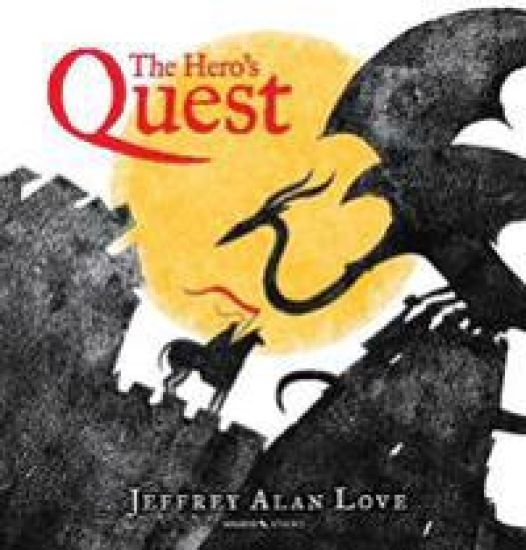
The Hero's Quest

The Hero's Quest

Jeffrey Alan Love

Walker Studio
2019
sidottu
A picture-book quest through the worlds of fantasy, myth and magic, for all young reading heroes.Join our every-hero Rider on their quest through the story worlds of fantasy and myth. Packed with vivid dragons, wolves and sea-monsters from the stunning imagination of celebrated cult fantasy artist, Jeffrey Alan Love (Norse Myths: Tales of Odin, Thor and Loki), this book immerses readers into a picture-book Game of Thrones world for children aged 6 and up.
Military Resources and International War

Military Resources and International War

Jeffrey Alan Carnegie

Peter Lang Publishing Inc
2021
sidottu
Do leaders make war decisions individually or do they consider other ongoing conflicts? Most researchers assume dyadic independence out of convenience. In this book, Jeffrey Alan Carnegie presents evidence that this is a faulty assumption. First, he develops a formal theory in which limited military resources act as a constraint on the ability of leaders to engage in international conflicts. Country leaders plan accordingly by considering the entire picture of conflicts. This theory, in contrast to dyadic dependence, implies a different data-generating process for international conflicts. Second, he tests both theories using summary statistics, network analysis, and logistic regression. All three methods show strong support for military resource division theory. Carnegie further shows that the dependent effects change with time, even when controlling for polarity. The effects also differ between regions, which implies cultural factors at work. Third, he suggests for the future that researchers use multiple methods to account for different types of dependencies, because no single method can address them all. He shows how to make the best use of logistic regression and social network analysis for conflict statistics. He offers suggestions to policy makers for how best to incorporate this theory in analysis. Finally, Carnegie concludes by comparing predictions of the two theories regarding conflicts for the United States, especially Iran and North Korea. This book will be of interest to conflict researchers in academia and government who want to better understand the effect of coalitions on modern warfare.
The Great Serpent Mound: An Ancient Ohio Mystery
Author Jeffrey Alan John explores the history, theories and fundamental Serpent Mound questions: What culture made it? Why? And when? Thousands of years ago, people in what would become southern Ohio encountered a vista they recognized as special. They couldn't know that their view overlooked a 300-million-year-old crater, but as time passed, they made the plateau a resting place for generations of societies that eventually raised--with considerable planning and effort--the Great Serpent Mound, a place where history and mystery coincide. Uninhabited and overgrown when early Ohio settlers found it, the preserved effigy inspired pioneering archaeology and continues to prompt increasingly elaborate thinking. Scientists say that it measures the calendar, while theologians and mystics ponder its spiritual meaning.
Where Caciques and Mapmakers Met

Where Caciques and Mapmakers Met

Jeffrey Alan Erbig Jr.

The University of North Carolina Press
2020
sidottu
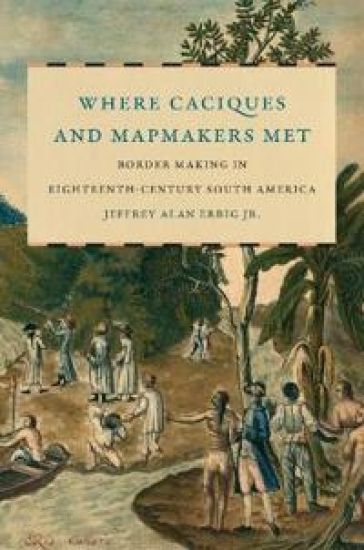
During the late eighteenth century, Portugal and Spain sent joint mapping expeditions to draw a nearly 10,000-mile border between Brazil and Spanish South America. These boundary commissions were the largest ever sent to the Americas and coincided with broader imperial reforms enacted throughout the hemisphere. Where Caciques and Mapmakers Met considers what these efforts meant to Indigenous peoples whose lands the border crossed. Moving beyond common frameworks that assess mapped borders strictly via colonial law or Native sovereignty, it examines the interplay between imperial and Indigenous spatial imaginaries. What results is an intricate spatial history of border making in southeastern South America (present-day Argentina, Brazil, and Uruguay) with global implications. Drawing upon manuscripts from over two dozen archives in seven countries, Jeffrey Alan Erbig Jr. traces on-the-ground interactions between Ibero-American colonists, Jesuit and Guarani mission-dwellers, and autonomous Indigenous peoples as they responded to ever-changing notions of territorial possession. It reveals that Native agents shaped when and where the border was drawn, and fused it to their own territorial claims. While mapmakers' assertions of Indigenous disappearance or subjugation shaped historiographical imaginations thereafter, Erbig reveals that the formation of a border was contingent upon Native engagement and authority.
Where Caciques and Mapmakers Met

Where Caciques and Mapmakers Met

Jeffrey Alan Erbig Jr.

The University of North Carolina Press
2020
pokkari
During the late eighteenth century, Portugal and Spain sent joint mapping expeditions to draw a nearly 10,000-mile border between Brazil and Spanish South America. These boundary commissions were the largest ever sent to the Americas and coincided with broader imperial reforms enacted throughout the hemisphere. Where Caciques and Mapmakers Met considers what these efforts meant to Indigenous peoples whose lands the border crossed. Moving beyond common frameworks that assess mapped borders strictly via colonial law or Native sovereignty, it examines the interplay between imperial and Indigenous spatial imaginaries. What results is an intricate spatial history of border making in southeastern South America (present-day Argentina, Brazil, and Uruguay) with global implications. Drawing upon manuscripts from over two dozen archives in seven countries, Jeffrey Alan Erbig Jr. traces on-the-ground interactions between Ibero-American colonists, Jesuit and Guarani mission-dwellers, and autonomous Indigenous peoples as they responded to ever-changing notions of territorial possession. It reveals that Native agents shaped when and where the border was drawn, and fused it to their own territorial claims. While mapmakers' assertions of Indigenous disappearance or subjugation shaped historiographical imaginations thereafter, Erbig reveals that the formation of a border was contingent upon Native engagement and authority.