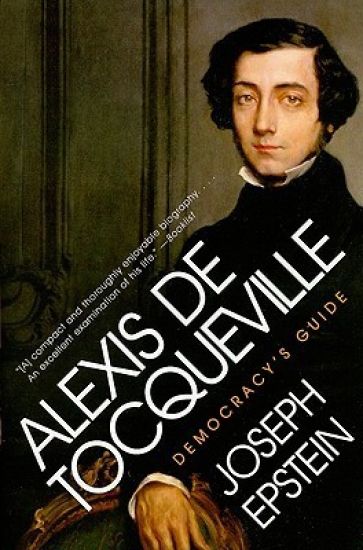
Part of the acclaimed Eminent Lives series, Alexis de Tocqueville dissects the legacy of the celebrated cultural observer. Joseph Epstein, distinguished literary historian and author of the bestselling Snobbery: The American Version, provides a fresh account of the celebrated writer's classic travels in America, and compares what de Tocqueville witnessed to the current state of our nation.
This title opens a new window into the life and thought of Alexis de Tocqueville, presenting him as not only a political thinker but also a person deeply shaped by the tensions and ideals of his time. Known for Democracy in America, Tocqueville’s insights into American democracy have often overshadowed his reflections on French society, friendship, and personal struggles. This compilation of letters, many unpublished in English before, spans his political career, his friendships, and his inner conflicts, revealing his ongoing battle between intellectual ideals and the harsh realities of the political landscape. His letters bring to light a Tocqueville who was both drawn to political action and increasingly disillusioned by the self-serving nature of his era’s middle class. Tocqueville’s correspondence reveals a figure influenced by both Enlightenment rationalism and Romanticism’s emphasis on feeling and individuality. While often critical of Romantic melancholy, he was himself plagued by existential doubt and frustration over the limited impact of his political actions. He viewed society’s growing emphasis on materialism and self-interest as symptoms of a broader decline, leaving him torn between admiration for civic virtues and disappointment in the era’s lack of ambition. Religion and friendship emerge as stabilizing forces in his life, with his close bond with Gustave de Beaumont standing out as a source of both comfort and challenge. The letters show how Tocqueville’s personal relationships and ethical convictions shaped his intellectual pursuits and his concerns for France’s future. The editors, Roger Boesche and James Toupin, present these letters with careful translation and thorough contextual notes, giving readers both the historical background and access to Tocqueville’s unique literary style. The work provides readers with a portrait of a man wrestling with the challenges of his age, caught between democratic ideals and the evolving reality of French society. For modern readers, these letters illuminate how Tocqueville’s personal struggles informed his enduring political insights, highlighting his belief in community and civic duty as essential defenses against tyranny. This title is part of UC Press's Voices Revived program, which commemorates University of California Press’s mission to seek out and cultivate the brightest minds and give them voice, reach, and impact. Drawing on a backlist dating to 1893, Voices Revived makes high-quality, peer-reviewed scholarship accessible once again using print-on-demand technology. This title was originally published in 1985.
This title opens a new window into the life and thought of Alexis de Tocqueville, presenting him as not only a political thinker but also a person deeply shaped by the tensions and ideals of his time. Known for Democracy in America, Tocqueville’s insights into American democracy have often overshadowed his reflections on French society, friendship, and personal struggles. This compilation of letters, many unpublished in English before, spans his political career, his friendships, and his inner conflicts, revealing his ongoing battle between intellectual ideals and the harsh realities of the political landscape. His letters bring to light a Tocqueville who was both drawn to political action and increasingly disillusioned by the self-serving nature of his era’s middle class. Tocqueville’s correspondence reveals a figure influenced by both Enlightenment rationalism and Romanticism’s emphasis on feeling and individuality. While often critical of Romantic melancholy, he was himself plagued by existential doubt and frustration over the limited impact of his political actions. He viewed society’s growing emphasis on materialism and self-interest as symptoms of a broader decline, leaving him torn between admiration for civic virtues and disappointment in the era’s lack of ambition. Religion and friendship emerge as stabilizing forces in his life, with his close bond with Gustave de Beaumont standing out as a source of both comfort and challenge. The letters show how Tocqueville’s personal relationships and ethical convictions shaped his intellectual pursuits and his concerns for France’s future. The editors, Roger Boesche and James Toupin, present these letters with careful translation and thorough contextual notes, giving readers both the historical background and access to Tocqueville’s unique literary style. The work provides readers with a portrait of a man wrestling with the challenges of his age, caught between democratic ideals and the evolving reality of French society. For modern readers, these letters illuminate how Tocqueville’s personal struggles informed his enduring political insights, highlighting his belief in community and civic duty as essential defenses against tyranny. This title is part of UC Press's Voices Revived program, which commemorates University of California Press’s mission to seek out and cultivate the brightest minds and give them voice, reach, and impact. Drawing on a backlist dating to 1893, Voices Revived makes high-quality, peer-reviewed scholarship accessible once again using print-on-demand technology. This title was originally published in 1985.
The book proposes a new interpretation of Alexis de Tocqueville that views him first and foremost as a social scientist rather than as a political theorist. Drawing on his earlier work on the explanation of social behavior, Elster argues that Tocqueville's main claim to our attention today rests on the large number of exportable causal mechanisms to be found in his work, many of which are still worthy of further exploration. Elster proposes a novel reading of Democracy in America in which the key explanatory variable is the rapid economic and political turnover rather than equality of wealth at any given point in time. He also offers a reading of The Ancien Régime and the Revolution as grounded in the psychological relations among the peasantry, the bourgeoisie, and the nobility. Consistently going beyond exegetical commentary, he argues that Tocqueville is eminently worth reading today for his substantive and methodological insights.
The book proposes a new interpretation of Alexis de Tocqueville that views him first and foremost as a social scientist rather than as a political theorist. Drawing on his earlier work on the explanation of social behavior, Elster argues that Tocqueville's main claim to our attention today rests on the large number of exportable causal mechanisms to be found in his work, many of which are still worthy of further exploration. Elster proposes a novel reading of Democracy in America in which the key explanatory variable is the rapid economic and political turnover rather than equality of wealth at any given point in time. He also offers a reading of The Ancien Régime and the Revolution as grounded in the psychological relations among the peasantry, the bourgeoisie, and the nobility. Consistently going beyond exegetical commentary, he argues that Tocqueville is eminently worth reading today for his substantive and methodological insights.
In 1835, Alexis de Tocqueville famously called for 'a new political science' that could address the problems and possibilities of a 'world itself quite new.' For Tocqueville, the democratic world needed not just a new political science but also new arts of statesmanship and leadership. In this volume, Brian Danoff and L. Joseph Hebert, Jr., have brought together a diverse set of essays revealing that Tocqueville's understanding of democratic statesmanship remains highly relevant today. The first chapter of the book is a new translation of Tocqueville's 1852 address to the Academy of Moral and Political Sciences, in which Tocqueville offers a profound exploration of the relationship between theory and practice, and between statesmanship and political philosophy. Subsequent chapters explore the relationship between Tocqueville's ideas on statesmanship, on the one hand, and the ideas of Plato, Aristotle, Machiavelli, Montesquieu, the Puritans, the Framers of the U.S. Constitution, Oakeshott, Willa Cather, and the Second Vatican Council, on the other. Timely and provocative, these essays show the relevance of Tocqueville's theory of statesmanship for thinking about such contemporary issues as the effects of NGOs on civic life, the powers of the American presidency, the place of the jury in a democratic polity, the role of religion in public life, the future of democracy in Europe, and the proper balance between liberalism and realism in foreign policy.
In 1835, Alexis de Tocqueville famously called for 'a new political science' that could address the problems and possibilities of a 'world itself quite new.' For Tocqueville, the democratic world needed not just a new political science but also new arts of statesmanship and leadership. In this volume, Brian Danoff and L. Joseph Hebert, Jr., have brought together a diverse set of essays revealing that Tocqueville's understanding of democratic statesmanship remains highly relevant today. The first chapter of the book is a new translation of Tocqueville's 1852 address to the Academy of Moral and Political Sciences, in which Tocqueville offers a profound exploration of the relationship between theory and practice, and between statesmanship and political philosophy. Subsequent chapters explore the relationship between Tocqueville's ideas on statesmanship, on the one hand, and the ideas of Plato, Aristotle, Machiavelli, Montesquieu, the Puritans, the Framers of the U.S. Constitution, Oakeshott, Willa Cather, and the Second Vatican Council, on the other. Timely and provocative, these essays show the relevance of Tocqueville's theory of statesmanship for thinking about such contemporary issues as the effects of NGOs on civic life, the powers of the American presidency, the place of the jury in a democratic polity, the role of religion in public life, the future of democracy in Europe, and the proper balance between liberalism and realism in foreign policy.
In this groundbreaking new work, Matthew Mancini tells the surprising story of Alexis de Tocqueville's reception in American thought and culture from the time of his 1831 visit to the United States to the turn of the twenty-first century. The author uncovers an historical record that is replete with unmistakable evidence of Tocqueville's continuing importance to American intellectuals throughout the post-Civil War period of his supposed oblivion, and also of his reputation being exaggerated by recent historians referring to the post-World War II decades. Through comprehensive analysis of Tocqueville's published works, Mancini critically examines the ways in which Tocqueville's ideas have been received and, at times, misunderstood. Mancini challenges almost every element of the common understanding of Tocqueville's reception into American intellectual culture while recovering and re-examining many important intellectuals of the last 150 years. In doing so, Mancini inscribes an important chapter in American cultural history, namely the idea of Tocqueville himself.
Drawing upon a variety of primary sources, this work scrutinizes Tocqueville's actual political action in 1848-1852 and suggests his famous Souvenirs (Recollections) reflect second thoughts more than deeds. As a pragmatic strategist operating from a small left-center faction, Tocqueville attempted to construct a future France uniting political liberty (including universal manhood suffrage) with social stability. The book details Tocqueville's contribution to the new constitution and concludes he deliberately strengthened the executive branch to counterbalance the strong unicameral legislature. While opposed to socialism, he advocated major advances in public education and government assistance to the poor. The work explores his relationship with Louis Napoléon Bonaparte. Tocqueville cultivated friendship with President Bonaparte, whom he hoped to utilize for his own political purposes. Tocqueville eagerly became Lois Napoléon's Foreign Minister and shared his desire for liberalizing the Papal government of Rome while suppressing domestic radicalism. As President Bonaparte approached the end of his constitutionally allowable term, Tocqueville advocated amendment of the constitution (unsuccessfully) and an illegal election to allow Louis Napoléon to retain power. He considered this the best option for preserving order and some liberty. However, he opposed Presidential use of military force and protested the coup of December 2, 1851. Ultimately Tocqueville blamed extremists, both socialists and reactionaries, for the destruction of the moderate republic he had labored to found.
Alexis de Tocqueville visited Ireland in the company of his good friend Gustave de Beaumont in July and August of 1835. At the time of his visit, Tocqueville had just acquired an international reputation with the publication of the first two volumes of his celebrated Democracy in America. His profound interest in the great transition from aristocracy to democracy then taking place in the western world including Ireland was given special point in his observations. Of equal interest to Tocqueville were the problem of poverty, the pace of religion in civil society, and the intriguing ambivalence of the Irish peasant toward the law. The notes on conversations, letters to family, and vivid descriptions Tocqueville wrote on his visit to Ireland bring the problems of pre- and early-famine Ireland into sharp focus.Tocqueville was welcome everywhere, in the mansions of the Protestant bishops and in the simple homes of priests whom he accompanied on their rounds through their parishes. His visits to the poorhouse, the university, the sites of the Assizes and the Office of the Clerk of the Crown of Ireland are among the recorded visits and impressions of his journey. He noted the conditions of the towns and countryside, saw that people starved amid plenty and was told repeatedly that in Ireland the aristocracy made the problems and the poor sustained each other.He recorded conversations in their entirety. He made clear notes on what he saw and heard, often noting his own reactions. The diary and the letters that he wrote to his family about his visit to Ireland provide a rare insight into one of the seminal minds of the nineteenth century.This edition of his journal is perhaps the first serious scholarly effort to place Tocqueville's journey to Ireland in its proper intellectual, geographical, and historical context. The forty-seven episodes, with the exception of three, have been arranged in chronological order according to their occurrence. This volume includes a map of Irish roads originally produced in the atlas accompanying the ""Second Report of the Railway Commissioners, Ireland, 1838.
Alexis de Tocqueville, a young aristocrat of twenty-five, worried deeply about the future of France as well as his own fate in his native country, which had just experienced its second revolution in less than fifty years. Along with Gustave de Beaumont, a fellow magistrate, Tocqueville conceived the idea that by traveling to America he could penetrate the secret of the modern world, in which democracy and equality were destined to rule.Alexis de Tocqueville and Gustave de Beaumont in America reproduces the journey of these two friends in an authoritative and elegant volume. Zunz and Goldhammer present most of the surviving letters, notebooks, and other texts that Tocqueville and Beaumont wrote during their decisive American journey of 1831-32, as well as their reflections and correspondence on America following their return to France. Also reproduced here are most of the sketches from the two sketchbooks Beaumont filled during their travels. The two young men relied on these documents in writing their individual works on America, Tocqueville's seminal Democracy in America (1835-40) and Beaumont's novel Marie or, Slavery in the United States (1835).Focusing on American equality, Tocqueville made a lasting contribution to Western political thought by framing modern history as a continuous struggle between political liberty and social equality, and presented the United States as having struck a proper balance between the two ideals. Beaumont concentrated instead on the brutality of racial prejudice. These extraordinarily rich and often profound texts constitute the indispensable record of their intertwined engagement with the United States, which we see here through the unfailingly intelligent gaze of two young Frenchmen with a unique appreciation of what was novel in the American experiment.
This title is an important addition to the "MCLT" series. This volume includes an intellectual biography, historical context, critical exposition of Alexis de Tocqueville's work, reception and influence, contemporary relevance, bibliography including references to electronic resources and an index. "Major Conservative and Libertarian Thinkers" provides comprehensive accounts of the works of seminal conservative thinkers from a variety of periods, disciplines and traditions - the first series of its kind. Even the selection of thinkers adds another aspect to conservative thinking, including not only theorists but also thinkers in literary forms and those who are also practitioners. The series is comprised of twenty volumes.